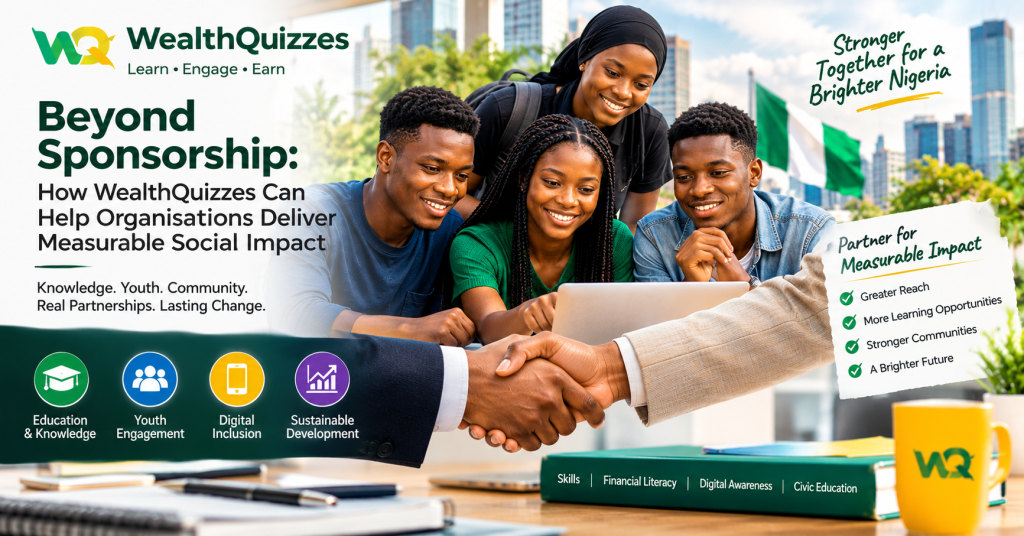
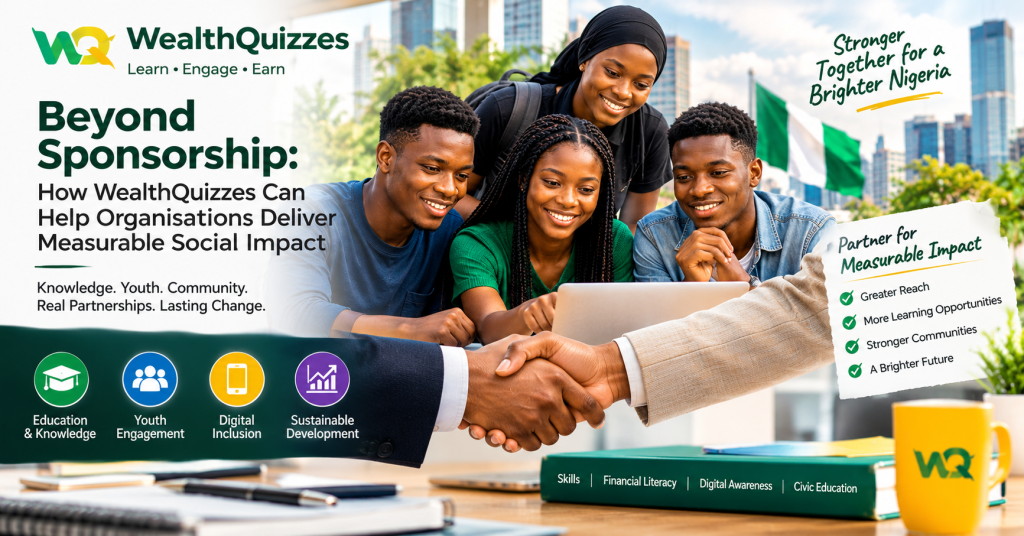
Beyond Sponsorship: How WealthQuizzes Can Help Organisations Deliver Measurable Social Impact
The Value of WealthQuizzes’ Partnership Proposals
WealthQuizzes Blog | Learn • Engage • Earn
Introduction: From Funding Requests to Measurable Outcomes
Corporate social responsibility and development partnerships are evolving. Organisations are increasingly expected to demonstrate not only the resources they commit to social initiatives, but also the outcomes those initiatives produce. Funding a programme, sponsoring an event or displaying a corporate logo may generate visibility, but these activities do not automatically establish that communities have gained knowledge, young people have developed useful skills or participants have become better equipped to make informed decisions.
The more important question is this: what has changed as a result of the intervention?
For Nigerian organisations seeking to support youth development, financial education, digital inclusion and community engagement, this question creates an opportunity to consider more interactive and measurable approaches to social investment.
WealthQuizzes, a Nigerian knowledge-based digital engagement platform built around quizzes, participation and performance-based rewards, offers a potential avenue for exploring such approaches. Rather than treating collaboration solely as a request for sponsorship, the platform could work with suitable organisations to develop structured programmes that combine knowledge quizzes, financial education, digital awareness and youth engagement around agreed objectives.
The proposition is straightforward: partners would contribute resources, expertise, access or other agreed support, while the programme would be designed to produce identifiable outputs and assessable outcomes. Progress would be monitored against targets established before implementation, and the findings would help determine whether the programme should be improved, continued or expanded.
This approach would move the discussion beyond sponsorship as an isolated transaction towards collaboration focused on learning, participation, accountability and measurable social value.
1. Why Social Investment Must Go Beyond Visibility
Sponsorship and corporate social responsibility remain valuable tools for supporting communities, raising awareness and strengthening relationships with stakeholders. However, visibility is only one possible benefit of a social investment programme.
A company might sponsor a youth event that attracts thousands of attendees. That figure demonstrates reach, but it does not reveal how many participants acquired useful knowledge, understood the subject being discussed or applied what they learned afterwards.
Similarly, a digital awareness campaign may record substantial impressions and clicks without establishing whether users can recognise fraudulent messages, protect their personal information or evaluate online claims more effectively.
These distinctions are central to effective programme evaluation.
The Organisation for Economic Co-operation and Development (OECD) has established six widely used criteria for evaluating development interventions: relevance, coherence, effectiveness, efficiency, impact and sustainability. These criteria encourage organisations to examine whether a programme addresses a genuine need, achieves its objectives, uses resources appropriately and produces benefits that can endure. OECD — Evaluation Criteria.
Applied to corporate social investment, this framework encourages a more disciplined approach. Instead of asking only how much funding was committed or how many people attended, partners can ask:
- Did the programme address a clearly identified community need?
- Did participants gain the knowledge or skills the programme intended to develop?
- Were the resources used efficiently?
- Did the programme reach the intended population, including underserved groups?
- Were any improvements sustained beyond the initial activity?
- What evidence supports the conclusions being drawn?
For WealthQuizzes, this creates an opportunity to develop proposals around specific social objectives rather than presenting digital visibility or user acquisition as the sole justification for partnership.
2. The Case for Combining Knowledge Quizzes with Social Development
Knowledge quizzes can provide an interactive way to introduce information, test understanding and encourage participants to revisit subjects. Their value is greatest when questions are accurate, content is relevant and feedback helps participants understand the reasoning behind correct answers.
A quiz should not be confused with a complete educational programme. Nevertheless, it can form one component of a broader intervention that includes educational material, discussion, practical exercises and follow-up assessment.
WealthQuizzes could potentially help partners organise such activities across four connected areas.
Financial education: Participants could engage with questions and scenarios about budgeting, saving, responsible spending, borrowing, financial fraud and evaluating financial offers.
Digital awareness: Activities could cover password security, privacy, phishing, misinformation, responsible online conduct and safe use of digital services.
Civic and general knowledge: Participants could explore Nigerian history, public institutions, community responsibilities, critical thinking and the importance of verifying information.
Youth engagement: Structured challenges and knowledge activities could give young people an accessible way to participate in educational initiatives, while providing programme organisers with data on participation and learning progress.
The key is to connect each activity to a defined objective. A financial literacy programme, for example, should not merely ask questions about money. It should aim to improve participants’ understanding of practical financial concepts and assess whether that understanding has improved.
The World Bank’s work on financial capability emphasises that financial capability involves the knowledge, attitudes, skills and behaviours needed to manage resources and make use of appropriate financial services. It also cautions that the effectiveness of financial education programmes varies, making careful design and evaluation important.
This is an important principle for any WealthQuizzes partnership: participation can be a starting point, but meaningful learning must be assessed rather than assumed.
3. What a Structured WealthQuizzes Partnership Programme Could Look Like
A potential partner could work with WealthQuizzes to develop a defined programme around an agreed target group, subject area, duration and set of measurable objectives.
Consider an illustrative 90-day Youth Financial and Digital Awareness Programme. This is a proposed model, not an existing programme or a claim of results already achieved by WealthQuizzes.
The programme could be organised in five stages:
Stage 1 — Needs assessment and programme design. The partners identify the intended beneficiaries, determine their priority learning needs, establish baseline knowledge and agree on the expected outcomes. The design should reflect the participants’ age, language, accessibility needs and level of digital experience.
Stage 2 — Content development and validation. Relevant educational material and quiz questions are prepared or selected. Subject-matter experts review the content for accuracy, clarity and suitability. The partners agree on the learning objectives and the way progress will be assessed.
Stage 3 — Participant recruitment and engagement. The partners use appropriate channels to invite eligible participants. Communication explains the programme’s purpose, participation requirements, privacy arrangements and any applicable reward conditions. Participation should be voluntary and accessible to the intended audience.
Stage 4 — Learning activities and follow-up. Participants engage with quizzes and supporting educational material. They may also receive explanations, practical scenarios or links to authoritative resources. Follow-up assessments test whether participants have improved their understanding.
Stage 5 — Evaluation and reporting. The partners review participation, completion, knowledge gains, user feedback, costs and any relevant differences between participant groups. The findings inform a joint decision on whether to continue, improve or expand the programme.
A structured approach makes the proposed collaboration easier to evaluate. It also gives the sponsoring organisation a clearer view of what its resources are supporting and how performance will be reported.
4. Illustrative Programme Areas and Potential Outcomes
Different organisations have different mandates. A bank may prioritise financial capability; a telecommunications company may focus on digital safety; an educational institution may emphasise learning outcomes; and a consumer-facing company may be interested in youth engagement and responsible digital participation.
WealthQuizzes could explore programme designs that reflect these differing priorities.
A. Financial literacy and responsible decision-making
A financial education programme could cover budgeting, saving, distinguishing needs from wants, identifying suspicious offers and understanding the risks of borrowing or making financial decisions without adequate information.
Participants could complete an initial assessment, engage with the learning activities and take a comparable follow-up assessment. Scenario-based questions could test whether they can apply concepts rather than simply recall definitions.
Potential measures include the number of participants completing the programme, improvement in assessment scores, ability to identify common fraud indicators and confidence in making basic financial decisions.
B. Digital safety and awareness
A digital awareness programme could introduce practical lessons about online privacy, suspicious links, impersonation, misinformation, account security and responsible sharing of content.
Participants could work through realistic examples and identify safer responses. Follow-up assessments could measure whether they can recognise common risks and select appropriate protective actions.
This type of initiative could complement broader digital literacy efforts. Nigeria’s National Information Technology Development Agency provides digital literacy initiatives and resources, including the National Digital Literacy Dashboard, which tracks reported training and digital literacy progress across the country.
A WealthQuizzes programme would not replace comprehensive digital skills training. It could, however, serve as a supplementary engagement and assessment component within a wider initiative, subject to agreement with the relevant partner.
C. Civic knowledge and critical thinking
A civic knowledge programme could cover public institutions, Nigerian history, constitutional awareness, community participation and the evaluation of information.
Participants could be asked to distinguish evidence-based claims from unsupported assertions, identify appropriate sources and demonstrate understanding of civic concepts.
Potential outcomes include improved assessment performance, greater ability to identify reliable information and increased awareness of appropriate channels for constructive community participation. Actual civic behaviour would require separate measurement and should not be inferred from quiz scores alone.
D. Youth participation and lifelong learning
A broader youth engagement programme could combine different subject areas through scheduled knowledge challenges, learning campaigns and interactive activities.
Partners could set participation goals for specific communities or groups and examine which content attracts sustained interest. Measures could include first-time participation, programme completion, repeat engagement, participant satisfaction and learning gains.
The programme should avoid treating downloads, registrations or repeated quiz attempts as proof of social impact. Those are useful activity indicators, but they must be considered alongside evidence of learning and other intended outcomes.
5. Measuring Results Against Agreed Targets
A credible partnership should establish its measures of success before the programme begins. Without a baseline and defined targets, it becomes difficult to determine whether an intervention has made a meaningful contribution.
The OECD’s guidance on managing for sustainable development results emphasises the importance of planning, monitoring, evaluation, accountability and using evidence to improve programme decisions.
For WealthQuizzes, a joint monitoring framework could distinguish four levels of measurement.
| Measurement level | What it examines | Illustrative indicators |
|---|---|---|
| Inputs | Resources committed | Funding, staff time, content development and technical support |
| Outputs | Activities delivered | Participants enrolled, quizzes completed and learning materials accessed |
| Outcomes | Changes following participation | Improvement in knowledge scores, retention of information and ability to answer practical scenarios |
| Longer-term impact | Wider or sustained effects | Continued application of knowledge, safer digital practices or improved financial decision-making, where these can be credibly assessed |
The distinction is important. If a programme enrols 5,000 young people, that is a participation result. If participants demonstrate improved knowledge, that is an outcome. If a subsequent evaluation establishes that relevant behaviours improved and that the programme contributed to those changes, the evidence may support a more substantial impact claim.
A partnership could set illustrative targets such as:
- Enrol 2,000 eligible participants within the agreed period.
- Achieve a minimum 70% programme completion rate.
- Obtain matched baseline and follow-up assessments for at least 60% of enrolled participants.
- Achieve an agreed average improvement in financial or digital awareness scores.
- Deliver the programme within the approved budget and timetable.
- Produce a final report documenting results, limitations, participant feedback and recommendations.
These figures are examples only. They are not current WealthQuizzes performance statistics or promises of future achievement. Actual targets should be set after assessing the audience, budget, programme duration, baseline findings and operational capacity.
The parties should also agree on how missing data, participant withdrawal and incomplete assessments will be handled. Where feasible, comparison groups or other suitable evaluation methods can help distinguish programme-related change from improvements that might have occurred for other reasons.
6. Reporting and Accountability: Giving Partners Evidence They Can Use
A well-designed partnership should provide the sponsoring organisation with a clear account of how the initiative performed. Reporting should be sufficiently detailed to support decisions, but concise enough to communicate the results to management, programme teams and other authorised stakeholders.
A reporting framework could include:
- Programme summary: Objectives, target audience, activities delivered and implementation period.
- Performance dashboard: Agreed targets compared with actual results.
- Learning outcomes: Baseline and follow-up assessment findings, including the number of participants assessed.
- Inclusion analysis: Participation and results across relevant groups, where lawful and appropriate to collect.
- Financial accountability: Expenditure against the approved budget and an explanation of significant variances.
- Lessons learned: What worked, what did not work, implementation challenges and proposed improvements.
- Recommendations: Whether to continue, modify, expand or discontinue the programme.
Reports should distinguish verified findings from estimates, interpretations and projections. They should disclose limitations and avoid attributing outcomes to the programme unless the evidence supports that conclusion.
For example, a programme might show that participants’ average scores increased after completing a learning activity. That would demonstrate a change in assessment performance, but it would not by itself prove that participants subsequently changed their financial behaviour or became less vulnerable to fraud.
Responsible reporting is not a weakness. It is a basis for learning, credibility and better allocation of resources.
7. Why the Partnership Could Benefit Both the Organisation and WealthQuizzes
A properly designed partnership should create value for both parties without compromising the programme’s public-interest objectives.
For the partner, potential benefits include a structured way to support youth development, financial education or digital awareness; measurable engagement with a defined audience; opportunities to test new approaches to community outreach; and evidence that can inform future social investment decisions.
For WealthQuizzes, collaboration could provide resources to improve programme delivery, access to relevant communities, expert guidance, opportunities to strengthen content quality and a basis for evaluating the effectiveness of its interactive engagement model.
The benefits would depend on the agreement and the results achieved. Neither increased visibility nor a partner’s participation should be presented as proof of endorsement, educational effectiveness or commercial success unless the relevant evidence exists.
The programme should also preserve a clear distinction between learning activities and commercial incentives. Where WealthQuizzes’ performance-based rewards form part of the user experience, participation requirements and reward conditions should be transparent. Rewards must not be portrayed as guaranteed income, and users should not be encouraged to spend money they cannot afford to lose.
A social impact initiative should be judged principally by the agreed social and educational outcomes, not by the number of people persuaded to spend money on the platform.
8. Safeguards, Inclusion and Responsible Implementation
Measurable social impact depends on more than setting targets. The programme must also protect participants, handle information responsibly and ensure that its activities are suitable for the intended audience.
Partners should agree on their respective responsibilities for content approval, recruitment, participant communication, complaints, data security, reporting and financial management. Personal information should be collected only where necessary, handled in accordance with applicable data protection requirements and protected against unauthorised access.
The Nigeria Data Protection Commission provides official information on Nigeria’s data protection framework. Where a programme involves personal data, the partners should assess their obligations and document the arrangements governing collection, access, retention and disclosure.
Inclusion should be considered at the design stage. Data costs, connectivity, device availability, disability, language and digital literacy can all affect participation. Depending on the programme, partners may need community-based recruitment, accessible content, offline learning resources or alternative assessment arrangements.
Independent review may also be appropriate for programmes involving substantial funding, sensitive subject matter or significant public claims. The level of assurance should be proportionate to the scale and risks of the intervention.
These safeguards help ensure that a programme is not only measurable, but also fair, credible and responsible.
9. From a Pilot Programme to Sustainable Social Impact
A short pilot can help the parties test whether the proposed model is useful, affordable and operationally feasible. It should also reveal what needs to change before any wider rollout.
At the end of the pilot, the partners could review the evidence against the agreed targets, examine implementation costs, assess participant feedback and identify any unintended consequences. They could then decide whether to continue, revise or expand the programme.
Scaling should depend on demonstrated feasibility and evidence of value, not simply on high registration numbers or positive publicity. If learning gains are weak, content may need improvement. If certain groups are underrepresented, the recruitment strategy may require adjustment. If the cost per active participant is too high, the delivery model may need to change.
This process makes the partnership a learning exercise as well as a delivery mechanism. It allows organisations to improve their interventions over time and helps WealthQuizzes develop a more evidence-informed approach to digital engagement.
Long-term sustainability may require diversified funding, stronger implementation capacity, collaboration with additional institutions and integration with existing programmes. It may also require a decision to discontinue activities that do not produce sufficient value.
The ultimate objective is not to expand every initiative indefinitely. It is to identify approaches that meet real needs, deliver credible results and justify the resources invested.
Conclusion: Make Every Partnership Count
Beyond sponsorship lies the opportunity to build structured programmes that connect organisational resources with practical learning, meaningful youth engagement and measurable social objectives.
WealthQuizzes could work with suitable Nigerian organisations to develop initiatives combining knowledge quizzes, financial education, digital awareness and other relevant subjects. With clearly defined objectives, credible content, baseline assessments, agreed targets and transparent reporting, such programmes could give partners a practical framework for testing and evaluating their contribution to social development.
The case for collaboration should not rest on promises that a digital platform will automatically transform communities. It should rest on a more disciplined proposition: identify a genuine need, design an appropriate intervention, deliver it responsibly, measure the results and use the evidence to improve.
For organisations, this offers a way to explore social investment beyond visibility alone. For WealthQuizzes, it creates an opportunity to demonstrate how interactive knowledge-based engagement could complement broader educational and development efforts.
The strongest partnership will be one in which both parties understand their responsibilities, participants receive genuine value and results are assessed honestly against agreed objectives.
Sponsorship can provide the resources to begin an initiative. Strategic partnership can help design, deliver and evaluate it. Measurable social impact emerges when the programme produces meaningful results—and the evidence shows what difference it has made.
Selected Authorities and Further Reading
- OECD — Evaluation Criteria. A framework for assessing relevance, coherence, effectiveness, efficiency, impact and sustainability in development interventions.
https://www.oecd.org/en/topics/sub-issues/development-co-operation-evaluation-and-effectiveness/evaluation-criteria.html - OECD — Managing for Sustainable Development Results. Guidance on planning, monitoring, accountability, evaluation and using evidence to improve development programmes.
https://www.oecd.org/en/publications/development-co-operation-tips-tools-insights-practices_be69e0cf-en/managing-for-sustainable-development-results_8e326a5d-en.html - World Bank — Financial Capability. Resources on financial knowledge, skills, attitudes and behaviours, including considerations for designing effective financial education initiatives.
https://responsiblefinance.worldbank.org/en/responsible-finance/financial-capability - UNICEF Nigeria — Connecting Every Child to Digital Learning. An example of a digital learning initiative and the operational considerations involved in reaching underserved learners.
https://www.unicef.org/nigeria/stories/connecting-every-child-digital-learning - Nigeria Data Protection Commission. Official information on Nigeria’s data protection framework.
https://ndpc.gov.ng/ - National Digital Literacy Dashboard, Nigeria. A government dashboard tracking reported digital literacy training and progress.
https://dashboard.digitalliteracy.nitda.gov.ng/ - WealthQuizzes. Official website for information about the knowledge-based digital engagement platform.
https://wealthquizzes.com/
WealthQuizzes Blog | Learn • Engage • Earn | Where knowledge becomes wealth.