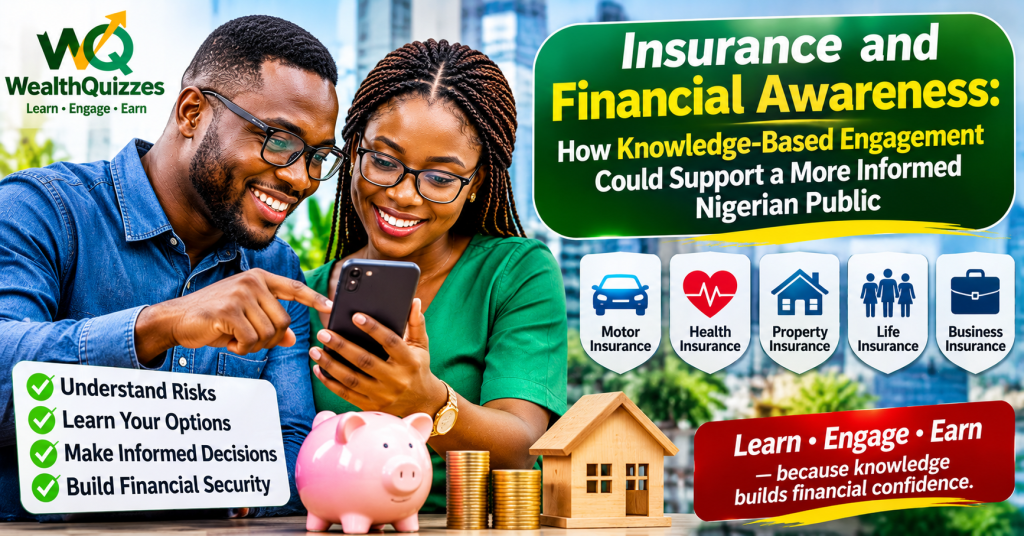
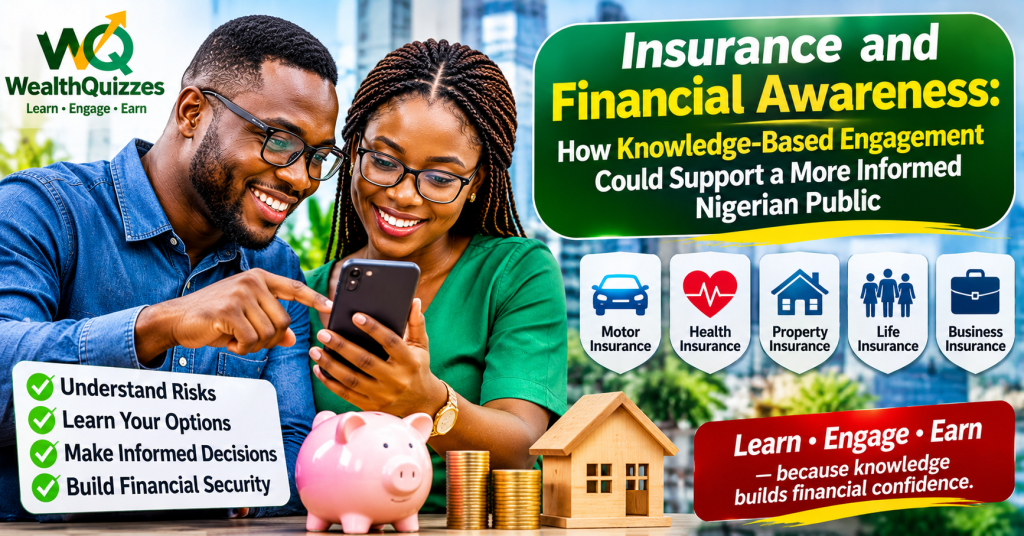
Insurance and Financial Awareness: How Knowledge-Based Engagement Could Support a More Informed Nigerian Public
Introduction
Financial protection is an essential component of personal, family and business stability. Individuals encounter risks every day: accidents, illness, property damage, business interruption, loss of income and other unexpected events capable of creating significant financial hardship. Yet the ability to identify these risks and understand the financial tools available to manage them remains an important challenge.
Insurance is one of the mechanisms through which individuals, households and businesses can transfer certain financial risks in exchange for agreed premiums and contractual protection. However, the usefulness of insurance depends not merely on the existence of insurance products, but also on whether people understand what insurance does, how it works, what it covers, what it excludes and how to access the protection for which they have paid.
In Nigeria, improving insurance awareness represents an important opportunity for insurers, regulators, financial institutions, educational organisations and digital platforms to contribute to a more financially informed population.
One promising approach is knowledge-based engagement: using interactive learning experiences, quizzes, educational challenges and digital campaigns to communicate financial and insurance concepts in ways that encourage participation, curiosity and retention.
For WealthQuizzes, this presents an opportunity to explore strategic partnerships with insurance companies and other financial-sector organisations to promote insurance literacy through interactive digital engagement.
The objective is not simply to advertise insurance products. It is to help people understand financial risks, make better-informed decisions and appreciate the role of insurance in responsible financial planning.
1. Understanding the Insurance Awareness Challenge in Nigeria
Insurance plays an important role in financial resilience, yet awareness, understanding, trust and accessibility remain significant challenges in Nigeria.
The EFInA Access to Financial Services in Nigeria 2023 Survey reported that approximately 3.1% of Nigerian adults, representing about 3.4 million people, were insured. The survey also identified barriers including affordability, limited awareness and trust concerns. Awareness of microinsurance was particularly low, with only approximately 11% of Nigerians reportedly aware of microinsurance products.
These figures illustrate the gap between the existence of financial protection products and the extent to which the population understands or accesses them.
Source: EFInA, Access to Financial Services in Nigeria 2023 Survey. Access the survey report.
The National Insurance Commission (NAICOM), in its Strategic Plan 2024–2028, recognises the importance of improving insurance awareness and literacy, broadening insurance coverage and developing more effective distribution channels. Its strategic objectives include improving consumer awareness and insurance literacy levels and expanding access to insurance products and services.
Source: NAICOM, Strategic Plan 2024–2028. Read the strategy.
These developments indicate that insurance awareness is not merely a marketing concern for individual insurance companies. It is an important issue for the wider financial-services ecosystem.
A population that understands financial risks and the purpose of insurance is better positioned to evaluate available protection, ask relevant questions, compare products and make informed decisions.
2. Why Insurance Education Matters
Many people encounter insurance through advertisements, agents, compulsory insurance requirements, workplace arrangements or recommendations from friends and family. However, encountering insurance information does not necessarily mean understanding it.
A person may know that motor insurance exists without understanding the difference between third-party liability protection and comprehensive cover. Another may have health insurance without understanding the limits, exclusions, waiting periods or procedures for accessing benefits.
Similarly, a business owner may recognise the importance of protecting business assets but lack sufficient knowledge of available insurance options, the risks covered or the documentation required when making a claim.
Insurance education can address these knowledge gaps.
A well-designed awareness programme can help participants understand:
- The basic principles of risk management and risk transfer.
- The purpose and operation of insurance.
- Different types of insurance and their practical applications.
- The distinction between insurance premiums and savings or investment contributions.
- The meaning of policy terms, conditions, exclusions and limitations.
- The importance of accurate disclosure when purchasing insurance.
- The responsibilities of policyholders.
- How to identify authorised insurance providers and intermediaries.
- The procedures for reporting insured events and making claims.
- The importance of reviewing insurance needs as circumstances change.
The Central Bank of Nigeria recognises financial literacy as an important component of consumer protection, financial inclusion and effective participation in the financial system. Its financial-literacy framework emphasises the importance of helping consumers develop the knowledge and skills required to manage financial resources and make informed financial decisions.
Source: Central Bank of Nigeria — Financial Literacy.
Insurance education should therefore be viewed as part of broader financial capability development.
3. Moving Beyond Traditional Insurance Advertising
Insurance companies invest in advertising, sales distribution, agents, brokers, digital channels and customer communication. These remain important components of market development.
However, advertising and education serve different purposes.
Advertising may introduce a product, communicate its benefits and encourage prospective customers to make enquiries. Education, by contrast, seeks to improve the consumer’s understanding of the underlying financial concepts, risks, obligations and decision-making processes.
A person who understands why insurance exists may be better equipped to appreciate its relevance. A person who understands how claims work may be more confident asking questions before purchasing a policy. A consumer who understands exclusions may be less likely to develop unrealistic expectations.
This creates an opportunity for insurers to complement conventional marketing with interactive educational initiatives.
Rather than merely telling the public that insurance is important, organisations could create programmes that invite participants to explore the reasons insurance matters, test their knowledge and learn from their responses.
This approach could make financial-awareness campaigns more participatory and potentially more memorable.
4. The Potential of Knowledge-Based Engagement
Knowledge-based engagement combines educational content with active participation.
Instead of presenting information exclusively through brochures, advertisements or conventional lectures, participants interact with questions, challenges, scenarios and feedback.
For example, a quiz could present the following scenario:
A commercial driver is involved in an accident that damages another person’s vehicle. What type of insurance may provide protection against liability to third parties, subject to the applicable policy terms?
Participants would select an answer and receive an explanation of the relevant insurance principle.
Another scenario might ask:
A business owner purchases insurance for a shop but fails to disclose a material fact required by the insurer. Why could this create problems when a claim is made?
The purpose is not simply to test whether someone knows the correct answer. It is to use the question as an entry point for understanding a practical concept.
Research on retrieval practice and learning indicates that actively recalling information can improve retention compared with some passive learning approaches. Roediger and Karpicke’s influential 2006 study, Test-Enhanced Learning: Taking Memory Tests Improves Long-Term Retention, demonstrated the benefits of retrieval practice in learning and memory.
Source: Roediger, H. L. & Karpicke, J. D. (2006). Test-Enhanced Learning: Taking Memory Tests Improves Long-Term Retention.
Knowledge-based engagement could therefore provide insurers with an additional channel for communicating relevant information through active participation. Nevertheless, quizzes should not be assumed to produce lasting knowledge or behavioural change automatically. Explanations, repeated exposure, sound content and appropriate assessment are essential.
5. How Insurance Companies Could Collaborate with WealthQuizzes
WealthQuizzes could explore several partnership models with insurance companies, depending on the objectives, audience and resources of each organisation.
A. Sponsored Insurance-Literacy Campaigns
An insurer could sponsor a dedicated campaign designed to improve public understanding of insurance.
Possible themes include:
- How insurance works.
- Why financial protection matters.
- Understanding motor insurance.
- Life insurance and family financial protection.
- Health insurance awareness.
- Business insurance for entrepreneurs.
- Property protection.
- Understanding insurance policy documents.
- Insurance myths and misconceptions.
The insurer could fund the campaign and provide subject-matter expertise, while WealthQuizzes develops an interactive quiz experience and manages agreed aspects of the digital engagement.
This arrangement could allow an insurer to associate its brand with financial education while reaching participants through an interactive platform.
B. Themed Insurance Knowledge Challenges
A dedicated insurance category or challenge could be developed around specific topics.
For instance, a campaign titled How Well Do You Understand Insurance? could introduce participants to fundamental insurance principles through progressive questions.
A motor-insurance challenge could examine third-party liability, vehicle documentation, claims reporting and the responsibilities of motorists.
A life-insurance challenge could address financial protection for dependants, policy beneficiaries and the importance of understanding policy conditions.
A business-protection challenge could introduce entrepreneurs to risks associated with property, liability, employees, operations and business interruption.
These campaigns could be designed to accommodate different levels of prior knowledge, beginning with basic concepts and progressing towards more advanced questions.
C. Financial Protection Awareness Campaigns
Insurers could sponsor campaigns addressing real-life financial vulnerabilities.
For example, participants could explore scenarios involving:
- Unexpected medical expenses.
- Damage to personal property.
- Road accidents.
- Fire incidents.
- Business losses.
- Agricultural risks.
- Family financial responsibilities.
- Emergencies and loss of income.
The questions could help participants understand how risk management combines preventive measures, emergency savings, responsible financial planning and insurance where appropriate.
The objective would be to present insurance as one component of a broader financial-protection strategy rather than suggesting that insurance eliminates every financial risk.
D. Microinsurance and Inclusive Insurance Awareness
Microinsurance and other inclusive insurance products may be relevant to low-income individuals, informal-sector workers, small businesses, farmers and other populations whose financial circumstances may limit access to conventional insurance products.
The United Nations Development Programme’s Inclusive Insurance and Risk Finance diagnostic for Nigeria identified consumer awareness and trust as important barriers to inclusive insurance and recommended support for consumer education, collaboration among stakeholders and strategies to improve insurance literacy.
Source: UNDP, Inclusive Insurance and Risk Financing in Nigeria: Snapshot and Way Forward 2023. Read the report.
WealthQuizzes could potentially support awareness campaigns explaining the concept of microinsurance, the types of risks it may address, how premiums and benefits work, and the importance of understanding product eligibility and exclusions.
Such initiatives could be particularly valuable when developed alongside insurers offering products appropriate to the intended audience.
Education alone cannot make an unsuitable or unaffordable product accessible. Successful inclusion requires appropriate products, distribution, affordability, consumer protection and trust.
6. Reaching Young People, Entrepreneurs and Underserved Communities
Insurance awareness programmes should not assume that all consumers have the same needs, experiences or level of financial knowledge.
Young adults may benefit from understanding motor insurance, personal financial protection, health risks and the financial responsibilities associated with independent living.
Entrepreneurs and small-business owners may require awareness of business assets, liability risks, employees, operations, agricultural risks and business continuity.
Workers in the informal sector may benefit from accessible explanations of health protection, life protection, personal accident cover and inclusive insurance options.
Women, rural communities, students, traders, artisans and other underserved populations may require educational content tailored to their circumstances, language preferences, digital accessibility and available financial products.
WealthQuizzes could explore campaigns designed around these groups, subject to its audience reach, technical capabilities and the resources of participating partners.
Content could be presented in simple language, supported by practical scenarios and potentially adapted into locally relevant formats.
This approach would help avoid a one-size-fits-all model of financial education.
7. Building Trust Through Transparency and Consumer Education
Insurance awareness and consumer trust are closely connected.
Some consumers may have concerns about whether insurers will honour claims, whether policy terms are transparent, whether premiums are affordable or whether the benefits of a product justify its cost.
These concerns cannot be resolved through advertising alone.
An insurer seeking to build confidence must demonstrate responsible conduct, clear communication, fair treatment, appropriate products and effective claims administration.
Educational campaigns can complement these efforts by helping consumers understand:
- What a policy actually promises.
- What circumstances may trigger a claim.
- What exclusions and limitations apply.
- What documents may be required.
- How claims are reported and processed.
- Where complaints can be made.
- How to verify an insurer or intermediary.
- The importance of reading policy documents before committing.
NAICOM’s 2026 public statements have continued to emphasise the importance of public engagement, insurance awareness, trust, transparent documentation and consumer understanding of claims procedures.
Source: NAICOM — Insurance Week 2026 Public Address and Related Communications.
For WealthQuizzes, this creates an important partnership principle: sponsored educational content should be accurate, independently verified and transparent about its commercial relationship.
An insurer may sponsor a campaign, but the educational value and integrity of the content should remain central.
8. Measuring the Effectiveness of Insurance Education
A campaign should not be evaluated solely by the number of participants or the amount of publicity generated.
If the objective is insurance awareness, measurement should consider whether participants actually understand the concepts being presented.
Potential indicators include:
- Number of participants reached.
- Quiz participation and completion rates.
- Repeat participation.
- Accuracy of responses before and after educational interventions.
- Improvement in knowledge scores.
- Understanding of insurance terminology.
- Participant feedback.
- Engagement with educational explanations.
- Campaign cost per participant.
- Partner satisfaction.
- Follow-up interest in additional educational material.
Where feasible, campaigns could include pre-campaign and post-campaign assessments to examine whether participants demonstrate improved understanding.
For example, a participant could answer an initial set of questions assessing knowledge of insurance exclusions, claims procedures and policy obligations. Following an educational campaign, a comparable assessment could evaluate whether understanding has improved.
Such measurement would provide stronger evidence of educational value than participation figures alone.
However, increased quiz scores do not automatically establish increased insurance uptake, improved financial resilience or better claims outcomes. These are different outcomes requiring separate evidence and appropriate evaluation.
9. The Commercial Opportunity for Insurers and WealthQuizzes
A properly structured partnership could create value for both parties.
For insurers, potential benefits include:
- Additional channels for public education.
- Greater brand visibility.
- Interactive engagement with prospective consumers.
- Opportunities to communicate insurance concepts.
- Support for financial-literacy and inclusion initiatives.
- Campaign reporting and measurable participation.
- Opportunities to explore new audience segments.
For WealthQuizzes, potential benefits include:
- Sponsorship revenue.
- New strategic partnerships.
- Development of specialised financial-literacy content.
- Greater brand credibility through responsible collaboration.
- Opportunities to expand engagement campaigns.
- Potential access to partner expertise and promotional channels.
The partnership model could involve sponsored quiz categories, time-limited awareness campaigns, co-branded challenges, sponsored rewards or longer-term financial-literacy programmes.
The strongest arrangement would begin with a clearly defined pilot, agreed responsibilities, a realistic budget, appropriate content-review procedures and measurable objectives.
Both parties should also address consumer protection, advertising compliance, data protection, intellectual property, campaign reporting and reward fulfilment before implementation.
10. A Broader Vision for Financially Informed Nigeria
Insurance literacy should not be treated as an isolated subject.
It is connected to financial literacy, entrepreneurship, savings, responsible borrowing, investment awareness, consumer rights, risk management and personal financial planning.
A person who understands the concept of risk may become better equipped to evaluate financial decisions beyond insurance. A small-business owner who understands risk management may become more conscious of business continuity. A young adult who learns the principles of financial protection may begin to ask more informed questions about the financial products available to them.
Knowledge-based digital platforms could complement the work of regulators, insurers, educational institutions, financial institutions, development organisations and other stakeholders by making selected educational experiences more accessible and interactive.
WealthQuizzes could explore this opportunity through carefully designed financial-awareness campaigns, supported by credible authorities, qualified subject-matter reviewers and responsible commercial partnerships.
The long-term objective should not be to encourage people to purchase insurance indiscriminately. It should be to encourage people to understand their risks, assess their circumstances, evaluate appropriate protection and make informed financial decisions.
Conclusion
Nigeria’s insurance sector has an important opportunity to deepen public awareness, improve consumer understanding and strengthen confidence in financial protection.
The challenge is not simply to convince people that insurance exists. It is to help them understand why it matters, how it works, what it protects, what it does not protect and how to make informed decisions when considering insurance products.
Knowledge-based engagement offers a promising complementary approach. Through interactive quizzes, educational challenges, practical scenarios and targeted digital campaigns, insurers could explore more participatory ways of communicating insurance concepts.
WealthQuizzes could become a potential strategic partner in this effort by developing sponsored insurance-awareness campaigns that combine education, engagement and measurable participation.
Such partnerships must be grounded in credible information, transparency, appropriate products, responsible marketing and respect for consumer rights. They must also recognise that education is only one component of improving insurance inclusion; affordability, accessibility, trust and actual service quality remain equally important.
A more informed public is better positioned to evaluate financial risks, ask meaningful questions and make decisions with greater confidence.
The opportunity for insurers and WealthQuizzes is therefore not merely to promote insurance. It is to contribute to a culture in which financial protection is better understood, financial decisions are more informed and knowledge becomes a practical tool for improving people’s lives.
WealthQuizzes — Learn • Engage • Earn. Where Knowledge Becomes Wealth.
Selected Authorities and Further Reading
- EFInA — Access to Financial Services in Nigeria 2023 Survey. Research on financial inclusion, insurance uptake, affordability, awareness and barriers to insurance access.
Download the report - National Insurance Commission (NAICOM) — Strategic Plan 2024–2028. Insurance coverage, penetration, consumer awareness, insurance literacy and distribution.
Read the strategic plan - Central Bank of Nigeria — Financial Literacy. Consumer education, financial inclusion, financial capability and financial decision-making.
CBN Financial Literacy - United Nations Development Programme (UNDP) — Inclusive Insurance and Risk Financing in Nigeria: Snapshot and Way Forward 2023. Insurance awareness, trust, inclusive insurance, consumer education and risk financing.
Read the report - International Association of Insurance Supervisors (IAIS) and World Bank — Identify and Address Insurance Protection Gaps. Financial literacy, risk awareness and consumer understanding as demand-side strategies for addressing protection gaps.
Access the paper - Roediger, H. L. & Karpicke, J. D. (2006). “Test-Enhanced Learning: Taking Memory Tests Improves Long-Term Retention.” Psychological Science.
Read the research - Alli, N. G. & Ganiyu, K. (2025). “Empowering Insurance Consumers in Nigeria: Exploring the Interplay between Financial Literacy, Trust, and Decision-Making.” Journal of Risk Management and Insurance.
Read the study - OECD — Financial Literacy and Consumer Protection. International resources on financial education, consumer awareness and responsible financial decision-making.
OECD financial education resources - National Insurance Commission (NAICOM). Regulatory information, consumer awareness initiatives and insurance-sector resources.
Official NAICOM website - Federal Competition and Consumer Protection Commission (FCCPC). Consumer rights, fair commercial practices and consumer-protection resources in Nigeria.
Official FCCPC website