
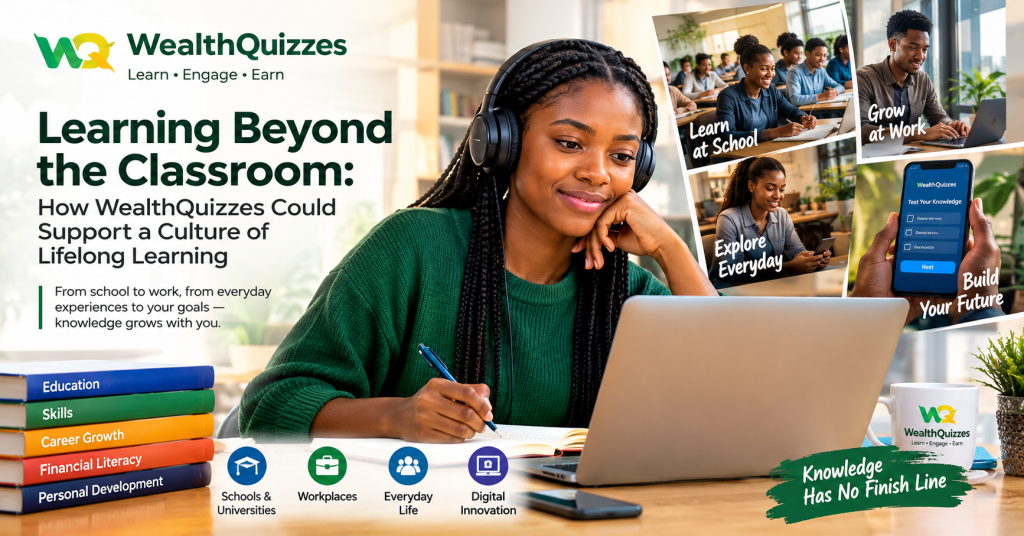
Learning Beyond the Classroom: How WealthQuizzes Could Support a Culture of Lifelong Learning
Youth Empowerment and National Development
WealthQuizzes Blog | Learn • Engage • Earn
Introduction: Learning Does Not End When School Ends
For many people, learning is associated with classrooms, teachers, textbooks, examinations and certificates. These remain essential components of education, but they represent only part of the learning that takes place throughout a person’s life.
People continue to learn when they enter employment, manage a household, start a business, engage with technology, follow public affairs, participate in community activities or encounter unfamiliar challenges. A conversation can introduce a new perspective. A workplace task can reveal a gap in someone’s knowledge. A mistake can prompt reflection, while a question can inspire further research.
This broader understanding of learning is particularly relevant in a world where information, technology and professional expectations continue to evolve.
For Nigeria, promoting lifelong learning offers an opportunity to complement formal education, support personal development and encourage people to remain curious beyond their years in school. Digital platforms can contribute by making selected learning experiences more accessible, interactive and convenient.
WealthQuizzes, a Nigerian knowledge-based quiz and digital engagement platform, approaches this opportunity through interactive questions, multiple subject categories and a structured quiz experience. Its model encourages users to test their knowledge and participate in activities that may complement learning acquired at school, university, work and through everyday experience.
The central proposition is not that quizzes can replace education. It is that learning can continue beyond the classroom, and thoughtfully designed digital experiences can help make that continuation more engaging.
1. Understanding Lifelong Learning
The UNESCO Institute for Lifelong Learning describes lifelong learning as an approach that encompasses people of all ages, different levels of education, varied learning methods and multiple environments, including schools, workplaces, families and communities. It recognises that learning can be formal, non-formal or informal. Explore UNESCO’s explanation of lifelong learning.
These distinctions are important.
Formal learning takes place through structured educational institutions and programmes, often leading to recognised qualifications. School education, university degrees and accredited vocational programmes are examples.
Non-formal learning involves organised learning activities outside the conventional formal education system. Examples include professional workshops, community training programmes and structured short courses that may not lead to formal qualifications.
Informal learning takes place through everyday experiences, personal interests, independent reading, conversations, observation and self-directed exploration. It may be intentional or arise naturally from daily life.
Lifelong learning brings these forms together. A university graduate may continue learning through professional development. A trader may develop new business knowledge by studying customer behaviour. A parent may acquire digital skills while helping a child with schoolwork. A young adult may improve general knowledge through reading and interactive quizzes.
The principle is that education is not confined to a particular age, institution or stage of life.
For WealthQuizzes, this creates a clear area of relevance: the platform can offer an additional setting in which people engage with questions and information outside conventional classrooms.
2. Why Learning Must Continue After Formal Education
Formal education provides a foundation, but the knowledge acquired at school or university may need to be refreshed, expanded or applied in new circumstances.
Technology changes. Industries develop new practices. Laws and regulations are amended. Businesses encounter new challenges, and people make decisions throughout their lives that require them to understand unfamiliar information.
A qualification may establish that someone completed a programme of study, but it does not mean that learning has ended.
Consider a graduate who studied economics several years ago. Their formal education may have provided a foundation in economic principles, but understanding contemporary financial technology, consumer protection and digital business models may require additional learning.
Similarly, someone who has worked in a particular industry for years may need to acquire new digital skills as workplace processes change.
Lifelong learning helps people remain intellectually engaged and better prepared to respond to changing circumstances. It can also encourage humility: recognising that expertise in one area does not automatically mean expertise in every other area.
This does not mean that everyone must constantly enrol in expensive courses or acquire additional qualifications. Learning can also take place through reading, discussion, observation, practice and other accessible activities.
A culture of lifelong learning emerges when people see learning as an ongoing part of life rather than an obligation that ends with an examination.
3. The Science of Active Recall and Knowledge Retention
One way to reinforce learning is to retrieve information from memory instead of merely reviewing it.
In their influential 2006 study, Test-Enhanced Learning: Taking Memory Tests Improves Long-Term Retention, psychologists Henry L. Roediger III and Jeffrey D. Karpicke investigated how testing affects the retention of learned material. Their experiments found that repeated testing could support better retention over time than repeated study alone under the conditions examined. Read the research in Psychological Science.
This phenomenon is commonly known as the testing effect or retrieval-practice effect.
The finding offers a useful foundation for understanding why quizzes can have educational value beyond measuring performance. When learners attempt to recall information, they actively engage with what they have learned. Questions can also help them identify information they remember confidently and areas that require further study.
However, not every quiz automatically produces meaningful learning. The benefits depend on factors such as the quality of the questions, the learner’s prior knowledge, feedback, opportunities to revisit information and the complexity of the subject.
A quiz that tests recall without providing explanations may reveal a knowledge gap without fully resolving it. Further reading, practice or instruction may still be necessary.
This distinction is important when considering WealthQuizzes. Its quiz format offers a potential mechanism for active knowledge engagement. Its contribution to sustained learning could be strengthened by accurate questions, useful explanations where appropriate and links to further learning resources.
4. Reinforcing Knowledge Acquired in Schools and Universities
Schools and universities introduce learners to organised bodies of knowledge. Yet students may not always have opportunities to revisit every subject after completing a course or examination.
Informal digital learning can provide another opportunity to encounter familiar concepts and test recall.
For example, a student who has studied Nigerian history may use knowledge quizzes to revisit historical events, institutions and personalities. Someone who has studied business administration may engage with general questions about management, entrepreneurship or finance. A person interested in science may use quizzes as a prompt to investigate unfamiliar concepts.
The purpose is not to reproduce the full curriculum or replace the teacher. It is to encourage continued engagement with knowledge.
There is also a potential benefit in discovering gaps. If a learner repeatedly struggles with a subject, that experience may indicate a need to consult textbooks, seek instruction or use more specialised learning materials.
For educators, knowledge-based platforms may offer ideas for supplementary revision or extracurricular engagement, provided the content is accurate and appropriate for the intended audience.
Any formal educational partnership would need to define its learning objectives, review the accuracy of questions and determine how the activity complements existing teaching. Participation figures alone would not establish that educational outcomes had improved.
Used appropriately, informal quizzes can become one component of a broader learning routine that includes reading, instruction, discussion and practical application.
5. Learning in the Workplace: Staying Curious and Adaptable
The workplace is another important environment for lifelong learning.
Employees learn through experience, feedback, collaboration, professional development and the practical demands of their responsibilities. Entrepreneurs learn from customers, suppliers, market changes and the consequences of business decisions.
However, workplace learning does not always address every area of knowledge a person may need. Someone may be technically proficient in their role while having limited knowledge of personal finance, public affairs, digital safety or developments outside their profession.
Informal learning can encourage broader intellectual engagement.
A person working in retail, for instance, may use general knowledge and business quizzes as a starting point for exploring economics, consumer behaviour or financial literacy. A young entrepreneur may encounter a question that prompts further research into business planning or responsible financial management.
Such activities do not replace professional training, technical certification or practical experience. They may instead help maintain curiosity and encourage users to investigate topics beyond their immediate duties.
For employers, this creates a possible area for carefully designed engagement initiatives. A company could explore knowledge-based activities as a supplement to established training, with content tailored to its objectives and reviewed for accuracy.
The important distinction is between general engagement and demonstrated occupational competence. A quiz result should not be treated as proof that someone possesses the practical skills required for a job unless the assessment has been specifically designed and validated for that purpose.
6. Everyday Life Is a Classroom Too
Lifelong learning also develops through ordinary decisions and experiences.
Managing household expenses may encourage people to learn about budgeting. Comparing products can involve researching quality, warranties and consumer rights. Using digital services may create a need to understand privacy, online fraud and secure account practices.
Public affairs, cultural activities, sports and conversations with others can also prompt people to explore new information.
Knowledge-based digital activities can complement these experiences by exposing users to subjects they may not encounter in their daily routines.
A participant who enjoys football, for example, may also explore Nigerian history or general knowledge. Someone interested in entertainment may become curious about science, geography or financial concepts through questions in other categories.
This cross-subject engagement can help make learning feel less like a separate obligation and more like a normal part of everyday life.
Nevertheless, curiosity must be supported by credible information. Where a question raises an important or complex issue, users should be encouraged to consult authoritative sources rather than treating a short quiz response as a complete explanation.
The objective is not to make every ordinary activity an examination. It is to help people recognise opportunities to learn from the world around them.
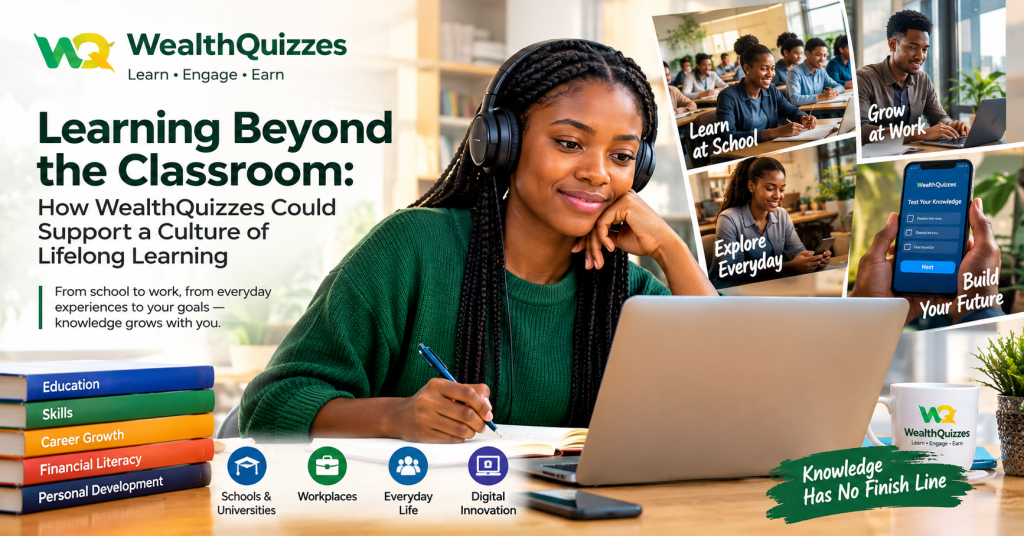
7. WealthQuizzes: Making Knowledge-Based Engagement Part of Daily Life
WealthQuizzes brings together interactive quizzes, varied subject categories, timed responses and progression through stages. The platform’s model gives users a structured way to test their knowledge and engage with questions beyond formal educational settings.
Its philosophy, Learn • Engage • Earn, reflects three elements of the experience.
Learn: Users encounter questions across different subjects and can use their performance as a prompt to revisit or investigate information.
Engage: Interactive quizzes provide a structured activity that encourages active participation rather than passive consumption alone.
Earn: Participants may qualify for applicable rewards when they meet the platform’s stated requirements.
The reward element requires careful explanation. Rewards are conditional on qualifying performance and the applicable terms; they are not guaranteed income. Users should understand the current subscription charges, stage rules, eligibility requirements and withdrawal conditions before participating.
From a lifelong-learning perspective, the most useful approach is to see the platform as one possible element of a broader routine. A user might read a book, follow a credible educational resource, participate in a quiz, investigate an unfamiliar answer and then apply the knowledge in daily life.
The quiz is the starting point or reinforcement activity, not necessarily the complete learning experience.
WealthQuizzes’ potential contribution depends on maintaining accurate content, a reliable user experience, transparent rules and responsible engagement practices. Its educational value should be assessed through evidence rather than assumed simply because users participate.
Explore the platform at www.wealthquizzes.com.
8. Digital Access Must Be Matched by Quality and Inclusion
Digital platforms can make certain learning activities available beyond the physical boundaries of a classroom. However, access to technology does not automatically produce equal access to learning.
The UNESCO Institute for Lifelong Learning emphasises that lifelong learning involves multiple environments and modalities, and that learning opportunities should be accessible across different stages of life. Read UNESCO’s lifelong-learning overview.
In Nigeria, affordability, connectivity, device compatibility and differences in digital confidence can influence who benefits from online services.
A platform seeking wider participation must consider these realities. Clear instructions, a usable interface, appropriate support and responsible handling of user information are important. Where possible, low-data design and compatibility with a range of devices may also improve accessibility.
Content quality matters just as much. Incorrect answers, ambiguous wording or outdated information can undermine trust and confuse users. A credible knowledge platform should have processes for reviewing questions, correcting errors and improving content.
There is also a need to avoid overstating what informal learning can accomplish. Digital quizzes do not provide all the instruction, mentoring, practical experience or recognised credentials that people may need. They work best when they complement other learning opportunities and encourage further exploration.
9. Building a Culture of Lifelong Learning in Nigeria
A culture of lifelong learning cannot be created by a single platform. It requires a wider environment in which schools, universities, employers, families, public institutions, community organisations and technology businesses recognise the value of continuous learning.
Schools can encourage curiosity beyond examinations. Universities can support alumni in continuing professional development. Employers can provide training and opportunities to acquire new skills. Libraries and community organisations can facilitate access to educational resources. Digital platforms can offer supplementary experiences that encourage people to remain engaged with knowledge.
WealthQuizzes could explore responsible collaborations with educational institutions, youth-development organisations and corporate partners interested in knowledge-based engagement. Such initiatives might involve carefully designed quizzes on financial awareness, digital safety, history or other relevant subjects.
To be credible, these programmes would need defined objectives, accurate content, appropriate safeguards and evaluation methods. They should assess whether participants actually benefited, not merely how many people registered or completed an activity.
A stronger culture of lifelong learning also requires an attitude shift. People should feel that asking questions, correcting misunderstandings and learning new things are signs of growth rather than weakness.
This matters for young adults entering a changing economy, but it also matters for experienced professionals, parents, entrepreneurs and older adults. Learning remains relevant throughout life.
Conclusion: Make Learning a Habit, Not Just a Phase
Education does not end when a person leaves school, receives a degree or secures a job. Knowledge must be revisited, expanded and applied as circumstances change.
Research on retrieval practice shows why actively recalling information can support retention. UNESCO’s lifelong-learning framework highlights the importance of learning across formal, non-formal and informal settings. Together, these perspectives reinforce the value of treating learning as an ongoing process.
WealthQuizzes can contribute to this culture by offering an interactive environment in which users test their knowledge, engage with different subjects and use their performance as a prompt for further exploration.
It cannot replace formal education, professional training or practical experience. Its opportunity lies in complementing them—making knowledge-based participation a convenient part of everyday life while maintaining responsible standards and realistic expectations.
A classroom may introduce a person to knowledge. A workplace may teach its practical application. Daily experience may reveal why it matters. Informal digital learning can help keep the process active.
The future belongs not only to those who have learned, but also to those who remain willing to learn.
WealthQuizzes — Learn • Engage • Earn.
Participation and rewards are subject to the platform’s applicable terms and conditions. Rewards are conditional on qualifying performance and are not guaranteed income.
Selected Authorities and Further Reading
- UNESCO Institute for Lifelong Learning. Lifelong Learning. Read the institutional overview.
- UNESCO. Lifelong Learning for All: What You Need to Know. Explore the framework.
- Roediger, H. L. III, & Karpicke, J. D. (2006). “Test-Enhanced Learning: Taking Memory Tests Improves Long-Term Retention.” Psychological Science, 17(3), 249–255. https://doi.org/10.1111/j.1467-9280.2006.01693.x.
- Roediger, H. L. III, & Karpicke, J. D. (2006). “The Power of Testing Memory: Basic Research and Implications for Educational Practice.” Perspectives on Psychological Science, 1(3), 181–210. https://doi.org/10.1111/j.1745-6916.2006.00012.x.
- WealthQuizzes. Official website and platform information. Visit WealthQuizzes.


