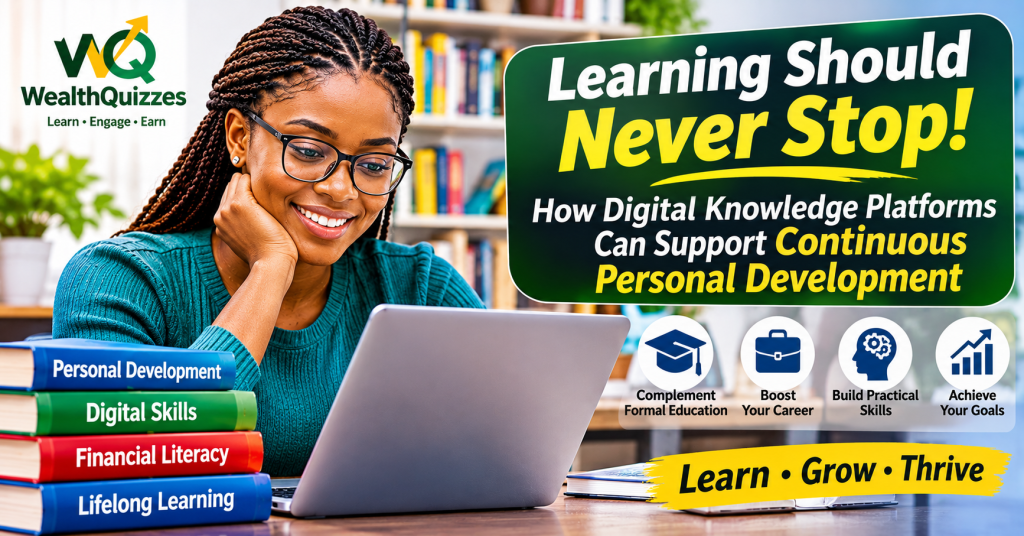
Learning Should Never Stop: How Digital Knowledge Platforms Can Support Continuous Personal Development
Introduction
Education is often associated with classrooms, schools, universities, examinations and academic qualifications. These institutions play an indispensable role in developing knowledge, building intellectual foundations and preparing individuals for professional and social responsibilities. However, learning should not end when a person graduates, completes a professional examination or secures employment.
The world continues to change. Technology transforms industries, new business models emerge, professional standards evolve, economic conditions fluctuate and societies confront new challenges. Knowledge acquired several years ago may require updating, while skills that were once sufficient for a particular occupation may no longer meet changing workplace demands.
In this environment, the ability to continue learning is itself an important life skill.
Continuous personal development involves the deliberate and sustained acquisition of knowledge, skills, attitudes and competencies throughout life. It encompasses formal education, professional training, independent study, workplace experience, community participation and informal learning through everyday activities.
Digital knowledge platforms can contribute significantly to this process. By making educational resources accessible beyond traditional classrooms and training institutions, they can help individuals learn at their own pace, explore new subjects, strengthen existing competencies and acquire practical knowledge relevant to everyday life.
The objective is not to replace formal education or professional qualifications. It is to complement them by creating additional opportunities for people to remain informed, adaptable and intellectually engaged throughout their lives.
1. Learning Is a Lifelong Process, Not a One-Time Achievement
One of the most important misconceptions about education is that learning is substantially completed once an individual obtains an academic qualification.
A university degree, diploma or professional certificate demonstrates achievement within a particular programme of study. It does not establish that the holder has acquired every skill required for the rest of their life.
Knowledge evolves. Professional practices change. New research challenges established assumptions. Technology introduces unfamiliar tools and methods. Even individuals who remain in the same occupation for decades may need to acquire new competencies to perform effectively.
The International Labour Organization (ILO), in its 2026 flagship report, Lifelong Learning and Skills for the Future, defines lifelong learning broadly to include learning activities undertaken throughout life in educational, workplace, family and other social contexts. It recognises that people acquire knowledge and capabilities through formal, non-formal and informal processes, whether or not those activities result in recognised qualifications.
The report identifies lifelong learning as an important foundation for employability, productivity, innovation, social inclusion and personal advancement. It also highlights the need to make quality learning opportunities more accessible, particularly for workers and communities that face barriers to structured training. <Cite refs={[“turn974650search0″,”turn974650search4”]}/>
This perspective is important because it recognises that education is not confined to institutions. A person can continue developing their financial knowledge, communication skills, technological competence, business judgment and understanding of society long after formal schooling has ended.
Learning should therefore be regarded as a continuous process of intellectual and practical development.
2. Digital Learning as a Complement to Formal Education
Formal education provides structure, recognised curricula, trained educators, assessment systems and, where applicable, accredited qualifications. These remain essential, particularly in professions that require regulated training, supervised practice or formal certification.
Digital learning platforms offer a different but complementary form of educational access.
They can expose learners to additional subjects, reinforce classroom knowledge, provide supplementary explanations and encourage independent exploration beyond the prescribed curriculum.
For example, a university student studying economics may use digital resources to explore personal finance, entrepreneurship, investment principles and business management. A law student may supplement academic study with learning about technology, financial literacy, communication and contemporary business practices. A secondary school graduate may use online learning materials to develop digital skills before entering higher education or the labour market.
These opportunities can broaden a learner’s knowledge beyond the boundaries of a particular academic programme.
UNESCO’s Recommendation on Adult Learning and Education recognises formal, non-formal and informal learning as important components of lifelong learning. It emphasises that adult education should support the development of capabilities needed for personal fulfilment, participation in society and the world of work. <Cite refs={[“turn974650search36”]}/>
Digital learning platforms can help advance this broader educational objective by making supplementary knowledge more accessible.
However, an important distinction must be maintained: completing an online quiz, watching an educational video or reading a digital article does not automatically confer an academic or professional qualification. Digital learning should complement accredited education where accreditation is required, not misrepresent itself as a substitute for it.
3. Supporting Professional Development and Career Advancement
The modern workplace increasingly requires people to update their skills and adapt to changing professional expectations.
Technology, automation, artificial intelligence, new regulatory requirements and changing business practices are transforming the competencies demanded across industries. Professionals who fail to update their knowledge may struggle to remain effective, even where they have substantial experience.
Continuous professional development helps individuals maintain competence, improve performance and prepare for new responsibilities.
Digital learning can support this process through flexible access to educational materials, professional resources, short courses, specialised tutorials, industry updates and knowledge assessments.
Consider a small-business owner who wishes to improve financial management. The individual may already possess considerable entrepreneurial experience but need to strengthen their understanding of cash-flow management, budgeting, taxation, digital marketing and customer retention.
Similarly, a legal practitioner may need to keep abreast of legislative developments, emerging technologies, data protection, alternative dispute resolution and new approaches to professional service delivery.
A technology professional may need to acquire additional skills as software, cybersecurity standards and artificial intelligence applications evolve.
The OECD’s Skills Outlook 2025 identifies adult learning, continuing education, workplace training, reskilling and upskilling as important components of adapting to changing skills requirements. It warns that participation in adult learning remains unequal and that individuals who need retraining may also face significant barriers to accessing it. <Cite refs={[“turn974650search5″,”turn974650search10”]}/>
Digital platforms can help reduce some of these barriers by allowing people to learn without necessarily leaving employment, travelling to a training centre or committing immediately to lengthy programmes.
They can also encourage professionals to develop knowledge outside their immediate areas of specialisation, strengthening adaptability and broadening career opportunities.
Nevertheless, where professional bodies prescribe specific continuing professional development requirements, learners must ensure that their chosen activities satisfy the applicable rules. Not every online learning activity qualifies for recognised CPD credit.
4. Encouraging Self-Directed Learning and Intellectual Curiosity
One of the most valuable outcomes of continuous personal development is the ability to take responsibility for one’s own learning.
Self-directed learning occurs when individuals identify areas in which they need to improve, establish learning objectives, locate suitable resources, monitor their progress and apply what they have learned.
It requires more than access to educational materials. It involves curiosity, discipline, motivation and the willingness to investigate unfamiliar subjects.
Digital knowledge platforms can encourage these qualities by allowing users to explore topics according to their interests, knowledge levels and personal objectives.
A learner interested in entrepreneurship may begin with basic business concepts before exploring market research, financial planning, customer acquisition and business strategy. Someone interested in technology may progress from digital literacy to data analysis, cybersecurity and artificial intelligence.
The OECD’s Education Policy Outlook 2025 identifies three important foundations of lifelong learning: the willingness to keep learning, the skills required to acquire and apply knowledge, and the practical means needed to participate. These include curiosity and confidence, cognitive and digital capabilities, and access to time, resources and supportive networks. <Cite refs={[“turn974650search1”]}/>
This framework highlights an important point: providing learning materials is not enough. Digital platforms should also help people develop the motivation and practical capabilities required to use those materials effectively.
Short learning activities, progress tracking, knowledge challenges, explanatory feedback and opportunities to revisit previously studied subjects can help sustain engagement.
The ultimate objective should be to cultivate independent learners who continue acquiring knowledge even when no examination, certificate or immediate financial reward is involved.
5. Acquiring Practical Knowledge Beyond Academic Qualifications
Academic education and practical knowledge are complementary, but they are not identical.
Formal education provides theoretical foundations, structured learning and specialised understanding. Practical knowledge helps individuals apply what they know to real-life situations, make decisions and solve problems.
A person may possess an academic qualification but still need to learn how to prepare a personal budget, evaluate a business opportunity, negotiate effectively, communicate professionally or protect themselves against online fraud.
Likewise, an individual who has never studied business formally may acquire valuable entrepreneurial knowledge through experience, independent study, mentorship and practical training.
Important areas of practical knowledge include:
Personal finance: Understanding budgeting, saving, borrowing, interest, financial risks, responsible spending and long-term financial planning.
Entrepreneurship and business: Learning about customer needs, business models, pricing, record-keeping, marketing, cash flow and operational management.
Digital and technological literacy: Understanding how to use digital tools, protect personal information, assess online content and adapt to emerging technologies.
Communication and interpersonal skills: Developing the ability to write clearly, present ideas, negotiate, listen effectively and work with others.
Civic and social awareness: Understanding public institutions, citizens’ responsibilities, social issues, public policies and the importance of informed participation.
Critical thinking and decision-making: Learning to evaluate evidence, identify assumptions, compare alternatives and assess risks before reaching conclusions.
The ILO’s 2026 report stresses that skills development must extend beyond narrow technical competencies. It identifies the importance of combining technical capabilities with foundational cognitive, social and other transferable skills. <Cite refs={[“turn974650search3″,”turn974650search2”]}/>
This is particularly relevant in a changing economy. Technical knowledge may help someone perform a specific task, but communication, problem-solving, adaptability and sound judgment can influence how effectively that person applies their knowledge in different circumstances.
Digital knowledge platforms can make these practical subjects more accessible to individuals who may not have the opportunity to study them through conventional academic programmes.
6. Digital Accessibility and Flexible Learning Opportunities
Accessibility is one of the strongest advantages of digital learning.
Traditional education and training may require learners to attend a particular institution, follow fixed timetables, travel long distances or pay fees that are difficult to afford. These arrangements are necessary in many educational contexts, but they can restrict participation for people with employment, family or financial responsibilities.
Digital platforms can provide alternative opportunities through mobile devices, online resources, recorded lessons, interactive exercises and flexible learning schedules.
A working professional may study after office hours. A small-business owner may learn during a quiet period. A university student may revise a subject while travelling. An individual living outside a major urban centre may access educational resources without regularly travelling to a training institution.
For countries such as Nigeria, this flexibility can be particularly useful where access to quality educational resources and professional development opportunities varies across locations and income groups.
However, digital accessibility should not be confused with universal access.
Internet connectivity, electricity, device affordability, data costs, language barriers, disability accessibility and digital literacy can all affect participation. People without reliable connectivity or suitable devices may remain excluded.
The World Bank’s work on digital development and skills highlights the importance of building the infrastructure and capabilities required for people to participate meaningfully in the digital economy.
Consequently, effective digital learning initiatives should consider affordability, mobile compatibility, low-bandwidth access, accessible interfaces and appropriate support for learners with different levels of digital experience.
Technology can widen educational opportunities, but only when its design and delivery take account of the people it is intended to serve.
7. The Role of Interactive Learning, Quizzes and Knowledge Assessment
Learning becomes more meaningful when individuals have opportunities to test what they understand and identify areas requiring improvement.
Passive exposure to information does not necessarily establish that a person has understood or retained it. A learner may read an article, watch a video or listen to a presentation without being able to recall the key principles or apply them correctly.
Interactive learning can help address this limitation.
Quizzes, knowledge challenges, practice exercises and self-assessment activities encourage learners to retrieve information, consider possible answers and evaluate their understanding.
Research by Henry Roediger and Jeffrey Karpicke, published in Psychological Science in 2006, demonstrated that retrieval practice through testing can improve long-term retention compared with repeated study alone under the conditions examined in their experiments.
A subsequent review by John Dunlosky and other researchers, published in Psychological Science in the Public Interest in 2013, identified practice testing and distributed practice among the learning techniques with particularly strong evidence of effectiveness. These findings support the educational value of appropriately designed quizzes and repeated knowledge assessments.
However, quizzes are most useful when they are properly designed. Questions should be accurate, clearly worded and aligned with the intended learning objective. Where appropriate, explanations should accompany answers so that learners understand why a response is correct.
Digital knowledge platforms can therefore use quizzes not merely as entertainment or assessment tools, but as part of a wider learning process.
For example, a learner who answers questions on financial literacy can identify gaps in their understanding of budgeting, interest rates or investment risk. A person participating in history or civic-awareness challenges can strengthen their knowledge of institutions, events and public affairs.
The educational benefit is greater when learners are encouraged to revisit difficult subjects, study explanations and apply what they have learned outside the platform.
8. The Importance of Quality, Credibility and Responsible Digital Learning
The accessibility of digital learning creates opportunities, but it also creates responsibilities.
Not every online course, article, tutorial or educational platform provides accurate or reliable information. Some resources contain outdated material, misleading explanations or unverified claims. Others may promise qualifications or career outcomes that they cannot legitimately deliver.
Learners must therefore develop the ability to evaluate the quality of educational content.
A responsible digital learning platform should ensure that its materials are researched, fact-checked, appropriately referenced and periodically reviewed. Where specialist subjects are involved, qualified or suitably experienced reviewers should contribute to content development.
Platforms should also communicate clearly about what their learning activities provide. Participation in an informal online learning activity should not be presented as equivalent to a recognised qualification unless the relevant accreditation or recognition genuinely exists.
The OECD’s work on adult learning emphasises the importance of quality, flexibility and recognition in developing effective learning pathways. Its 2025 report, Trends in Adult Learning, discusses the potential of modular learning and micro-credentials while highlighting the need to ensure that such programmes are credible, accessible and recognised by employers where recognition is claimed. <Cite refs={[“turn974650search39″,”turn974650search10”]}/>
For learners, the practical lesson is to be selective. They should consider the credibility of the provider, the quality of the materials, the relevance of the subject and the extent to which the acquired knowledge can be applied.
For digital platforms, trust must be earned through consistent standards rather than promotional claims.
9. WealthQuizzes: Making Continuous Learning Engaging and Accessible
For WealthQuizzes, continuous personal development presents an opportunity to demonstrate how knowledge-based digital engagement can contribute to a broader culture of learning.
The platform’s quiz-based model provides a format through which users can engage with knowledge across different subjects, including finance, sports, history, entertainment and general knowledge.
This creates opportunities for users to explore subjects beyond their immediate academic or professional interests.
For example, a participant who regularly engages with financial knowledge questions may become more familiar with budgeting, saving, business concepts and financial decision-making. Someone interested in sports may strengthen their understanding of sporting history, statistics and major events. A learner exploring history may develop a broader understanding of historical developments and their relevance to contemporary society.
The potential educational value can be expanded through deliberate content and product development.
WealthQuizzes could consider:
- Expanding practical knowledge categories: Giving greater attention to personal finance, entrepreneurship, digital literacy, communication, civic awareness and everyday decision-making.
- Introducing progressive learning pathways: Organising related subjects into introductory, intermediate and advanced levels so that users can develop knowledge systematically.
- Providing explanatory feedback: Accompanying correct answers with concise explanations and credible references where appropriate.
- Encouraging continuous revision: Making it easier for users to revisit subjects, review difficult questions and reinforce previously acquired knowledge.
- Maintaining strong editorial standards: Ensuring that questions are accurate, properly researched, clearly worded and periodically reviewed.
- Exploring educational partnerships: Working with schools, universities, professional bodies, development organisations and other suitable institutions to develop relevant knowledge initiatives.
- Measuring educational engagement: Looking beyond participation figures to assess knowledge retention, improvement in quiz performance, user satisfaction and the ability to apply knowledge in practical situations.
It is important to distinguish these development opportunities from outcomes that have already been demonstrated. A quiz platform can create opportunities for learning, but sustained educational impact requires appropriate content, sound instructional design, user engagement and credible evaluation.
WealthQuizzes should therefore view continuous learning not merely as a marketing theme, but as an opportunity to strengthen the educational substance of its platform.
Its contribution can be particularly valuable where it makes practical knowledge more engaging and accessible to people who may not otherwise encounter those subjects through formal education.
10. Measuring Personal Development Beyond Certificates and Participation
Continuous personal development should ultimately be evaluated by what individuals learn and how effectively they apply that knowledge.
Certificates, course completions, quiz scores and participation figures can provide useful evidence of engagement. However, they do not necessarily demonstrate competence or meaningful behavioural change.
A person may complete several online courses without acquiring the ability to perform the relevant tasks. Another may develop valuable practical skills through independent study, workplace experience or community participation without obtaining a formal certificate.
A more comprehensive approach should consider:
- Improvement in knowledge and understanding.
- Ability to apply concepts to practical situations.
- Development of problem-solving and critical-thinking skills.
- Greater confidence in using relevant digital tools.
- Improved professional or business practices.
- Ability to adapt to new responsibilities and changing circumstances.
- Continued engagement in learning over time.
Digital platforms can use pre-assessments, post-assessments, practical exercises, progress records and user feedback to evaluate aspects of learning.
Where measurable outcomes are claimed, the platform should use appropriate assessment methods and avoid treating participation alone as proof of educational impact.
This is consistent with the broader direction of international lifelong learning policy: learning systems should support the development, application and recognition of capabilities, not merely the accumulation of course completions.
Conclusion
Learning should never stop because the knowledge and skills required to navigate life continue to evolve.
Formal education remains essential, but it is only one component of a much wider learning journey. Professional development, independent study, workplace experience, practical training and everyday knowledge acquisition all contribute to personal growth.
Digital knowledge platforms can make this journey more accessible by providing flexible learning opportunities, interactive assessments and exposure to subjects beyond traditional academic programmes.
Their value lies not simply in the amount of information they make available, but in their ability to encourage curiosity, strengthen understanding and help people apply knowledge in meaningful ways.
For Nigeria, expanding access to continuous learning can support a more adaptable workforce, better-informed entrepreneurs, more confident professionals and citizens who are better equipped to make responsible decisions.
For WealthQuizzes, this represents an opportunity to contribute to a culture in which knowledge is not confined to classrooms, examinations or professional institutions. Through accessible content, credible questions, engaging assessments and continuous improvement, the platform can encourage people to keep learning across different stages of life.
A qualification may mark the completion of a particular course of study, but it should never mark the end of intellectual development.
The future belongs not only to those who have learned, but also to those who remain willing to learn.
Learn • Engage • Earn — because personal development begins with a commitment to lifelong learning.
Selected Authorities and Further Reading
- International Labour Organization (2026), Lifelong Learning and Skills for the Future. A major report examining lifelong learning across education, work and society, including its importance for employability, inclusion, productivity and personal advancement.
https://doi.org/10.54394/00033011 - International Labour Organization (2026), Lifelong Learning and Skills for the Future: Insights for Africa. Examines the African context, changing skills demand, inequalities in access to learning and priorities for more inclusive lifelong learning systems.
https://www.ilo.org/publications/lifelong-learning-and-skills-future-insights-africa - OECD (2025), OECD Skills Outlook 2025: Widening Opportunities by Investing in 21st-Century Skills. Discusses adult learning, reskilling, upskilling and the importance of continuous skills development.
https://www.oecd.org/en/publications/oecd-skills-outlook-2025_26163cd3-en.html - OECD (2025), Education Policy Outlook 2025. Examines lifelong learning across different stages of life and the importance of willingness, skills and practical means for sustained learning.
https://www.oecd.org/en/publications/education-policy-outlook-2025_c3f402ba-en.html - OECD (2025), Trends in Adult Learning. Examines adult learning participation, barriers to access, flexible learning pathways and the development of micro-credentials.
https://www.oecd.org/en/publications/trends-in-adult-learning_f0d8514f-en.html - UNESCO (2015), Recommendation on Adult Learning and Education. Establishes an important international framework recognising formal, non-formal and informal adult learning as components of lifelong learning.
https://unesdoc.unesco.org/ark:/48223/pf0000245179 - Roediger, H. L. III and Karpicke, J. D. (2006), “Test-Enhanced Learning: Taking Memory Tests Improves Long-Term Retention.” Psychological Science, 17(3), 249–255. Research on retrieval practice and long-term knowledge retention.
https://doi.org/10.1111/j.1467-9280.2006.01693.x - Dunlosky, J. et al. (2013), “Improving Students’ Learning With Effective Learning Techniques: Promising Directions From Cognitive and Educational Psychology.” Psychological Science in the Public Interest, 14(1), 4–58. Reviews evidence on learning techniques, including practice testing and distributed practice.
https://doi.org/10.1177/1529100612453266 - World Bank, Skills and Workforce Development. Resources and analysis on education, skills development, employability and workforce transformation.
https://www.worldbank.org/ext/en/topic/education/skills-and-workforce-development - UNESCO Institute for Lifelong Learning. Research, policy guidance and resources on lifelong learning, adult education and learning societies.
https://www.uil.unesco.org/