
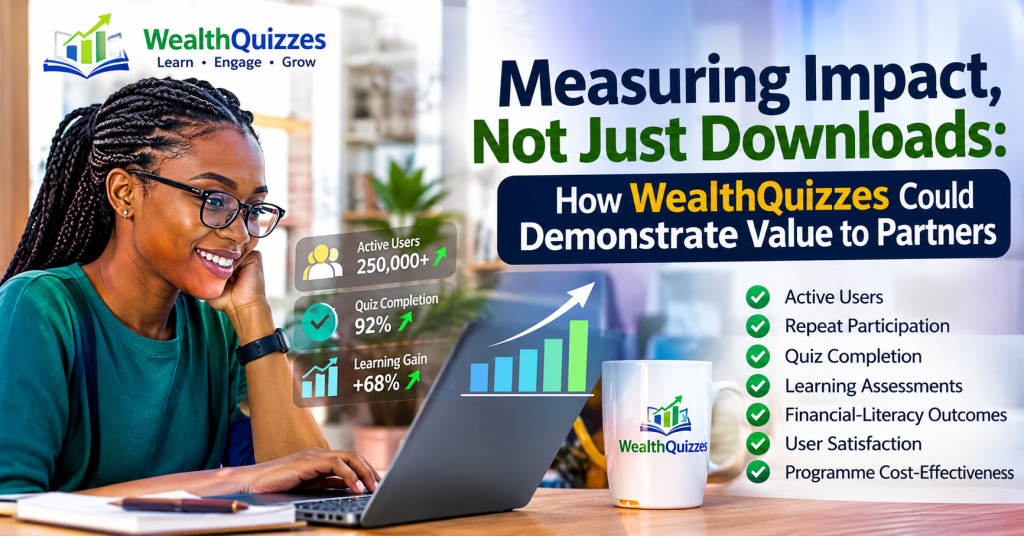
Measuring Impact, Not Just Downloads: How WealthQuizzes Could Demonstrate Value to Partners
Turning digital participation into measurable outcomes, credible evidence and strategic value
In today’s digital economy, attracting users to a platform is only the beginning of the journey. The more important questions are what those users do after registering, whether they return, what they learn, how their behaviour changes and whether the platform delivers meaningful value to the organisations supporting it.
For digital businesses seeking corporate partnerships, this distinction is particularly important. A large download figure may create an impressive presentation, but it does not necessarily demonstrate active engagement, customer loyalty, improved knowledge or measurable social impact.
For WealthQuizzes, a Nigerian knowledge-based digital engagement and rewards platform, this presents both a responsibility and an opportunity. Rather than measuring success principally through downloads and registrations, WealthQuizzes could develop a structured impact-measurement framework that demonstrates how people participate, engage with knowledge, improve their understanding and respond to sponsored programmes.
Such an approach would strengthen the platform’s proposition to banks, telecommunications companies, educational institutions, consumer brands and development-oriented organisations.
The central argument is straightforward: corporate partners should be able to see not merely how many people accessed a digital platform, but what happened because they participated.
1. Why downloads and registrations are not sufficient measures of success
Downloads are useful indicators of initial reach. They can show that people have discovered a product and expressed enough interest to install it. Registrations provide an additional indication that individuals have taken steps to access the platform.
However, neither metric establishes whether users actually engage with the product.
A person may download an application, register, complete one activity and never return. Another may participate regularly, complete several learning activities and demonstrate measurable improvement in knowledge. Although both individuals count as registered users, their levels of engagement and potential programme value are substantially different.
This is why digital platforms must distinguish between:
- Reach: How many people were exposed to or accessed the platform?
- Engagement: How actively did those people use it?
- Retention: Did they return and continue participating?
- Completion: Did they finish the activities they started?
- Learning: Did their knowledge or understanding improve?
- Satisfaction: Did they find the experience useful and accessible?
- Efficiency: Were the results achieved at a reasonable cost?
The Organisation for Economic Co-operation and Development (OECD), through its Development Assistance Committee (DAC) evaluation framework, identifies six complementary criteria for evaluating programmes: relevance, coherence, effectiveness, efficiency, impact and sustainability. These criteria provide a useful foundation for assessing corporate-supported digital initiatives.
The OECD cautions that evaluation criteria should be applied thoughtfully and according to the purpose and context of the intervention. In practical terms, a corporate-sponsored knowledge programme should have clearly defined objectives and indicators before implementation, rather than attempting to manufacture evidence of success after the programme has ended.
2. Measuring active users: Establishing genuine participation
The first important step is to distinguish registered users from active users.
For WealthQuizzes, an active user should be someone who undertakes a meaningful platform activity within a defined reporting period. Depending on the programme, this could include starting a quiz, submitting an answer, completing a quiz session or participating in a sponsored challenge.
Merely opening the application may be insufficient to establish meaningful engagement.
Useful indicators include:
Daily Active Users (DAU): The number of distinct users undertaking a qualifying activity within a day.
Weekly Active Users (WAU): The number of distinct users undertaking a qualifying activity within a seven-day period.
Monthly Active Users (MAU): The number of distinct users undertaking a qualifying activity within a calendar month or rolling 30-day period.
Activation rate: The proportion of registered users who complete a defined first meaningful activity.
Active-user ratio: The proportion of registered users who qualify as active during the reporting period.
These indicators would help WealthQuizzes demonstrate whether its audience is simply accumulating or actually participating.
For corporate partners, the distinction matters. A bank sponsoring a financial-literacy challenge would be more interested in the number of people who actively participated in the programme than the total number of people who downloaded the application at some point.
The platform should also report active users by programme, category and relevant audience segment, subject to appropriate privacy safeguards. This would help partners understand which activities generate meaningful participation.
3. Measuring repeat participation and user retention
A successful digital engagement programme should give users a reason to return.
Repeat participation provides evidence that users are finding sufficient value, interest or relevance in the experience to engage more than once. It can also help identify weaknesses in the user journey.
WealthQuizzes could monitor:
- The percentage of first-time participants who return within seven days.
- The percentage who return within 30 days.
- The average number of quiz sessions completed per active user.
- The percentage of users who participate in multiple quiz categories.
- The number of users who participate in successive sponsored challenges.
- Retention rates across different registration cohorts.
A cohort is a group of users who share a common starting point, such as registering during the same week or participating in the same sponsored campaign. Tracking cohorts allows the platform to assess whether users acquired during a particular campaign continue participating over time.
For example, if 5,000 people register during a sponsored campaign, the platform should not report only the 5,000 registrations. It should also establish how many completed an activity, how many returned after seven days and how many remained active after 30 days.
These figures would provide a more meaningful assessment of the campaign’s effectiveness.
Importantly, repeat participation should not be treated as proof of learning. It measures continued engagement, not necessarily improved knowledge. Both should be assessed separately.
4. Measuring quiz starts and completion rates
Quiz completion is another important performance indicator because it reveals whether users follow through on activities they begin.
A platform may attract substantial traffic but experience poor completion because of complicated navigation, technical difficulties, inappropriate question difficulty, connectivity limitations or an unsatisfactory user experience.
WealthQuizzes could measure:
Quiz-start rate: The proportion of users who begin a quiz after viewing or accessing the relevant activity.
Quiz-completion rate: The proportion of users who complete a quiz out of those who started it.
Question response rate: The proportion of questions presented for which users submit valid responses.
Average completion time: The average time users take to complete a defined quiz or activity.
Abandonment rate: The proportion of users who start an activity but do not complete it.
For example, if 2,000 users start a sponsored financial-literacy challenge and 1,500 complete it, the completion rate is:
[
\frac{1,500}{2,000}\times100=75%
]
This tells the partner that three-quarters of those who started the activity completed it.
However, completion figures must be interpreted carefully. Where a quiz is designed as a competitive activity, some users may deliberately stop after an incorrect answer. The platform should therefore distinguish between voluntary abandonment, technical interruption, disqualification under programme rules and normal completion.
Such distinctions will make reports more accurate and useful.
5. Measuring learning outcomes: Moving beyond participation
This is arguably one of the most important opportunities for WealthQuizzes.
If a platform describes itself as knowledge-based and seeks partnerships around education, financial literacy or public awareness, it should be able to demonstrate more than the number of questions answered. It should develop a credible method for assessing whether participation improves knowledge or understanding.
A practical approach is to introduce baseline and endline assessments.
A baseline assessment measures what participants know before a learning intervention. An endline assessment measures their knowledge after completing the relevant programme.
For example, a bank sponsoring a financial-literacy programme could support a series of quizzes covering budgeting, savings, interest rates, responsible borrowing, digital payments and fraud prevention.
Participants could complete an initial assessment before the learning activities and a comparable assessment afterwards.
The difference between the two scores would provide an indication of knowledge change.
Suppose participants record an average baseline score of 45% and an average endline score of 68%. The programme would have recorded an improvement of 23 percentage points.
That is more informative than simply reporting that 10,000 questions were answered.
Nevertheless, an increase in scores does not automatically establish that the programme caused the improvement. Participants may have obtained relevant information elsewhere, remembered earlier questions or become familiar with the assessment format.
For stronger evidence, WealthQuizzes could use equivalent but non-identical assessment questions, appropriate intervals between assessments and, where feasible, a comparison group that does not receive the same intervention during the evaluation period.
UNESCO explains that learning assessments provide information about what learners know and can do, how learning is distributed across groups and which factors influence achievement. It also emphasises that assessment evidence can guide improvements in learning resources and educational strategies.
UNESCO – Assessment for Improved Learning Outcomes
The World Bank’s Impact Evaluation in Practice handbook similarly emphasises the importance of defining intended results, establishing baseline data and designing appropriate evaluation methods before programme implementation.
World Bank – Impact Evaluation in Practice
6. Measuring financial-literacy outcomes
Financial literacy offers a particularly promising area for corporate partnerships involving banks, fintech companies, insurance providers and other financial institutions.
However, a programme should not claim to improve financial literacy merely because participants answered questions about money.
A credible assessment should examine relevant dimensions of financial knowledge, attitudes and behaviour.
The OECD/International Network on Financial Education (OECD/INFE) provides an internationally recognised framework for measuring financial literacy, financial inclusion, financial resilience and financial well-being.
Its 2022 measurement toolkit incorporates questions on digital financial literacy and examines three important dimensions:
- Knowledge: Understanding financial concepts such as interest, inflation, risk, budgeting and financial products.
- Attitudes: The values and perspectives that influence financial decisions, including planning, saving and spending.
- Behaviour: Practical financial actions, such as budgeting, comparing financial products, managing expenditure and taking steps to protect oneself against fraud.
WealthQuizzes could adapt relevant assessment concepts to develop structured Nigerian financial-literacy programmes.
For instance, a sponsored programme might assess whether participants understand the difference between simple and compound interest, recognise common financial fraud techniques, understand the consequences of borrowing or appreciate the importance of maintaining an emergency fund.
A stronger programme could also use follow-up surveys to examine whether participants report applying the knowledge in everyday decisions.
There is an important distinction here: correctly answering a question about budgeting does not establish that a participant consistently maintains a budget. Knowledge, reported behaviour and independently verified behaviour are different levels of evidence.
Accordingly, reports should identify precisely what was measured and avoid presenting quiz scores as proof of improved financial well-being.
OECD/INFE – Toolkit for Measuring Financial Literacy and Financial Inclusion 2022
7. Measuring user satisfaction and experience
Even a technically sound digital platform may struggle to deliver value if users find it difficult, confusing or frustrating.
User satisfaction is therefore an important part of impact measurement.
WealthQuizzes could periodically collect feedback on:
- Ease of registration and navigation.
- Clarity of quiz instructions and questions.
- Relevance and quality of content.
- Reliability and responsiveness of the application.
- Fairness and transparency of programme rules.
- Accessibility across different devices and network conditions.
- Overall satisfaction and willingness to participate again.
Short in-app surveys, post-activity feedback forms and periodic user interviews could provide useful information.
The platform could also adopt a Net Promoter Score (NPS) survey, which asks users how likely they are to recommend the platform to others. However, NPS should not be treated as a complete measure of satisfaction or impact. It is one indicator among several and should be interpreted alongside actual usage and retention data.
For corporate partners, this information could help identify whether a sponsored programme is delivering a positive experience and where improvements are required.
8. Measuring cost-effectiveness: What did the programme achieve for the money spent?
Corporate partners must also understand whether the resources committed to a programme produced reasonable results.
This is where cost-effectiveness analysis becomes important.
Rather than focusing exclusively on total expenditure, WealthQuizzes could calculate the cost of achieving specific outcomes.
For example:
| Indicator | Illustrative calculation |
|---|---|
| Cost per registered participant | Total programme cost ÷ registered participants |
| Cost per active participant | Total programme cost ÷ active participants |
| Cost per completed quiz | Total programme cost ÷ completed quizzes |
| Cost per learning assessment completer | Total programme cost ÷ participants completing assessments |
| Cost per participant demonstrating improvement | Total programme cost ÷ participants meeting the defined improvement threshold |
Consider a hypothetical sponsored programme costing ₦5 million.
If 10,000 people register, 6,000 become active participants, 4,500 complete the programme and 3,000 demonstrate a pre-defined improvement in assessment scores, the relevant costs would be:
- Cost per registered participant: approximately ₦500.
- Cost per active participant: approximately ₦833.
- Cost per programme completer: approximately ₦1,111.
- Cost per participant demonstrating improvement: approximately ₦1,667.
These figures are illustrative, not WealthQuizzes performance results.
They demonstrate why the number of registrations alone is an inadequate basis for evaluating programme expenditure. A partner should understand the cost of reaching the specific outcome it values.
Cost-effectiveness comparisons must also be fair. Programmes should be compared only where their objectives, target audiences, outcome definitions and measurement periods are sufficiently similar.
The OECD’s evaluation framework identifies efficiency as a key consideration, including whether resources are converted into results economically and within an appropriate timeframe.
9. Building a credible impact-measurement framework for WealthQuizzes
To translate these indicators into a practical reporting system, WealthQuizzes could adopt a structured framework with five stages.
Stage One: Define the programme objectives.
Every corporate partnership should begin with clearly stated objectives. A financial institution may prioritise financial literacy, while a telecommunications company may focus on digital engagement, digital safety or digital inclusion.
The indicators must reflect the partner’s actual objectives.
Stage Two: Establish baseline measurements.
Before the programme begins, WealthQuizzes should identify the information required to measure performance. This may include existing user activity, baseline knowledge scores, user satisfaction and relevant audience characteristics.
Where an existing user population is involved, historical platform data may provide some baseline information. Where learning outcomes are concerned, a properly designed pre-programme assessment will usually be necessary.
Stage Three: Monitor performance throughout implementation.
The platform should collect relevant activity data consistently. This includes active users, quiz starts, completions, repeat participation, assessment scores, feedback and programme expenditure.
Stage Four: Conduct an endline assessment.
At the conclusion of the programme, WealthQuizzes should compare results against the agreed targets and baseline measurements. It should identify what was achieved, what was not achieved and the reasons for any significant performance gaps.
Stage Five: Prepare a partner impact report.
The final report should present the programme objectives, methodology, target audience, key indicators, results, limitations, expenditure and recommendations.
It should use clear charts, tables and concise explanations rather than relying on promotional language.
Where the evidence supports it, the report may also identify opportunities for programme expansion.
10. A proposed 90-day pilot for measurable corporate partnerships
A 90-day pilot could provide a practical starting point for implementing this framework.
The following is an illustrative structure that could be adapted to the objectives and resources of an individual partner.
| Period | Key activities | Expected evidence |
|---|---|---|
| Days 1–15 | Programme design, partner objectives, audience definition and baseline assessment | Approved measurement framework and baseline report |
| Days 16–45 | Programme launch, user acquisition and initial participation | Registration, activation and engagement data |
| Days 46–75 | Continued engagement, repeat challenges and interim assessments | Retention, completion and participation reports |
| Days 76–90 | Endline assessments, user feedback and cost analysis | Final performance and impact report |
The partner and WealthQuizzes should agree on specific targets before launch. These should be realistic, measurable and consistent with the programme’s budget and intended audience.
The pilot should also establish clear reporting responsibilities, data-access arrangements, privacy safeguards and the method for verifying reported results.
A successful pilot should not automatically lead to expansion. It should provide sufficient evidence for the parties to decide whether to continue, modify or discontinue the programme.
11. Data protection, integrity and credibility must underpin measurement
Collecting user data creates responsibilities.
WealthQuizzes must ensure that its measurement framework operates in accordance with the Nigeria Data Protection Act 2023 and applicable data protection requirements.
This includes establishing a lawful basis for processing personal data, providing appropriate privacy information, limiting data collection to what is necessary, maintaining suitable security controls and regulating how information is shared with corporate partners.
Partners should ordinarily receive aggregated and appropriately anonymised programme reports rather than unrestricted access to identifiable user records.
The platform should also avoid collecting sensitive information simply because it might be useful for future marketing or reporting.
Equally important is the integrity of the results. Reports must distinguish actual performance from targets, estimates and projections. They should not count the same participant multiple times when reporting unique users, inflate engagement figures through repeated events or describe registration as proof of learning.
Credibility is built not by reporting only favourable results, but by reporting accurately.
Conclusion: Evidence is the foundation of sustainable partnerships
The future of digital partnerships will increasingly depend on the ability of platforms to demonstrate measurable value.
For WealthQuizzes, the opportunity is to move beyond the conventional narrative of downloads, registrations and promotional reach towards a more credible proposition built around active participation, repeat engagement, completed learning activities, measurable knowledge development, user satisfaction and cost-effectiveness.
This approach would give corporate partners a clearer understanding of what their support achieves.
A bank could assess the reach and learning outcomes of a sponsored financial-literacy programme. A telecommunications company could evaluate participation and user engagement in a digital inclusion initiative. An educational institution could examine knowledge acquisition and programme completion. A consumer brand could assess the effectiveness of an interactive customer engagement campaign.
The important point is that each partnership should be measured against its own objectives, using indicators that are meaningful, transparent and verifiable.
WealthQuizzes does not need to claim that every user becomes more knowledgeable or that every sponsored programme produces lasting behavioural change. It needs to establish the systems through which such outcomes can be properly assessed.
Downloads may demonstrate discovery. Registrations may demonstrate interest. Active participation demonstrates engagement. Learning assessments provide evidence of knowledge development. Cost-effectiveness demonstrates whether the resources committed are producing worthwhile results.
That is the difference between a platform that merely reports activity and one that can demonstrate value.
For WealthQuizzes, building this measurement culture could become an important competitive advantage: helping transform corporate partnerships from sponsorship announcements into structured programmes with clear objectives, measurable outcomes and credible evidence of performance.
Selected Authorities and Further Reading
- OECD (2021), Applying Evaluation Criteria Thoughtfully. A practical guide to relevance, coherence, effectiveness, efficiency, impact and sustainability in programme evaluation.
https://doi.org/10.1787/543e84ed-en - OECD (2022), OECD/INFE Toolkit for Measuring Financial Literacy and Financial Inclusion 2022. An internationally recognised framework for measuring financial knowledge, attitudes, behaviour, inclusion and digital financial literacy.
https://doi.org/10.1787/cbc4114f-en - World Bank (2016), Impact Evaluation in Practice, Second Edition. A practical guide to baseline measurement, evaluation design, comparison groups and evidence-based programme assessment.
https://www.worldbank.org/en/programs/sief-trust-fund/publication/impact-evaluation-in-practice - UNESCO, Assessment for Improved Learning Outcomes. Guidance on measuring what learners know and can do, and using assessment evidence to improve learning.
https://www.unesco.org/en/learning-assessments - World Bank, Development Impact Group (DIME). Resources on impact evaluation, evidence-based decision-making and cost-effectiveness.
https://www.worldbank.org/en/about/unit/unit-dec/impactevaluation/about - Federal Republic of Nigeria, Nigeria Data Protection Act 2023. The statutory framework governing personal data processing in Nigeria.
https://ndpc.gov.ng/resources/


