
Nigeria’s Electoral History: From Colonial Voting to INEC and the Modern Election
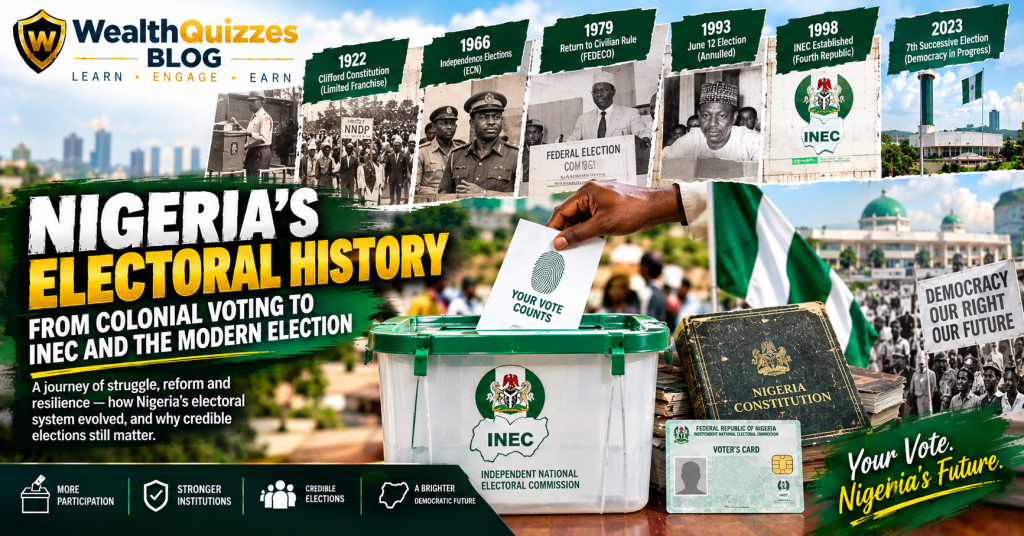
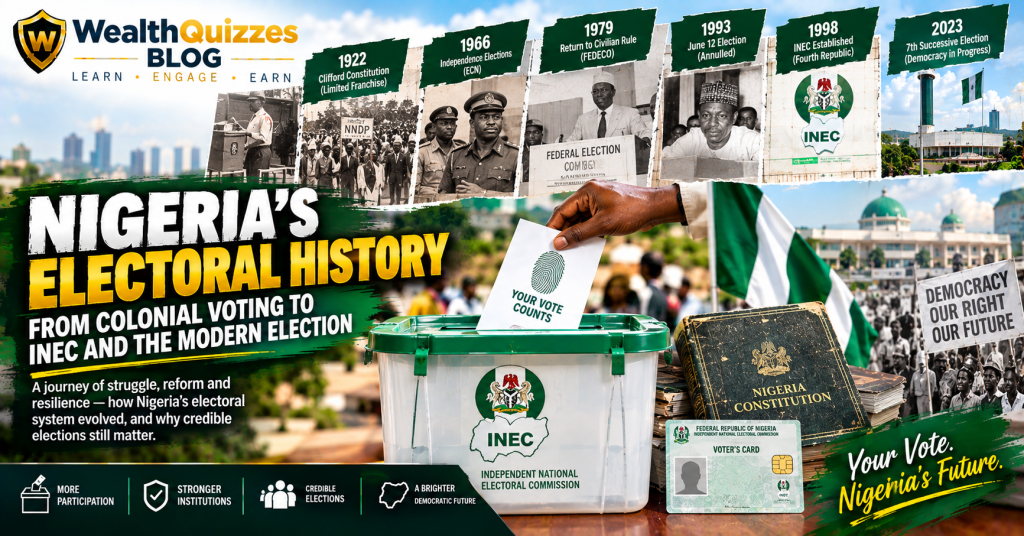
Nigeria’s electoral history is the story of a country learning, often painfully, how political authority can be transferred through the ballot rather than through force. From the highly restricted elections introduced under the Clifford Constitution of 1922, through the nationalist politics of the 1940s and 1950s, the turbulent elections of the First and Second Republics, the annulled presidential election of 12 June 1993, and the establishment of the Independent National Electoral Commission (INEC) in 1998, Nigeria’s electoral system has undergone profound transformation.
The journey has not been linear. Elections have sometimes expanded political participation and strengthened constitutional government; at other times, disputed elections, electoral violence, manipulation and military intervention have contributed to political instability.
Today, Nigeria possesses a permanent constitutional electoral management body, a nationwide voter-registration system, sophisticated accreditation technology and increasingly elaborate rules governing voting, collation and declaration. Yet the fundamental question remains the same one that confronted Nigeria’s early nationalists: how can the people’s votes be translated into legitimate and credible government?
The Beginning: The Clifford Constitution of 1922
Nigeria’s first formal electoral experiment dates to the Clifford Constitution of 1922.
The constitution introduced the first electoral system into Nigeria and created a Legislative Council to replace the earlier Nigerian Council. However, it was an extremely limited form of representation.
Only four elected positions were provided: three for Lagos and one for Calabar. Moreover, the franchise was restricted to adult male residents who met stringent property or income qualifications. The annual income threshold was £100, effectively excluding the overwhelming majority of Nigerians. (sccr.gov.ng)
The first elections were conducted in 1923, with subsequent elections taking place at five-year intervals through 1938. The system remained overwhelmingly southern and did not extend electoral representation to the Northern Region. (inecnigeria.org)
Nevertheless, the significance of the Clifford Constitution should not be underestimated.
It introduced the elective principle into Nigerian constitutional politics.
For the first time, a limited number of Nigerians could participate directly in choosing representatives to a central legislative institution. The restricted franchise was profoundly undemocratic by modern standards, but the principle it introduced would become increasingly difficult for the colonial government to reverse.
Elections and the Rise of Nigerian Nationalism
The emergence of elections contributed to the development of organised political activity.
Herbert Macaulay’s Nigerian National Democratic Party (NNDP) became an important force in Lagos politics, while the Nigerian Youth Movement (NYM) emerged later as another significant political organisation.
The electoral arena therefore became more than a mechanism for selecting representatives. It became a platform through which Nigerian nationalists criticised colonial policies, demanded greater representation and developed political organisations.
INEC’s historical review similarly notes that the introduction of electoral politics contributed to the development of Nigerian political parties, although participation remained restricted and geographically narrow. (inecnigeria.org)
The Richards and Macpherson Constitutions
Nigeria’s electoral system changed substantially during the constitutional reforms of the 1940s and early 1950s.
The Richards Constitution of 1946 expanded the role of regional institutions and introduced a more elaborate representative framework. But the constitution remained fundamentally colonial and was criticised by Nigerian political actors for insufficient consultation.
The Macpherson Constitution of 1951 went considerably further.
One of its most important features was the extensive consultation that preceded its development. Constitutional proposals were discussed at local and regional levels before reaching the central stage. Scholars of Nigerian constitutional development have identified this process as an important early example of broader Nigerian participation in constitutional politics.
The Macpherson arrangements also expanded representative institutions and increased the political significance of the regions.
This was an important development because Nigerian politics was no longer confined to Lagos and a tiny educated elite.
Political mobilisation was spreading.
The 1959 Elections and the Road to Independence
The next major milestone was the 1959 general election, conducted shortly before independence.
By this point, Nigeria had developed major political parties with strong regional bases, including:
- Northern People’s Congress (NPC);
- National Council of Nigeria and the Cameroons (NCNC); and
- Action Group (AG).
The electoral competition reflected Nigeria’s political diversity. Parties had different regional strongholds, ideological tendencies and political constituencies.
The Electoral Commission of Nigeria (ECN) was established to conduct the 1959 elections. According to INEC’s institutional history, ECN represents the beginning of Nigeria’s modern succession of electoral management bodies. (inecnigeria.org)
The election paved the way for Nigeria’s independence on 1 October 1960.
However, independence did not immediately produce a completely independent electoral institution.
The First Republic: FEC, 1964 and 1965
Following independence, the Federal Electoral Commission (FEC) was established in 1960.
FEC conducted the 1964 federal election and the 1965 regional elections. (inecnigeria.org)
The First Republic operated under a parliamentary system in which political parties and regional governments were extremely powerful.
But the 1964 and 1965 elections exposed serious weaknesses.
The 1964 federal election was heavily contested and produced disputes over participation and the conduct of the poll. The 1965 Western Region election was followed by severe political violence, popularly remembered through the expression “Operation Wetie.”
The deterioration of the political environment was one factor within the wider crisis that culminated in the 15 January 1966 military coup.
The electoral system therefore became associated with both the promise of democratic representation and the dangers of political competition without sufficiently strong institutions.
Military Rule and the Suspension of Electoral Politics
The military coup of January 1966 brought the First Republic to an end.
For several years, elections ceased to be the mechanism through which national political authority was transferred.
The military subsequently reorganised Nigeria’s political structure, including the creation of states in 1967. Political parties were banned, elected legislatures were dissolved and executive authority was concentrated in military governments.
This period demonstrates an important fact about Nigeria’s electoral history:
Election management cannot be separated from the wider political environment.
An electoral commission can organise voting, but elections require constitutional government, political parties willing to accept rules, independent institutions, security, courts and political actors prepared to accept defeat.
FEDECO and the Return to Civilian Rule in 1979
After more than a decade of military rule, General Olusegun Obasanjo’s military government began the transition to civilian government.
A new Federal Electoral Commission (FEDECO) was established in 1978.
FEDECO conducted the 1979 general elections, which returned Nigeria to civilian government and ushered in the Second Republic under President Shehu Shagari. It also conducted the 1983 elections. (inecnigeria.org)
The 1979 election was particularly significant because Nigeria simultaneously moved from the parliamentary model of the First Republic to a presidential system.
The electoral system therefore had to accommodate a new constitutional arrangement.
The presidency was now a nationally contested office, and the Constitution required a candidate not merely to win the largest number of votes but also to satisfy a geographical spread requirement across the federation.
That principle remains important in Nigerian presidential elections today.
The 1983 Election and Another Military Intervention
The 1983 elections were followed by widespread allegations of electoral malpractice and violence.
The political crisis contributed to the military coup of 31 December 1983, which removed the Second Republic from office.
Once again, Nigeria’s democratic experiment was interrupted.
The lesson was becoming increasingly obvious: Nigeria could create constitutional institutions and conduct elections, but the durability of democracy depended on the credibility of the electoral process and the willingness of political actors to operate within constitutional limits.
NEC and the June 12, 1993 Election
The next major electoral experiment occurred during General Ibrahim Babangida’s transition programme.
The National Electoral Commission (NEC) was established in 1987 and was given responsibility for conducting elections during the transition.
NEC introduced several notable innovations, including the Option A4 voting system and an open-ballot arrangement. It conducted local and state elections and eventually the presidential election of 12 June 1993. (inecnigeria.org)
The June 12 election became one of the most consequential elections in Nigerian history.
Two presidential candidates contested the election:
- Moshood Kashimawo Olawale Abiola of the Social Democratic Party (SDP);
- Bashir Tofa of the National Republican Convention (NRC).
Voting took place on 12 June.
NEC began the process of collating the results, but the election was never formally completed through an official presidential declaration.
On 23 June 1993, the military government annulled the election and suspended NEC. Contemporary documentation records that the annulment came amid legal challenges and intense political controversy. (ecoi.net)
The annulment generated a profound political crisis.
June 12 subsequently became a symbol of the Nigerian struggle for credible democratic choice and was officially recognised as Democracy Day by the Federal Government from 2018.
NECON and the Abacha Transition
After General Sani Abacha seized power in November 1993, Nigeria’s transition programme was reorganised.
In 1995, the military government established the National Electoral Commission of Nigeria (NECON).
NECON conducted local-government and other transition elections during the Abacha era. However, the proposed transition was interrupted by Abacha’s death in June 1998. (inecnigeria.org)
The collapse of the Abacha transition created another opportunity for democratic restoration.
The Birth of INEC
General Abdulsalami Abubakar’s government dissolved NECON and established the Independent National Electoral Commission (INEC) in 1998.
INEC organised the transitional elections that ushered Nigeria into the Fourth Republic on 29 May 1999. (inecnigeria.org)
Unlike the temporary electoral bodies that had appeared and disappeared with different political regimes, INEC was established as a permanent constitutional institution.
Under the 1999 Constitution, INEC’s responsibilities include organising elections for the offices of President, Vice-President, governors, deputy governors, members of the Senate, House of Representatives and State Houses of Assembly. It also registers political parties, registers voters, monitors campaigns, conducts voter and civic education and performs other electoral functions. (inecnigeria.org)
This represented a major institutional evolution.
Nigeria’s electoral system had moved from a colonial arrangement in which elections were conducted by the administrative machinery of government to a constitutionally established specialist electoral management body.
The Fourth Republic: Seven General Elections
Since 1999, Nigeria has conducted successive general elections in:
1999, 2003, 2007, 2011, 2015, 2019 and 2023.
INEC describes the 2023 election as the seventh successive general election since the return to democracy in 1999. (inecnigeria.org)
This uninterrupted sequence is historically significant.
Nigeria had previously experienced repeated interruptions of constitutional government. The fact that elected governments have succeeded one another since 1999 represents an important institutional achievement, even though individual elections have continued to generate controversy.
The 2015 election was particularly historic because it produced the first defeat of an incumbent Nigerian president seeking re-election at the federal level.
INEC’s own assessment describes 2015 as a watershed in Nigeria’s electoral history. (inecnigeria.org)
The Evolution of Electoral Technology
Nigeria’s electoral system has also evolved technologically.
Earlier elections relied heavily on paper registers, physical ballot papers and manual collation.
Over time, Nigeria introduced:
- biometric voter registration;
- Permanent Voter Cards (PVCs);
- Smart Card Readers;
- the Bimodal Voter Accreditation System (BVAS); and
- the INEC Result Viewing Portal (IReV).
INEC identifies BVAS and IReV among its major electoral reforms and technological developments. (inecnigeria.org)
The purpose of these technologies is not simply to make elections more modern. Their deeper objective is to strengthen the chain between voter accreditation, ballots cast, recorded results and public verification.
INEC’s procedures also provide for results to move through several levels of collation, from the polling unit and Registration Area/Ward through the LGA and state levels, depending on the type of election. Presidential results ultimately undergo national collation and declaration. (inecnigeria.org)
The Continuing Problem of Electoral Credibility
Technology alone cannot solve Nigeria’s electoral problems.
The credibility of an election depends on the entire electoral ecosystem.
This includes:
- accurate voter registration;
- credible party primaries;
- internal party democracy;
- campaign finance transparency;
- freedom from intimidation;
- impartial security agencies;
- competent election officials;
- transparent collation;
- effective dispute resolution;
- credible courts; and
- acceptance of legitimate results.
INEC itself identifies autonomy, transparency, integrity, credibility, impartiality and equity among its institutional values. (inecnigeria.org)
These principles are important because an electoral commission cannot manufacture public trust simply by deploying technology.
Trust ultimately comes from whether citizens believe that the rules were applied fairly.
Electoral Disputes and the Courts
Nigeria’s electoral history has also produced a sophisticated system of judicial review.
Election results can be challenged before specialised election tribunals and, depending on the election and appellate stage, the Court of Appeal and Supreme Court.
This is important because an election is not necessarily the final legal event when polling ends.
The law provides procedures through which allegations concerning qualification, electoral malpractice, compliance with electoral law and other matters can be adjudicated.
The courts therefore form an important part of Nigeria’s electoral architecture.
From Restricted Franchise to Mass Democracy
The contrast between 1922 and the present is striking.
In the 1920s, only a tiny number of qualified men in Lagos and Calabar could participate in legislative elections. The £100 income threshold excluded most Nigerians.
Today, Nigeria operates a mass electoral system covering all 36 states, the FCT and 774 Local Government Areas, with a permanent constitutional electoral commission. (inecnigeria.org)
The transformation has therefore been enormous.
Yet the fundamental principle has remained constant:
Political legitimacy ultimately depends upon the consent of the governed.
Conclusion
Nigeria’s electoral history is neither a simple story of democratic progress nor an uninterrupted catalogue of failure.
It is a history of experimentation, expansion, interruption, institutional rebuilding and reform.
The Clifford Constitution introduced a severely restricted elective principle in 1922. Nationalist politics gradually expanded the significance of elections. The ECN conducted the 1959 elections that preceded independence, while FEC administered the early post-independence elections. Military intervention interrupted democratic government in 1966. FEDECO helped restore civilian rule in 1979, only for another military coup to end the Second Republic in 1983. NEC administered the transition that culminated in the historic but annulled June 12, 1993 presidential election. NECON later attempted another transition before the emergence of INEC in 1998. (inecnigeria.org)
Since 1999, INEC has overseen seven successive general elections, with continuing reforms aimed at improving the integrity and transparency of the process. (inecnigeria.org)
The history therefore leads to an important conclusion.
Nigeria does not merely need elections; it needs elections that citizens can trust.
The challenge of the future is consequently not just to increase voter numbers or introduce newer technology. It is to build an electoral culture in which political parties respect internal democracy, candidates compete fairly, institutions act independently, voters can participate without intimidation, results can be independently verified, disputes can be resolved lawfully and winners and losers accept constitutional outcomes.
From the four restricted seats of the Clifford era to nationwide elections administered through biometric technology, Nigeria’s electoral journey has travelled a remarkable distance.
But the destination—a genuinely trusted electoral democracy—is still a work in progress.