
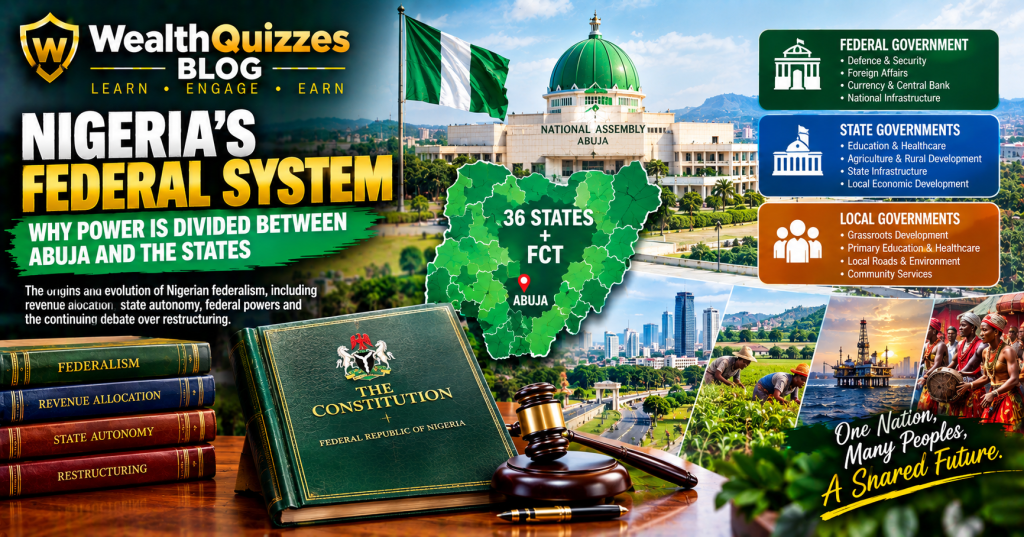
Nigeria’s Federal System: Why Power Is Divided Between Abuja and the States
Nigeria is a federation because the country was deliberately structured to distribute governmental authority between a central Federal Government and constituent states, rather than concentrating all public power in Abuja. Yet Nigerian federalism has never been static. It has evolved from a relatively decentralised federation of large regions at independence into a much more centralised federation of 36 states and the Federal Capital Territory (FCT).
This evolution has been shaped by Nigeria’s extraordinary diversity, political crises, military rule, the discovery of petroleum, struggles over revenue allocation, demands for minority protection and the continuing search for a workable balance between national unity and subnational autonomy.
As political scientist Rotimi T. Suberu observes, Nigeria moved from a relatively decentralised parliamentary federation of four large regions to a centrist presidential federation of 36 states, with the military playing a decisive role in that transformation. OUP Academic
The question, therefore, is not simply why Nigeria has a Federal Government and state governments. It is why power was divided in the first place, how that division changed, and why the balance between Abuja and the states remains one of Nigeria’s most important constitutional debates.
What Is Federalism?
Federalism is a system of government in which constitutional authority is divided between at least two levels of government, with each level possessing areas of responsibility that cannot simply be abolished or taken over at will by the other.
In a federation, the central government handles matters requiring national coordination, while constituent governments exercise authority over matters that can more effectively be administered closer to the people.
Nigeria’s Constitution reflects this principle. The 1999 Constitution establishes Nigeria as a Federal Republic and distributes legislative authority between the Federal Government and the states. The Constitution also provides for federal legislative powers over matters such as defence, foreign affairs, immigration, customs, currency and several other issues of national importance. Nigeria Rights Commission
Federalism is therefore different from a unitary system, where subnational governments derive their authority primarily from the central government.
But Nigeria’s federal system has a particularly important complication: the Federal Government is considerably more powerful than the states in many areas.
The Colonial Origins of Nigerian Federalism
Nigeria’s federal structure cannot be understood without examining its colonial origins.
The country was created through the amalgamation of territories that had previously possessed different political, cultural, economic and administrative histories. The Oxford Handbook of Nigerian History describes Nigeria as an aggregation of diverse cultures, languages, political institutions and economic relationships brought together under colonial rule. OUP Academic
The constitutional development of the late colonial period gradually introduced regional government and greater Nigerian participation in public affairs.
By independence in 1960, Nigeria had three major regions:
- Northern Region
- Western Region
- Eastern Region
The Mid-Western Region was created in 1963, producing a four-region federation.
This arrangement gave the regions substantial authority. They had their own governments, legislatures and administrative structures and exercised considerable control over economic and developmental affairs.
However, the arrangement also contained a fundamental structural problem.
As Suberu explains, the Northern Region was larger than the other regions combined in population and territory. In a deeply plural society, this imbalance contributed to intense inter-regional and inter-party competition during the First Republic. OUP Academic
Federalism was therefore both a solution and a source of tension.
It allowed different regions to exercise considerable self-government, but it also created powerful regional political blocs.
Why Nigeria Needed Federalism
There was an obvious constitutional logic behind federalism.
Nigeria was too diverse to be governed effectively through a single uniform political structure without significant regional or local participation.
Different parts of the country possessed different:
- political traditions;
- ethnic and linguistic compositions;
- economic structures;
- religious configurations;
- agricultural systems;
- commercial networks; and
- developmental priorities.
Federalism allowed these differences to coexist within one country.
The central government could address national matters, while regional and later state governments could respond to local circumstances.
This remains one of the fundamental arguments for federalism in Nigeria: unity does not necessarily require uniformity.
The Collapse of Regional Federalism
The regional system was radically transformed after the military coups of 1966 and the Nigerian Civil War crisis.
In May 1967, General Yakubu Gowon’s government abolished the four-region system and created 12 states.
This was one of the most consequential decisions in Nigerian political history.
The creation of states reduced the political power of the old regions and responded, in part, to longstanding demands by minority communities for greater political representation and administrative autonomy.
Further state creation followed:
- 1976: 19 states and the Federal Capital Territory;
- 1987: 21 states;
- 1991: 30 states;
- 1996: 36 states.
The transformation did more than redraw Nigeria’s political map. It changed the nature of Nigerian federalism.
Instead of a federation dominated by a few large regional governments, Nigeria became a federation of numerous smaller states, with a substantially stronger central government.
Suberu identifies this military-era transformation as a movement toward centralised presidential federalism, accompanied by greater federal control over constitutional functions and fiscal resources. OUP Academic
What Does Abuja Control?
The Federal Government retains authority over matters whose effects extend across the country or which require a unified national policy.
The Constitution’s Exclusive Legislative List gives the National Assembly authority over numerous areas, including:
- defence and national security;
- external affairs;
- citizenship and naturalisation;
- immigration;
- customs and excise;
- currency and legal tender;
- banking and certain financial matters;
- aviation;
- shipping and navigation;
- telecommunications-related matters;
- federal trunk roads; and
- several aspects of natural resources and intergovernmental finance. Nigeria Rights Commission
These responsibilities explain why Abuja exercises enormous influence over Nigeria’s political and economic life.
The Federal Government also operates institutions that affect citizens across all 36 states, including the armed forces, federal courts, foreign service, immigration authorities, customs service and numerous federal regulatory and development agencies.
Federal control is particularly significant in fiscal matters.
Why Revenue Is at the Centre of Nigerian Federalism
Perhaps no issue better explains the tension between Abuja and the states than revenue allocation.
Nigeria operates a system in which substantial revenues are collected centrally and subsequently distributed among the Federal Government, states and local governments.
Historically, the situation was very different.
During the early years of federalism, regions possessed stronger revenue bases and greater fiscal autonomy. Revenue allocation arrangements included principles such as derivation, whereby regions received a share of revenues generated from resources within their territories.
The rise of petroleum fundamentally altered this arrangement.
By the 1970s, petroleum had become the dominant source of government revenue, while control over petroleum taxation, rents and royalties increasingly became centralised. Adedotun O. Phillips, writing in Publius: The Journal of Federalism, notes that from the early 1970s the bulk of Nigerian government revenue was collected by the national government, much of it from petroleum taxes and mining rents and royalties. OUP Academic
The result was a major transformation of fiscal federalism.
States increasingly depended upon allocations from the centre.
A study of Nigeria’s post-independence fiscal federalism similarly found substantial state dependence on federal revenues and argued that states require meaningful financial autonomy if they are to make a stronger contribution to national development. ScienceDirect
The Federation Account
The modern system revolves substantially around the Federation Account, from which revenues are distributed among the three levels of government.
The IMF explains that Nigeria’s Federation Account has historically included revenues such as oil income, company income tax and customs and excise duties, with intergovernmental transfers intended to address both vertical and horizontal fiscal imbalances. IMF eLibrary
Vertical imbalance refers to the fact that one level of government—particularly the Federal Government—controls more revenue sources than the responsibilities assigned to it require, while states and local governments may have substantial expenditure responsibilities without equivalent independent revenue.
Horizontal imbalance, meanwhile, concerns differences among states themselves. Lagos, Rivers, Kano, Delta and other states do not possess identical populations, economic structures, natural resources or internally generated revenue capacities.
Federal transfers are therefore intended partly to redistribute resources and maintain a degree of national fiscal balance.
The Constitution also provides for a Revenue Mobilisation Allocation and Fiscal Commission (RMAFC), which monitors Federation Account revenue and disbursement and reviews revenue-allocation principles. Edo State Judiciary
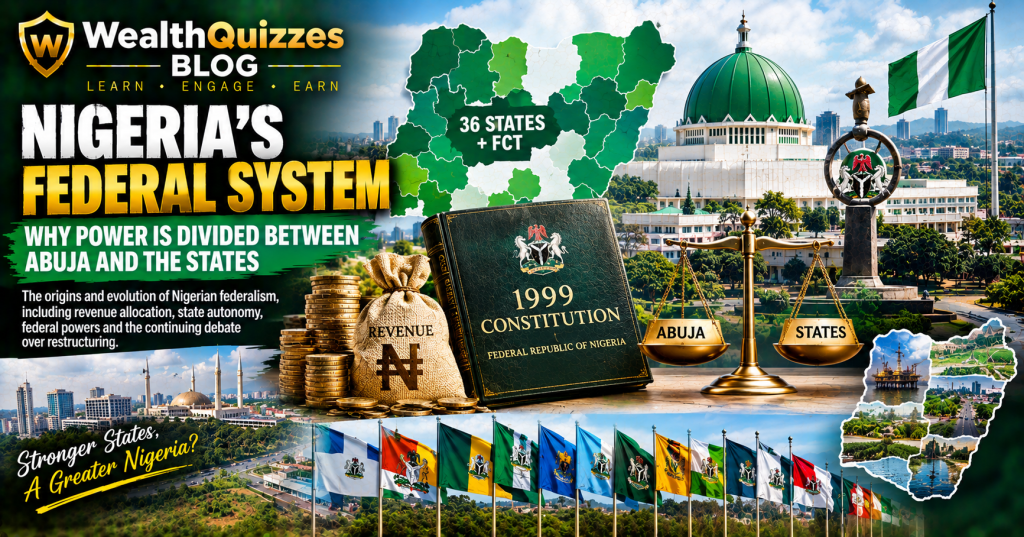
The Derivation Principle
One of the most politically sensitive features of Nigeria’s fiscal federalism is the derivation principle.
The principle recognises that states producing certain natural resources should receive a specified share of revenue derived from those resources.
Under the 1999 constitutional framework, the Constitution provides for a derivation allocation of not less than 13 percent of revenue from natural resources to the relevant producing states. IMF eLibrary
This is particularly significant in the Niger Delta, where petroleum production is concentrated.
For oil-producing states, derivation is regarded as an issue of equity, environmental burden and resource ownership.
For other states, however, the debate raises questions about whether natural resources should be treated primarily as resources belonging to producing territories or as national resources belonging to the federation as a whole.
This disagreement is at the heart of Nigeria’s long-running debate over resource control.
State Autonomy: How Powerful Are the States?
Nigerian states are constitutionally significant political units. They have governors, elected state assemblies, ministries, courts and substantial responsibilities for public services.
They are not simply administrative branches of Abuja.
Yet their autonomy is constrained by several realities.
First, many states rely heavily on federal allocations.
Second, important revenue sources are constitutionally or legislatively controlled at the federal level.
Third, Nigeria’s Constitution assigns numerous major policy areas to federal authority.
Fourth, the Federal Government has historically exercised considerable influence over local government administration, security and fiscal arrangements.
Olufunmbi Elemo argues that throughout Nigeria’s postcolonial history, political leaders have frequently sought control over the principal mechanisms of revenue generation, with these struggles influencing whether authority was centralised or dispersed. OUP Academic
This helps explain why Nigerian federalism can appear paradoxical:
Nigeria has many states, but many states remain financially and institutionally dependent on Abuja.
Federalism and the Judiciary
Federalism also requires mechanisms for resolving disputes between governments.
The Supreme Court has consequently become an important institution in Nigeria’s federal system.
Rotimi Suberu’s study of the Supreme Court’s role after 1999 examined numerous federal-state disputes involving offshore oil resources, revenue allocation, local governance and public order. The Court increasingly became an important arbiter of disputes within the federation. Cambridge University Press
This illustrates a fundamental principle of federalism: when constitutional powers overlap or governments disagree about jurisdiction, an independent judicial institution must be capable of interpreting the constitutional boundaries.
Why Is Restructuring Still Being Demanded?
Nigeria’s federal system has remained controversial because many Nigerians believe the present distribution of powers does not adequately reflect the country’s political and economic realities.
Contemporary restructuring demands commonly involve:
- greater fiscal autonomy for states;
- devolution of powers from Abuja;
- stronger state control over development;
- reform of revenue allocation;
- resource control;
- greater local-government autonomy;
- changes to the Exclusive Legislative List;
- improved regional economic cooperation;
- reduction of federal administrative concentration; and
- constitutional reform.
Cyril Obi and Godwin Onuoha identify decentralisation, fiscal federalism, revenue allocation, regional power-sharing, citizenship and the broader “national question” as major drivers of restructuring debates since the return to democratic rule in 1999. OUP Academic
The disagreement is not simply between those who want restructuring and those who oppose it.
There is also disagreement about what restructuring should mean.
Some advocates favour a return to stronger regional autonomy. Others want greater powers for the existing 36 states. Some focus principally on fiscal federalism and resource control. Others argue that the most urgent reform should be local-government autonomy.
As the Oxford Handbook of Nigerian History notes, even among advocates of decentralisation, there has not always been a single, clearly defined model of the federation they want to replace the existing system. OUP Academic
The Central Question: Unity or Autonomy?
The Nigerian federal debate ultimately revolves around a difficult constitutional balance.
Too much centralisation can weaken state institutions, reduce accountability and make Abuja responsible for matters that could potentially be handled more effectively closer to citizens.
Too much decentralisation, however, can produce severe inequalities among states and potentially intensify regional competition in a country with a history of political and communal conflict.
This tension was visible even in the First Republic. Suberu warns against romanticising the old regional system because, although it provided substantial regional self-rule, its structural imbalances contributed to intense political conflict and ultimately its violent collapse. OUP Academic
The lesson is important: decentralisation by itself is not enough.
A successful federation also requires constitutional safeguards, credible institutions, fair revenue arrangements, accountable governments and mechanisms for resolving disputes peacefully.
Nigeria’s Federal System Today
Nigeria’s federal system is therefore the product of historical compromise rather than a single constitutional design.
It began with large regions, moved through state creation and military centralisation, and eventually settled into the present 36-state presidential federation under the 1999 Constitution.
The system divides authority between Abuja and the states because Nigeria must simultaneously preserve national unity and accommodate enormous political, cultural, geographic and economic diversity.
But the division is imperfect.
The Federal Government remains dominant in national security, major taxation, natural-resource governance and many regulatory fields, while states carry significant responsibilities but depend heavily on federal transfers.
This imbalance explains why fiscal federalism remains at the centre of Nigerian politics.
The future debate will consequently not be resolved merely by asking whether Nigeria should have more or fewer states. The more fundamental question is who should exercise which powers, who should collect which revenues, who should be accountable for which services, and how national resources should be distributed fairly across the federation.
Nigeria’s federal system has survived regional conflict, military rule, civil war, repeated constitutional transitions and the return to democratic government. Yet, as Rotimi Suberu’s scholarship demonstrates, the country’s constitutional transition remains unfinished. OUP Academic
The continuing debate over restructuring is therefore not a rejection of federalism itself. At its core, it is an argument about what kind of federalism Nigeria needs—one capable of combining a strong and cohesive Nigerian state with genuinely effective, accountable and sufficiently autonomous states.
That remains one of the defining constitutional questions of Nigeria’s Fourth Republic.


