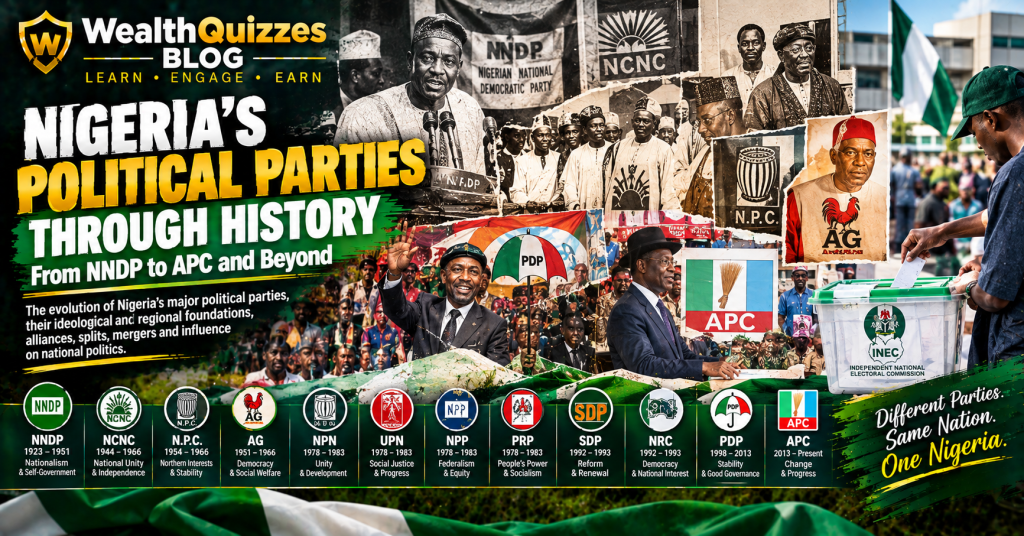
Nigeria’s Political Parties Through History: From NNDP to APC and Beyond
The evolution of Nigeria’s major political parties, their ideological and regional foundations, alliances, splits, mergers and influence on national politics
Introduction
The history of political parties in Nigeria is, in many respects, the history of the country’s struggle to reconcile regional interests, ethnic and religious diversity, competing economic visions, and the pursuit of national unity. From the Nigerian National Democratic Party (NNDP), established in 1923, to the emergence of the All Progressives Congress (APC) as a governing party in 2015, political organisations have helped shape Nigeria’s constitutional development, independence movement, democratic experiments and changing patterns of power.
Yet the evolution of Nigerian parties has not followed a straightforward path from colonial nationalism to mature ideological competition. Parties have frequently been built around influential personalities, regional constituencies, elite alliances and the practical objective of winning office. They have also been repeatedly interrupted by military rule, electoral crises, internal disputes and mergers designed to improve their chances of electoral success.
Lynn Schler’s chapter in The Oxford Handbook of Nigerian History explains that the transition from colonial rule to independence intensified competition among political parties, leaders, regions and social groups. More recent scholarship similarly observes that Nigeria has maintained a multiparty system in law while often operating, in practice, around a small number of dominant parties. These perspectives provide a useful starting point for understanding both the achievements and limitations of Nigerian party politics.
1. The NNDP and the Beginnings of Party Politics
The formal history of Nigerian political parties is commonly traced to the founding of the Nigerian National Democratic Party by Herbert Macaulay in 1923. Its emergence followed the introduction of the Clifford Constitution of 1922, which provided for a limited elective principle and allowed a small number of representatives to be elected in Lagos and Calabar. The franchise was highly restricted, excluding the overwhelming majority of Nigerians from direct electoral participation.
The NNDP contested elections in Lagos and became an important vehicle for challenging aspects of colonial administration. It advocated greater African participation in government and helped establish party organisation as a means of political representation. Its influence, however, was concentrated largely in Lagos, where the limited electorate and the political circumstances of the colonial capital shaped its activities.
The NNDP was not a mass national party in the modern sense. Nevertheless, it established an important precedent: political demands could be organised around a party structure, articulated through elections and advanced against colonial authority.
The Lagos Youth Movement, later known as the Nigerian Youth Movement (NYM), broadened the nationalist political environment during the 1930s. The NYM attracted educated Nigerians who sought greater political representation and social reform. Its early appeal extended beyond a single ethnic constituency, although internal divisions and leadership rivalries eventually weakened its position.
The significance of these early organisations lies not only in their electoral achievements but also in their contribution to the development of political consciousness. They helped create a political arena in which Nigerians could debate representation, rights, constitutional reform and the future of colonial government. Scholarship on colonial Nigeria cautions, however, against treating the growth of these organisations as an uninterrupted march towards national unity: their reach was constrained by limited suffrage, regional inequalities and the colonial constitutional framework.
2. The Rise of Regional Parties: NCNC, NPC and Action Group
The constitutional changes of the 1940s and 1950s encouraged the emergence of larger political organisations. Three parties became particularly influential in the struggle for independence and the politics of the First Republic: the National Council of Nigeria and the Cameroons (NCNC), the Northern People’s Congress (NPC), and the Action Group (AG).
The NCNC: Nationalism and Eastern Support
Founded in 1944, the NCNC initially brought together political, cultural and civic organisations under a broad nationalist umbrella. Herbert Macaulay was its first president, while Nnamdi Azikiwe became its most prominent leader and a powerful voice for self-government.
The NCNC presented itself as a national movement opposed to colonial rule. It attracted substantial support in the Eastern Region and among many Igbo voters, while also maintaining links with nationalist activists elsewhere. Its political outlook combined the demand for independence with a commitment to African self-government and social advancement.
Although the NCNC’s national aspirations were genuine and consequential, its support base became increasingly associated with the East. This illustrates a recurring feature of Nigerian politics: a party could articulate a national programme while relying heavily on a particular region for its electoral strength.
The NPC: Northern Interests and Traditional Institutions
The Northern People’s Congress developed from northern political and cultural associations and became the dominant party in the Northern Region. Its leading figure, Ahmadu Bello, the Sardauna of Sokoto, maintained close political relationships with the region’s traditional institutions and northern elites. Abubakar Tafawa Balewa, who became Nigeria’s first prime minister at independence, was another central NPC figure.
The NPC’s political outlook placed considerable emphasis on regional autonomy, social order and the interests of northern communities. Its influence was strengthened by the Northern Region’s population and electoral representation, as well as by its ability to mobilise support through established political and traditional networks.
It is misleading, however, to treat the North as politically uniform. Northern politics also included movements such as the Northern Elements Progressive Union (NEPU), associated with Aminu Kano, which challenged established northern elites and advocated a more radical populist agenda. The existence of such movements demonstrates that class, ideology and intra-regional competition mattered alongside ethnicity and religion.
The Action Group: Federalism and Welfare Policies
The Action Group emerged in 1951 under the leadership of Obafemi Awolowo. Its strongest base was in the Western Region, particularly among Yoruba constituencies, and it became associated with a more programmatic approach to governance than was typical of many of its rivals.
The AG advocated federalism and pursued policies that included the expansion of education and social welfare in the Western Region. Its government’s introduction of free primary education in the region became one of the most significant examples of a political party translating its programme into public policy.
The AG also demonstrated that political parties could compete on questions of governance and social development, not merely on constitutional status or regional representation. Nevertheless, its regional foundation and internal leadership conflicts limited its ability to establish an enduring national coalition.
The NCNC, NPC and AG were indispensable to the independence process, but their competition also exposed the difficulties of building a shared political identity across Nigeria’s diverse regions. The regional foundations of these parties would continue to influence electoral alliances and political conflict after independence.
3. Independence, the First Republic and the Crisis of Party Competition
Nigeria gained independence on 1 October 1960 under a parliamentary system. The NPC emerged as the largest party in the federal legislature, while the NCNC and its allies and the Action Group remained powerful competitors. No single party could govern without considering the country’s regional balance and the need for parliamentary alliances.
The NPC and NCNC formed a governing coalition, with Tafawa Balewa serving as prime minister and Azikiwe becoming governor-general and later president when Nigeria became a republic in 1963. The Action Group occupied the opposition space, although the party itself became weakened by a serious internal crisis.
The crisis within the AG, including the split between Awolowo and his deputy, Samuel Ladoke Akintola, contributed to political instability in the Western Region. Disputes over leadership, party control and regional government became entangled with wider national tensions. Electoral controversies and allegations of manipulation further eroded confidence in political institutions.
The 1964 federal elections and the 1965 Western Region election intensified these disputes. Nigeria’s First Republic ultimately collapsed following the military coup of January 1966 and the counter-coup later that year. The military takeover ended the existing party system and suspended democratic political competition.
The collapse of the First Republic demonstrated the danger of allowing electoral rivalry, regional distrust and elite conflict to overwhelm constitutional institutions. It also interrupted the organic development of political parties, preventing them from building stable organisations and long-term traditions across successive democratic cycles.
4. The Second Republic: NPN, UPN, NPP, PRP and GNPP
After years of military rule and the Nigerian Civil War, the transition to civilian government culminated in the Second Republic in 1979. The return to democracy brought a new party system, although several parties drew inspiration from political networks and traditions that had developed before the 1966 collapse.
Five parties became particularly prominent:
- National Party of Nigeria (NPN): A broad coalition with considerable support in the North and other regions, it won the 1979 presidential election and brought Shehu Shagari to power.
- Unity Party of Nigeria (UPN): Led by Obafemi Awolowo, it inherited much of the Action Group’s political tradition and emphasised education, employment, health and social welfare.
- Nigerian People’s Party (NPP): Associated with leaders including Nnamdi Azikiwe, it drew support particularly from the East and parts of the Middle Belt.
- People’s Redemption Party (PRP): Linked to Aminu Kano, it advanced a populist and socially progressive agenda and mobilised support among constituencies dissatisfied with established elites.
- Great Nigeria People’s Party (GNPP): Led by Waziri Ibrahim, it drew support in parts of the North-East and reflected the importance of regional leadership and coalition-building.
The NPN’s success depended on a wider electoral coalition than any single region could provide. The UPN, meanwhile, demonstrated how a party with a more identifiable programme could maintain strong regional support while seeking national office. The PRP’s presence showed that political competition also involved questions of inequality, social justice and the distribution of economic opportunities.
However, the Second Republic was short-lived. The disputed 1983 elections, intensifying political conflict and concerns about governance preceded the military coup of December 1983, which removed Shagari’s government. Once again, military intervention terminated the party system before it could mature into a stable democratic tradition.
5. The Third Republic: The State-Created SDP and NRC
The transition programme of General Ibrahim Babangida introduced a distinctive experiment in Nigerian party politics. Rather than allowing political actors to establish parties freely from the outset, the military government created two officially sanctioned parties: the Social Democratic Party (SDP) and the National Republican Convention (NRC).
The arrangement was intended to reduce the ethnic and regional fragmentation associated with earlier party systems. In practice, however, both parties contained diverse factions, regional networks and powerful personalities. Their names suggested ideological differences, but scholarship has questioned whether the two-party experiment produced a clear and sustained distinction in policy orientation.
The SDP nominated Moshood Kashimawo Olawale (M.K.O.) Abiola for the presidential election of 12 June 1993, while Bashir Tofa contested for the NRC. The election is widely regarded as a landmark in Nigeria’s democratic history because of its broad appeal across regional and religious divisions. Its official conclusion was prevented by the annulment of the election by the Babangida regime.
The annulment triggered a profound political crisis and damaged confidence in the transition process. The short-lived Third Republic, including subsequent developments under General Sani Abacha, failed to establish a durable democratic party system. The episode nevertheless remains important because it demonstrated the possibility of a presidential campaign whose support crossed established regional boundaries.
6. The Fourth Republic: PDP Dominance and the Return of Multiparty Politics
Nigeria’s return to civilian rule in 1999 reopened the political space. Three parties contested the first general elections of the Fourth Republic: the People’s Democratic Party (PDP), the All People’s Party (APP), and the Alliance for Democracy (AD).
The PDP emerged as the dominant national party, winning the presidential election with Olusegun Obasanjo as its candidate. The APP, later renamed the All Nigeria People’s Party (ANPP), and the AD formed an alliance to challenge the PDP’s position. The AD’s strength was concentrated in the South-West, while the APP/ANPP developed significant support in parts of the North.
The PDP’s emergence was closely connected to the G-34, a coalition of prominent Nigerians opposed to Abacha’s attempt to remain in power through a civilian transition. As discussed by Jide Ojo in The Oxford Handbook of Nigerian Politics, the PDP’s eventual loss of power in 2015 followed a gradual weakening of its vision, organisational coherence and reputation, alongside the consolidation of opposition interests into a stronger electoral platform.
The PDP governed Nigeria from 1999 to 2015, winning four consecutive presidential elections. Its strength rested on a broad national network, access to political elites across regions and an ability to accommodate competing interests within a single organisation. That breadth helped the party maintain national dominance, but it also created recurring disputes over nominations, zoning, patronage and leadership succession.
The party’s internal conflicts became increasingly consequential. As factions competed for control, some politicians defected to rival parties, while others challenged decisions through the courts. These disputes exposed the difference between having a nationwide party structure and maintaining effective internal democracy. The PDP’s eventual defeat in 2015 showed that a dominant party could lose power when its organisational advantages were matched by a more cohesive opposition alliance.
7. The APC Merger: How Opposition Parties Changed the Political Landscape
The creation of the All Progressives Congress in 2013 marked a major turning point. The APC emerged from the merger of the Action Congress of Nigeria (ACN), the Congress for Progressive Change (CPC), the All Nigeria People’s Party (ANPP), and factions associated with other parties, including the All Progressives Grand Alliance (APGA) and the PDP.
The merger brought together political networks that had previously competed separately. The ACN had a strong base in the South-West; the CPC was associated with Muhammadu Buhari and had substantial support in the North; and the ANPP maintained its own networks, especially in northern states. Their union was intended to overcome the opposition’s fragmentation and create a credible national alternative to the PDP.
The APC’s victory in the 2015 presidential election was historic: Muhammadu Buhari defeated the incumbent, Goodluck Jonathan, marking the first time in Nigeria’s history that an opposition party had defeated a sitting president at the ballot box and taken control of the federal government. The result demonstrated the power of electoral coordination and coalition-building.
The merger was not proof that Nigeria had become a fully ideological party system. Rather, it showed that parties with differing histories and internal interests could unite around a shared objective: defeating a dominant incumbent. Research on Nigerian party ideology has argued that the country’s major parties often converge around elite competition and electoral strategy, even where their names or manifestos suggest stronger ideological distinctions.
The APC retained the presidency in 2019 and 2023, although it has continued to face internal disputes, defections and challenges over leadership and candidate selection. As with the PDP before it, the APC’s long-term strength depends not simply on its ability to win elections, but on its capacity to maintain internal cohesion, deliver public services and respond to citizens’ expectations.
8. Beyond the Two Dominant Parties: Labour Party, NNPP and Other Platforms
Although the PDP and APC have dominated national politics since 1999, Nigeria’s party system has never been limited legally to two parties. The Labour Party (LP), the New Nigeria Peoples Party (NNPP), the Social Democratic Party (SDP), the African Democratic Congress (ADC), APGA and several smaller organisations have offered alternative platforms at different times.
The 2023 general election illustrated this more pluralistic reality. Labour Party candidate Peter Obi attracted substantial support, particularly among younger voters and in parts of the South-East, while NNPP candidate Rabiu Musa Kwankwaso mobilised a strong political base in Kano and surrounding areas. Their performances challenged the assumption that presidential politics would always be decided exclusively by the APC and PDP.
Yet electoral visibility does not automatically translate into durable institutional strength. Smaller parties must develop functioning structures across states, transparent nomination procedures, reliable funding, clear policy programmes and the ability to sustain political activity between elections. Without these foundations, parties risk becoming vehicles for individual candidacies rather than enduring institutions.
The current official register maintained by the Independent National Electoral Commission lists 22 recognised political parties. That number confirms the legal existence of a multiparty system, but the effective influence of each party varies considerably. A party’s practical significance depends on its organisation, electoral reach, public credibility and ability to win representation.
9. Ideology, Alliances and the Continuing Challenge of Party Development
Across Nigeria’s political history, several patterns recur.
First, regional foundations remain influential. The political networks associated with the NPC, AG and NCNC helped shape later party alignments, even when subsequent organisations adopted new names and national platforms.
Second, mergers and defections are central features of political competition. The APC’s creation demonstrated the electoral advantage of uniting fragmented opposition forces, while defections and internal splits have repeatedly weakened parties that once appeared dominant.
Third, ideological clarity remains limited. Parties may promote different slogans or policy priorities, but the practical contest often centres on personalities, patronage, access to state power and electoral calculations. This makes it difficult for voters to distinguish parties consistently by their positions on taxation, welfare, public services, federalism, economic regulation or institutional reform.
Fourth, internal party democracy is critical. When candidate selection and leadership decisions are dominated by a narrow group, disputes can produce litigation, defections and fragmentation. Parties that cannot manage disagreement internally may struggle to sustain public confidence.
Finally, military interruptions left a deep institutional legacy. The collapse of the First and Second Republics, together with the failed Third Republic transition, repeatedly interrupted the development of stable party organisations. The Fourth Republic has lasted longer than previous democratic periods, but endurance alone does not guarantee stronger ideological competition or more accountable governance.
Conclusion
From the NNDP’s early challenge to colonial administration to the APC’s historic electoral victory in 2015, Nigerian political parties have evolved through nationalism, regional competition, military interruption, elite bargaining, mergers and renewed democratic contestation. They have helped mobilise citizens, advance constitutional change, organise opposition and transfer power through elections. They have also reflected the country’s enduring difficulties in managing diversity, establishing ideological consistency and building institutions that outlast individual leaders.
The central lesson is that political parties matter most when they function as more than election-winning machines. Strong parties require transparent internal processes, credible manifestos, consistent policy positions, accountable leadership and a meaningful relationship with citizens between elections. Nigeria’s future party system will be shaped not only by which party wins the next election, but by whether parties can develop into durable democratic institutions capable of representing competing interests while protecting the common good.
Selected Authorities and Further Reading
- Lynn Schler, “Political, Economic, and Social Change in Nigeria, 1945–1960,” in The Oxford Handbook of Nigerian History, Oxford University Press (2022): https://academic.oup.com/edited-volume/40577/chapter-abstract/348083949
- “Party Politics and Personalities,” in Understanding Colonial Nigeria, Cambridge University Press (2024): https://www.cambridge.org/core/books/abs/understanding-colonial-nigeria/party-politics-and-personalities/8FB4E7A134E68AAF46D4D8D8CA161315
- Jake D. Dan-Azumi, “Political Parties in Nigeria’s Fourth Republic, 1999–2019,” in Political Parties and the Crisis of Democracy, Oxford University Press (2024): https://academic.oup.com/book/58013/chapter/479034155
- Jide Ojo, “The People’s Democratic Party: From the 1999 Transition to the 2015 Turnover,” in The Oxford Handbook of Nigerian Politics (2018): https://academic.oup.com/edited-volume/27978/chapter-abstract/211657620
- “Party Ideology in Nigeria’s Four Republics: A Case of Right-Wing Convergence,” The Journal of Modern African Studies, Cambridge University Press: https://www.cambridge.org/core/journals/journal-of-modern-african-studies/article/party-ideology-in-nigerias-four-republics-a-case-of-rightwing-convergence/99EA57A4E0052AF2B9F670FCD69A6517
- Independent National Electoral Commission (INEC), “Registered Political Parties”: https://www.inecnigeria.org/parties