
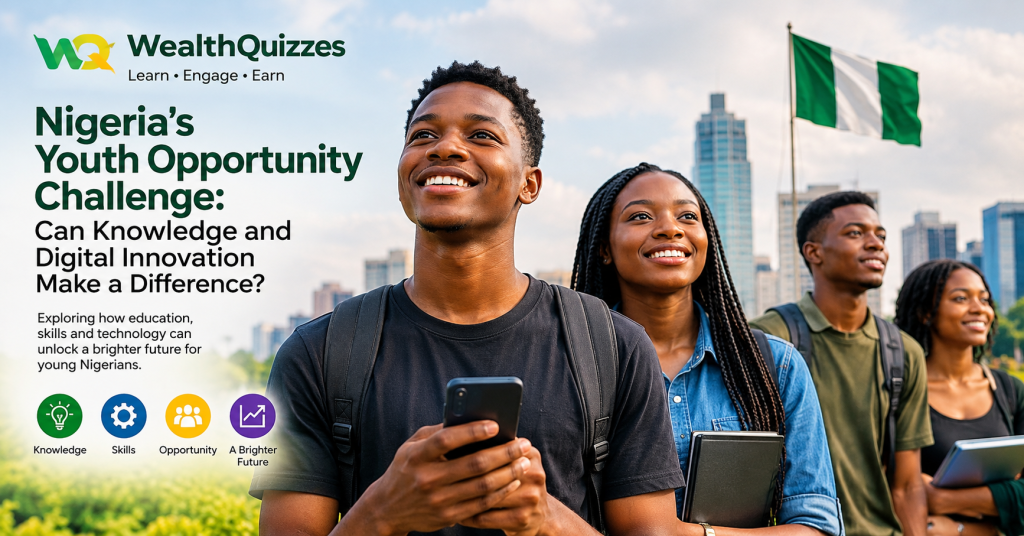
Nigeria’s Youth Opportunity Challenge: Can Knowledge and Digital Innovation Make a Difference?
Youth Empowerment and National Development
Introduction: Nigeria’s Greatest Resource Is Its People
Nigeria’s young population represents one of the country’s most significant assets. Across its cities, towns and rural communities are young people with ideas, ambitions, creativity and the desire to build better futures for themselves and their families. Yet the transition from potential to opportunity remains difficult for many.
Access to quality education, relevant skills, decent employment, affordable technology, business capital and professional networks is uneven. A young person may complete formal education and still struggle to find suitable employment. Another may possess entrepreneurial ability but lack the resources, digital skills or connections required to turn an idea into a sustainable business. Others may have access to a smartphone but limited opportunities to use digital technology for learning, professional development or economic participation.
These challenges raise an important question: Can knowledge, digital innovation and accessible learning platforms help young Nigerians prepare for opportunities and participate more effectively in national development?
The answer is that they can contribute, provided they are part of a broader response that includes quality education, relevant skills training, job creation, infrastructure, responsible business practices and effective public policy.
WealthQuizzes, a Nigerian knowledge-based quiz and digital engagement platform, approaches this opportunity from a specific direction: encouraging people to test their knowledge, participate in interactive quizzes and engage with different subjects through a structured digital experience. Its ambition is to make knowledge-based participation more engaging while offering conditional rewards in accordance with applicable platform rules.
The platform cannot independently resolve Nigeria’s youth opportunity challenge. However, it illustrates how locally developed digital services may contribute to a wider ecosystem of learning, engagement and innovation.
1. Understanding the Youth Opportunity Challenge
Youth development is about more than counting the number of people who attend school or possess academic qualifications. It also concerns whether young people can acquire useful capabilities, access economic opportunities, participate in society and build sustainable livelihoods.
The World Bank’s 2026 report, State of the Nigerian Youth, examines the circumstances of Nigerians aged 15–30 across education and skills, employment, health and well-being, financial and digital inclusion, and civic engagement. Its broad scope reflects the interconnected nature of youth development. Read the World Bank report.
Several barriers deserve particular attention.
Education does not always translate into employment
Formal education remains essential. Schools, colleges, universities and vocational institutions provide structured learning, recognised qualifications and opportunities to develop intellectual and technical abilities.
Nevertheless, educational attainment alone does not guarantee employment. Graduates may face limited vacancies, intense competition, insufficient work experience or a mismatch between their training and the requirements of available positions.
The World Bank’s research on skill demand in Nigerian online job vacancies provides a useful perspective on the relationship between employers’ requirements and the skills candidates need to demonstrate. Read Nigeria — Skill Demand Trends: Insights from Online Job Vacancy Data.
The policy implication is not that formal education has lost its value. Rather, education must be complemented by relevant practical skills, work experience, career guidance and stronger connections between learning institutions and employers.
Limited economic opportunities
Even capable and well-prepared young people require opportunities to apply their abilities. Where job creation is insufficient, business costs are high or access to productive resources is limited, the transition from education to economic independence can be prolonged.
Entrepreneurship offers one possible route, but it is not a universal substitute for employment. Young entrepreneurs may need financing, business knowledge, mentoring, reliable infrastructure, customers and access to markets.
Youth empowerment therefore requires both capability development and an economic environment in which those capabilities can be put to productive use.
Unequal access to digital opportunities
Digital technology can widen access to information and learning, but the benefits are not distributed equally.
The World Bank’s Nigeria Digital Economy Diagnostic identifies digital infrastructure, digital platforms, digital financial services, digital entrepreneurship and digital skills as important pillars of an inclusive digital economy. It also highlights barriers that can prevent poorer and less digitally equipped populations from benefiting fully. Explore the World Bank’s analysis.
The cost of devices and data, inconsistent connectivity, limited digital confidence and differences between urban and rural communities can all affect participation.
A digital platform cannot claim to empower everyone merely because it is available online. Genuine inclusion requires attention to affordability, usability, accessibility and the circumstances of people who remain underserved.
2. Knowledge as a Foundation for Opportunity
Knowledge is valuable because it enables people to understand information, evaluate choices and respond more intelligently to problems.
For young Nigerians, knowledge can support decisions about personal finance, entrepreneurship, digital safety, careers, education and civic participation. It can also help people identify areas in which they need additional training.
However, knowledge should not be confused with a complete professional skill set. Knowing the principles of business management, for example, is different from running a profitable enterprise. Understanding computer concepts is not the same as possessing the technical competence required for a software development role.
Knowledge is best understood as a foundation that must be combined with practical application, experience, judgement and access to opportunities.
Research in cognitive psychology provides further reasons to value active engagement with information. In their 2006 study, Test-Enhanced Learning: Taking Memory Tests Improves Long-Term Retention, Henry L. Roediger III and Jeffrey D. Karpicke found that retrieval practice—attempting to recall previously learned material—can improve longer-term retention under appropriate conditions. Read the study in Psychological Science.
This research offers a relevant principle for knowledge-based digital platforms. Asking questions can give users opportunities to retrieve information, assess what they know and recognise gaps in their understanding.
It does not mean that every quiz automatically produces lasting learning. Outcomes depend on factors including question quality, feedback, prior knowledge and opportunities to revisit material. Nevertheless, thoughtfully designed quizzes can complement other learning methods.
3. How Digital Knowledge Platforms Can Complement Formal Education
Formal education provides structured curricula, teachers, recognised qualifications and opportunities for deeper study. A knowledge-based digital platform serves a different purpose.
It can offer short, interactive activities through which users test themselves, encounter different subjects and engage with information outside a conventional classroom.
This complementary role has several potential benefits.
First, it can encourage active participation. Instead of only reading or watching content, users answer questions and receive an indication of their performance.
Second, it can stimulate curiosity. Questions across history, science, finance, sports, culture and general knowledge can encourage participants to explore subjects they might not otherwise investigate.
Third, it can support self-assessment. Incorrect answers may reveal areas where additional reading or practice would be useful, provided the platform offers appropriate explanations or users seek further learning resources.
Fourth, it can create opportunities for continued engagement. A structured digital experience may encourage users to revisit topics and challenge themselves over time.
These benefits should be presented realistically. A quiz platform is not a replacement for teachers, textbooks, accredited courses, practical training or recognised qualifications. Its value lies in complementing those resources by making certain forms of knowledge-based participation more interactive.
For WealthQuizzes, this is an important part of the opportunity: to provide an engaging digital environment in which users can test their knowledge across a variety of subjects and participate according to the platform’s rules.
4. Employability Requires More Than Knowledge Alone
Employability is a combination of capabilities that enables a person to seek, secure and perform work. Depending on the occupation, these may include technical expertise, communication, critical thinking, digital literacy, teamwork, reliability and problem-solving.
A quiz may test factual knowledge or reasoning, but it cannot independently establish whether someone is ready for a particular job. Employers may also require portfolios, certifications, practical demonstrations, professional references and relevant experience.
This distinction is important when considering the contribution of platforms such as WealthQuizzes.
Knowledge-based participation can form one part of a broader personal-development routine. A user might engage with general knowledge quizzes while also completing a digital-skills course, learning a trade, developing a portfolio or participating in an apprenticeship.
For example, a young person interested in digital marketing could combine general learning and knowledge challenges with practical training in content creation, analytics, campaign planning and customer research. Someone interested in entrepreneurship could combine knowledge-based activities with bookkeeping, market research, customer service and business planning.
The quiz platform would not replace these practical activities. It could provide an additional channel for engagement and self-testing alongside them.
The wider lesson is that empowerment programmes should connect learning to application. Knowledge becomes more economically useful when people have opportunities to demonstrate competence, gain experience and meet the needs of employers or customers.
5. WealthQuizzes: Making Knowledge-Based Participation Engaging
WealthQuizzes operates within this broader digital-learning and engagement landscape. Its model brings together interactive quizzes, multiple subject categories, timed responses, progressive stages and rewards linked to qualifying performance under the applicable rules.
Its brand philosophy, Learn • Engage • Earn, expresses three connected elements.
- Learn: Engage with questions and information across different subject areas, while recognising that deeper study may be necessary to develop lasting understanding.
- Engage: Participate actively in a structured digital experience rather than simply consuming information passively.
- Earn: Have the opportunity to qualify for applicable rewards by meeting the platform’s stated performance requirements.
The final element requires particular clarity. Rewards are conditional, not guaranteed income. Participation does not assure a financial return, employment or business success. Users should understand the applicable subscription charges, stage requirements, reward conditions and withdrawal rules before participating.
WealthQuizzes should be viewed as a knowledge-based engagement platform with potential to complement wider learning and development activities—not as a substitute for formal education, vocational training or employment programmes.
Its contribution to youth empowerment will ultimately depend on the quality of the experience it provides, the trust it earns, its accessibility and its ability to demonstrate meaningful outcomes.
Further information about the platform is available at www.wealthquizzes.com.
6. Digital Innovation Can Support Wider Youth-Development Initiatives
The greatest potential for knowledge platforms may emerge when they complement other institutions rather than operate in isolation.
Collaboration with educational institutions
Schools, universities, vocational centres and community learning organisations could explore whether quiz-based activities complement their educational objectives. Such collaborations would need accurate content, clear learning outcomes and appropriate assessment.
Collaboration with employers
Employers and professional organisations could explore knowledge challenges related to workplace awareness, industry terminology or introductory career information. Any initiative should distinguish general knowledge assessment from actual recruitment or professional qualification.
Collaboration with youth-development organisations
Development organisations may be interested in programmes that encourage participation in financial awareness, digital safety, entrepreneurship or civic education. A platform could provide one engagement channel within a broader programme that also includes instruction, mentoring and practical support.
Collaboration with responsible corporate partners
Businesses could support appropriately designed educational campaigns or digital-engagement activities where objectives align with their expertise and social-investment priorities.
These are potential avenues for collaboration, not claims that such partnerships have already been secured by WealthQuizzes.
Successful programmes would require clearly defined responsibilities, appropriate safeguards, agreed budgets and measurable outcomes. They should also be evaluated honestly to establish whether they deliver meaningful benefits.
7. Reaching More Young Nigerians Requires Inclusion and Trust
A digital initiative designed to support opportunity must account for the people who face the greatest barriers to participation.
This means considering data affordability, device compatibility, accessibility for people with disabilities, language, digital literacy and connectivity outside major cities. It also means designing clear instructions and providing effective customer support.
Gender and socioeconomic inequalities deserve attention as well. Research published by the World Bank in 2025 on digital skills among adolescent girls in Northern Nigeria illustrates how access to devices, internet connectivity and opportunities to develop digital capabilities can differ substantially among young people. Read the World Bank research brief.
Inclusion cannot be achieved through technology alone. It may require partnerships, community outreach, affordable access and programmes that respond to local circumstances.
Trust is equally important. Platforms must communicate their rules transparently, protect user information, respond appropriately to complaints and avoid exaggerated promises.
For a platform that offers conditional rewards, responsible communication is especially important. Young people should never be encouraged to treat uncertain rewards as a dependable source of income or to spend money they cannot afford to lose.
8. Measuring Impact: From Ambition to Evidence
A credible youth-empowerment strategy must distinguish between participation figures and demonstrated outcomes.
The number of registrations, downloads or completed quizzes may indicate reach and engagement. Those figures alone do not establish that users have acquired lasting knowledge, improved their employability or increased their income.
A stronger evaluation framework would examine several dimensions:
- Access: Who can use the platform, and which groups face barriers?
- Engagement: Do users participate meaningfully and return over time?
- Knowledge: Where appropriate, do assessments indicate improved understanding or retention?
- User experience: Are the rules clear, the technology reliable and complaints handled effectively?
- Partnership outcomes: Do collaborative programmes meet their agreed objectives?
- Longer-term value: Where feasible, is there evidence that participation complements further learning, training or other development activities?
These measures would help WealthQuizzes and potential partners understand what works, what requires improvement and where additional investment might be justified.
The goal should not be to claim national transformation before evidence exists. It should be to build a service that can demonstrate its value progressively and transparently.
Conclusion: Turning Youth Potential into Wider Opportunity
Nigeria’s youth opportunity challenge cannot be solved by one application, one training programme or one policy intervention. It requires coordinated action across education, employment, enterprise development, digital infrastructure, public policy and private-sector investment.
Knowledge and digital innovation nevertheless have an important role to play. Knowledge helps people understand their options; practical skills enable them to apply what they know; digital platforms can widen access to selected learning experiences; and effective institutions help connect capabilities with real opportunities.
WealthQuizzes is pursuing a focused role within this wider landscape by encouraging knowledge-based participation through interactive quizzes and a structured, performance-based reward model. Its potential contribution lies in complementing formal education and youth-development initiatives—not replacing them or promising outcomes it cannot guarantee.
The opportunity ahead is to improve accessibility, strengthen trust, explore responsible partnerships and measure results honestly.
Nigeria’s young people deserve more than messages about their potential. They deserve credible opportunities to develop their capabilities and apply them in the real world. Digital innovation can be part of that effort when it is designed around genuine needs, responsible practices and evidence of value.
WealthQuizzes — Learn • Engage • Earn.
Participation and rewards are subject to the platform’s applicable terms and conditions. Rewards are conditional on qualifying performance and are not guaranteed income.
Selected Authorities and Further Reading
- World Bank (2026). State of the Nigerian Youth. Read the report.
- World Bank. Nigeria Digital Economy Diagnostic: A Plan for Building Nigeria’s Inclusive Digital Future. Read the overview.
- World Bank / Mastercard Foundation (2025). Nigeria — Skill Demand Trends: Insights from Online Job Vacancy Data. Read the research.
- Roediger, H. L. III, & Karpicke, J. D. (2006). “Test-Enhanced Learning: Taking Memory Tests Improves Long-Term Retention.” Psychological Science, 17(3), 249–255. https://doi.org/10.1111/j.1467-9280.2006.01693.x.
- World Bank (2025). Digital Skills Profiles of Adolescent Girls in Northern Nigeria: Implications for School-based Digital Literacy Programs. Read the research brief.
- WealthQuizzes. Official website and platform information. Visit WealthQuizzes.


