

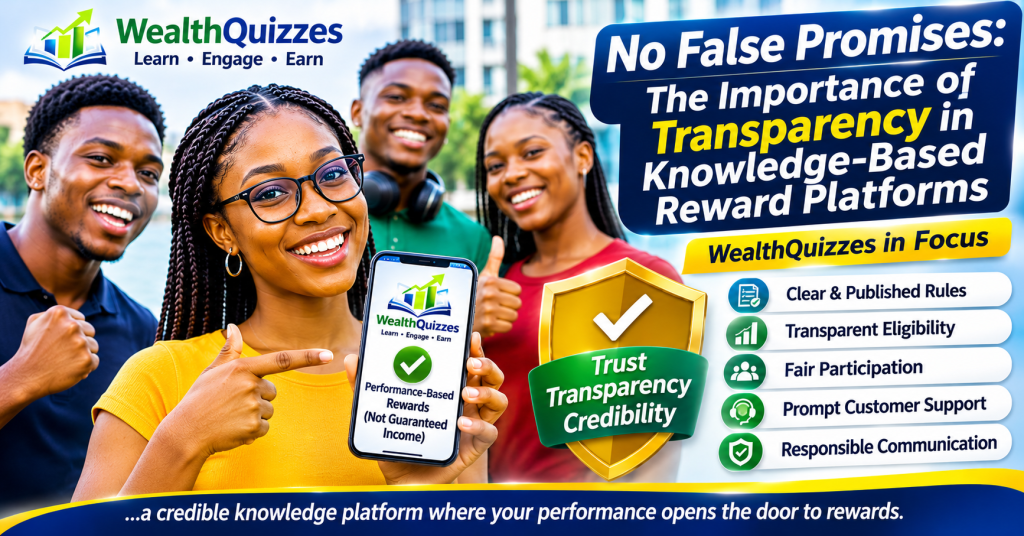
No False Promises: The Importance of Transparency in Knowledge-Based Reward Platforms — WealthQuizzes in Focus
Why performance-based rewards must never be confused with guaranteed income, and why clear rules, fair participation conditions and responsible marketing are essential to building a credible digital platform.
Introduction: Opportunity Must Never Be Confused with a Guarantee
The digital economy continues to create innovative ways for people to learn, interact, participate in online activities and access new forms of opportunity. One increasingly visible feature of this development is the emergence of digital platforms that combine user participation with incentives, benefits or performance-based rewards.
These platforms can offer engaging experiences and introduce new ways of recognising knowledge, skill, effort and participation. However, their long-term credibility depends on an important principle: users must understand exactly what is being offered and what they can reasonably expect to receive.
There is a fundamental difference between an opportunity to qualify for a reward and a guarantee that a person will earn money. A platform that fails to communicate this distinction may create unrealistic expectations, expose itself to consumer complaints and undermine the confidence it needs to grow.
For WealthQuizzes, a Nigerian knowledge-based digital engagement platform built around the philosophy of Learn • Engage • Earn, this distinction is particularly important.
WealthQuizzes seeks to make knowledge more engaging through interactive quizzes, progressive stages and performance-related rewards. Its proposition is that users can test their knowledge, participate in structured challenges and qualify for applicable rewards when they satisfy the relevant performance and eligibility conditions.
That proposition should be communicated confidently, but accurately.
WealthQuizzes is not offering guaranteed income merely because someone registers, subscribes or participates. Rather, its reward proposition is conditional upon the applicable rules and the user’s performance. Making this distinction clear is not a weakness in the business model. It is an essential part of responsible communication and sustainable digital business development.
1. Understanding the Difference Between Performance-Based Rewards and Guaranteed Income
One of the most important responsibilities of any platform offering incentives is to explain the nature of its reward system.
A guaranteed-income proposition suggests that a person can expect a predetermined financial return simply by meeting specified entry conditions or participating in an activity. A performance-based reward system operates differently: eligibility depends on satisfying defined criteria, which may include accuracy, successful completion, speed, achievement of specified stages or other measurable requirements.
This distinction matters because participation does not necessarily produce a reward.
Consider a knowledge-based quiz platform. A user may register, subscribe and begin answering questions. However, the user’s eventual eligibility for a reward may depend on answering questions correctly and satisfying the applicable stage requirements. Another participant may not qualify because the required performance standard was not achieved.
It would therefore be misleading to advertise the platform as though every participant is assured of making money.
For WealthQuizzes, the more accurate proposition is that users have an opportunity to participate in knowledge-based challenges and qualify for applicable performance-related rewards under the platform’s published conditions.
This also means that marketing should not describe rewards as salaries, guaranteed earnings, investment returns or assured financial benefits. The platform should not suggest that users can depend on participation to meet their financial obligations.
The distinction is particularly important when marketing to young people and other individuals who may interpret promotional claims as promises of financial security.
The Federal Trade Commission (FTC) in the United States, although not a Nigerian regulator and not directly governing WealthQuizzes, offers a useful comparative lesson in its guidance on deceptive earnings claims. It explains that claims about earnings must be truthful, substantiated and presented in a manner that does not create misleading expectations about what participants are likely to achieve. It also warns that a general disclaimer that results are not guaranteed may be insufficient where the overall advertisement creates a contrary impression.
The broader lesson applies to responsible digital marketing everywhere: a disclaimer cannot reliably correct a misleading headline or an exaggerated promotional message.
2. Transparency Is a Consumer Right, Not a Marketing Option
Transparency is not simply a business preference. It is an important consumer protection principle.
In Nigeria, the Federal Competition and Consumer Protection Act 2018 (FCCPA) establishes standards governing the relationship between businesses and consumers. Part XV of the Act provides for consumer rights, including the right to information in plain and understandable language and the right to full disclosure of material information.
Section 114 addresses the provision of information in language that consumers can understand. Section 115 concerns disclosure of material facts, including prices. Section 123 requires factually accurate information about goods and services and prohibits misleading or deceptive representations. Section 124 addresses coercive, undue-influence and unfair marketing practices.
These provisions have direct relevance to digital platforms that charge subscription fees or offer conditional rewards.
For WealthQuizzes, transparency should begin before a user commits money or begins a paid participation session. The user should be able to understand the nature of the service, the applicable subscription charge, the participation process and the conditions governing rewards.
A platform should not expect users to discover important restrictions only after they have paid or encountered a problem.
The OECD’s Recommendation on Consumer Protection in E-commerce similarly emphasises that online disclosures should be clear, accurate, easily accessible and conspicuous. It recommends that information be presented in plain language, at the relevant time, and in a manner that enables consumers to retain an accurate record of the transaction.
Its 2022 report, Enhancing Online Disclosure Effectiveness, further explains that disclosures may fail if businesses merely satisfy technical requirements without considering whether users can actually understand the information.
For WealthQuizzes, this means that important conditions should not be hidden in lengthy terms and conditions or presented in language that ordinary users struggle to understand. The information must be accessible, visible and sufficiently clear to support informed participation.
3. Published Rules: Every Participant Should Know the Conditions
A credible knowledge-based reward platform must have clear and consistently applied participation rules.
Rules provide the framework within which users participate and the business administers its services. They establish expectations, reduce uncertainty and provide a basis for resolving disagreements.
For WealthQuizzes, the published rules should explain, as applicable:
- The registration and participation requirements.
- The subscription charges and what those charges cover.
- The structure of the quiz stages.
- The consequences of incorrect or unanswered questions.
- The performance criteria for qualifying for rewards.
- The applicable reward calculation or allocation method.
- The conditions governing referral-related benefits, where offered.
- The minimum withdrawal threshold and verification requirements.
- The procedure for handling disputed transactions and reward enquiries.
- Any restrictions, limitations or circumstances that may affect participation.
The purpose of these disclosures is not to overwhelm users with technical information. It is to ensure that they understand the material conditions before making decisions.
For instance, if an incorrect answer or a missed question terminates a session, that consequence should be explained before participation. If a user must satisfy a minimum balance and complete identity verification before requesting a withdrawal, those requirements should be clearly disclosed.
Equally, where a particular reward is conditional upon successful completion of a stage, the user should know the relevant condition before beginning that stage.
The FCCPA also addresses contractual terms and notices that seek to limit or exclude a business’s liability. Under section 128, certain notices or agreements must be brought to the consumer’s attention before the transaction is concluded. Section 129 identifies prohibited contractual terms, including certain unfair exclusions of liability.
Consequently, publishing terms and conditions should not become an excuse for burying important information or attempting to avoid legitimate responsibility. The objective should be genuine disclosure and fair dealing.
4. Fair Participation Requirements: Consistency Builds Confidence
Transparency must be accompanied by fairness.
A platform may publish extensive rules, but those rules will mean little if they are applied inconsistently or changed arbitrarily.
Fair participation requires that users be assessed according to disclosed and objectively applicable criteria. Where performance determines reward eligibility, the method of assessing that performance should be sufficiently reliable to support consistent outcomes.
For WealthQuizzes, this involves ensuring that quiz questions are properly structured, answer options are clear, correct answers are verifiable and the applicable performance requirements are consistently implemented.
Question quality is particularly important. A user should not lose an opportunity because of an ambiguous question, an incorrect answer key or an avoidable technical error.
Similarly, where a technical interruption affects a user’s participation, the platform should have a defined process for investigating the circumstances and determining the appropriate response under its rules.
Fairness also requires that users receive consistent treatment irrespective of their popularity, social status, referral network or personal relationship with the platform’s operators.
The OECD Guidelines for Multinational Enterprises on Responsible Business Conduct emphasise the importance of fair marketing practices and accurate, verifiable information that enables consumers to make informed decisions. Although these Guidelines are not a substitute for Nigerian legislation, they provide a useful international benchmark for responsible commercial conduct.
For WealthQuizzes, fairness should be reflected in the design of its quizzes, the administration of its rewards and the handling of complaints.
5. Responsible Marketing: Promote the Opportunity, Not an Illusion
Marketing is essential to the growth of any digital business. A platform must communicate its value, attract users and distinguish itself from competing services.
However, there is a difference between promoting an opportunity and creating an illusion.
A responsible advertisement should accurately describe the product or service, explain the material conditions and avoid suggesting that a result is certain where it is not.
For WealthQuizzes, promotional communication should focus on its genuine proposition:
Learn. Engage. Demonstrate your knowledge. Qualify for applicable rewards based on performance and the platform’s rules.
This is a meaningful proposition in its own right. It does not require exaggerated claims.
The platform should avoid statements such as:
- “Everyone who joins WealthQuizzes makes money.”
- “Guaranteed daily income from answering questions.”
- “Subscribe today and secure a guaranteed reward.”
- “Earn a fixed amount without any risk or effort.”
Such statements may create expectations that the underlying reward structure cannot support.
Similarly, promotional images and testimonials should not imply that exceptional outcomes are typical. Where user experiences or reward examples are published, they should be genuine, properly authorised and presented with enough context to avoid misleading other users.
The Advertising Regulatory Council of Nigeria (ARCON) identifies misleading statements, spurious testimonials, exaggerations and misleading offers as abuses that responsible advertising regulation seeks to prevent. ARCON’s statutory framework is provided by the Advertising Regulatory Council of Nigeria Act 2022.
The FCCPA’s section 123 also establishes an important statutory standard: commercial representations should be factually accurate and must not be misleading or deceptive.
These standards should guide WealthQuizzes’ website content, social media campaigns, influencer communications, referral promotions, WhatsApp messages and other marketing channels.
A strong brand does not need to promise what it cannot guarantee. It needs to explain what it genuinely offers and demonstrate that its operations support its claims.
6. Reward Administration: Transparency Must Continue After Participation
A platform’s responsibility does not end when a user has completed a quiz.
Where the rules establish that a participant has qualified for a reward, the administration of that reward becomes an important test of the platform’s credibility.
Users should be able to understand how their performance is assessed, how qualifying rewards are calculated or credited and what additional conditions must be satisfied before withdrawal.
For WealthQuizzes, this calls for reliable transaction records, accurate reward calculations, proper account verification and a clear process for resolving discrepancies.
Where a withdrawal request requires identity verification or satisfaction of a minimum threshold, the user should be informed of those requirements in advance.
Where a transaction is delayed, the platform should provide a reasonable explanation and keep the affected user informed.
Section 130 of the FCCPA addresses timely service delivery and requires businesses to notify and update consumers where unavoidable delays occur.
This is particularly relevant to digital services where users may be unable to distinguish between a processing delay, a technical problem and an actual failure to administer a transaction.
A reliable system should therefore make it possible to trace relevant transactions, investigate complaints and communicate outcomes.
For WealthQuizzes, consistency in reward administration will be more persuasive than repeated assurances that the platform is trustworthy. Users will develop confidence when their actual experiences correspond with the published rules.
7. Customer Support and Complaints: Accountability Is Part of Transparency
No digital platform can reasonably promise that technical or operational problems will never occur. What distinguishes a responsible business is how it responds when they do.
A user may experience a failed payment, an account-access problem, a disputed quiz result or a delay in processing an eligible withdrawal. In each situation, the platform should provide an accessible channel for assistance.
WealthQuizzes should maintain a structured customer-support process through which enquiries and complaints can be acknowledged, recorded, investigated and resolved.
A good complaint-handling system should provide:
- A clear channel through which users can submit complaints.
- Acknowledgement within a reasonable and communicated timeframe.
- A reference or record that allows the complaint to be tracked.
- Objective investigation based on relevant transaction and participation records.
- A clear explanation of the outcome.
- Escalation where the issue cannot be resolved at the first level.
The FCCPC also advises consumers to approach the service provider first and, where dissatisfied with the response, seek assistance through the Commission’s complaint channels.
For WealthQuizzes, effective customer support is not merely a way of managing dissatisfaction. It is an opportunity to demonstrate accountability and reinforce the confidence of users.
8. Transparency as a Foundation for Corporate Partnerships
The importance of transparency extends beyond individual users.
Banks, telecommunications companies, insurers, technology firms, educational institutions and development organisations considering partnerships with digital platforms must assess the credibility of the businesses they engage.
A partnership proposal may be attractive, but institutional decision-makers will reasonably want to understand the platform’s operating model, management capacity, consumer protection arrangements, data governance, financial sustainability and ability to deliver agreed commitments.
For WealthQuizzes, this creates a strong reason to institutionalise transparency.
Potential partners should be able to examine clearly documented programme objectives, participation rules, reward arrangements, delivery responsibilities, performance indicators and reporting procedures.
Where a partnership involves a sponsored knowledge competition or financial literacy campaign, for example, the parties should agree in advance on the target audience, programme design, eligibility conditions, reward budget, communication standards and method of evaluating results.
This approach protects the interests of users and partners alike.
It also makes it easier to distinguish genuine programme performance from promotional claims. A partner should be able to assess the results of a campaign using reliable information rather than unsupported assertions.
The OECD’s work on consumer protection and online disclosure reinforces the importance of clear information and informed decision-making in digital transactions. Those principles are equally valuable when digital businesses seek to establish institutional relationships.
A transparent platform is better positioned to demonstrate that it understands its responsibilities and can be trusted with a structured programme.
9. The WealthQuizzes Commitment: Making Transparency an Operating Standard
For WealthQuizzes, the next stage of development should involve turning transparency from a communication principle into a measurable operational standard.
This requires deliberate attention to several areas.
First, accessible participation rules. The terms governing subscriptions, quiz stages, performance requirements and rewards should be easy to locate and understand.
Second, responsible promotional language. All marketing materials should distinguish performance-based rewards from guaranteed income and avoid unsupported earnings claims.
Third, accurate content and assessment. Questions, answer keys, scoring processes and performance records should be subject to appropriate quality-control procedures.
Fourth, reliable reward administration. Qualifying rewards should be calculated and administered according to published rules, with appropriate records and procedures for investigating discrepancies.
Fifth, effective customer support. Users should have accessible channels for raising complaints and receiving meaningful responses.
Sixth, responsible data handling. Personal information should be processed and protected in accordance with applicable data protection requirements, including the Nigeria Data Protection Act 2023.
Seventh, evidence-based reporting. Claims about user participation, rewards, learning outcomes and social impact should be supported by verifiable records.
These commitments are not merely about avoiding complaints or regulatory difficulties. They are about developing a business that users can understand, evaluate and confidently recommend.
Conclusion: Real Opportunity Does Not Require False Promises
The future of digital rewards platforms should not be built on exaggerated claims, unrealistic expectations or promotional messages that confuse participation with guaranteed financial returns.
It should be built on clear rules, fair opportunities, accurate information, consistent administration and respect for users.
For WealthQuizzes, the opportunity is to demonstrate that knowledge-based digital engagement can be presented in a responsible and commercially sustainable manner. Its Learn • Engage • Earn philosophy provides a framework for connecting knowledge, participation and conditional performance-based rewards.
The platform does not need to promise that everyone will earn money. It needs to explain how participation works, what users must do, what conditions govern rewards and what responsibilities the platform undertakes.
That is a stronger and more defensible proposition.
For users, transparency supports informed participation. For corporate partners, it strengthens confidence in the platform’s governance and operating standards. For WealthQuizzes, it provides a foundation for reputation, customer loyalty and sustainable growth.
As the platform develops, its success should not be measured only by the number of people it attracts, but also by the quality of the experience it delivers and the confidence it earns.
At WealthQuizzes, the objective is not to sell promises. It is to create a credible knowledge-based opportunity where participation, performance and applicable rewards are governed by clear and fair rules.
WealthQuizzes — Learn • Engage • Earn. Where Knowledge Becomes Wealth.
Selected Authorities and Further Reading
- Federal Competition and Consumer Protection Act 2018 (Nigeria) — particularly sections 114, 115, 123, 124, 128, 129 and 130. Federal Competition and Consumer Protection Commission, Rights and Responsibilities. https://fccpc.gov.ng/consumers/consumer-rights-responsibilities/rights-responsibilities/
- Federal Competition and Consumer Protection Commission, Federal Competition and Consumer Protection Act 2018. Official statutory text. https://fccpc.gov.ng/wp-content/uploads/2022/07/FCCPA-2018.pdf
- Organisation for Economic Co-operation and Development (OECD), Recommendation of the Council on Consumer Protection in E-commerce (2016), particularly the provisions on online disclosures. https://legalinstruments.oecd.org/public/doc/336/336.en.pdf
- OECD, Enhancing Online Disclosure Effectiveness, OECD Digital Economy Papers No. 335 (25 October 2022). https://doi.org/10.1787/6d7ea79c-en
- Advertising Regulatory Council of Nigeria Act 2022. Advertising Regulatory Council of Nigeria. https://advertcouncil.gov.ng/documents/ARCON%20Act%202022.pdf
- Advertising Regulatory Council of Nigeria, Advertisements Vetting and Responsible Advertising Practice. https://advertcouncil.gov.ng/_adverts_vetting.php
- Nigeria Data Protection Act 2023, establishing the statutory framework for lawful and accountable processing of personal data in Nigeria. Nigeria Data Protection Commission. https://ndpc.gov.ng/
- Federal Trade Commission (United States), Business Guidance Concerning Multi-Level Marketing: Deceptive Earnings and Product Claims. This is comparative guidance, not Nigerian law, but provides useful illustrations of the risks associated with misleading or unsubstantiated earnings representations. https://www.ftc.gov/business-guidance/resources/business-guidance-concerning-multi-level-marketing


