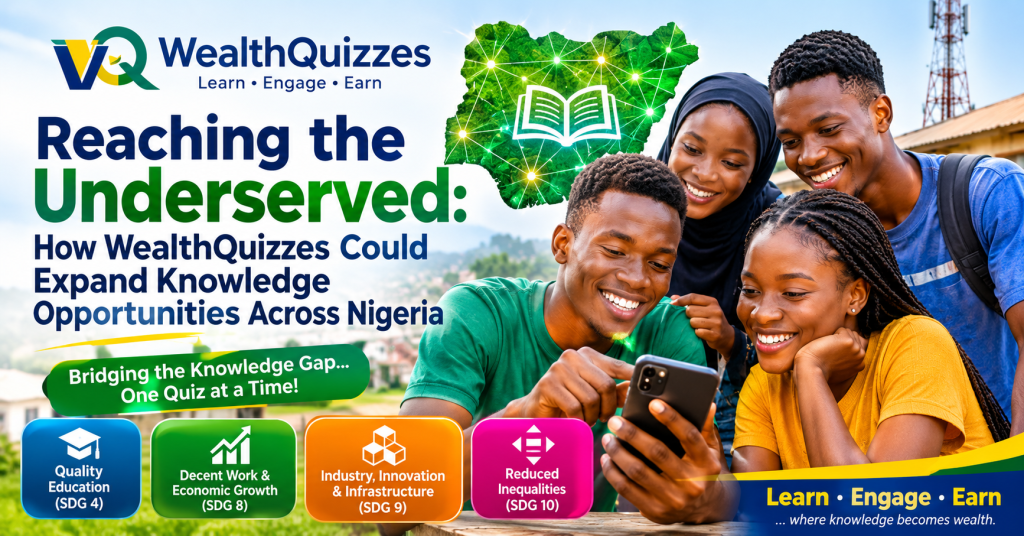
Reaching the Underserved: How WealthQuizzes Could Expand Knowledge Opportunities Across Nigeria
Impact, Innovation and Organisational Opportunities
Introduction: Making Knowledge Opportunities Accessible Beyond Major Cities
Nigeria’s digital transformation presents enormous opportunities for education, entrepreneurship, innovation and economic participation. Yet, the benefits of this transformation are not equally distributed. While residents of major commercial centres increasingly access digital services, educational resources and online opportunities, many people in rural communities, smaller towns and economically disadvantaged areas continue to encounter significant barriers.
These barriers include the cost of internet access, unreliable electricity, limited network coverage, unsuitable devices, inadequate digital skills, language differences and limited awareness of available opportunities.
Consequently, the challenge is no longer simply about developing digital platforms. It is also about ensuring that people who are traditionally underserved can access, understand and benefit from them.
For WealthQuizzes, a Nigerian knowledge-based digital engagement platform operated by TOPBRAINS Knowledge Teasers Company Limited, this presents both a social opportunity and a strategic growth objective.
Built around the principle “Learn • Engage • Earn,” WealthQuizzes seeks to make knowledge-based participation more engaging through interactive quizzes and conditional rewards. Its potential contribution to national development will, however, depend partly on whether the platform can reach audiences beyond the more connected and commercially active urban population.
This article examines how affordability, mobile accessibility, low-bandwidth design, inclusive content and carefully selected outreach partnerships could help WealthQuizzes broaden participation across Nigeria.
1. Understanding the Digital Inclusion Challenge in Nigeria
The digital divide is not simply the difference between people who own smartphones and those who do not. It also concerns the differences in people’s ability to access, afford, understand and use digital technology effectively.
The International Telecommunication Union (ITU), in its 2025 report on digital development in Africa, identifies substantial disparities in connectivity between urban and rural populations, as well as between higher-income and lower-income groups.
According to the ITU, approximately 38% of Africa’s population used the internet in 2024, compared with a global average of 68%. Internet use was estimated at 57% among urban populations but only 23% among rural populations. The report also identified affordability, digital literacy and inadequate connectivity as continuing barriers to adoption.
Although these figures are continental rather than Nigeria-specific, they demonstrate the wider structural challenges that affect digital participation across the region. ITU, State of Digital Development and Trends in the Africa Region.
Nigeria’s own experience reflects similar concerns.
The Federal Ministry of Communications, Innovation and Digital Economy’s January 2024 white paper, Broadband Access for All: Deepening Nigeria’s National Backbone and Middle Mile Infrastructure, identified gaps in broadband infrastructure, particularly in rural areas. It also highlighted the consequences of limited connectivity for access to information, economic opportunities and participation in the digital economy. Federal Ministry of Communications, Innovation and Digital Economy, Broadband Access for All.
The World Bank has also drawn attention to Nigeria’s digital infrastructure challenges. Its Nigeria Digital Economy Diagnostic identifies limited rural connectivity, inadequate fixed broadband infrastructure and the concentration of parts of the digital entrepreneurship ecosystem in cities such as Lagos and Abuja as important development concerns. World Bank, Nigeria Digital Economy Diagnostic.
These findings point to an important consideration for WealthQuizzes: a platform’s national relevance should be measured not only by the number of people it can potentially reach, but also by its ability to accommodate the circumstances of people who face barriers to digital participation.
2. Affordability: Making Participation Economically Realistic
One of the most significant barriers to digital inclusion is affordability.
For individuals with limited disposable income, the cost of purchasing mobile data, maintaining a smartphone and keeping devices charged can influence whether they participate in online activities.
A platform may offer valuable educational content, but if accessing it consumes excessive data or requires repeated paid subscriptions that are beyond the user’s means, its potential reach will remain restricted.
WealthQuizzes can address this challenge through a combination of product design and carefully structured partnership initiatives.
Low-cost participation models
An affordable entry point can reduce the financial barrier to trying a digital service. WealthQuizzes’ existing low-entry subscription model provides a possible foundation for encouraging participation among users with different income levels.
However, affordability must be considered holistically. A low subscription price does not automatically make a platform affordable if users must also spend substantial amounts on data or encounter other hidden costs.
The platform should therefore examine the total cost of participation, including subscription charges, data consumption and the frequency of repeat engagement.
Sponsored participation
Corporate partners could support selected educational campaigns by sponsoring access for defined groups.
For example, a bank, telecommunications company, educational institution or development organisation might fund a limited number of participation credits for students, young entrepreneurs or participants in an identified underserved community.
Such an arrangement could reduce the direct financial barrier without requiring WealthQuizzes to abandon its commercial model.
Community-based incentives
Partners could also sponsor educational challenges through which participants receive clearly defined recognition, learning resources or conditional rewards.
Any such programme must communicate its rules transparently. Rewards should never be presented as guaranteed income, and participants should understand the conditions attached to them.
The objective is to make participation more accessible while maintaining financial sustainability and user confidence.
3. Mobile Accessibility: Designing for the Devices People Actually Use
In many parts of Nigeria, smartphones are the principal means of accessing the internet.
For this reason, mobile accessibility should be central to any strategy aimed at reaching underserved populations.
A platform designed primarily around high-performance devices, large screens or demanding technical requirements may unintentionally exclude users with entry-level smartphones.
WealthQuizzes should therefore prioritise a mobile experience that performs reliably across a broad range of Android devices and operating conditions.
Important considerations include:
- Compatibility with commonly used Android operating-system versions.
- Efficient memory and processing requirements.
- Readable text and clear navigation on smaller screens.
- Simple registration and account-recovery processes.
- Minimal unnecessary background activity.
- Reliable handling of interruptions caused by unstable connectivity.
- Clear error messages and accessible customer support.
The user experience should not assume that every participant owns the latest smartphone or has access to uninterrupted electricity and high-speed internet.
The Nigerian Communications Commission (NCC) has increasingly emphasised the importance of examining actual network experience rather than relying exclusively on general coverage information. Its network-performance reporting identifies differences in network quality, congestion and urban-rural performance.
This reinforces the need for digital platforms to consider real operating conditions when designing services for a national audience. NCC, Network Performance Reports.
4. Low-Bandwidth Design: Making Every Megabyte Count
A digital service intended to reach people in underserved communities must be conscious of data consumption.
Where connectivity is unreliable or expensive, unnecessary images, animations, video content and repeated downloads can discourage participation.
Low-bandwidth design is therefore not merely a technical preference. It is an inclusion strategy.
WealthQuizzes could explore several improvements, subject to its technical architecture and development capacity.
Optimised images and graphics: Images should be compressed and delivered in appropriate formats. Large visual assets should not be loaded unnecessarily.
Lightweight interfaces: Pages should prioritise essential information, clear navigation and efficient loading rather than excessive animations and decorative elements.
Efficient question delivery: Quiz questions and answer options should be transmitted using lightweight data structures, reducing unnecessary network requests.
Resilient session handling: Where technically feasible, the platform could preserve relevant session information during temporary network interruptions and provide clear recovery procedures.
Reduced background data consumption: Unnecessary background synchronisation and automatic media downloads should be minimised.
Progressive enhancement: Essential functions should remain usable on supported lower-performance devices and slower connections, while additional features can be made available where devices and networks permit.
These measures could improve the experience for users in rural communities, smaller towns and locations with inconsistent network quality.
It is important, however, not to confuse low-bandwidth optimisation with offline functionality. An online quiz platform still requires connectivity for the functions that depend on its servers. Any offline capability would need to be deliberately developed, tested and secured.
5. Inclusive Content: Making Knowledge Relevant to Different Communities
Digital inclusion involves more than providing access to technology. The content available through that technology must also be relevant, understandable and accessible.
Nigeria is a country of considerable linguistic, cultural and educational diversity. A digital knowledge platform seeking national participation must recognise these differences.
For WealthQuizzes, inclusive content development could involve several approaches.
Local and national knowledge
Quiz categories could incorporate Nigerian history, geography, culture, public institutions, entrepreneurship, civic awareness and other subjects relevant to everyday life.
Questions could explore the histories and contributions of different regions, notable Nigerian personalities, cultural heritage and national development.
This would help make the platform more relevant to users who may not identify with content focused predominantly on international entertainment or urban lifestyles.
Practical knowledge
Educational content should also address subjects with direct relevance to people’s lives.
Examples include:
- Basic financial literacy and personal budgeting.
- Agricultural innovation and modern farming practices.
- Entrepreneurship and small-business management.
- Digital safety and online fraud awareness.
- Health awareness and preventive practices.
- Environmental responsibility.
- Vocational and technical knowledge.
For rural communities, for example, a knowledge challenge addressing agricultural productivity, financial management or climate awareness may be more immediately relevant than a campaign focused exclusively on corporate careers.
Language accessibility
English remains an important language of formal education and national communication, but language differences can affect participation.
WealthQuizzes could explore carefully reviewed translations or explanatory materials in major Nigerian languages, including Hausa, Yoruba and Igbo, where there is a clear audience and operational case.
Local-language adaptation should not be treated as a mechanical translation exercise. Questions must retain their intended meaning, avoid cultural ambiguity and be reviewed by competent speakers.
Different educational backgrounds
Questions should also be structured with appropriate difficulty levels.
A platform that assumes every participant has the same educational background risks discouraging people whose formal schooling has been limited.
A balanced content strategy could combine introductory, intermediate and advanced knowledge, with clear explanations where appropriate.
Inclusivity does not mean eliminating intellectual challenge. It means creating fair opportunities for people with different backgrounds to participate and improve.
6. Strategic Outreach Partnerships: Reaching Communities Through Trusted Networks
Technology alone cannot guarantee access to underserved communities.
People are more likely to discover and trust new digital services when they are introduced through credible organisations and familiar institutions.
For WealthQuizzes, partnerships could provide an important route to audiences that conventional online advertising may not reach effectively.
Potential outreach partners include:
Schools and tertiary institutions: Educational institutions could support knowledge competitions, campus engagement programmes and extracurricular learning initiatives.
Community-based organisations: Local organisations with established relationships in underserved communities could help identify relevant audiences and communicate campaign information.
Youth organisations: Youth associations, professional development groups and entrepreneurship networks could support the distribution of educational challenges.
Telecommunications companies: Mobile network operators could explore sponsored-data arrangements, digital-literacy campaigns and community outreach initiatives, subject to technical feasibility and regulatory requirements.
Financial institutions: Banks and financial-technology companies could support financial-literacy campaigns, responsible digital-payment education and sponsored participation initiatives.
Development organisations and NGOs: Organisations working in education, youth empowerment, digital inclusion and community development could explore targeted pilot programmes.
Public institutions: Relevant government agencies and local authorities could be approached where a proposed programme aligns with their statutory responsibilities and development priorities.
The selection of partners should be deliberate. WealthQuizzes should prioritise organisations with credible community relationships, relevant expertise, measurable objectives and the capacity to support implementation.
A partnership should not be pursued merely because an organisation has a recognisable name.
7. Learning from Established Digital Inclusion Initiatives
There are useful examples of how technology and institutional partnerships can expand access to learning in Nigeria.
UNICEF’s Nigeria Learning Passport initiative demonstrates the potential of digital learning platforms to reach large numbers of learners through structured educational content.
In a report published on 7 February 2025, UNICEF stated that Nigeria’s Learning Passport recorded a sixfold increase in registrations during 2023, reaching more than 750,000 children. The organisation also identified infrastructure limitations, affordability and digital-literacy gaps as continuing challenges to digital learning in the country. UNICEF, Connecting Every Child to Digital Learning.
The Learning Passport is an educational initiative, not a direct equivalent of WealthQuizzes. Nevertheless, it illustrates an important lesson: digital platforms can support wider participation when they are combined with relevant content, institutional support and deliberate attention to access barriers.
Similarly, the World Bank’s Building Resilient Digital Infrastructure for Growth (BRIDGE) Project, approved in October 2025, is designed to expand affordable broadband access in underserved areas of Nigeria. The project is intended to support connections to households, public schools, health facilities and local government offices. World Bank, Nigeria: World Bank Approves New Financing to Enhance Digital Infrastructure and Health Security.
These initiatives reinforce the importance of collaboration between public institutions, development partners and private-sector organisations.
WealthQuizzes could explore a complementary role by focusing on interactive knowledge engagement rather than attempting to replicate formal learning platforms or broadband infrastructure projects.
8. A Practical National Outreach Model for WealthQuizzes
A realistic national inclusion strategy should begin with manageable pilots and expand based on evidence.
Rather than immediately pursuing nationwide coverage, WealthQuizzes could adopt a phased approach.
Phase One: Identify underserved audiences
The platform should identify communities and demographic groups that are underrepresented in its existing user base.
Relevant considerations could include location, network access, device capability, affordability, educational background and digital literacy.
This exercise should use proportionate, lawful data collection and avoid unnecessary personal information.
Phase Two: Select pilot communities
A small number of communities across different geopolitical zones could be selected for pilot campaigns.
Selection should be based on clear criteria, including the presence of credible outreach partners, connectivity conditions, target audience needs and the feasibility of implementation.
Phase Three: Develop relevant content
Campaign themes should reflect the needs of the selected communities.
For example:
- Agricultural knowledge and entrepreneurship in selected farming communities.
- Digital literacy and online safety for young people.
- Financial literacy for students and small-business operators.
- General knowledge and educational engagement for youth groups.
- Career awareness and technology challenges for tertiary institutions.
Phase Four: Secure institutional support
WealthQuizzes could approach selected organisations for sponsorship, technical support, educational expertise, promotional assistance or access to community networks.
Each partner should have a clearly defined role and measurable contribution.
Phase Five: Implement and evaluate
The pilot should track participation, completion, technical performance, user feedback and relevant learning outcomes.
The results would help determine whether the approach is suitable for expansion.
9. Measuring Inclusion: How Will We Know Whether the Strategy Works?
A national inclusion strategy must be supported by measurable evidence.
It is not enough to report that a campaign was launched in a rural community or that a certain number of people received promotional messages.
WealthQuizzes could develop an inclusion-focused performance framework incorporating the following indicators:
| Area | Suggested performance indicator |
|---|---|
| Geographic reach | Number of participating communities and locations outside major cities |
| Accessibility | Successful participation across supported device categories |
| Affordability | Average participation cost and sponsored-access beneficiaries |
| Engagement | Unique participants, completion rates and repeat participation |
| Learning | Pre- and post-campaign knowledge assessment |
| Inclusion | Participation across selected demographic groups, where lawfully measured |
| Technical performance | Loading time, failed sessions and interruption rates |
| Sustainability | Repeat engagement and continuation of partner-supported programmes |
The distinction between reach and meaningful participation is particularly important.
A person who receives a promotional message has been reached. A person who successfully accesses the platform, completes a knowledge challenge and receives the intended educational content has participated.
Likewise, participation alone does not prove learning. Where educational improvement is an objective, the programme should include suitable assessment methods.
The OECD’s evaluation guidance provides a useful framework through its criteria of relevance, coherence, effectiveness, efficiency, impact and sustainability. These principles can help ensure that inclusion programmes are evaluated according to their actual objectives rather than publicity figures alone.
10. The Challenges WealthQuizzes Must Address
A credible inclusion strategy must also acknowledge its limitations.
Infrastructure limitations: WealthQuizzes cannot independently resolve weak network coverage, inadequate electricity supply or the absence of affordable broadband infrastructure.
Affordability: Low subscription charges will not eliminate the financial burden of data costs and device ownership.
Digital literacy: Some intended beneficiaries may require basic guidance before they can use the platform effectively.
Language and cultural relevance: Poorly adapted translations or culturally insensitive questions could discourage participation.
Trust and security: Users must be confident that the platform is genuine, that participation rules are transparent and that personal information is appropriately protected.
Operational capacity: Expansion into additional communities requires customer support, reliable technology, partner coordination and sufficient financial resources.
Commercial sustainability: Sponsored access and free participation campaigns require funding. These arrangements must be structured so that social objectives do not undermine the platform’s long-term viability.
Recognising these challenges does not weaken the case for inclusion. It makes the proposed strategy more realistic and defensible.
Conclusion: A More Inclusive Future for Knowledge Participation
Nigeria’s digital future should not be defined exclusively by the growth of technology in major commercial centres. It should also be measured by the extent to which people in smaller towns, rural communities and economically disadvantaged areas can access and benefit from digital opportunities.
For WealthQuizzes, reaching underserved populations represents both an opportunity for national expansion and an opportunity to contribute to broader educational and digital-inclusion objectives.
Through affordable participation models, mobile-friendly technology, low-bandwidth optimisation, inclusive content and carefully selected outreach partnerships, the platform could explore ways of making knowledge-based engagement more accessible across different communities.
The most effective strategy would not rely on advertising alone. It would combine product improvements with community relationships, corporate sponsorship, educational expertise and measurable implementation.
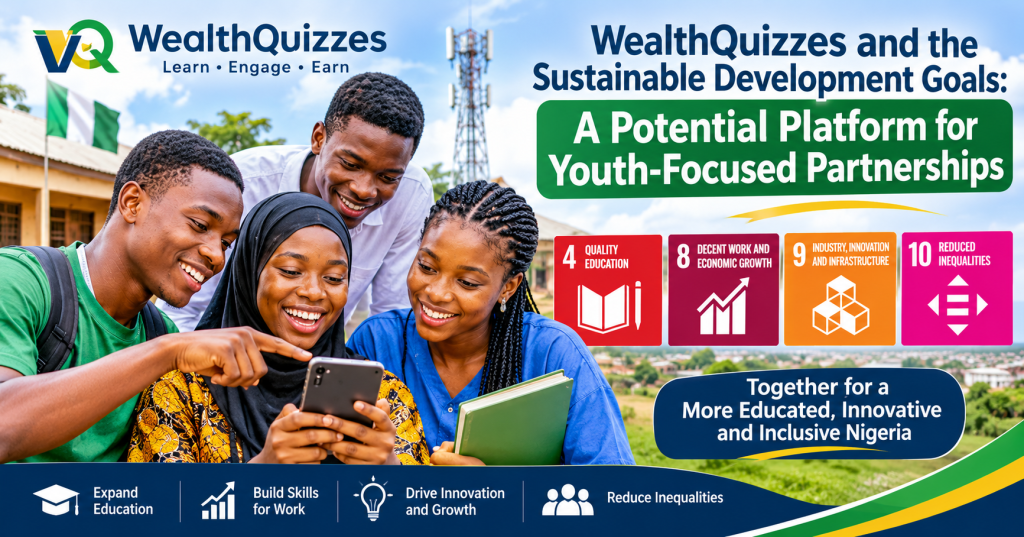
This approach also aligns with important national and international development priorities, particularly Sustainable Development Goal 4 (Quality Education), SDG 9 (Industry, Innovation and Infrastructure) and SDG 10 (Reduced Inequalities).
However, the real test will be evidence: whether people who were previously excluded can participate, whether the experience is affordable and accessible, and whether the programmes deliver meaningful educational value.
Knowledge should not be an opportunity reserved for those who live in major cities, own expensive devices or enjoy uninterrupted internet access.
With the right partnerships, technology and commitment to inclusion, WealthQuizzes could help create more opportunities for Nigerians to learn, participate and benefit from the growing digital economy.
The ambition should be national in reach, inclusive in design and measurable in impact.
Selected Authorities and Further Reading
- International Telecommunication Union (ITU). State of Digital Development and Trends in the Africa Region: Challenges and Opportunities (2025). Provides evidence on internet adoption, urban-rural connectivity differences and barriers to digital inclusion. https://www.itu.int/itu-d/reports/statistics/wp-content/uploads/sites/5/2025/04/2500037E_SDDT_2025_Africa_FINAL.pdf
- Federal Ministry of Communications, Innovation and Digital Economy. Broadband Access for All: Deepening Nigeria’s National Backbone and Middle Mile Infrastructure (January 2024). Examines Nigeria’s broadband infrastructure and the need to expand affordable connectivity. https://nban.gov.ng/wp-content/uploads/2025/02/FMCIDE-White-Paper-BROADBAND-ACCESS-FOR-ALL-DEEPENING-NIGERIAS-NATIONAL-BACKBONE-AND-MIDDLE-MILE-INFRASTRUCTURE-JANUARY-2024.pdf
- World Bank. Nigeria Digital Economy Diagnostic: A Plan for Building Nigeria’s Inclusive Digital Future. Examines infrastructure, digital entrepreneurship and barriers to inclusive digital development. https://www.worldbank.org/en/country/nigeria/publication/nigeria-digital-economy-diagnostic-a-plan-for-building-nigerias-inclusive-digital-future
- UNICEF Nigeria. Connecting Every Child to Digital Learning (7 February 2025). Discusses the Nigeria Learning Passport and challenges affecting digital learning access. https://www.unicef.org/nigeria/stories/connecting-every-child-digital-learning
- World Bank. Nigeria: World Bank Approves New Financing to Enhance Digital Infrastructure and Health Security (7 October 2025). Provides details of the BRIDGE Project and its intended contribution to affordable broadband expansion. https://www.worldbank.org/en/news/press-release/2025/10/07/world-bank-approves-new-financing-to-enhance-nigeria-digital-infrastructure-and-health-security
- Nigerian Communications Commission (NCC). Network Performance Reports. Provides information on network quality, urban-rural differences and connectivity challenges in Nigeria. https://www.ncc.gov.ng/market-data-reports/network-performance-report
- Organisation for Economic Co-operation and Development (OECD). Applying Evaluation Criteria Thoughtfully (2021). Provides guidance on evaluating development interventions using relevance, coherence, effectiveness, efficiency, impact and sustainability. https://doi.org/10.1787/543e84ed-en
About WealthQuizzes: WealthQuizzes is a Nigerian knowledge-based digital engagement platform operated by TOPBRAINS Knowledge Teasers Company Limited. Its guiding principle is Learn • Engage • Earn. Further information is available at https://wealthquizzes.com/.