
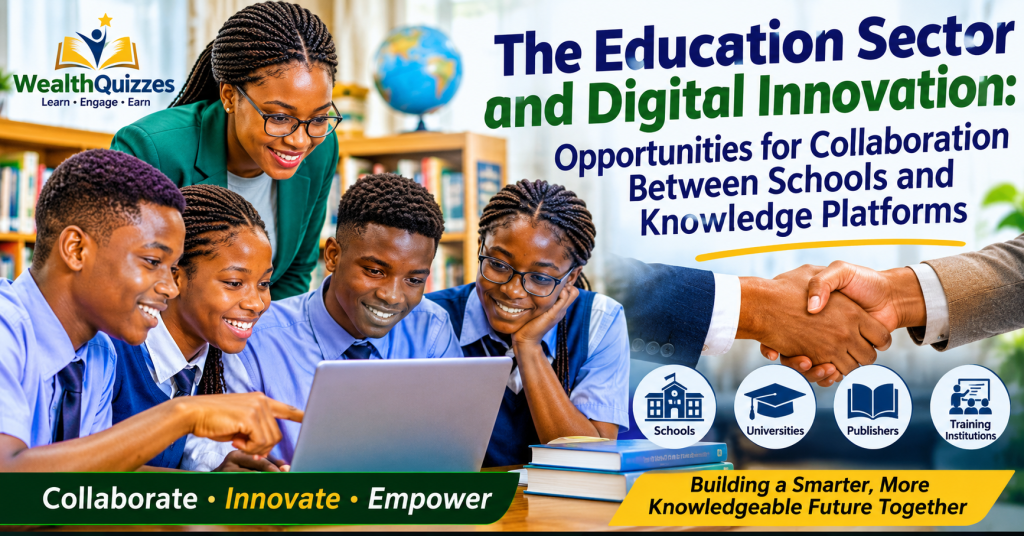
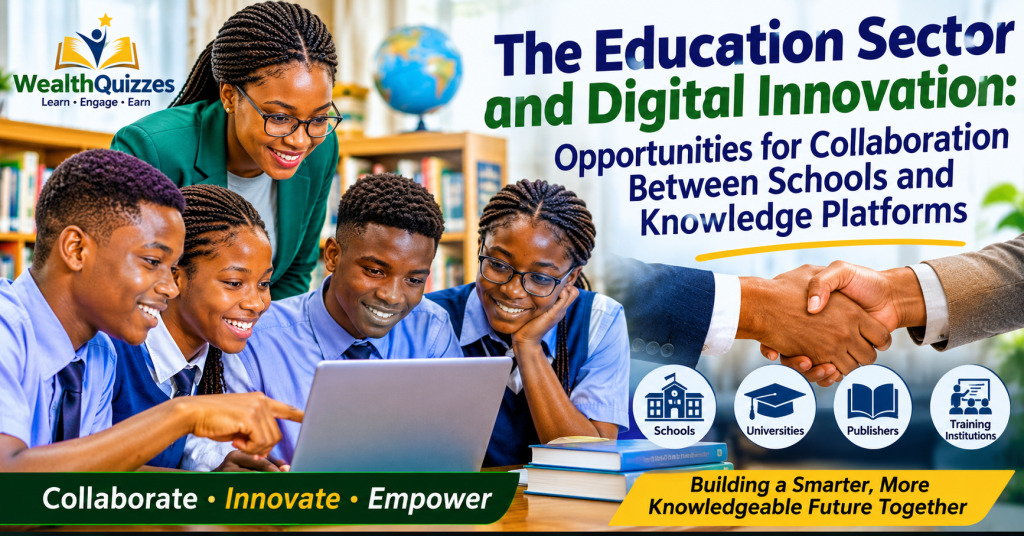
The Education Sector and Digital Innovation: Opportunities for Collaboration Between Schools and Knowledge Platforms
Building a More Engaging, Inclusive and Digitally Connected Learning Environment
Education is undergoing a significant transformation. The traditional classroom remains fundamental to learning, but the increasing availability of digital technology is creating new opportunities for students, teachers, educational institutions and learning organisations to extend education beyond conventional classroom boundaries.
From digital learning resources and online assessment tools to educational games, interactive competitions and knowledge-based platforms, technology is changing how information is delivered, how learners engage with educational content and how knowledge can be reinforced outside formal teaching hours.
For Nigeria, where educational access, learning quality, youth development, digital inclusion and employability remain important national priorities, collaboration between schools and digital knowledge platforms presents an opportunity to complement existing educational structures rather than replace them.
Knowledge platforms can provide supplementary learning experiences, encourage intellectual participation, promote healthy academic competition and expose students to practical knowledge across different disciplines. Educational institutions, in turn, can contribute subject expertise, curriculum insight, credibility, learner engagement and structured opportunities for participation.
The future of educational innovation may therefore depend not merely on the availability of technology, but on the strength of partnerships between institutions that educate and platforms that make learning more accessible, interactive and engaging.
1. Education Beyond the Traditional Classroom
Formal education provides the foundation for intellectual development, academic discipline and professional preparation. Schools, colleges, universities and training institutions remain indispensable because they provide structured curricula, qualified educators, recognised qualifications and organised learning environments.
However, learning does not necessarily end when a lecture concludes, a student leaves the classroom or an examination is completed.
Students increasingly need opportunities to reinforce what they have learnt, explore subjects beyond prescribed materials, develop practical knowledge and cultivate the ability to think independently.
Digital knowledge platforms can help bridge this gap by creating additional channels through which learners interact with educational content.
A student studying economics, for example, may encounter concepts relating to inflation, savings, investment, entrepreneurship and financial markets in the classroom. A supplementary digital quiz or knowledge challenge could provide opportunities to revisit those concepts, test understanding and identify areas requiring further attention.
Similarly, students studying history, science, mathematics, literature, technology or civic education could engage with questions designed to reinforce concepts, stimulate curiosity and encourage further research.
The objective is not to compete with teachers or undermine formal education. Rather, it is to create complementary learning experiences that make education more continuous, participatory and accessible.
2. The Growing Importance of Digital Learning
International educational authorities increasingly recognise the opportunities and challenges associated with digital technology in education.
The UNESCO has emphasised that technology can support educational access, teaching, learning and innovation, while also warning that technology should be evaluated according to whether it genuinely improves educational outcomes.
Its Global Education Monitoring Report 2023: Technology in Education stresses the importance of evidence, equitable access, appropriate use and the interests of learners in decisions concerning educational technology.
The World Bank has also consistently highlighted the importance of education, skills development and human capital in economic development, particularly in countries where young populations require opportunities to acquire relevant knowledge and capabilities.
These perspectives suggest that digital innovation should not be measured simply by the number of devices, applications or platforms introduced into educational environments.
Its value should be assessed by what it contributes to learning, participation, accessibility, educational quality and the development of relevant competencies.
Knowledge platforms can potentially contribute to these objectives when their content is accurate, their design is accessible and their activities are aligned with meaningful educational goals.
3. Supplementary Learning Through Knowledge-Based Platforms
One of the most practical areas for collaboration between educational institutions and digital knowledge platforms is supplementary learning.
A knowledge platform can provide students with additional opportunities to practise, revise and test their understanding of topics covered in formal education.
Such activities could include:
Subject-specific quizzes in mathematics, English, science, economics and other disciplines.
General knowledge challenges covering history, geography, current affairs and civic education.
Financial literacy activities covering savings, budgeting, responsible borrowing and financial decision-making.
Technology-related challenges introducing digital literacy, cybersecurity awareness and emerging technological concepts.
Revision exercises designed to reinforce topics before examinations.
Practical knowledge challenges that connect classroom learning with everyday situations.
The effectiveness of such activities would depend significantly on their educational design.
Questions should be accurate, appropriately structured and relevant to the intended learners. Difficulty levels should be suitable for the participants, and where educational reinforcement is intended, explanations of correct answers should ideally accompany the exercise or be made available after participation.
A platform that merely records correct or incorrect answers may generate engagement. A platform that also helps learners understand why an answer is correct can potentially provide greater educational value.
This distinction is important. Competition may motivate participation, but understanding should remain a central objective of educational collaboration.
4. Knowledge Competitions as Tools for Motivation and Participation
Knowledge competitions can provide another valuable area of collaboration.
Academic competitions have traditionally taken the form of debates, spelling contests, mathematics competitions, science fairs, quiz tournaments and inter-school events. Digital platforms offer opportunities to extend these activities beyond physical venues and make participation more flexible.
Schools could collaborate with knowledge platforms to organise:
Inter-school digital quiz competitions.
Subject-based challenges in science, mathematics, history and literature.
Financial literacy competitions.
General knowledge tournaments.
University-level intellectual challenges.
Special competitions during educational awareness campaigns.
Digital competitions celebrating national holidays, international observances or academic milestones.
Such competitions can encourage students to prepare, research, practise, think critically and participate in constructive intellectual activities.
They may also create opportunities for students who are not traditionally represented in conventional academic competitions to demonstrate their knowledge and abilities.
However, competition design matters. Excessive emphasis on speed, prizes or rankings could disadvantage learners who require additional time, have disabilities, limited internet access or less familiarity with digital technology.
Educational partnerships should therefore consider fairness, age-appropriate participation, accessibility, clear rules and alternative participation arrangements where practicable.
The objective should be to encourage intellectual development, confidence and healthy competition—not merely to produce winners.
5. Partnerships With Primary and Secondary Schools
Primary and secondary schools represent an important opportunity for digital educational collaboration because they provide structured environments in which learners can be introduced to supplementary knowledge and digital participation.
A partnership programme could begin with a limited number of schools and clearly defined objectives.
For example, a participating school might select a particular subject or educational theme for a monthly knowledge challenge. The digital platform could provide the questions, participation mechanism, leaderboard or competition structure, while teachers help identify appropriate subject areas and assess the educational relevance of the activity.
Possible arrangements include:
School knowledge clubs: Establishing digital or hybrid knowledge clubs where learners periodically participate in educational quizzes, discussions and research activities.
Inter-school competitions: Organising competitions among participating schools, with recognition for individual learners, teams or institutions.
Supplementary revision programmes: Developing quiz-based activities that reinforce topics students have already studied.
Educational awareness campaigns: Collaborating on programmes covering financial literacy, environmental awareness, technology, civic responsibility, health education or entrepreneurship.
Teacher-supported participation: Allowing teachers to recommend topics, review content and encourage participation without creating unnecessary administrative burdens.
Schools should retain control over educational appropriateness, learner welfare, participation permissions and the extent to which activities are integrated into their academic programmes.
Partnerships should also avoid requiring students to purchase subscriptions, devices or internet access merely to participate in school-endorsed activities unless such costs are transparently disclosed and genuinely justified. Inclusive alternatives should be considered.
6. Universities and Higher Institutions: A Wider Intellectual Ecosystem
Universities and other tertiary institutions offer opportunities that extend beyond conventional student quizzes.
Their students possess diverse interests, disciplinary backgrounds and intellectual capabilities. Collaboration could create programmes designed to promote multidisciplinary knowledge, research awareness, practical skills and engagement with contemporary issues.
Potential initiatives include:
University-wide knowledge competitions.
Faculty-based intellectual challenges.
Entrepreneurship and business knowledge programmes.
Financial and investment literacy initiatives.
Technology and innovation competitions.
Public policy and civic knowledge challenges.
Graduate development and employability programmes.
Research-informed question development.
Student ambassador programmes.
Digital participation initiatives for campus communities.
Universities could also contribute to the quality and credibility of educational content by engaging lecturers, researchers, postgraduate students and relevant academic departments in developing or reviewing question banks.
For example, a university’s economics department might assist in reviewing questions relating to economic concepts, while its computer science department could contribute to digital literacy or cybersecurity awareness content.
Such collaboration could create mutual value. Digital platforms may obtain access to academic expertise and structured communities of learners, while institutions could gain additional channels for engagement, outreach, educational innovation and student participation.
Any arrangement involving university names, logos, endorsements, academic credit or institutional recognition would, of course, require appropriate authorisation.
7. Educational Publishers: Connecting Books With Interactive Learning
Educational publishers occupy a particularly interesting position in the digital learning ecosystem.
They already invest in textbooks, workbooks, study guides, examination materials, reference publications and educational content. Digital knowledge platforms could provide a complementary mechanism for making that content more interactive.
A publisher-platform partnership could involve converting selected concepts from approved educational materials into supplementary quizzes, revision challenges or knowledge competitions.
For example:
A textbook chapter could be accompanied by a digital revision quiz.
A study guide could include access to supplementary knowledge challenges.
A publisher could sponsor a competition based on a particular subject.
A book launch could be accompanied by a digital knowledge campaign.
A series of publications could be promoted through topic-based competitions.
Students could participate in challenges designed to reinforce knowledge contained in selected educational resources.
Such arrangements could support publishers in extending engagement with their educational materials while creating additional learning opportunities for students.
The intellectual property implications must be properly addressed. A platform should not reproduce substantial portions of copyrighted textbooks, question banks or proprietary educational materials without appropriate permission or another lawful basis.
Partnership agreements should clearly address licensing, attribution, ownership of newly created questions, permitted usage, distribution rights and commercial arrangements.
The strongest partnership would combine the publisher’s subject expertise and educational content with the platform’s interactive capabilities, without compromising the intellectual property rights of either party.
8. Training Institutions and Professional Development
Digital knowledge platforms may also collaborate with vocational centres, professional training institutions, technical colleges, entrepreneurship programmes and skills-development organisations.
Learning in these environments often focuses on practical competencies that learners must understand, apply and retain.
Supplementary knowledge challenges could cover:
Entrepreneurship and small-business management.
Workplace safety.
Customer service.
Financial management.
Digital skills.
Communication and professional ethics.
Basic legal and regulatory awareness.
Technical knowledge relevant to particular vocational disciplines.
Training institutions could use digital quizzes as revision exercises, diagnostic assessments, informal knowledge checks or supplementary engagement activities.
For instance, trainees completing an entrepreneurship programme might participate in challenges covering business planning, bookkeeping, customer acquisition, cash flow and business decision-making.
However, knowledge-based quizzes should not be confused with practical competency assessments where the ability to demonstrate a skill is essential. A quiz may assess theoretical understanding of electrical safety, for example, but it cannot substitute for an appropriately supervised practical assessment of electrical work.
The distinction between knowledge and demonstrated competence should remain clear.
9. Teacher Participation and Content Development
Teachers are central to the success of educational innovation.
Technology introduced without meaningful teacher involvement may fail to address the actual needs of learners, curriculum requirements or classroom realities.
The UNESCO Global Education Monitoring Report 2023 emphasises the importance of teacher preparation, appropriate technology, equitable access and evidence-informed implementation. It cautions against treating technology as an automatic solution to educational challenges.
Global Education Monitoring Report+2
Consequently, schools and knowledge platforms should consider teachers as partners in development and implementation.
Teachers could participate in:
Identifying relevant educational themes.
Reviewing questions for accuracy and age appropriateness.
Recommending appropriate difficulty levels.
Providing feedback on platform usability.
Identifying gaps in students’ understanding.
Supporting educational competitions.
Evaluating whether digital activities complement classroom teaching.
Platforms may also consider professional development workshops introducing educators to digital assessment, interactive learning design, content development and responsible use of educational technology.
Such programmes should be practical, relevant and respectful of teachers’ professional expertise.
10. Digital Participation, Inclusion and Accessibility
The opportunities presented by educational technology are not automatically available to every learner.
Differences in internet connectivity, device availability, affordability, digital literacy, disability, location and socioeconomic circumstances can affect participation.
UNESCO’s 2023 report highlights substantial disparities in access to technology and warns that digital interventions may exclude disadvantaged learners if equity is not adequately considered.
unesdoc.unesco.org+1
Partnerships should therefore incorporate inclusion into their design.
Possible measures include:
Mobile-friendly platforms.
Low-data participation options where technically feasible.
Accessible interfaces for learners with disabilities.
Appropriate content for different age groups.
Flexible participation periods.
Clear and simple instructions.
Offline or school-assisted participation options where practicable.
Avoiding unnecessary personal data collection.
Transparent participation costs.
Appropriate safeguards for minors.
In Nigeria, this is particularly important because digital educational opportunities should not become privileges available only to learners attending well-resourced institutions or living in areas with reliable connectivity.
A successful collaboration should aim to broaden participation rather than reinforce existing educational inequalities.
11. Safeguarding, Privacy and Institutional Trust
Educational partnerships require more than an attractive platform and an engaging competition. They require safeguards capable of protecting learners, maintaining institutional confidence and managing risks associated with digital participation.
Where children or minors are involved, safeguarding considerations become particularly important.
Schools and platform operators should carefully address:
Appropriate age requirements and participation arrangements.
Parental or guardian consent where legally or institutionally required.
Protection of personal information.
Restrictions on inappropriate communication.
Reporting and complaint mechanisms.
Responsible moderation of online communities.
Appropriate use of photographs, names and identifiable learner information.
Transparent rules for competitions and rewards.
Security of participant information.
Clear responsibilities between the institution and platform operator.
Nigeria’s Data Protection Act 2023 provides the relevant legal framework for personal data processing, including provisions concerning lawful processing, data subject rights, security and children’s personal data.
The precise obligations applicable to a proposed partnership should be assessed before implementation, particularly where student records, personal identifiers, behavioural information, competition results or other personal data may be processed.
Trust is essential. Educational institutions should not endorse a digital platform simply because it is innovative or commercially attractive. They should assess its suitability, transparency, operational reliability, safeguarding arrangements and compliance obligations.
12. The WealthQuizzes Opportunity: A Potential Educational Partnership Model
For WealthQuizzes, collaboration with the education sector represents an opportunity to explore a meaningful extension of its knowledge-based engagement model.
Its quiz format could potentially be adapted for educational engagement programmes that complement existing learning activities.
The opportunity is not necessarily to transform WealthQuizzes into a formal educational institution, examination body or substitute for school curricula. Rather, it is to explore how its existing knowledge-based participation structure could support supplementary educational engagement.
School Knowledge Challenge
Schools could participate in scheduled challenges involving general knowledge, financial literacy, history, science, technology and other educational subjects.
Campus Knowledge League
Universities and tertiary institutions could explore inter-faculty, inter-departmental or institution-wide competitions designed to encourage intellectual engagement and participation.
Supplementary Learning Programme
Teachers and subject specialists could collaborate in developing questions that reinforce selected classroom topics and encourage students to explore additional knowledge.
Publisher Collaboration
Educational publishers could explore sponsored quizzes, book-linked learning challenges and interactive campaigns based on approved educational materials.
Skills and Training Challenges
Training institutions could explore digital knowledge challenges relating to entrepreneurship, workplace skills, technology, financial literacy and professional development.
These are potential partnership concepts, not representations that WealthQuizzes currently operates formal programmes with schools, universities, publishers or training institutions.
The practical implementation of any initiative would depend on institutional interest, appropriate content, operational capacity, platform suitability, safeguarding arrangements, funding and agreed partnership terms.
13. A Practical Framework for Developing Educational Partnerships
Rather than pursuing large-scale educational collaborations immediately, a carefully structured pilot programme may provide a more realistic starting point.
A possible framework could involve the following stages:
Stage 1 — Identify suitable partners
Approach a limited number of schools, universities, publishers or training institutions with a clearly defined proposal explaining the objectives, proposed activities and potential benefits.
Stage 2 — Define the educational objective
Each partnership should have a specific objective. Examples include improving supplementary engagement with financial literacy, encouraging participation in general knowledge competitions or supporting revision of selected subject areas.
Stage 3 — Develop and review content
Questions should be researched, fact-checked and reviewed by appropriately qualified educators or subject specialists. Content should be age-appropriate and aligned with the programme’s stated objectives.
Stage 4 — Conduct a limited pilot
Run a pilot involving a manageable number of participants and a defined period. A pilot could test participation, technical reliability, learner experience, content quality and institutional feedback.
Stage 5 — Evaluate performance
Measure the programme against its stated objectives rather than relying exclusively on downloads, registrations or competition participation.
Stage 6 — Improve and scale
Use the findings to refine the programme before expanding to additional schools or institutions.
This approach would reduce implementation risks, provide evidence of feasibility and help distinguish genuinely valuable educational initiatives from activities that merely generate publicity.
14. Measuring Educational and Partnership Impact
The value of educational collaboration should be evaluated through measurable indicators.
Potential metrics include:
| Area | Possible indicators |
|---|---|
| Participation | Number of participating institutions and learners |
| Engagement | Completion rates, repeat participation and time spent on activities |
| Knowledge | Pre- and post-activity assessments where appropriate |
| Content quality | Accuracy, relevance, review completion and reported errors |
| Accessibility | Participation across different learner groups |
| Institutional satisfaction | Feedback from teachers, administrators and partner organisations |
| Technical performance | Reliability, accessibility and reported technical difficulties |
| Programme sustainability | Cost per participant, partner retention and repeat programmes |
Where a partnership claims to improve knowledge or learning, participation figures alone are insufficient evidence.
A properly designed assessment should distinguish between activity metrics—such as quiz attempts—and outcome metrics—such as measurable improvement in knowledge.
The distinction would enhance credibility and help institutions determine whether a programme merits continuation or expansion.
Conclusion: Collaboration Can Expand the Possibilities of Education
The future of education will not be determined solely by classrooms, textbooks or technology. It will increasingly depend on how effectively these elements work together to create meaningful learning experiences.
Schools, universities, educational publishers and training institutions possess valuable educational expertise, established learner communities and institutional credibility. Digital knowledge platforms offer additional opportunities for interaction, participation, accessibility and innovation.
When these strengths are combined responsibly, educational partnerships can support supplementary learning, knowledge competitions, intellectual development, digital participation and the cultivation of practical knowledge.
For Nigeria, the opportunity is particularly significant. A growing generation of digitally connected learners deserves educational experiences that extend beyond passive consumption of information and encourage curiosity, critical thinking, participation and continuous development.
WealthQuizzes could explore this opportunity through carefully designed educational partnerships, beginning with limited pilot programmes, credible content, institutional collaboration and measurable outcomes.
Ultimately, the strongest educational innovations are not those that merely introduce technology into learning. They are those that make learning more meaningful, accessible, engaging and valuable to the people it is intended to serve.
The classroom remains essential. But the opportunities to learn, explore and develop knowledge need not end at its doors.
Selected Authorities and Further Reading
1. UNESCO — Global Education Monitoring Report 2023: Technology in Education: A Tool on Whose Terms?
Examines the opportunities, limitations, equity implications and appropriate use of technology in education.
2. UNESCO — What Are Appropriate Uses of Technology in Education?
Discusses the conditions under which technology can appropriately support learning, including the role of teachers and evidence-based implementation.
3. World Bank — Digital Technologies in Education
Explores the role of technology in improving educational delivery, teacher development, assessment, digital learning and system effectiveness.
4. UNESCO — Education 2030: Incheon Declaration and Framework for Action
Provides the international framework for Sustainable Development Goal 4: inclusive and equitable quality education and lifelong learning opportunities for all.
5. World Bank — Education and Human Capital
Research and resources on education, skills development, human capital and economic development.
Explore World Bank education resources
6. UNESCO — Digital Learning and Transformation of Education
Resources on digital learning, educational innovation and technology-enabled education.
Explore UNESCO’s digital education resources
WealthQuizzes — Learn • Engage • Earn
Where Knowledge Becomes Wealth.


