
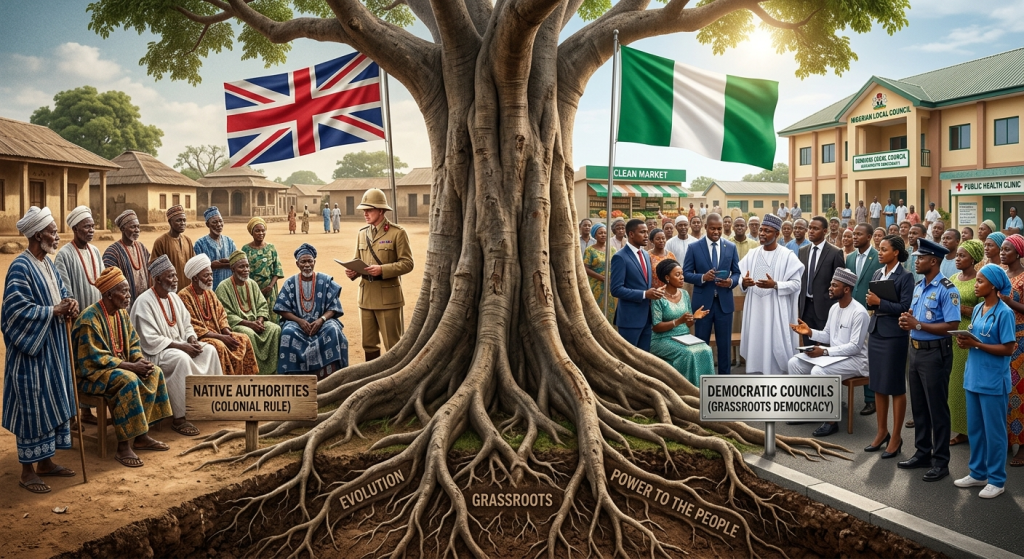
The History of Local Government in Nigeria: From Native Authorities to Democratic Councils
Local government is the level of government closest to the ordinary Nigerian citizen. It is where government encounters people not primarily through national policy debates in Abuja, but through roads, markets, drainage, sanitation, primary healthcare, community infrastructure, birth registration, motor parks and other everyday services.
Yet Nigeria’s local government system did not begin as a democratic institution. Its modern history can be traced through several distinct phases: pre-colonial systems of community governance; British Native Authorities and indirect rule; the gradual introduction of representative local government in the 1950s; post-independence experimentation; the landmark 1976 reforms; constitutional recognition under the 1979 and 1999 Constitutions; and the continuing struggle for genuine local autonomy.
As distinguished Nigerian political scientist Alex Gboyega has observed, representative local government in Nigeria is comparatively recent. Its development accelerated during the transition to regional self-government in the 1950s, when Nigerian political leaders began transferring authority from traditional rulers toward elected representatives. ResearchGate
The story of Nigerian local government is therefore also a story about colonialism, democratisation, traditional authority, federalism and the struggle to bring political power closer to the people.
Before Colonial Rule: Local Governance Already Existed
It is important not to begin the history of Nigerian local government with the British.
Long before colonial administration, societies across the territory now called Nigeria possessed sophisticated systems for governing communities and resolving disputes.
The political structures were diverse. The Hausa emirates operated through hierarchical institutions; Yoruba political communities combined kingship with councils and other checks on authority; Benin possessed a highly organised monarchical administration; while many Igbo communities relied heavily on village assemblies, lineage institutions, age grades and councils of elders.
Cambridge’s Understanding Colonial Nigeria stresses that British administrators encountered societies with established indigenous political and administrative systems. The variation in those systems significantly influenced how indirect rule was subsequently implemented in different parts of Nigeria. Cambridge University Press
This distinction matters because British colonial local administration did not create local governance from nothing. Rather, it appropriated, modified and sometimes distorted existing institutions for colonial purposes.
The Native Authority System
The most influential colonial experiment was indirect rule.
The system associated particularly with Lord Frederick Lugard sought to govern through existing or adapted indigenous authorities rather than relying entirely upon British officials. In Northern Nigeria, the British found relatively centralised political structures, particularly the emirate system associated with the Sokoto Caliphate, that could be incorporated into colonial administration.
British political officers supervised the indigenous authorities while the Emirs and other recognised rulers continued to perform substantial administrative functions.
A contemporary British parliamentary discussion in 1925 described how the British retained the existing system of native government in Northern Nigeria while transferring the ultimate responsibility of the Emirs from the Sultan of Sokoto to the colonial government. Hansard
The resulting Native Authority was therefore not an independent local government in the modern democratic sense. It was an instrument of colonial administration.
Native Authorities were involved in matters such as taxation, courts, policing, local works and administration. They could possess Native Treasuries, Native Courts and Native Police or other coercive mechanisms under colonial supervision.
The Problem of Indirect Rule in Southern Nigeria
The British experience was very different in many parts of Southern Nigeria.
In areas where there were no single rulers whose authority could easily be converted into a colonial administrative structure, British officials sometimes created or empowered individuals as local authorities.
This became particularly controversial in southeastern Nigeria through the Warrant Chief system.
Historian Adiele E. Afigbo, in his classic study The Warrant Chiefs: Indirect Rule in Southeastern Nigeria, 1891–1929, demonstrated how British officials attempted to administer societies whose political authority was often distributed among villages, lineages, elders and other institutions rather than concentrated in a single paramount ruler. Africabib
The result was frequently problematic.
Individuals could receive colonial recognition as “chiefs” without possessing the traditional legitimacy that British administrators assumed they had. Native Courts and taxation could consequently become instruments of coercion rather than institutions of locally legitimate government.
The resistance generated by these arrangements contributed to a gradual reassessment of colonial local administration.
From Native Administration to Representative Local Government
By the 1930s and 1940s, the British increasingly modified the Native Authority system.
Native Administration became more formalised, and local councils gradually emerged. But the fundamental transition occurred during the era of decolonisation.
As Nigerian political leaders assumed greater control over regional governments in the 1950s, they began reforming local administration.
Gboyega argues that representative local government developed alongside the struggle for regional self-government. Nigerian politicians saw local government as a means of demonstrating their capacity for responsible administration while also creating political structures capable of mobilising communities in the independence movement. ResearchGate
This was a major conceptual transformation.
The question was no longer simply:
How can the colonial government administer local communities?
It increasingly became:
How can Nigerians govern their own communities through representative institutions?
Local Government in the First Republic
At independence in 1960, Nigeria inherited a highly uneven local-government system.
The three major regions developed local government in different ways, reflecting their political traditions and administrative priorities.
The Western Region, for example, experimented extensively with local government reform. A 1976 assessment of Western State’s earlier reforms records an attempt in 1973 to reconcile small community identities with the need for economically viable administrative units. The reforms included reducing the number of councils from 114 to 39 and establishing 335 Area Committees to facilitate grassroots participation. Africabib
This reveals a problem that has remained with Nigeria ever since:
A local government unit must be sufficiently large to provide meaningful services, but sufficiently close to its population to retain a sense of community and accountability.
The Eastern and Northern systems also underwent reforms, but Nigeria still lacked a single uniform model of local government.
The Military and the Push for Uniformity
Military intervention dramatically altered Nigeria’s political structure.
The 1967 creation of 12 states and subsequent state creation weakened the old regional governments. But local government remained uneven and heavily dependent upon state governments.
By the mid-1970s, there was growing recognition that Nigeria needed a more coherent system.
This produced the 1976 Local Government Reform.
The reform is arguably the single most important turning point in the history of modern Nigerian local government.
The Landmark 1976 Local Government Reform
The Federal Military Government under General Murtala Mohammed, and subsequently General Olusegun Obasanjo, introduced nationwide reforms designed to establish a more uniform local government system.
A committee associated with the reform process was chaired by Ibrahim Dasuki, who later became Sultan of Sokoto.
The reform guidelines defined local government as government exercised through representative councils with specific powers over defined areas, intended to give councils substantial control over local affairs and the institutional and financial capacity to initiate and implement projects. Cambridge University Press
The reform had several major objectives:
- bringing government closer to the people;
- encouraging grassroots participation;
- improving administrative efficiency;
- creating viable local government units;
- reducing excessive state-government control;
- providing clearer sources of finance;
- encouraging elected councils;
- integrating traditional institutions without allowing them to replace democratic councils.
The reform created 301 local government areas, establishing a more uniform framework throughout Nigeria. Carnegie Endowment
This was revolutionary because it attempted to make local government a recognised component of Nigeria’s governmental architecture rather than merely an extension of state administration.
Traditional Rulers and Democratic Councils
One of the most significant consequences of the 1976 reform was the separation between traditional authority and democratic local government.
Traditional rulers were not abolished. They continued to possess important cultural, customary and advisory functions.
But they were no longer supposed to constitute the democratic government of the local area.
This distinction remains fundamental today.
A traditional ruler may command enormous cultural legitimacy, but that does not make the person the elected chairman of a Local Government Council.
The modern council derives its authority from law and elections, whereas traditional institutions derive theirs from history, custom and community recognition.
The separation was therefore an important step in Nigeria’s democratisation.
The 1979 Constitution and Local Government
The 1976 reforms received an important constitutional foundation through the 1979 Constitution.
Scholar Alex Gboyega described the constitutional elevation of local government as having its roots in the 1976 reforms. The constitutional arrangement nevertheless generated disputes over whether responsibility for local government belonged primarily to the states or involved a joint federal-state responsibility. Wiley Online Library
This ambiguity would become one of the recurring problems of Nigerian local government.
The Federal Government could recognise and finance local government, but states retained substantial administrative influence.
That tension has never completely disappeared.
The Second Republic: Democracy Without Local Elections?
Nigeria returned to civilian rule in 1979, but the constitutional promise of democratic local government did not automatically translate into effective local democracy.
Gboyega’s research on the period 1979–1983 found that no local government elections were conducted throughout the Second Republic, despite the constitutional and legal expectation of representative local government. He further argued that even where elections existed, limited autonomy and weak participation could undermine the democratic purpose of local government. Africabib
This was an early demonstration of a recurring Nigerian problem:
The existence of a constitutional provision does not necessarily guarantee its effective implementation.
Military Rule and Further Reform
The military governments of the 1980s and 1990s repeatedly reorganised local government.
The 1988 Civil Service Reforms under General Ibrahim Babangida affected local government administration and personnel. Later reforms attempted to clarify relationships between elected councils, traditional institutions and state governments.
By the 1990s, Nigeria had moved toward the current figure of 774 Local Government Areas.
But the relationship between Local Government Councils and state governments remained contentious.
A study by Musa Abba Aji of the National Institute for Policy and Strategic Studies concluded that the 1976 reforms and subsequent constitutional arrangements gave local governments substantial responsibilities but that state governments repeatedly reduced local councils to subordinate roles. NIPSS Kuru Repository
Local Government Under the 1999 Constitution
The return to democratic rule in 1999 gave local government an important constitutional guarantee.
Section 7(1) of the 1999 Constitution provides that the system of local government by democratically elected local government councils is guaranteed, requiring every state government to ensure their existence under legislation providing for their structure, composition, finance and functions. Wikisource
The Constitution’s Fourth Schedule specifies numerous functions of local government councils.
These include:
- construction and maintenance of local roads and drains;
- markets and motor parks;
- public conveniences;
- refuse and sewage disposal;
- registration of births, deaths and marriages;
- assessment and collection of certain local rates;
- regulation of shops and kiosks;
- cemeteries and burial grounds; and
- participation in primary, adult and vocational education, agriculture and health services. Constitute Project
These responsibilities explain why local government matters so much to ordinary citizens.
Federal and state governments may formulate broad policy, but many of the services people encounter daily are fundamentally local.
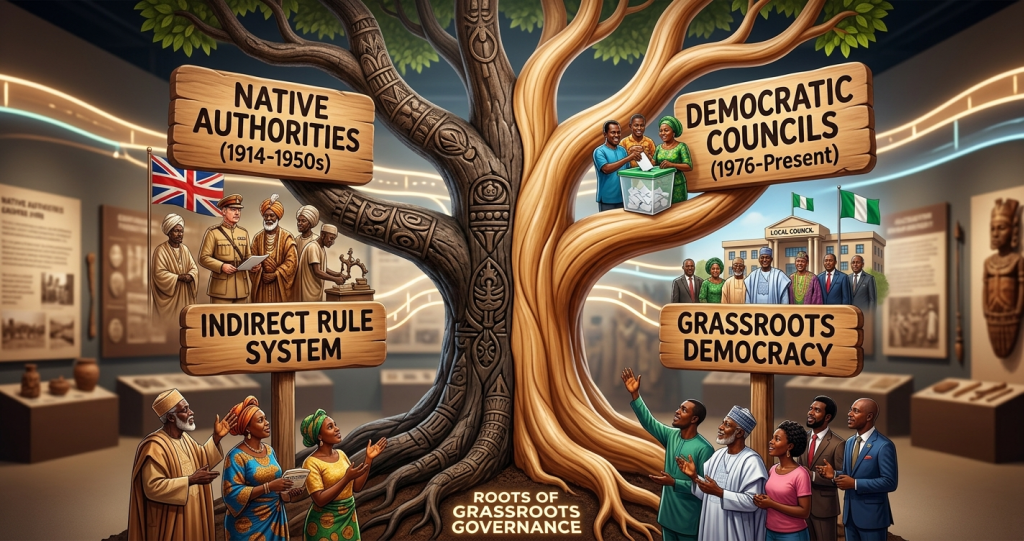
Why Local Government Is Central to Grassroots Governance
Local government matters for a simple reason:
government is ultimately judged where citizens experience it.
A resident may never meet the President or a Federal Minister. A person may never visit a state secretariat. But that same person interacts with government through a local market, motor park, waste-disposal system, local road, community health facility or registration office.
Local government also provides an avenue for political participation.
Council elections can introduce citizens to democratic politics at the most immediate level. Community leaders, councillors, chairmen and local political organisations can become training grounds for broader political leadership.
Gboyega’s work emphasises precisely this representative and participatory dimension of local government, while also warning that limited autonomy can prevent the institution from fulfilling its democratic potential. CiteSeerX
The Problem of Local Government Autonomy
The greatest unresolved issue is autonomy.
Nigeria’s constitutional framework guarantees democratically elected councils, but state governments have historically exercised considerable influence over local government structures and finances.
This has generated a long-running argument: should local governments be substantially controlled by state governments, or should they enjoy stronger constitutional and financial independence?
The debate became particularly significant in the 2024 Supreme Court litigation on local government autonomy, in which the Federal Government challenged the practice of state governments controlling or withholding local government allocations.
The Supreme Court’s judgment addressed the constitutional status of democratically elected councils and the handling of funds allocated to local governments from the Federation Account. The judgment reaffirmed the constitutional importance of local governments and addressed the controversy surrounding the State Joint Local Government Account. Premium Times Nigeria
The significance extends beyond accounting.
If a local council does not control the resources legally allocated to it, its ability to provide services or respond to citizens is inevitably weakened.
Local government autonomy is therefore fundamentally a question of accountability.
If citizens elect a council but another level of government controls its finances and administrative decisions, determining who is actually responsible for local performance becomes difficult.
The Continuing Evolution of Local Government
The history of Nigerian local government can therefore be divided broadly into several stages:
- Pre-colonial indigenous governance, involving diverse traditional and community institutions;
- Colonial Native Authorities, operating under indirect rule;
- Native Administration and early councils, as colonial structures evolved;
- Representative local government in the 1950s, as Nigerian political leaders assumed greater responsibility;
- Post-independence regional experimentation, with different systems across the federation;
- The 1976 nationwide reform, which established the foundation of the modern system;
- Constitutional recognition under the 1979 Constitution;
- Military-era administrative reforms; and
- The 1999 constitutional era, in which democratically elected local councils became constitutionally guaranteed.
The transformation has therefore been much more than an administrative reform programme.
It represents Nigeria’s gradual movement from governance through traditional and colonial intermediaries toward representative democratic institutions at the grassroots.
Conclusion
The history of local government in Nigeria is ultimately the history of a difficult attempt to bring government closer to the people.
The British Native Authority system was designed principally to facilitate colonial administration through indigenous structures. In some places it incorporated existing institutions; in others, particularly in southeastern Nigeria, it created or empowered authorities that did not necessarily possess traditional legitimacy. The scholarship of Adiele Afigbo remains particularly important for understanding this complicated history. Africabib
The transition to representative local government accelerated during decolonisation, as Nigerian politicians began replacing appointed traditional authorities with councils and representatives. Alex Gboyega’s scholarship demonstrates how this development was closely connected to the emergence of Nigerian self-government and political participation. ResearchGate
The decisive watershed came with the 1976 Local Government Reform, which sought to create a unified national system based on representative councils, defined functions, financial resources and grassroots participation. Carnegie Endowment
Yet nearly five decades later, the central problem remains unresolved: how much autonomy should local governments actually possess?
Nigeria’s constitutional promise is clear that local government should be democratic. Its practical history is less straightforward.
For local government to fulfil its purpose, councils must have credible elections, predictable funding, competent personnel, meaningful responsibilities and sufficient institutional independence to answer to the people who elect them.
The future of Nigerian grassroots governance therefore depends not merely on creating or renaming Local Government Areas. It depends on making local government genuinely local, genuinely democratic and genuinely accountable.
That is the unfinished journey from the Native Authority to the democratic council.


