
The North American World Cup Revolution: How FIFA World Cup 2026 Is Rewriting Football History Before Our Eyes
From Record Crowds and the 48-Team Format to New Football Nations and Unprecedented Fan Engagement, the Biggest FIFA World Cup Ever Is Transforming the Beautiful Game
Every FIFA World Cup leaves behind a legacy. Some tournaments are remembered for unforgettable goals, others for legendary champions, while a few fundamentally change the direction of world football. The ongoing FIFA World Cup 2026 is rapidly proving to be one of those transformational tournaments. Long before the eventual lifting of the famous FIFA World Cup Trophy, this edition has already distinguished itself as one of the most innovative, commercially successful and globally inclusive competitions ever organised.
Hosted jointly by the United States, Canada and Mexico—the first three-nation hosting arrangement in FIFA World Cup history—the tournament has introduced sweeping changes that are already reshaping international football. From the historic expansion to 48 participating nations and the introduction of a new competition format to record-breaking attendances, unprecedented global television audiences, emerging football powers and revolutionary fan engagement through digital platforms, World Cup 2026 is demonstrating that football continues to evolve without losing its universal appeal.
FIFA President Gianni Infantino has repeatedly described the tournament as “the biggest and most inclusive FIFA World Cup in history,” reflecting FIFA’s objective of making football truly global while expanding opportunities for emerging football nations. FIFA has consistently maintained that the expanded competition is designed not merely to increase participation but also to stimulate football development across every confederation.
The First 48-Team FIFA World Cup Has Changed Everything
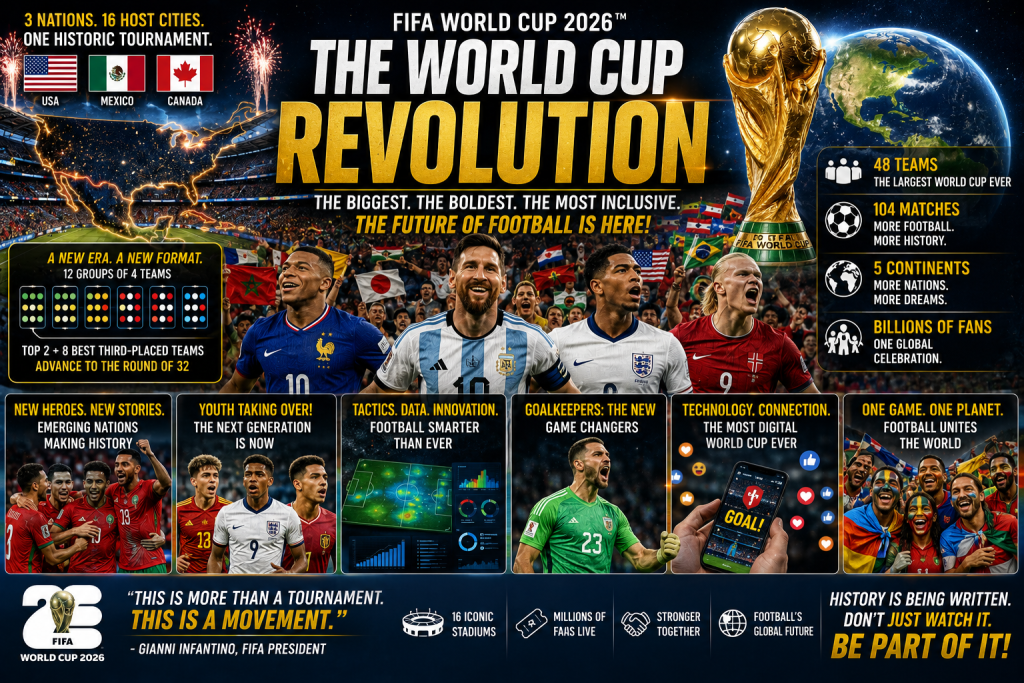
Perhaps the single most important innovation of FIFA World Cup 2026 is its expansion from 32 to 48 participating nations.
This is the largest structural change to the tournament since France 1998 expanded the competition from 24 to 32 teams.
Rather than eight groups of four, FIFA adopted twelve groups of four nations, with the top two teams in each group, alongside the eight best third-placed teams, progressing to a Round of 32 before the traditional knockout stages.
According to FIFA, the expansion increased the total number of matches from 64 to 104 while significantly broadening representation across every continental confederation. The governing body argued that the revised format would provide more countries with realistic opportunities to qualify without compromising the quality of competition.
Critics initially questioned whether expansion would dilute the tournament.
Thus far, the opposite has largely occurred.
Instead of producing one-sided contests, many newly qualified nations have demonstrated remarkable competitiveness against traditional football giants.
The result has been one of the most unpredictable World Cups in recent memory.
The Rise of New Football Nations
Perhaps no storyline has captured global attention more than the continued emergence of countries traditionally considered outsiders.
For decades, international football was largely dominated by a small collection of European and South American nations.
World Cup 2026 has challenged that perception.
Norway’s remarkable journey to the semi-finals, including their famous elimination of Brazil, became one of the defining stories of the tournament. Led by Erling Haaland and Martin Ødegaard, Norway demonstrated that careful long-term player development can rapidly elevate a nation into football’s elite.
Morocco once again confirmed that their historic run to the semi-finals in Qatar four years earlier was no accident. Their appearance in another World Cup quarter-final reinforced Africa’s growing competitiveness on football’s biggest stage.
Similarly, Egypt’s fearless performance against defending champions Argentina and several impressive displays from Asian, CONCACAF and African representatives illustrated that the traditional hierarchy of international football continues to evolve.
Former Arsenal manager Arsène Wenger, now FIFA’s Chief of Global Football Development, has consistently argued that improved coaching, sports science and youth development have significantly reduced the gap separating elite nations from emerging football countries.
World Cup 2026 has provided compelling evidence supporting that assessment.
Youth Has Become Football’s Greatest Asset
One unmistakable feature of this tournament has been the extraordinary influence of young players.
Never before have so many teenagers and players under the age of twenty-three occupied such central roles for serious World Cup contenders.
Spain’s Lamine Yamal has continued astonishing football supporters worldwide through his maturity, creativity and confidence under enormous pressure.
England’s Jude Bellingham has once again established himself among the world’s finest midfielders despite still being in the early stages of his career.
France’s Kylian Mbappé, although now one of football’s established superstars, remains the standard against which modern attacking players are measured.
Argentina have similarly benefited from younger stars including Julián Álvarez, Enzo Fernández and Alexis Mac Allister complementing Lionel Messi’s extraordinary experience.
Former Manchester United manager Sir Alex Ferguson famously observed that “youth is fearless.”
The ongoing tournament has repeatedly illustrated exactly that principle.
Young footballers appear increasingly prepared to embrace responsibility on the sport’s biggest stage.
Tactical Football Has Reached New Heights
Beyond individual performances, World Cup 2026 has become a fascinating exhibition of tactical innovation.
Managers now possess access to unprecedented volumes of performance data, GPS tracking, artificial intelligence-assisted analysis and advanced sports science.
These developments have transformed how teams prepare for opponents.
Rather than relying solely upon traditional scouting reports, coaching staffs now analyse pressing triggers, passing networks, defensive spacing, transition speed and player workload using sophisticated analytical software.
Pep Guardiola has often described modern football as “a game of positioning.”
The ongoing World Cup has consistently reflected that philosophy.
Successful teams have not necessarily been those with the greatest individual talent but those capable of maintaining superior collective organisation.
Spain, France, England and Argentina have each displayed tactical flexibility rather than rigid adherence to one playing style.
That adaptability has become one of football’s greatest competitive advantages.
Goalkeepers Have Become Complete Footballers
Another remarkable trend throughout World Cup 2026 has been the evolving role of goalkeepers.
No longer restricted primarily to stopping shots, elite goalkeepers now function as additional outfield players.
Argentina’s Emiliano Martínez, France’s Mike Maignan, England’s Jordan Pickford and several others have repeatedly initiated attacks through intelligent distribution.
Modern goalkeepers are now expected to read defensive situations, organise pressing structures and contribute meaningfully during possession.
Former German goalkeeper Manuel Neuer revolutionised the concept of the “sweeper-keeper.”
World Cup 2026 demonstrates that his influence now extends across international football.
Sports Science Continues to Redefine Performance
Footballers have never been fitter.
According to FIFA’s High Performance Department, advances in nutrition, recovery protocols, hydration strategies, biomechanical analysis and performance monitoring have fundamentally altered elite football preparation.
Players now routinely cover greater distances while maintaining higher-intensity running throughout ninety minutes than was possible two decades ago.
Sports scientists continuously monitor fatigue, muscle stress and recovery using wearable technologies.
These developments explain why today’s World Cup football appears noticeably quicker and more physically demanding than previous generations.
Former Liverpool manager Jürgen Klopp has frequently emphasised that elite football increasingly rewards teams capable of maintaining high intensity over prolonged periods.
World Cup 2026 has reinforced that observation.
Digital Technology Has Changed the Fan Experience Forever
The ongoing World Cup is arguably the most digitally connected sporting event ever organised.
Millions of supporters now experience matches simultaneously across traditional television, streaming services and social media platforms.
Short video highlights circulate globally within minutes.
Artificial intelligence generates match statistics almost instantly.
Interactive graphics provide supporters with tactical insights previously available only to professional analysts.
Platforms including YouTube, TikTok, Instagram and X have transformed football into a continuous twenty-four-hour conversation extending well beyond the final whistle.
Football has become simultaneously a sporting spectacle and a global digital experience.
The Commercial Power of the World Cup Continues to Expand
The FIFA World Cup remains one of the world’s most valuable sporting properties.
Revenue generated through broadcasting rights, sponsorship agreements, hospitality programmes, licensing and ticket sales continues to increase with every tournament.
Major multinational corporations compete intensely for association with football’s biggest event because the World Cup delivers unparalleled global visibility.
FIFA’s commercial model supports development programmes, infrastructure investment and grassroots football initiatives across member associations worldwide.
Economists consistently identify the FIFA World Cup as one of the largest recurring sporting events in terms of worldwide economic impact.
Lionel Messi Continues to Defy Football History
Among all individual stories, Lionel Messi’s influence remains extraordinary.
Although no longer required to score every match, the Argentine captain continues dictating games through intelligence, creativity and leadership.
Against Switzerland in the quarter-finals, Messi did not find the net, ending an impressive scoring sequence.
Yet he remained Argentina’s most influential player by creating chances, controlling possession and producing the assist that helped send the defending champions into another World Cup semi-final.
Former Barcelona manager Pep Guardiola once remarked that truly great footballers influence matches regardless of statistics.
Messi continues proving that observation correct.
His performances remind supporters that football intelligence often outlasts physical attributes.
Football’s Global Future Has Never Looked Brighter
Perhaps the greatest achievement of FIFA World Cup 2026 extends beyond results.
This tournament has demonstrated that football’s future belongs not only to traditional powers but to every nation willing to invest patiently in coaching, infrastructure, youth academies and long-term planning.
Countries once considered outsiders now compete confidently with former world champions.
The quality of football continues improving.
Tactical innovation accelerates every year.
Young players assume leadership roles earlier than ever before.
The game has become more inclusive without sacrificing excellence.
That may ultimately become the defining legacy of this remarkable World Cup.
Conclusion
The ongoing FIFA World Cup 2026 is already far more than another international football tournament.
It is a landmark moment in the evolution of the world’s most popular sport.
The historic expansion to forty-eight teams, the emergence of new football powers, extraordinary tactical sophistication, revolutionary sports science, unprecedented digital engagement and remarkable performances from both established stars and fearless young talents have combined to produce one of the most compelling World Cups ever staged.
Whether the eventual champions are Argentina, England, France or Spain, the tournament has already achieved something arguably even more important.
It has demonstrated that football continues to evolve while remaining faithful to the qualities that made it the world’s game: unpredictability, passion, unity, excellence and hope.
When historians look back on FIFA World Cup 2026, they may remember it not simply as the tournament that crowned another world champion, but as the competition that ushered international football into an entirely new era.