
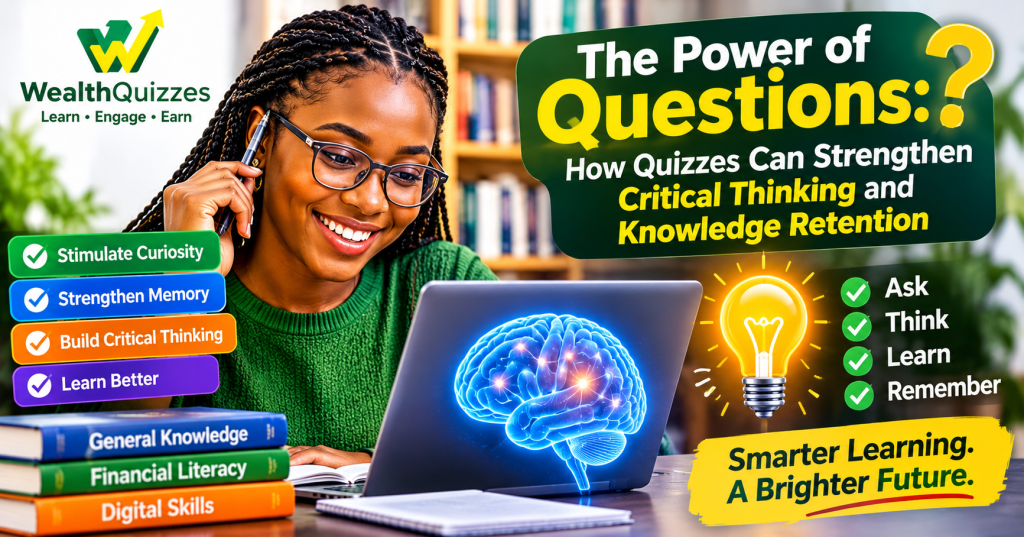
The Power of Questions: How Quizzes Can Strengthen Critical Thinking and Knowledge Retention
Introduction
Questions are among the most powerful instruments in learning. A well-designed question does more than test what a person already knows: it stimulates curiosity, activates memory, exposes gaps in understanding and encourages the learner to think more carefully about information.
This is why quizzes should not be regarded merely as entertainment or instruments for measuring academic performance. When properly designed, they can become effective learning tools that encourage active participation, strengthen knowledge retention and develop the ability to analyse information.
For WealthQuizzes, this presents an important opportunity. A knowledge-based quiz platform can offer more than a sequence of questions and answers. It can create an engaging environment in which users are encouraged to recall information, evaluate possible answers, learn from mistakes and progressively improve their understanding.
The effectiveness of such a platform, however, depends on the quality of its questions, the accuracy of its content, the appropriateness of its difficulty levels and the usefulness of the feedback provided to participants.
1. Questions Stimulate Curiosity and Active Learning
Curiosity is an important driver of intellectual development. People are naturally inclined to seek explanations when confronted with unfamiliar information, challenging problems or questions that expose gaps in their understanding.
A good question creates an intellectual invitation. It encourages a person to pause, consider possibilities and search for an answer. Rather than simply receiving information, the learner becomes actively involved in the process of discovering it.
Consider the difference between reading the statement that inflation reduces purchasing power and answering the question:
If the price of essential goods increases while a person’s income remains unchanged, what happens to that person’s purchasing power?
The second approach requires the learner to apply an idea rather than merely recognise a sentence. It encourages the participant to connect economic concepts with practical experience.
This distinction is important because passive exposure to information does not necessarily produce meaningful understanding. Active learning requires learners to engage with ideas, retrieve relevant knowledge and make connections.
Questions can therefore transform ordinary information into an intellectual exercise. They make learning participatory, encourage curiosity and provide a reason to investigate subjects beyond what is immediately familiar.
2. Retrieval Practice: How Quizzes Strengthen Knowledge Retention
One of the most important contributions of educational psychology to quiz-based learning is the concept of retrieval practice.
Retrieval practice involves deliberately recalling information from memory rather than simply reviewing or rereading it. When a learner attempts to remember a fact, concept or explanation, the process of retrieval can strengthen subsequent access to that information.
This phenomenon is widely known as the testing effect.
In their influential 2006 study, Test-Enhanced Learning: Taking Memory Tests Improves Long-Term Retention, Henry L. Roediger III and Jeffrey D. Karpicke investigated whether testing could improve memory beyond the benefits of repeated studying. Their experiments demonstrated that participants who practised recalling information performed better on delayed retention tests than those who repeatedly restudied the same material.
The researchers showed that testing is not simply a means of measuring learning; it can also contribute to learning itself.
This finding has important implications for digital quizzes. When users repeatedly encounter questions that require them to recall previously learned information, they have opportunities to strengthen their memory.
For example, a participant who answers questions about budgeting, savings, inflation and investment principles may gradually become more familiar with those concepts through repeated retrieval.
However, repetition must be purposeful. Asking the same question repeatedly within a short period may produce familiarity without necessarily developing deeper understanding. A more effective approach is to revisit important concepts at intervals, vary the wording and require learners to apply what they have previously encountered.
The objective should be to help users remember and understand information beyond the immediate quiz session.
3. Developing Critical Thinking Through Better Questions
Critical thinking involves examining information carefully, evaluating evidence, identifying assumptions, analysing arguments and reaching reasoned conclusions.
Not every quiz question develops these abilities equally.
A question that asks a participant to identify the capital of a country may test factual recall. A question that presents a financial scenario and asks the participant to identify the most reasonable course of action requires a different level of thinking.
Both forms of questions have educational value, but they serve different purposes.
A well-designed quiz should include questions that progressively move beyond simple recognition and recall to comprehension, application and analysis.
Consider the following examples:
Recall: What is inflation?
Comprehension: Why does inflation reduce the purchasing power of money?
Application: If the cost of essential goods increases by 15% while income remains unchanged, what practical effect is likely to occur?
Analysis: Which of two household budgets is more vulnerable to rising prices, and what evidence supports that conclusion?
The progression illustrates how questions can encourage increasingly sophisticated engagement with information.
Bloom’s revised taxonomy, developed by Lorin Anderson and David Krathwohl and based on the earlier work of Benjamin Bloom, provides a useful framework for thinking about educational objectives. It identifies six cognitive processes: remembering, understanding, applying, analysing, evaluating and creating.
Although a quiz platform may not be able to assess every level equally, the framework offers a valuable guide for designing questions that go beyond memorisation.
For WealthQuizzes, the implication is that quiz content should not consist exclusively of questions testing isolated facts. Where appropriate, it should also introduce practical scenarios, comparisons, cause-and-effect relationships and questions requiring participants to interpret information.
This would make the experience more intellectually stimulating and potentially more useful in everyday life.
4. The Importance of Well-Designed Questions
The educational value of a quiz depends substantially on the quality of its questions.
A poorly written question can confuse participants, produce unreliable results and undermine confidence in the platform. A well-written question, by contrast, communicates clearly what is being tested and gives participants a fair opportunity to demonstrate their knowledge.
Effective questions should satisfy several important requirements.
Clarity: The wording should be understandable and unambiguous. Participants should not have to guess what the question means.
Relevance: Questions should relate to the intended subject or learning objective. Unnecessary complexity should not distract from the knowledge being assessed.
Accuracy: Every question and its associated answer should be factually correct and supported by reliable information.
Appropriate scope: Questions should test knowledge that is reasonably connected to the subject matter and level of difficulty.
Fairness: Questions should not depend on misleading wording, hidden assumptions or irrelevant cultural references that unnecessarily disadvantage participants.
Answer validity: Where a question requires one correct answer, the alternatives should be carefully reviewed to ensure that only one option is defensibly correct.
These requirements are especially important for multiple-choice questions. Distractors—the incorrect answer options—should be plausible enough to test understanding, but not so ambiguous that they create legitimate uncertainty about the correct answer.
A quiz should challenge knowledge, not exploit poor wording.
5. Appropriate Difficulty: Finding the Balance Between Challenge and Frustration
Difficulty is another important consideration in quiz design.
If questions are consistently too easy, participants may become bored and fail to develop their knowledge. If questions are excessively difficult, obscure or unrelated to the expected level of understanding, users may become discouraged.
The objective should be to establish a reasonable progression that challenges participants while remaining fair and educationally meaningful.
A useful approach is to organise questions into different levels:
- Foundational questions: Test essential facts, definitions and basic concepts.
- Intermediate questions: Require comprehension, interpretation and the application of knowledge.
- Advanced questions: Require more detailed analysis, comparison, evaluation or specialised knowledge.
This structure enables a platform to accommodate participants with different levels of prior knowledge.
Difficulty should not, however, be confused with obscurity. A question is not necessarily educationally superior simply because very few people can answer it. Questions about obscure details may test specialised recall without developing meaningful understanding.
Similarly, trick questions are not automatically evidence of intellectual sophistication. They may reward attention to unusual wording rather than knowledge of the subject.
A good question should be challenging for a defensible reason.
For WealthQuizzes, progressive difficulty can make participation more engaging, provided that each level maintains factual accuracy, appropriate wording and a reasonable relationship between the expected knowledge and the challenge presented.
6. Feedback: Turning Wrong Answers into Learning Opportunities
One of the most valuable features of an effective quiz is meaningful feedback.
A participant who selects an incorrect answer should have an opportunity to understand why that answer was wrong and what the correct answer means.
Simply displaying a red cross or the words Wrong Answer may communicate the outcome, but it does little to explain the underlying concept.
Meaningful feedback should ideally provide:
- The correct answer.
- A brief explanation of why it is correct.
- Clarification of the misconception behind common incorrect answers, where appropriate.
- A useful example or reference that supports further understanding.
For example, if a participant incorrectly identifies inflation as an increase in the value of money, the feedback should explain that inflation generally refers to a sustained increase in the overall price level of goods and services, which reduces the purchasing power of money, all other relevant factors being equal.
That explanation turns an unsuccessful attempt into a learning opportunity.
The Education Endowment Foundation (EEF), in its guidance report Teacher Feedback to Improve Pupil Learning, emphasises that effective feedback should be grounded in sound initial instruction and an understanding of learners’ gaps in knowledge. The important consideration is not simply whether feedback is delivered, but whether it helps learners make progress.
The same principle applies to digital quizzes.
Feedback should be accurate, relevant and understandable. It should correct misconceptions without humiliating participants or making them feel that mistakes are evidence of inability.
A platform that treats incorrect answers as opportunities for improvement can encourage a more constructive relationship with learning.
7. Accuracy and Research: Protecting the Integrity of Quiz Content
Accuracy is non-negotiable in educational content.
A quiz that contains incorrect answers, misleading explanations or outdated information can teach users the wrong things. Repeated exposure to inaccurate material may create false confidence and undermine the credibility of the platform.
For this reason, quiz content should be developed through a structured editorial process.
Important measures include:
Research from credible sources: Questions should be based on reputable publications, recognised institutions, authoritative databases and reliable reference materials.
Independent verification: Important factual claims and answer keys should be checked before publication.
Editorial review: Questions should be reviewed for clarity, grammar, ambiguity and factual consistency.
Subject-matter review: Questions involving specialised subjects, such as finance, law, science or public policy, should receive appropriate expert scrutiny.
Regular updating: Questions involving changing information should be reviewed periodically.
Correction procedures: Users should have a way to report suspected errors, and verified errors should be corrected promptly.
The importance of these safeguards cannot be overstated. A platform that presents itself as a source of knowledge must take responsibility for the quality of the information it distributes.
For WealthQuizzes, this is also a matter of brand credibility. Users should be confident that the questions are properly researched and that the correct answers are defensible.
The objective should be to establish an editorial standard under which every published question has a clear purpose, a verified answer and an appropriate explanation.
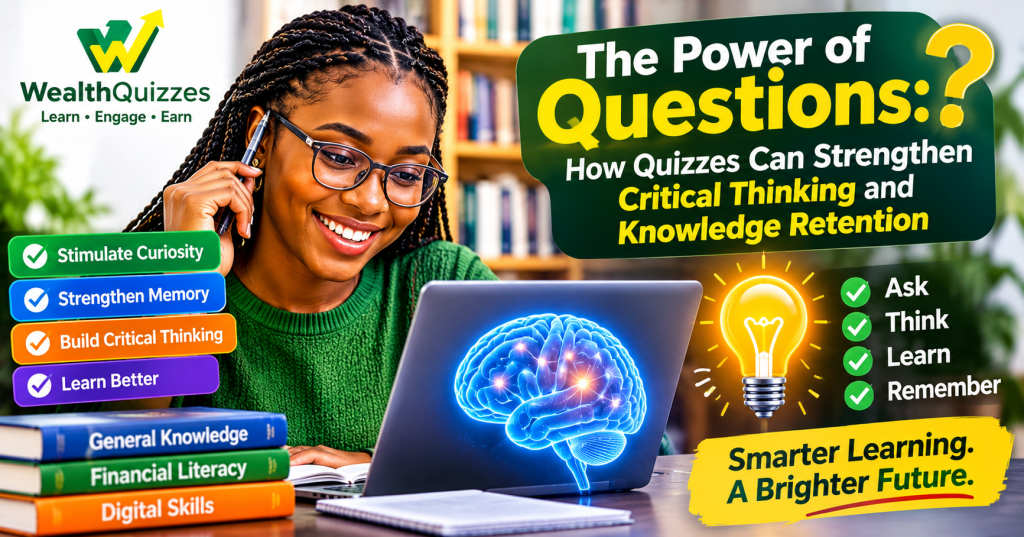
8. Spaced Practice: Why Learning Should Continue Beyond One Quiz Session
Knowledge retention is not necessarily achieved through a single successful attempt.
Information can become difficult to recall when it is not revisited. One way to address this is through distributed practice, commonly known as spaced learning.
Distributed practice involves spreading learning activities across different periods rather than concentrating all practice into one session.
In their 2013 review, Improving Students’ Learning With Effective Learning Techniques, John Dunlosky and his co-authors identified both practice testing and distributed practice as highly useful learning techniques.
A subsequent meta-analysis by Gregory Donoghue and John Hattie, published in Frontiers in Education in 2021, examined 242 studies involving 169,179 participants and identified practice testing and distributed practice among the most effective techniques reviewed.
These findings support a useful approach for quiz platforms: important concepts should be revisited at suitable intervals.
For example, a participant who answers questions about compound interest today may encounter related questions several days later, perhaps in a different practical context.
This approach can help reinforce previous learning and test whether the participant can still retrieve and apply the concept.
Digital platforms can support spaced practice through recurring challenges, revision questions, topic-based quizzes and carefully designed question rotation.
The objective is not simply to keep users answering questions. It is to help them retain and use what they have learned.
9. The Role of Digital Platforms in Making Learning Engaging
Digital platforms offer opportunities to make learning more accessible and interactive.
Traditional learning environments may be limited by time, location and available teaching resources. A well-designed digital quiz platform can enable users to engage with knowledge across different subjects and at times that suit them.
It can also introduce features that encourage participation, including:
- Subject-based quiz categories.
- Progressive levels of difficulty.
- Timed challenges.
- Recurring knowledge exercises.
- Explanations following selected answers.
- Progress indicators.
- Performance summaries.
- Opportunities to revisit previously attempted topics.
These features should serve educational objectives rather than become distractions.
For example, a countdown timer may add excitement and encourage quick recall, but excessive time pressure can disadvantage thoughtful learners or shift the focus from understanding to speed. Timed quizzes should therefore be used where speed is relevant to the intended activity, not as a substitute for educational quality.
Similarly, scores and rankings can motivate some participants, but they should not be the only measures of learning. A person who improves their understanding over time may be making meaningful progress even if they do not consistently achieve the highest score.
The most effective digital learning experiences combine engagement with substance.
10. WealthQuizzes: Making Every Question an Opportunity to Learn
WealthQuizzes has an opportunity to position its knowledge-based quiz experience as more than a competition for correct answers.
Its Learn • Engage • Earn proposition can be strengthened by ensuring that questions are not only engaging but also accurate, relevant and intellectually worthwhile.
Several practical priorities deserve attention.
First, establish strong content standards. Every question should have a clearly defined subject, verified answer and appropriate supporting reference. Questions should undergo editorial and factual review before publication.
Second, balance recall with comprehension and application. The question bank should include a mixture of factual questions, conceptual questions and practical scenarios. This will help participants engage with knowledge at different levels.
Third, maintain progressive difficulty. Questions should become more challenging in a logical and defensible manner, without relying on ambiguity or obscure information.
Fourth, provide meaningful explanations where the product design permits. Participants should have opportunities to understand why an answer is correct, particularly when they make mistakes. Where immediate explanations are not feasible during a timed session, explanations could be made available after the session.
Fifth, introduce opportunities for revision. Previously covered topics can be revisited through recurring challenges and varied questions to encourage longer-term retention.
Sixth, monitor question quality. Management should review questions that generate unusual patterns of incorrect responses, repeated complaints or disputes about answer accuracy. Such patterns may reveal poor wording, ambiguous options or factual errors.
Seventh, measure more than scores. Where technically feasible, WealthQuizzes should evaluate participation, repeat engagement, improvement in topic-based performance and user feedback. These indicators can help determine whether the platform is supporting meaningful learning rather than merely generating activity.
These measures should be implemented progressively and assessed against actual user data. A platform should not claim to have improved users’ knowledge or financial literacy without evidence capable of supporting that conclusion.
11. Measuring the Educational Value of Quizzes
If a digital quiz platform intends to contribute meaningfully to learning, it should develop ways to assess whether its activities are achieving that purpose.
Useful indicators may include:
| Area | Suggested measurement |
|---|---|
| Participation | Number of completed quiz sessions |
| Knowledge retention | Performance on delayed questions covering previously tested concepts |
| Comprehension | Ability to answer questions requiring explanation or interpretation |
| Application | Performance on practical scenario-based questions |
| Improvement | Changes in performance across comparable attempts |
| Content quality | Number of verified errors, disputed questions and corrected items |
| Feedback effectiveness | Whether explanations improve subsequent responses |
| User experience | Participant satisfaction and perceived educational value |
One particularly useful method is delayed assessment. Instead of evaluating performance only immediately after a quiz, a platform can revisit selected concepts after an interval and examine whether participants still remember them.
This provides a more meaningful indication of retention than an isolated score.
It is also important to recognise the limitations of quiz data. A high score does not necessarily prove deep understanding, just as a low score does not necessarily indicate an absence of knowledge. Performance may be influenced by time pressure, question wording, prior familiarity and other factors.
Evaluation should therefore combine quantitative performance data with appropriate qualitative feedback.
Conclusion: Better Questions Create Better Learning Opportunities
Questions are not merely instruments for determining who knows the correct answer. Properly designed, they stimulate curiosity, encourage active recall, test comprehension, develop analytical thinking and reinforce knowledge over time.
Research in cognitive and educational psychology supports the use of practice testing and distributed practice as effective learning techniques. However, their value depends on sound implementation. Questions must be accurate, clear, relevant and appropriately challenging. Feedback should explain mistakes and reinforce correct understanding. Important concepts should be revisited, and the educational value of quiz activities should be evaluated rather than assumed.
For WealthQuizzes, this presents an opportunity to build a platform where knowledge is not simply tested but continually explored, reinforced and applied.
A good quiz challenges the mind. A better quiz also teaches. And a well-designed sequence of questions can turn an ordinary digital interaction into a meaningful learning experience.
The power of questions lies not merely in the answers they produce, but in the thinking, understanding and lasting knowledge they help create.
Selected Authorities and Further Reading
- Roediger, H. L. III and Karpicke, J. D. (2006). “Test-Enhanced Learning: Taking Memory Tests Improves Long-Term Retention.” Psychological Science, 17(3), 249–255. Read the research article.
- Roediger, H. L. III and Karpicke, J. D. (2006). “The Power of Testing Memory: Basic Research and Implications for Educational Practice.” Perspectives on Psychological Science, 1(3), 181–210. Read the research article.
- Dunlosky, J., Rawson, K. A., Marsh, E. J., Nathan, M. J. and Willingham, D. T. (2013). “Improving Students’ Learning With Effective Learning Techniques.” Psychological Science in the Public Interest, 14(1), 4–58. Read the research review.
- Donoghue, G. M. and Hattie, J. A. C. (2021). “A Meta-Analysis of Ten Learning Techniques.” Frontiers in Education, 6. Read the meta-analysis.
- Anderson, L. W. and Krathwohl, D. R. (eds.) (2001). A Taxonomy for Learning, Teaching, and Assessing: A Revision of Bloom’s Taxonomy of Educational Objectives. Longman.
- Education Endowment Foundation (EEF). Teacher Feedback to Improve Pupil Learning: Guidance Report. Read the guidance.
These sources provide research-based guidance on retrieval practice, knowledge retention, learning assessment, cognitive development and effective feedback. Their findings support the educational potential of well-designed quizzes, but do not establish that every quiz format or competitive reward structure produces the same learning outcomes.


