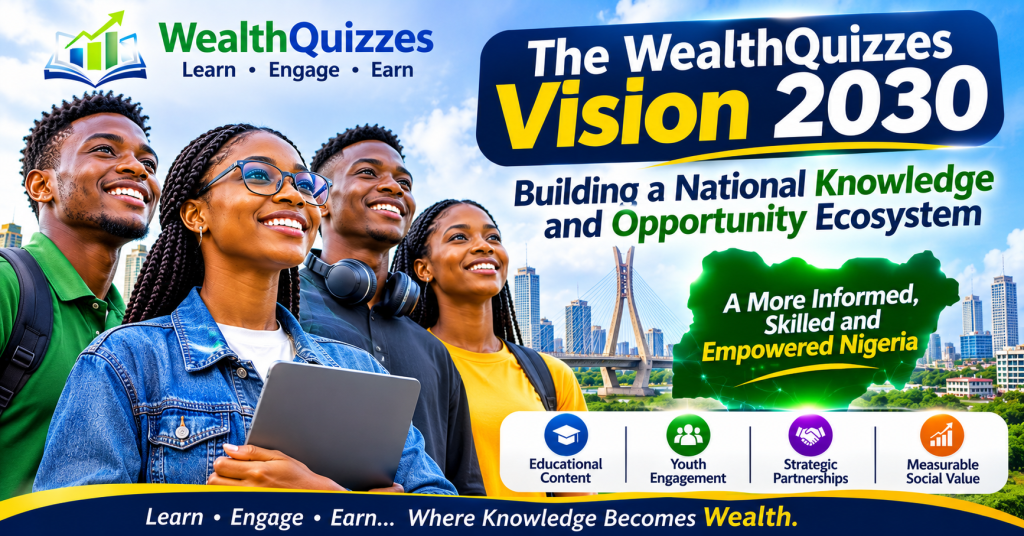
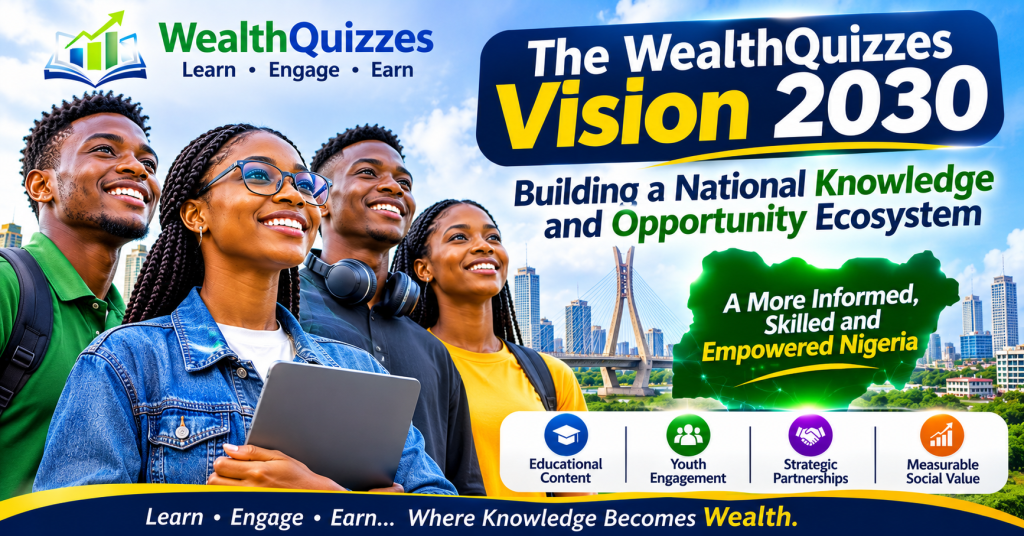
The WealthQuizzes Vision 2030: Building a National Knowledge and Opportunity Ecosystem
A forward-looking commitment to responsible digital growth, youth participation and measurable social value
Nigeria’s digital future will be shaped not only by the technologies its people consume, but also by the knowledge they acquire, the opportunities they can access and the capacity of local innovators to develop solutions that respond to their needs.
As the country continues to embrace digital transformation, an important opportunity exists to build platforms that combine knowledge, technology, meaningful participation and practical opportunities for young people. Such platforms can contribute to a more informed, digitally engaged and economically productive population.
It is against this background that WealthQuizzes envisages its long-term ambition towards 2030: to evolve beyond a knowledge-based digital quiz and engagement platform into a broader national knowledge and opportunity ecosystem.
The WealthQuizzes Vision 2030 is not a claim that this transformation has already been achieved. It is a forward-looking strategic ambition built around responsible growth, strategic partnerships, educational content, broader digital access, youth participation, local innovation and measurable social value.
Its central proposition is that digital participation should offer more than entertainment or passive screen time. It should create opportunities for people to learn, test their knowledge, engage with relevant information, develop useful competencies and participate in an increasingly digital economy.
The ambition is to build an ecosystem where knowledge creates opportunities, participation generates value and responsible partnerships help extend that value across Nigeria.
1. Building on a changing Nigerian digital landscape
Nigeria possesses considerable potential for digital innovation. Its large and youthful population, entrepreneurial culture, expanding technology sector and growing demand for digital services create opportunities for locally developed platforms to serve important social and commercial needs.
However, the country’s digital transformation remains uneven.
The World Bank’s Nigeria Digital Economy Diagnostic: A Plan for Building Nigeria’s Inclusive Digital Future identifies five foundational pillars of digital development: digital infrastructure, digital platforms, digital financial services, digital entrepreneurship and digital skills. It emphasises that strategic investment and innovation across these areas are necessary to unlock Nigeria’s digital economic potential.
The International Telecommunication Union’s Facts and Figures 2025 also illustrates the scale of the global digital divide. Its estimates indicate that approximately 74% of the world’s population used the internet in 2025, while Africa’s internet usage stood at approximately 36%. The figures demonstrate that digital expansion must be accompanied by attention to affordability, meaningful access, skills and inclusion.
For WealthQuizzes, these realities reinforce the importance of developing a platform that is relevant to Nigerian users and capable of growing through partnerships, accessibility and responsible innovation.
The vision is not simply to attract more users. It is to create a digital environment in which participation has educational, intellectual and practical value.
2. From a quiz platform to a national knowledge ecosystem
At its foundation, WealthQuizzes is a knowledge-based digital engagement platform built around quizzes, participation and conditional rewards. Its existing model provides a starting point for a broader vision of knowledge engagement.
By 2030, the ambition is to develop a more connected ecosystem that could bring together several complementary activities.
These include:
- Interactive knowledge quizzes and challenges.
- Financial-literacy and business-education content.
- General knowledge, Nigerian history and cultural education.
- Sports, entertainment and other interest-based knowledge activities.
- Educational articles, guides and digital learning resources.
- Sponsored knowledge competitions and themed engagement programmes.
- Opportunities for researchers, writers, educators and digital content contributors.
- Community participation and knowledge-sharing initiatives.
- Strategic partnerships with corporations, educational institutions and development organisations.
The objective is to create multiple entry points through which people can engage with knowledge according to their interests, needs and levels of experience.
A user interested in football, for example, could participate in sports knowledge challenges, while another interested in entrepreneurship could engage with business and financial-literacy content.
Over time, these different experiences could form part of a wider knowledge ecosystem that encourages curiosity, continuous learning and informed participation.
This expansion should be gradual. New services should be introduced only where there is a credible user need, adequate technical capacity, appropriate funding and a clear operational plan.
3. Making educational content a central pillar of growth
A sustainable knowledge ecosystem requires more than questions and answers. It requires reliable, relevant and regularly updated educational content.
One of the proposed priorities of WealthQuizzes Vision 2030 is therefore to strengthen the educational dimension of the platform.
This could involve developing or commissioning explanatory articles, short learning guides, financial-literacy resources, knowledge briefs, educational videos and subject-specific learning materials.
The content could cover areas such as:
Financial literacy: Budgeting, savings, responsible borrowing, digital payments, fraud prevention, financial planning and basic investment concepts.
Entrepreneurship and business knowledge: Business planning, customer relations, marketing, business finance, innovation and responsible enterprise development.
Digital literacy: Online safety, digital communication, information verification, cybersecurity awareness and responsible technology use.
Nigerian history and culture: National history, cultural heritage, significant personalities, historical events, literature and the preservation of indigenous knowledge.
General knowledge and civic awareness: Science, geography, public institutions, environmental awareness, citizenship and contemporary social issues.
The objective would be to complement quiz participation with opportunities to understand the subjects being tested.
For example, a participant who answers a question about compound interest could be directed to a short explanatory resource. A quiz on online fraud could be accompanied by guidance on recognising suspicious communications and protecting personal information.
This approach would make the platform more educationally useful than a system that merely records correct and incorrect answers.
UNESCO’s 2023 Global Education Monitoring Report, Technology in Education: A Tool on Whose Terms?, provides an important caution. It observes that robust evidence of the added value of educational technology remains limited and stresses that technology should serve educational objectives rather than become an objective in itself.
WealthQuizzes should therefore approach educational content with clear learning objectives, credible sources, editorial review and appropriate assessment methods. Digital technology should facilitate learning, not substitute for educational quality.
4. Promoting financial literacy and informed decision-making
Financial literacy presents a particularly relevant opportunity for a platform seeking to combine knowledge and practical participation.
Many young Nigerians encounter financial decisions involving income, spending, savings, borrowing, digital payments and financial security. Yet access to financial products does not automatically translate into the ability to make informed financial decisions.
WealthQuizzes could contribute to financial education by developing accessible, interactive content that explains essential financial concepts in practical and understandable terms.
Potential initiatives include:
- Sponsored financial-literacy challenges.
- Budgeting and savings knowledge campaigns.
- Digital financial security and fraud-awareness programmes.
- Responsible borrowing and credit-awareness education.
- Entrepreneurship and small-business knowledge challenges.
- Interactive learning programmes developed with financial institutions.
The Central Bank of Nigeria’s National Financial Literacy Framework provides a relevant national policy foundation for such initiatives. It recognises the importance of financial education, stakeholder collaboration, target-group segmentation and monitoring and evaluation.
Financial institutions could support relevant programmes through sponsorship, technical contributions, educational content, subject-matter expertise and distribution channels.
However, WealthQuizzes should distinguish educational participation from financial advice, investment recommendations or guaranteed financial outcomes. A participant’s improved performance in a financial-literacy quiz does not automatically establish that the individual has changed financial behaviour or achieved financial security.
Those outcomes require more rigorous and longer-term evaluation.
5. Expanding digital access and participation across Nigeria
A national knowledge ecosystem must be accessible beyond a limited group of urban, well-connected users.
Nigeria’s digital divide presents both a challenge and an opportunity for responsible expansion.
The ITU’s Measuring Digital Development: The State of Digital Development and Trends in the Africa Region reports substantial disparities in internet use between urban and rural populations across Africa. Its 2024 figures show internet usage of approximately 57% in urban areas compared with 23% in rural areas.
These figures demonstrate why digital inclusion must be treated as a practical design consideration.
WealthQuizzes Vision 2030 could pursue broader access through several measures:
Mobile accessibility: Continue improving the user experience across supported devices, particularly affordable Android smartphones.
Low-data design: Where technically feasible, optimise pages, images and other digital content to reduce unnecessary data consumption.
Connectivity partnerships: Explore arrangements with telecommunications companies and other relevant stakeholders that could make participation more affordable or accessible.
Community outreach: Work with schools, tertiary institutions, youth organisations, community groups and other credible local partners to introduce relevant knowledge programmes.
Inclusive content: Develop content that reflects different educational backgrounds, interests and levels of digital familiarity.
Accessibility improvements: Consider users with disabilities and other groups who may encounter barriers when using conventional digital interfaces.
These initiatives would require testing, investment and collaboration. WealthQuizzes cannot independently resolve Nigeria’s wider infrastructure, electricity or affordability challenges. However, it can design its services with those constraints in mind and work with partners capable of addressing them.
The ambition should be to make participation increasingly accessible without compromising platform security, reliability or content quality.
6. Creating meaningful opportunities for young Nigerians
Youth participation should be more than a marketing category. It should be an important component of the ecosystem’s development strategy.
WealthQuizzes could provide opportunities for young Nigerians to participate as users, knowledge contributors, researchers, writers, editors, content creators, community coordinators and digital professionals.
A structured contributor programme could, subject to funding and actual business requirements, engage individuals with relevant skills in:
- Quiz-question development and research.
- Fact-checking and editorial review.
- Educational writing and publishing.
- Graphic design and video production.
- Digital marketing and communications.
- Community coordination and user support.
- Technology development and product testing.
Such opportunities could provide practical experience and contribute to the growth of Nigeria’s digital creative and knowledge economy.
However, it is important to maintain a clear distinction between participation opportunities and guaranteed employment. Contributor engagements should be based on genuine work requirements, transparent selection procedures, clearly defined deliverables and fair compensation arrangements where work is commissioned.
The platform could also explore educational collaborations, internships and mentorship arrangements with appropriate institutions and professional organisations.
The broader objective is to create an environment in which young Nigerians are not merely consumers of digital products but can also contribute to the development of knowledge, content, technology and enterprise.
7. Building strategic corporate and institutional partnerships
No digital platform can achieve a genuinely national vision through independent effort alone.
Strategic partnerships will be essential to the WealthQuizzes Vision 2030.
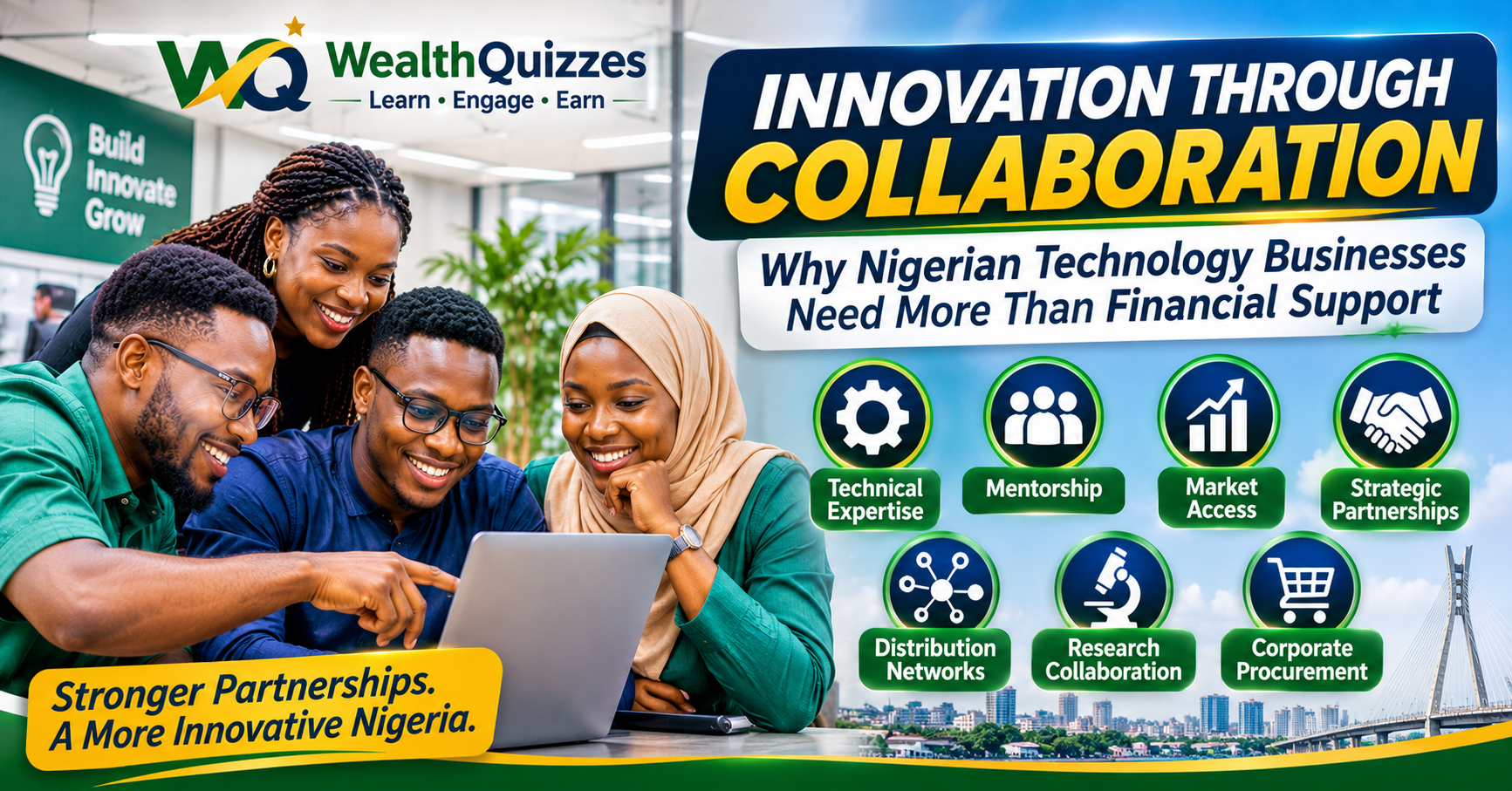
Banks, telecommunications companies, insurance providers, technology firms, educational institutions, media organisations, manufacturers, development agencies and other relevant organisations could contribute different forms of expertise and resources.
The potential partnership opportunities are extensive.
Financial institutions could support financial-literacy programmes, savings education, fraud-awareness campaigns and responsible financial engagement.
Telecommunications companies could explore connectivity support, digital inclusion initiatives, youth engagement programmes and sponsored knowledge challenges.
Educational institutions could collaborate on subject-specific content, knowledge assessments, research and structured learning programmes.
Technology companies could support technical development, cybersecurity, product improvement and digital skills initiatives.
Consumer brands and manufacturers could sponsor themed knowledge campaigns that connect their brands with relevant audiences and educational activities.
Development organisations could explore carefully designed programmes aligned with relevant objectives relating to education, youth development, digital inclusion and economic participation.
These partnerships should be built around clear responsibilities, realistic budgets, measurable objectives and transparent reporting.
WealthQuizzes should not pursue partnerships merely to accumulate logos or announcements. A partnership should have a defined purpose and deliver identifiable value to the participating organisations and intended beneficiaries.
8. Responsible growth, trust and institutional credibility
Long-term growth is meaningful only when it is accompanied by responsible operations.
As WealthQuizzes expands, the importance of trust, governance and regulatory compliance will increase.
The platform should progressively strengthen the following areas:
Data protection and privacy: Personal information should be collected and processed lawfully, transparently and securely, in accordance with the Nigeria Data Protection Act 2023 and applicable regulatory requirements.
Cybersecurity: Appropriate technical and organisational measures should be adopted to protect accounts, systems, payment processes and user information.
Transparent participation rules: Subscription arrangements, quiz rules, reward eligibility, promotional credits and withdrawal conditions should be clearly communicated and consistently administered.
Responsible reward communication: Rewards should be described accurately as conditional on applicable programme rules and performance. Marketing should not suggest guaranteed earnings or portray participation as a reliable source of income.
Content integrity: Questions and educational materials should be fact-checked, periodically reviewed and updated where necessary.
User protection: Complaints, disputes and technical problems should be addressed through accessible and documented support procedures.
Corporate governance: As the business grows, it should maintain appropriate financial records, internal controls, contractual arrangements and management accountability.
The Nigeria Startup Act 2022 and the National Digital Economy Policy and Strategy (2020–2030) provide relevant policy context for technology entrepreneurship and digital innovation. The Nigeria Data Protection Act 2023 provides an important statutory framework for the responsible handling of personal data.
Trust should not be treated as a promotional slogan. It must be demonstrated through consistent conduct, reliable service and accountability.
9. Measuring social value, not just platform growth
One of the defining features of WealthQuizzes Vision 2030 should be a commitment to measuring outcomes rather than relying exclusively on download figures, registrations or publicity.
The platform should progressively develop a measurement framework that captures both commercial performance and social value.
Potential indicators include:
| Strategic area | Proposed indicators |
|---|---|
| User participation | Registered users, active users, repeat participation and retention |
| Knowledge engagement | Quiz sessions, completion rates and subject-area participation |
| Educational value | Baseline and endline assessment scores, knowledge improvement and learning retention |
| Financial literacy | Understanding of savings, budgeting, borrowing and digital financial security |
| Digital inclusion | Participation across locations, gender groups and relevant underserved communities |
| Youth development | Contributors engaged, assignments completed, skills activities and mentorship participation |
| Partnerships | Active sponsors, programmes delivered, partner satisfaction and renewal rates |
| Commercial sustainability | Revenue, customer retention, operating costs and programme cost-effectiveness |
| User experience | Satisfaction, complaints, resolution times and platform reliability |
These indicators should be supported by reliable data collection and transparent reporting.
Where possible, programmes should establish baseline measurements before activities begin and conduct endline assessments afterwards.
The platform should also distinguish outputs from outcomes. The number of quizzes completed is an output. Demonstrated improvement in knowledge is an outcome. A sustained change in financial behaviour is a longer-term result that requires additional evidence.
This distinction is consistent with the OECD’s evaluation principles, which emphasise relevance, effectiveness, efficiency, impact and sustainability.
A credible annual impact report could eventually document the platform’s activities, partnerships, participation figures, learning assessments, inclusion initiatives, operational improvements and limitations.
Such reporting would help stakeholders understand what WealthQuizzes has actually achieved, what remains under development and where further investment is needed.
10. A practical roadmap towards 2030
A national vision requires an implementation strategy. WealthQuizzes should therefore pursue progressive development rather than attempt to introduce every proposed initiative simultaneously.
The following roadmap provides an illustrative framework.
2026–2027: Consolidation and institutional credibility
The immediate priority should be to strengthen the existing platform and establish the foundations for responsible growth.
Key priorities could include:
- Improving platform stability and user experience.
- Strengthening customer support and user communication.
- Developing reliable performance analytics.
- Improving educational content quality.
- Conducting structured sponsor-supported pilot programmes.
- Establishing clear partnership and reporting frameworks.
- Strengthening data protection, security and operational governance.
The objective is to demonstrate that the platform can deliver organised, measurable programmes reliably.
2028: Programme development and wider partnerships
With operational experience and stronger evidence, WealthQuizzes could expand its partnership activities.
Potential priorities include:
- More structured financial-literacy programmes.
- Corporate-sponsored knowledge challenges.
- Educational content collaborations.
- Contributor and digital creator initiatives.
- Partnerships with educational and youth organisations.
- Improved accessibility and connectivity initiatives.
Expansion should be based on demonstrated demand, adequate funding and lessons from earlier programmes.
2029: Wider geographical and institutional participation
The next stage could focus on extending successful programmes to additional states, communities and participant groups.
Possible priorities include:
- Partnerships with institutions in different geopolitical zones.
- Broader community-based knowledge programmes.
- More inclusive digital participation initiatives.
- Expanded content across Nigerian history, culture, business and education.
- Stronger programme evaluation and impact reporting.
The objective would be to move towards wider national participation while maintaining service quality.
2030: A recognised national knowledge and opportunity ecosystem
By 2030, the ambition would be for WealthQuizzes to have developed into a more mature digital knowledge ecosystem supported by credible partnerships, reliable educational content, measurable participation and sustainable operations.
The desired position would include:
- A stronger and more diverse national user community.
- Established corporate and institutional partnerships.
- A broader library of relevant educational content.
- Structured opportunities for knowledge contributors and digital creators.
- Demonstrable learning and engagement outcomes from supported programmes.
- Improved access for different categories of Nigerian users.
- Transparent annual performance and impact reporting.
- A commercially sustainable operating model.
These are strategic ambitions, not guaranteed outcomes. Their achievement will depend on funding, execution, technology, partnerships, market acceptance and the ability to adapt to changing conditions.
11. Aligning the vision with national and global development priorities
The WealthQuizzes Vision 2030 has potential areas of alignment with several United Nations Sustainable Development Goals.
SDG 4 – Quality Education: Through accessible knowledge content, digital learning resources and structured educational engagement.
SDG 8 – Decent Work and Economic Growth: Through responsible digital entrepreneurship, contributor opportunities and participation in the knowledge economy.
SDG 9 – Industry, Innovation and Infrastructure: Through the development and improvement of a locally operated digital platform and collaboration with technology partners.
SDG 10 – Reduced Inequalities: Through efforts to broaden access to digital knowledge and participation among underserved groups.
SDG 17 – Partnerships for the Goals: Through collaboration with corporations, educational institutions, development organisations and other stakeholders.
These connections should be understood as areas of potential contribution, not proof that WealthQuizzes has already achieved the relevant SDG targets.
The United Nations’ 2030 Agenda provides a framework for addressing interconnected development challenges. WealthQuizzes can use the SDGs as a reference for designing programmes, selecting relevant indicators and communicating its intended social contribution.
Conclusion: A vision built on knowledge, participation and opportunity
The WealthQuizzes Vision 2030 represents an ambitious opportunity to build on the platform’s knowledge-based digital engagement model and develop a broader ecosystem serving Nigerian users, corporate partners, educational stakeholders and the wider community.
Its success will not be determined by the number of promotional campaigns launched or the speed at which the platform expands. It will depend on the quality of its products, the relevance of its content, the trust it earns, the partnerships it develops and the measurable value it delivers.
The journey will require investment, technical improvement, disciplined management, responsible communication and a willingness to evaluate performance honestly.
For corporate partners, the opportunity is to participate in the development of a locally relevant digital platform through structured programmes that connect brand engagement with knowledge, youth participation and measurable outcomes.
For young Nigerians, the ambition is to create more accessible opportunities to engage with knowledge, develop useful understanding and contribute to the digital economy.
For the broader Nigerian technology ecosystem, the vision is to demonstrate how a homegrown digital innovation can grow through local understanding, responsible partnerships and sustained value creation.
By 2030, WealthQuizzes aspires to be more than a place where people answer questions. It seeks to become a platform through which knowledge connects people to learning, participation, creativity and opportunity.
The vision is ambitious, but its implementation must remain practical: build responsibly, partner strategically, measure honestly and expand on evidence.
Because the future of Nigeria’s digital economy should not be defined only by how many people are connected, but also by what they can learn, create, contribute and achieve through that connection.
WealthQuizzes — Learn • Engage • Earn. Where knowledge becomes wealth.
Selected Authorities and Further Reading
- World Bank (2019), Nigeria Digital Economy Diagnostic: A Plan for Building Nigeria’s Inclusive Digital Future.
Examines the foundations of Nigeria’s digital economy, including infrastructure, digital platforms, financial services, entrepreneurship and digital skills.
https://www.worldbank.org/en/country/nigeria/publication/nigeria-digital-economy-diagnostic-a-plan-for-building-nigerias-inclusive-digital-future - Federal Ministry of Communications and Digital Economy, National Digital Economy Policy and Strategy (2020–2030).
Provides Nigeria’s policy framework for digital transformation and economic development.
https://nitda.gov.ng/wp-content/uploads/2020/06/National-Digital-Economy-Policy-and-Strategy.pdf - International Telecommunication Union (2025), Measuring Digital Development: Facts and Figures 2025.
Provides current international and regional evidence on internet use, connectivity and digital divides.
https://www.itu.int/hub/publication/d-ind-ict_mdd-2025-3/ - International Telecommunication Union (2025), State of Digital Development and Trends in the Africa Region.
Examines digital connectivity, affordability and inclusion challenges across Africa.
https://www.itu.int/itu-d/reports/statistics/wp-content/uploads/sites/5/2025/04/2500037E_SDDT_2025_Africa_FINAL.pdf - UNESCO (2023), Global Education Monitoring Report: Technology in Education – A Tool on Whose Terms?.
Examines the opportunities and limitations of technology in education and the need for evidence-based implementation.
https://gem-report-2023.unesco.org/ - Federal Republic of Nigeria, Nigeria Startup Act 2022.
Establishes a framework for supporting technology-enabled startups, innovation and entrepreneurship.
https://www.startup.gov.ng/ - Central Bank of Nigeria, National Financial Literacy Framework.
Provides a Nigerian policy foundation for financial education, stakeholder collaboration and financial capability development.
https://www.cbn.gov.ng/FinInc/FinLit/ - Federal Republic of Nigeria, Nigeria Data Protection Act 2023.
Establishes the principal statutory framework for the processing and protection of personal data in Nigeria.
https://ndpc.gov.ng/ndp-act-2023/ - United Nations, Transforming Our World: The 2030 Agenda for Sustainable Development.
Provides the global framework for the Sustainable Development Goals.
https://sdgs.un.org/2030agenda - OECD (2019), Better Criteria for Better Evaluation: Revised Evaluation Criteria Definitions and Principles for Use.
Provides an internationally recognised framework for evaluating programme relevance, effectiveness, efficiency, impact and sustainability.
https://doi.org/10.1787/15a9c26b-en