
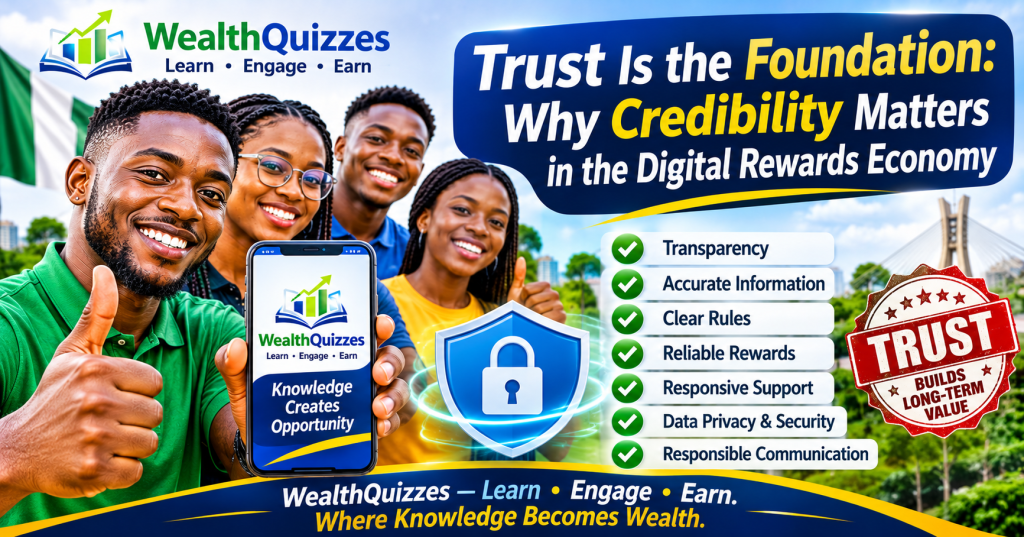
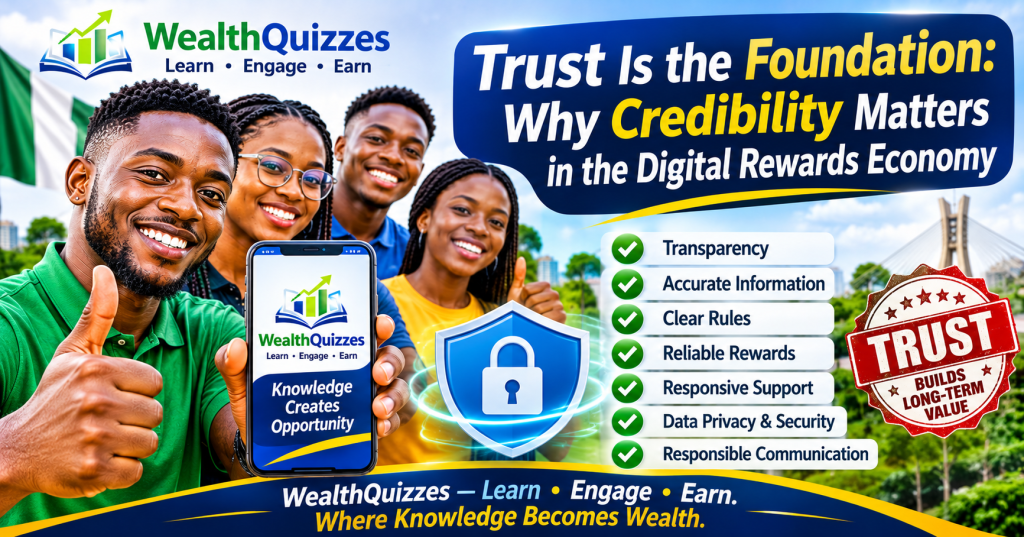
Trust Is the Foundation: Why Credibility Matters in the Digital Rewards Economy
How WealthQuizzes can build lasting confidence through transparency, accurate information, fair participation rules, reliable reward administration and responsible digital engagement.
Introduction: In the Digital Economy, Trust Is Everything
The digital economy has created new ways for people to learn, interact, transact and participate in commercial activities. From mobile banking and electronic commerce to online education and digital entertainment, technology has made services more accessible and convenient. Increasingly, digital platforms are also introducing incentives and rewards to encourage participation, recognise performance and sustain user engagement.
Yet, behind the convenience and opportunities offered by these platforms lies one fundamental requirement: trust.
People may discover a digital platform through an advertisement, download an application because of an attractive offer or register because of an interesting opportunity. However, what determines whether they remain active, recommend the platform to others and develop a lasting relationship with the business is often their confidence in how it operates.
This is particularly important for digital platforms that combine knowledge-based participation with performance-related rewards. Users must understand what they are participating in, what is expected of them, how performance is assessed, what conditions govern rewards and where to seek assistance when problems arise.
For WealthQuizzes, a Nigerian knowledge-based digital engagement platform built around the philosophy of Learn • Engage • Earn, trust is therefore more than a desirable brand attribute. It is a fundamental requirement for sustainable growth.
WealthQuizzes seeks to make knowledge more engaging by connecting interactive quizzes, participation and conditional performance-based rewards. However, the long-term value of this proposition will depend not simply on the attractiveness of its concept, but on the credibility, transparency and consistency with which it is delivered.
1. Why Trust Matters in the Digital Rewards Economy
Trust has always influenced commercial relationships. People are more willing to transact with businesses they consider reliable, transparent and accountable. The digital environment has made this relationship even more important because users frequently interact with businesses they cannot physically inspect or approach.
The Organisation for Economic Co-operation and Development (OECD), through its Going Digital Toolkit, recognises trust as essential to achieving the benefits of digital transformation. It identifies uncertainties surrounding digital security, information asymmetry, privacy and consumer protection as factors that can undermine confidence in digital environments. https://goingdigital.oecd.org/dimension/trust
The World Bank similarly identifies trust as an important enabler of digital financial services. Its work on digital financial inclusion highlights consumer awareness, effective consumer protection, ethical conduct and timely dispute resolution as important elements in encouraging confidence in digital transactions. https://digitalfinance.worldbank.org/topics/digital-financial-literacy/trust
These observations have direct relevance to digital rewards platforms.
A user considering participation in a knowledge-based platform may reasonably ask:
- Is the platform operated by an identifiable and accountable business?
- Are its participation requirements clearly explained?
- Are subscription charges and other applicable conditions disclosed?
- Are questions accurate and fairly presented?
- Are rewards administered according to published rules?
- Can users obtain assistance when transactions or account issues arise?
- Is personal information handled responsibly?
These are not unreasonable doubts. They are legitimate considerations in deciding whether to trust a digital service.
A platform that answers these questions clearly has a better foundation for developing lasting relationships with its users. One that ignores them risks losing confidence, even where its underlying product has genuine value.
2. Transparency: Users Deserve to Know What They Are Participating In
Transparency is one of the most important foundations of credibility.
A digital platform should not depend on ambiguity to attract participation. Users should understand the service being offered, the applicable charges, the rules governing participation and the conditions attached to any advertised benefit.
For WealthQuizzes, transparency begins with explaining its operating philosophy.
The platform combines knowledge-based quizzes with progressive participation stages and performance-related rewards. Its central proposition is that users can test and improve their knowledge through interactive engagement, while qualifying for applicable rewards where they satisfy the relevant performance and eligibility requirements.
It is important to communicate that proposition accurately.
A performance-based reward is not the same as guaranteed income. Participation does not automatically entitle every user to a reward, and promotional materials should never create that impression. The applicable rules, performance requirements and eligibility conditions must remain clear.
This distinction protects users from unrealistic expectations and protects the credibility of the platform.
Transparency should also extend to subscription charges, wallet transactions, withdrawal requirements, identity verification and any other material conditions that affect participation.
The Federal Competition and Consumer Protection Commission (FCCPC), in its explanation of consumer rights under Part XV of the Federal Competition and Consumer Protection Act 2018, identifies the right to information in plain and understandable language and the right to full disclosure of prices and material facts. It also highlights the importance of factually accurate marketing and fair dealing. https://fccpc.gov.ng/consumers/consumer-rights-responsibilities/rights-responsibilities/
The lesson for digital businesses is straightforward: important information should be communicated before a user makes a decision, not concealed in complicated terms that are difficult to understand.
For WealthQuizzes, clear communication is not merely good customer relations. It is an important expression of respect for the people who use the platform.
3. Accurate Information: Credibility Begins with What a Platform Says
A business cannot build lasting trust on exaggerated claims.
In an increasingly competitive digital environment, promotional messages are often designed to attract attention quickly. However, there is a significant difference between persuasive marketing and misleading representation.
A credible digital platform should communicate its features, benefits, limitations and requirements honestly.
WealthQuizzes should therefore maintain a clear distinction between what the platform currently offers, what it is developing and what it hopes to achieve in the future.
For example, an aspiration to reach a wider Nigerian audience should not be presented as an achievement already attained. A proposed partnership should not be described as an established relationship. Similarly, potential educational or social benefits should not be represented as independently verified outcomes unless reliable evidence supports the claim.
The same principle applies to rewards. Communications should explain that rewards depend on the applicable participation rules and performance conditions. They should not suggest that users are guaranteed a particular amount merely by registering, subscribing or participating.
This approach is consistent with the consumer protection standards reflected in section 123 of the FCCPA, which addresses factually accurate information and prohibits misleading or deceptive representations in the marketing of goods and services.
Accuracy also matters within the platform itself. Quiz questions should be properly researched, answers should be fact-checked and explanations should reflect reliable information. A platform that promotes knowledge must demonstrate respect for knowledge in the quality of its own content.
Ultimately, the credibility of WealthQuizzes will be strengthened when its public claims consistently match the actual experience it provides.
4. Clear Rules: Fairness Must Be Understandable and Predictable
Rules are essential to any structured digital participation system. They define expectations, establish boundaries and provide a common standard against which users and platform operators can assess conduct and performance.
However, having rules is not enough. Those rules must be accessible, understandable and consistently applied.
For a knowledge-based rewards platform such as WealthQuizzes, users should be able to understand the participation process, the stages involved, the consequences of incorrect or missed answers, the conditions for qualifying for rewards and the requirements for withdrawals.
Where eligibility depends on identity verification or a minimum withdrawal threshold, those requirements should be clearly communicated.
Likewise, where a session ends following an incorrect or unanswered question, the user should be informed of that consequence before participating. Where a reward is conditional upon satisfying specific criteria, those criteria should be available in clear language.
Fairness also requires consistency. A platform should not apply one standard to one user and a different standard to another without a legitimate and disclosed reason.
The OECD’s work on trust in online markets identifies information asymmetry and uncertainty as important challenges facing digital consumers. Clear terms and reliable safeguards help reduce those uncertainties. https://www.oecd.org/en/publications/oecd-business-and-finance-outlook-2019_af784794-en/full-report/component-10.html
For WealthQuizzes, clearly communicated rules can reduce avoidable disputes, strengthen user confidence and help establish a more predictable participation experience.
5. Consistent Reward Administration: Promises Must Be Matched by Processes
In the digital rewards economy, few things can damage confidence more quickly than inconsistent reward administration.
Where a platform advertises conditional rewards, users naturally expect the platform to administer qualifying rewards in accordance with its published rules. The process must be reliable, traceable and capable of being explained.
This requires more than promotional announcements. It requires sound internal processes.
A credible rewards administration system should address:
- Accurate recording of user participation and performance.
- Clear identification of users who satisfy the applicable eligibility requirements.
- Proper verification of qualifying reward balances.
- Reliable transaction records and reconciliation procedures.
- Clear communication where verification or processing takes additional time.
- An effective mechanism for investigating and resolving disputed transactions.
For WealthQuizzes, these operational considerations are particularly important because its proposition connects knowledge-based participation with conditional rewards.
The platform should ensure that users can understand how their participation translates into eligibility under the applicable rules. Where a user raises a genuine concern about a transaction or reward, the matter should be investigated objectively and resolved through a defined process.
No digital business should assume that users will continue to trust it simply because its original concept is attractive. Trust is reinforced when the platform consistently does what its published rules and commitments require.
The United Nations Conference on Trade and Development (UNCTAD), in its research paper Consumer Trust in the Digital Economy: The Case for Online Dispute Resolution, examines the relationship between effective dispute resolution, consumer confidence and business performance. Its findings highlight the potential of effective online dispute resolution mechanisms to strengthen trust, encourage customer loyalty and reduce dissatisfaction. https://unctad.org/publication/consumer-trust-digital-economy-case-online-dispute-resolution
This is an important lesson for WealthQuizzes: reward administration and dispute resolution should be treated as core operational responsibilities, not secondary customer-service activities.
6. Prompt Customer Support: Trust Is Tested When Something Goes Wrong
A digital platform may function smoothly for many users, but its credibility is often tested when a user encounters a problem.
A payment may not reflect immediately. A user may experience difficulty accessing an account. A withdrawal request may require additional verification. A technical error may interrupt participation.
In such circumstances, silence or vague responses can create unnecessary suspicion.
Effective customer support requires more than providing an email address or displaying a contact button. It requires a system through which complaints are acknowledged, investigated, tracked and resolved within reasonable timeframes.
For WealthQuizzes, this means maintaining responsive communication channels and ensuring that users receive clear information about the status of their complaints.
Where a problem cannot be resolved immediately, the user should be told what is being investigated, whether further information is required and when an update can reasonably be expected.
Customer support should also be professional and respectful. Users should not be ridiculed, intimidated or dismissed merely because they have raised a complaint. Equally, customer service personnel should be empowered to distinguish genuine operational problems from requests that cannot be granted under the platform’s published rules.
The FCCPA’s section 130, as explained by the FCCPC, emphasises timely service delivery and the need to notify and update consumers where unavoidable delays occur.
The broader principle is that accountability is demonstrated through action. A platform that responds constructively when problems arise has an opportunity to strengthen confidence, even where the original experience was unsatisfactory.
7. Data Privacy and Security: Users Must Feel Safe Participating
Trust in a digital platform extends beyond its visible features. It also concerns what happens to the personal information users provide.
Digital platforms may process names, contact details, account information, transaction records and other personal data. Users should have confidence that such information is collected for legitimate purposes, handled lawfully and protected against unauthorised access or misuse.
In Nigeria, the Nigeria Data Protection Act 2023 establishes the principal statutory framework for personal data protection. Its objectives include protecting the rights of data subjects and promoting responsible processing of personal information.
The Nigeria Data Protection Commission’s General Application and Implementation Directive provides further guidance on data protection principles, lawful processing, privacy information, data security and accountability. https://www.ndpc.gov.ng/Files/NDP-GAID-DRAFT.pdf
For WealthQuizzes, responsible data governance should include appropriate privacy notices, lawful processing arrangements, suitable technical and organisational safeguards, controlled access to personal information and clear procedures for addressing data-related complaints or incidents.
Users should not be left wondering why their information is being requested, how it will be used or whether it will be disclosed to third parties.
Data protection is not simply a regulatory obligation. It is an important component of the confidence users place in the platform.
8. Responsible Communication: Promoting Opportunity Without Creating Unrealistic Expectations
Marketing is necessary for digital business growth. However, the credibility of a business depends partly on how it communicates its value.
For a platform that combines participation and conditional rewards, promotional messages must be particularly careful.
WealthQuizzes should communicate its proposition as an opportunity to engage with knowledge-based quizzes and qualify for applicable rewards through performance, subject to the platform’s rules.
It should avoid suggesting that participation is a substitute for employment, a guaranteed source of income or a reliable means of solving personal financial difficulties.
Responsible communication also means avoiding fabricated testimonials, exaggerated user statistics, unsupported claims of nationwide impact and unverified partnership announcements.
The World Economic Forum’s 2024 white paper, Digital Trust: Supporting Individual Agency, identifies transparency, privacy and redressability as important dimensions of digital trust. It emphasises the importance of giving individuals meaningful agency in their interactions with digital systems. https://www.weforum.org/publications/digital-trust-supporting-individual-agency/
This principle is relevant to the way WealthQuizzes communicates with its users. People should be able to make informed decisions about whether to participate, how to use the platform and what expectations are reasonable.
The objective should not be to persuade everyone to participate at any cost. It should be to help interested users understand the platform sufficiently to make informed choices.
9. Trust as a Competitive Advantage and a Partnership Asset
Trust does not benefit users alone. It also has significant commercial implications.
A credible digital platform is better positioned to develop user loyalty, encourage referrals, reduce avoidable complaints and build a stronger reputation. These factors can contribute to sustainable customer acquisition and retention.
Trust is equally important when approaching corporate organisations, financial institutions, telecommunications companies, insurers, technology firms and development organisations.
Institutional partners do not evaluate digital platforms solely on the attractiveness of their concepts. They also consider operational capacity, governance, transparency, data protection, reputation, financial discipline and the ability to deliver agreed commitments.
For WealthQuizzes, this creates an important strategic opportunity.
The platform’s potential partnership proposition extends beyond brand visibility. It could provide a structured channel for interactive knowledge engagement, financial literacy campaigns, educational initiatives and youth-focused digital programmes.
However, prospective partners must be able to assess the platform’s credibility through evidence: clear programme documentation, defined responsibilities, transparent reporting, reliable user-engagement data and appropriate safeguards.
This is why trust should be embedded in the business’s operating model rather than treated as a promotional theme.
A partnership built on credibility is more likely to produce sustainable value than one based solely on publicity.
10. Building the WealthQuizzes Trust Standard
For WealthQuizzes, the next stage of growth should involve translating the principle of trust into measurable operational standards.
This can be pursued through a number of practical commitments:
Transparency: Keep participation rules, applicable charges, reward conditions and withdrawal requirements clear and accessible.
Accuracy: Ensure that promotional claims, quiz content, platform information and user communications are factually correct.
Fairness: Apply published rules consistently and maintain appropriate records of participation and reward decisions.
Responsiveness: Establish clear customer-support procedures, complaint-tracking mechanisms and reasonable response timelines.
Reliability: Maintain effective technical, payment and reward-administration processes, with clear communication when delays or interruptions occur.
Privacy and security: Apply appropriate data protection and cybersecurity safeguards in accordance with applicable Nigerian law.
Accountability: Monitor complaints, investigate recurring problems, learn from user feedback and make improvements where necessary.
These standards should not remain statements on a website. They should be reflected in actual procedures, staff responsibilities, technology systems and management decisions.
Where appropriate, WealthQuizzes can also publish periodic updates on service improvements, platform developments and verified engagement indicators. Such reporting would help users and prospective partners evaluate progress based on evidence rather than promotional claims.
Conclusion: Wealth Is Not Built on Knowledge Alone, but on Trust in How It Is Used
The digital rewards economy presents opportunities for businesses to develop innovative ways of engaging people, encouraging participation and recognising performance. But the sustainability of these opportunities depends on public confidence.
A platform may have an interesting concept, attractive branding and an ambitious growth strategy. Yet, without transparent communication, understandable rules, accurate information, reliable reward administration, responsive customer support and responsible data practices, its long-term prospects will remain uncertain.
For WealthQuizzes, the principle is clear: knowledge should attract participation, engagement should create value, and credibility should sustain the relationship.
Through its Learn • Engage • Earn philosophy, WealthQuizzes seeks to make knowledge-based participation more engaging while creating opportunities for users to qualify for applicable performance-based rewards. Its long-term ambition is to build a credible Nigerian digital platform capable of supporting learning, meaningful engagement and strategic collaboration.
Achieving that ambition requires more than attracting registrations or increasing downloads. It requires earning confidence one user interaction at a time.
Every accurately presented question, clearly explained rule, properly administered qualifying reward, responsibly handled complaint and honestly communicated update contributes to that objective.
For users, trust provides confidence to participate. For corporate organisations, it provides a stronger basis for collaboration. For the platform itself, it creates the foundation for sustainable growth.
At WealthQuizzes, the ambition is to turn knowledge into opportunity. But the foundation on which that ambition must stand is trust.
WealthQuizzes — Learn • Engage • Earn. Where Knowledge Becomes Wealth.
Selected Authorities and Further Reading
- Organisation for Economic Co-operation and Development (OECD), Going Digital Toolkit: Trust. https://goingdigital.oecd.org/dimension/trust
- OECD, OECD Business and Finance Outlook 2019, Chapter 5.2: The Role of Trust in Online Markets. https://www.oecd.org/en/publications/oecd-business-and-finance-outlook-2019_af784794-en/full-report/component-10.html
- United Nations Conference on Trade and Development (UNCTAD), Consumer Trust in the Digital Economy: The Case for Online Dispute Resolution (2021). https://unctad.org/publication/consumer-trust-digital-economy-case-online-dispute-resolution
- World Bank, Digital Finance Inclusion: Trust. https://digitalfinance.worldbank.org/topics/digital-financial-literacy/trust
- World Economic Forum, Digital Trust: Supporting Individual Agency (2024). https://www.weforum.org/publications/digital-trust-supporting-individual-agency/
- Federal Competition and Consumer Protection Act 2018, particularly Part XV; Federal Competition and Consumer Protection Commission, Consumer Rights and Responsibilities. https://fccpc.gov.ng/consumers/consumer-rights-responsibilities/rights-responsibilities/
- Nigeria Data Protection Act 2023; Nigeria Data Protection Commission, General Application and Implementation Directive (2024). https://www.ndpc.gov.ng/Files/NDP-GAID-DRAFT.pdf


