WealthQuizzes and the Sustainable Development Goals: A Potential Platform for Youth-Focused Partnerships
Sustainable Development, Youth Empowerment and Strategic Partnerships
Introduction: Connecting Knowledge with Sustainable Development
The Sustainable Development Goals (SDGs), adopted by the United Nations in 2015 as part of the 2030 Agenda for Sustainable Development, provide a global framework for addressing poverty, inequality, education, employment, innovation and other development priorities. Their achievement requires cooperation among governments, businesses, civil society, educational institutions and communities.
For Nigeria, where young people represent an important part of the country’s economic and social future, the question is not merely how to increase access to digital technology, but how to translate that access into meaningful opportunities for learning, skills development, innovation and inclusion.
This presents an opportunity to explore the role of knowledge-based digital platforms in youth-focused development initiatives.
WealthQuizzes, a Nigerian digital knowledge and engagement platform operated by TOPBRAINS Knowledge Teasers Company Limited, is built around the principle “Learn • Engage • Earn.” Through interactive quizzes and knowledge-based participation, the platform offers a potential channel for engaging users with educational and general-interest content.
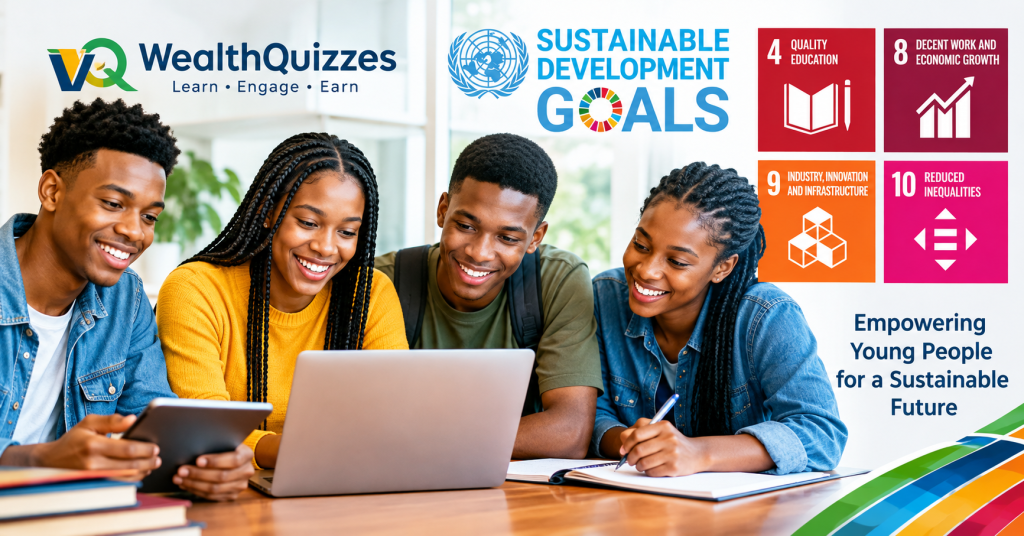
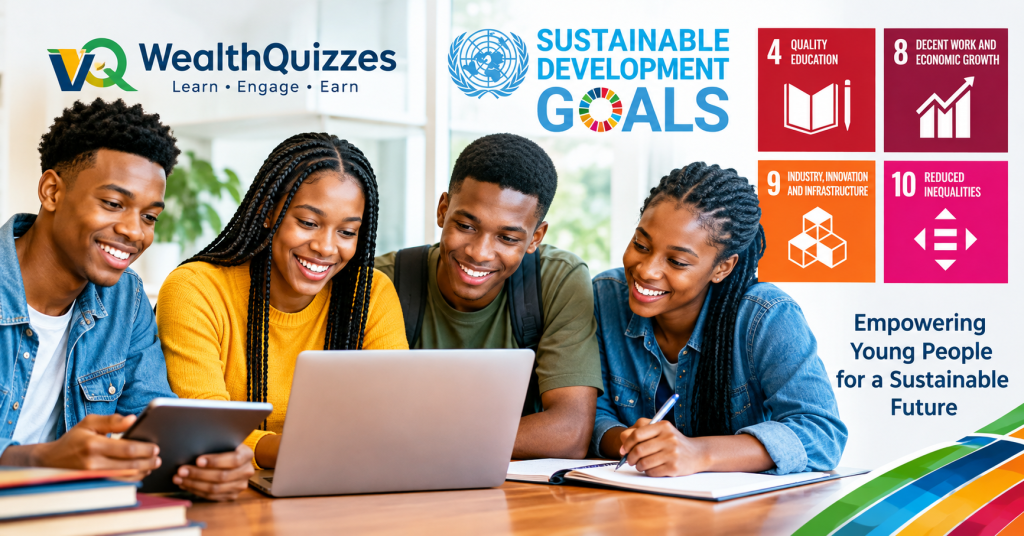
With appropriate programme design, partnerships and evaluation, WealthQuizzes could complement initiatives associated with four particularly relevant Sustainable Development Goals: SDG 4 (Quality Education), SDG 8 (Decent Work and Economic Growth), SDG 9 (Industry, Innovation and Infrastructure) and SDG 10 (Reduced Inequalities).
The proposition requires a clear distinction: a digital quiz platform cannot independently achieve these goals. However, it may contribute to specific activities and measurable outcomes within broader programmes led or supported by organisations with relevant expertise and resources.
The opportunity is to build practical collaborations that connect knowledge, youth participation and sustainable development.
1. Understanding the SDGs and the Role of Private-Sector Partnerships
The United Nations’ 2030 Agenda recognises that sustainable development requires coordinated action across economic, social and environmental priorities. Its goals are interconnected, meaning progress in one area can reinforce progress in another.
For example, accessible education can help people develop skills relevant to employment. Digital infrastructure can expand access to learning resources and economic opportunities. Inclusive programmes can help ensure that people facing social or economic barriers are not excluded from these benefits.
The United Nations Development Programme (UNDP) emphasises the importance of partnerships, institutional capacity and context-specific action in advancing the SDGs. Businesses can contribute through their products, services, resources, expertise and relationships with the communities they serve.
For WealthQuizzes, the relevant question is how its existing knowledge-engagement model might be adapted to complement well-defined development initiatives.
Potential partners could include telecommunications companies, banks, technology firms, educational institutions, youth-focused organisations, public agencies and development partners. Each could bring a different capability: funding, technical expertise, educational content, access to participants, professional mentorship or independent evaluation.
A successful partnership would begin with a defined development problem, not simply the desire to attach an SDG logo to a promotional campaign.
2. SDG 4: Quality Education and Lifelong Learning
SDG 4 seeks to ensure inclusive and equitable quality education and promote lifelong learning opportunities for all. Its targets include improving learning outcomes, expanding access to technical and vocational education, increasing relevant skills and promoting education for sustainable development.
The United Nations identifies persistent inequalities in educational access and learning outcomes as major barriers to achieving this goal. Its official SDG 4 framework also recognises the importance of literacy, numeracy, relevant skills and inclusive learning environments. United Nations, SDG 4: Quality Education.
How WealthQuizzes could complement SDG 4
Interactive knowledge platforms can offer an additional way to encourage learners to engage with information, test their understanding and revisit educational subjects.
Through carefully designed programmes, WealthQuizzes could complement formal education and community-based learning in several ways.
A. Knowledge reinforcement programmes
Educational partners could develop quiz-based activities covering literacy, numeracy, science, technology, Nigerian history, civic education and other appropriate subjects. These activities could help learners practise recalling information and identify areas requiring further study.
The strongest model would connect questions to reliable educational materials and provide explanations after answers, rather than relying exclusively on correct-or-incorrect scoring.
B. Financial and digital literacy
A partner-sponsored learning series could introduce participants to budgeting, saving, responsible borrowing, online privacy, cybersecurity and the safe use of digital financial services.
Banks, financial-education organisations and technology companies could contribute subject-matter expertise, while teachers or qualified specialists could review the content for accuracy.
C. Lifelong learning campaigns
Not all learning takes place in classrooms. A programme could invite young adults to participate in themed knowledge challenges relating to employability, entrepreneurship, communication, science and everyday decision-making.
D. Education-linked competitions
Schools, tertiary institutions and youth organisations could participate in structured knowledge competitions designed to promote curiosity, collaboration and continued learning. Where prizes or other incentives are included, eligibility and award conditions should be transparent.
These initiatives could support selected educational objectives, but they should not be presented as substitutes for qualified teachers, formal education, accredited training or access to educational infrastructure.
Measuring the educational contribution
Useful indicators could include participant numbers, completion rates, improvement between baseline and post-programme assessments, retention of selected knowledge and participant feedback.
A high number of quiz attempts does not, by itself, demonstrate educational improvement. A credible SDG 4 programme would therefore assess learning outcomes, not merely digital activity.
3. SDG 8: Decent Work, Economic Growth and Youth Opportunity
SDG 8 promotes sustained, inclusive and sustainable economic growth, productive employment and decent work for all. Its targets include improving productivity, supporting entrepreneurship, encouraging innovation and expanding access to decent employment.
The United Nations identifies youth employment as a significant challenge, particularly where young people lack relevant skills or face barriers to entering the labour market. It emphasises that decent work involves more than obtaining any job: it also concerns fair income, workplace security, social protection and opportunities for personal development. United Nations, SDG 8: Decent Work and Economic Growth.
How WealthQuizzes could complement SDG 8
Knowledge engagement can be a starting point for broader skills and employment initiatives, provided it is connected to practical opportunities.
A. Entrepreneurship and business knowledge
A themed programme could introduce young people to basic business planning, customer service, record-keeping, marketing, financial management and responsible enterprise development.
Small-business owners, professional associations, banks and entrepreneurship-support organisations could contribute questions, case studies and practical learning materials.
B. Career awareness and employability
A career-focused initiative could explore workplace communication, problem-solving, professional ethics, digital competence and general awareness of different industries.
However, quizzes alone cannot establish occupational competence. To make the programme more useful, partners could connect it to workshops, mentoring, practical assignments, internships or recognised training opportunities.
C. Digital and financial skills
Financial literacy and digital confidence can support informed decision-making in employment and entrepreneurship. A partnership could introduce participants to responsible financial planning, digital commerce, fraud prevention and the fundamentals of operating a small business.
D. Pathways to further opportunity
A well-designed programme could signpost participants to verified training providers, job-readiness resources, entrepreneurship programmes and relevant professional networks.
The purpose would be to connect knowledge engagement to subsequent opportunities rather than to suggest that participation automatically leads to employment or income.
A necessary distinction: engagement is not employment
WealthQuizzes should not claim to create jobs, increase national productivity or reduce youth unemployment merely because people participate in its quizzes.
Those outcomes require stronger evidence and often depend on factors beyond the platform’s control.
A responsible partnership would distinguish between direct outputs—such as participants reached or learning activities completed—and longer-term outcomes, such as skills acquired, training completed, businesses established or employment secured.
Where partners wish to assess those outcomes, follow-up research would be necessary.
4. SDG 9: Industry, Innovation and Infrastructure
SDG 9 focuses on resilient infrastructure, inclusive and sustainable industrialisation, and innovation. Its targets include expanding access to information and communications technology, supporting scientific research and improving technological capabilities. United Nations, SDG 9: Industry, Innovation and Infrastructure.
Digital technology can contribute to this goal by helping people access information, participate in digital services and develop familiarity with technology. Nevertheless, the benefits depend on infrastructure availability, affordability, digital skills and appropriate use.
How WealthQuizzes could complement SDG 9
A. Promoting digital confidence
A knowledge-based programme could introduce participants to internet safety, digital productivity, technology concepts and responsible use of online services.
Technology companies and telecommunications operators could support the initiative by contributing expertise, sponsoring selected activities or connecting participants to appropriate learning resources.
B. Encouraging interest in science and technology
Themed challenges could cover coding concepts, artificial intelligence, cybersecurity, engineering, renewable energy and technological innovation. These activities would aim to stimulate interest and encourage further study, rather than claim to replace practical technical training.
C. Supporting innovation awareness
A programme could showcase Nigerian innovators, local technology solutions and examples of how digital tools address practical challenges in agriculture, health, education, commerce and public services.
With support from universities, innovation hubs and technology organisations, the initiative could also direct participants to verified opportunities for deeper engagement.
D. Developing partnerships with technology and telecommunications companies
A telecommunications company could, subject to technical feasibility and regulatory requirements, support a digital-literacy challenge, provide educational content or explore sponsored access for a defined programme.
A technology company could contribute specialist knowledge or help connect participants to appropriate skills-development resources.
These are potential partnership models, not existing agreements or confirmed commitments.
Innovation must be evaluated by its usefulness
Introducing a digital platform is not sufficient evidence of innovation impact. The more important questions are whether the programme solves a defined problem, reaches its intended audience, functions reliably and creates measurable value.
For WealthQuizzes, a credible SDG 9 initiative would combine a suitable digital format with relevant content, accessibility considerations, technical reliability and a clear evaluation framework.
5. SDG 10: Reduced Inequalities and More Inclusive Participation
SDG 10 seeks to reduce inequality within and among countries. Target 10.2 specifically calls for the promotion of social, economic and political inclusion irrespective of age, sex, disability, race, ethnicity, origin, religion or economic or other status. Target 10.3 emphasises equal opportunity and reducing discriminatory outcomes. United Nations, SDG 10: Reduced Inequalities.
Digital platforms can expand access to information, but they can also reproduce existing inequalities if participation depends on devices, connectivity, literacy or disposable income that some people do not have.
For this reason, inclusion must be designed into a programme rather than assumed.
How WealthQuizzes could complement SDG 10
A. Designing for wider access
Partners could consider low-data content, accessible interfaces, clear language and mobile-friendly learning activities. Where technically and financially feasible, they could also explore sponsored participation or community access arrangements for groups facing affordability barriers.
B. Reaching underserved communities
Educational institutions, youth organisations, community groups and development partners could help identify audiences who are less likely to benefit from conventional digital campaigns.
Participation should be planned with attention to rural and underserved communities, gender disparities, disability inclusion and differences in digital access.
C. Inclusive knowledge challenges
Campaign content could reflect Nigeria’s diverse communities, histories, languages and experiences. Content development should avoid stereotypes and be reviewed for accuracy, cultural sensitivity and accessibility.
D. Fair and transparent participation
Any competition or reward structure should have clear eligibility rules, accessible instructions and transparent conditions. Where possible, programmes should offer meaningful participation without requiring users to make payments they cannot reasonably afford.
Where the platform’s ordinary commercial model is unsuitable for a target group, a sponsor-funded or otherwise appropriately subsidised programme could be considered.
Inclusion must be measured
A programme should not claim to reduce inequality simply because it is available online.
Useful indicators could include participation by geography and relevant demographic groups, completion gaps, accessibility feedback, participation costs and the proportion of intended underserved audiences reached.
Collecting demographic information must itself be lawful, proportionate and necessary. Where detailed personal data is not required, aggregate or anonymised reporting should be preferred.
These measures could help partners identify who benefits, who remains excluded and what changes are needed.
6. A Cross-Cutting Partnership Model: One Programme, Multiple Development Objectives
The four SDGs are interconnected. A carefully designed programme could therefore contribute to several objectives at once.
Consider an illustrative initiative titled the WealthQuizzes Youth Knowledge and Opportunity Challenge.
The programme could be developed with a coalition of educational institutions, technology companies, financial institutions and youth-focused organisations. Its content might cover digital literacy, entrepreneurship, financial awareness, science and innovation, and responsible citizenship.
Its potential contributions could be structured as follows:
| SDG | Programme component | Possible indicators |
|---|---|---|
| SDG 4 — Quality Education | Structured knowledge challenges and educational explanations | Learning gains, completion and retention |
| SDG 8 — Decent Work | Entrepreneurship, career awareness and employability content | Skills activities completed, referrals to training and follow-up outcomes |
| SDG 9 — Innovation | Digital literacy and science-and-technology challenges | Participation, digital knowledge gains and engagement with further learning |
| SDG 10 — Reduced Inequalities | Inclusive access and targeted community participation | Reach among intended groups, accessibility and participation gaps |
This framework is illustrative. The programme would need a detailed theory of change, defined responsibilities, a realistic budget and agreed indicators before launch.
It would also require partners to identify which outcomes they can reasonably influence. A quiz-based initiative may directly deliver learning activities; it may only indirectly influence employment or inequality.
7. Governance, Responsible Rewards and Data Protection
Any programme associated with sustainable development must maintain the trust of its participants and partners.
In Nigeria, the Nigeria Data Protection Act 2023 provides the legal framework for the processing of personal data. Organisations collaborating on a programme should establish their respective responsibilities for data collection, consent where applicable, lawful processing, security, retention, sharing and the handling of participants’ rights.
The Nigeria Data Protection Commission provides information and guidance on data-protection obligations. Nigeria Data Protection Commission.
Other essential safeguards include:
- Independent or qualified review of educational content.
- Clear disclosure of campaign conditions and eligibility.
- Appropriate protections for minors, where a programme includes them.
- Transparent handling of incentives and rewards.
- Accessible complaint and support channels.
- Clear agreements on intellectual property, brand use and reporting.
- Proportionate evaluation that avoids collecting unnecessary personal data.
Where rewards are offered, they must not be presented as guaranteed income or as a substitute for employment and education. Any programme should explain its terms before participation and avoid encouraging financially vulnerable users to take unreasonable risks.
These safeguards are not separate from sustainable development. They are part of ensuring that digital initiatives are responsible, inclusive and credible.
8. From Proposal to Evidence: A Practical Implementation Roadmap
To turn the concept into a credible partnership, WealthQuizzes and interested organisations could follow a phased process.
Phase One: Define the development priority. Identify whether the programme primarily targets learning, employability, innovation, inclusion or a combination of these areas.
Phase Two: Identify suitable partners. Engage organisations with relevant expertise, funding capacity, educational resources, community relationships or technical capabilities.
Phase Three: Co-design the programme. Agree on the target audience, curriculum or content themes, accessibility requirements, participant journey, responsibilities and safeguards.
Phase Four: Establish the baseline and targets. Define what success means before launch. Set measurable targets that are proportionate to the programme’s budget, duration and reach.
Phase Five: Implement a limited pilot. Test the programme with a defined audience and resolve operational, technical and content issues before considering expansion.
Phase Six: Evaluate and report. Compare actual results against the baseline and targets. Report successes, limitations and lessons learned, including any outcomes that were not achieved.
Phase Seven: Scale only where evidence supports it. Use the findings to improve the programme, seek further partners or determine whether the model is suitable for wider adoption.
A credible reporting framework should distinguish outputs from outcomes and avoid attributing wider social changes to the programme without evidence.
Conclusion: Turning Knowledge Engagement into a Practical Development Opportunity
The Sustainable Development Goals offer a useful framework for identifying where digital engagement can support broader development priorities. For WealthQuizzes, SDGs 4, 8, 9 and 10 provide a basis for exploring youth-focused partnerships involving education, employability, innovation and inclusion.
The platform’s knowledge-based format could complement educational programmes, encourage engagement with practical skills, promote digital awareness and create opportunities for organisations to connect with young audiences through structured participation.
However, meaningful contribution depends on more than alignment with the SDGs in principle. It requires appropriate content, capable partners, accessible delivery, responsible governance, realistic targets and evidence of results.
WealthQuizzes should therefore be positioned as a potential programme-delivery and engagement partner, not as an organisation that has already achieved these development outcomes.
For companies, educational institutions and development organisations, the opportunity is to test whether interactive knowledge initiatives can strengthen existing programmes and provide measurable value to participants.
For young people, the ambition is to create more opportunities to learn, participate and connect knowledge with practical pathways for development.
Ultimately, sustainable development is advanced not by labels alone, but by well-designed initiatives that respond to real needs, include people who might otherwise be left behind and demonstrate results.
WealthQuizzes’ potential contribution lies in helping turn knowledge into an engaging starting point for wider opportunities—through partnerships that are practical, inclusive and accountable.
Selected Authorities and Further Reading
- United Nations — Transforming Our World: The 2030 Agenda for Sustainable Development. The foundational framework for the 17 Sustainable Development Goals. https://sdgs.un.org/2030agenda
- United Nations Department of Economic and Social Affairs — Goal 4: Quality Education. Official targets and indicators for education and lifelong learning. https://sdgs.un.org/goals/goal4
- United Nations Department of Economic and Social Affairs — Goal 8: Decent Work and Economic Growth. Official targets covering employment, productivity and entrepreneurship. https://sdgs.un.org/goals/goal8
- United Nations Department of Economic and Social Affairs — Goal 9: Industry, Innovation and Infrastructure. Official targets covering innovation, infrastructure and ICT access. https://sdgs.un.org/goals/goal9
- United Nations Department of Economic and Social Affairs — Goal 10: Reduced Inequalities. Official targets on inclusion and equal opportunity. https://sdgs.un.org/goals/goal10
- United Nations Development Programme — Sustainable Development Goals. Background on the SDGs and the wider development framework. https://www.undp.org/sustainable-development-goals
- World Bank — Skills and Workforce Development. Research and policy resources on employability, digital skills and workforce development. https://www.worldbank.org/ext/en/topic/education/skills-and-workforce-development
- Nigeria Data Protection Commission. Guidance on Nigeria’s data-protection framework. https://ndpc.gov.ng/
- WealthQuizzes. Official platform website. https://wealthquizzes.com/
Editorial note: The proposed programmes in this article are illustrative partnership concepts. They should not be understood as existing agreements, confirmed funding commitments or verified development outcomes.