WealthQuizzes: How a Nigerian Innovation Is Turning Knowledge into Opportunity
Learn • Engage • Earn: The story of a homegrown digital platform reimagining how Nigerians learn, compete and discover new opportunities.
Introduction: When Knowledge Meets Opportunity
What if learning could become more engaging, competition could encourage intellectual growth, and demonstrating what you know could unlock an opportunity to earn rewards?
This is the idea behind WealthQuizzes, a Nigerian digital platform developed by TOPBRAINS Knowledge Teasers Company Limited. Built around the philosophy Learn • Engage • Earn, WealthQuizzes combines knowledge-based quizzes, progressive stages, timed challenges and performance-based rewards in an interactive digital experience.
Its proposition speaks to an important question facing Nigeria: how can technology be used not merely to entertain people, but also to encourage learning, develop knowledge, improve digital participation and create new forms of engagement?
Nigeria has a large and youthful population, with enormous potential to contribute to innovation, enterprise and national development. Yet unlocking that potential requires sustained investment in education, relevant skills, digital inclusion and meaningful opportunities. The World Bank’s 2026 report, State of the Nigerian Youth, examines these interconnected challenges, including education, employment, digital and financial inclusion, and civic participation. It underscores the importance of addressing the barriers that prevent young Nigerians from fully realising their potential. World Bank, State of the Nigerian Youth.
WealthQuizzes enters this wider landscape with a distinctive approach: making the acquisition and demonstration of knowledge an interactive experience that can be pursued through a mobile platform.
It is not a substitute for formal education, vocational training or employment. Nor should participation be understood as a guarantee of income. Rather, it represents a homegrown innovation seeking to connect knowledge, engagement and conditional rewards in a way that may complement broader efforts to empower Nigerians.
1. The WealthQuizzes Story: A Nigerian Idea with a Wider Ambition
WealthQuizzes was developed under the corporate identity of TOPBRAINS Knowledge Teasers Company Limited. Its underlying proposition is that knowledge can be more than something people acquire for examinations or professional advancement: it can also become the basis for an engaging, structured digital activity.
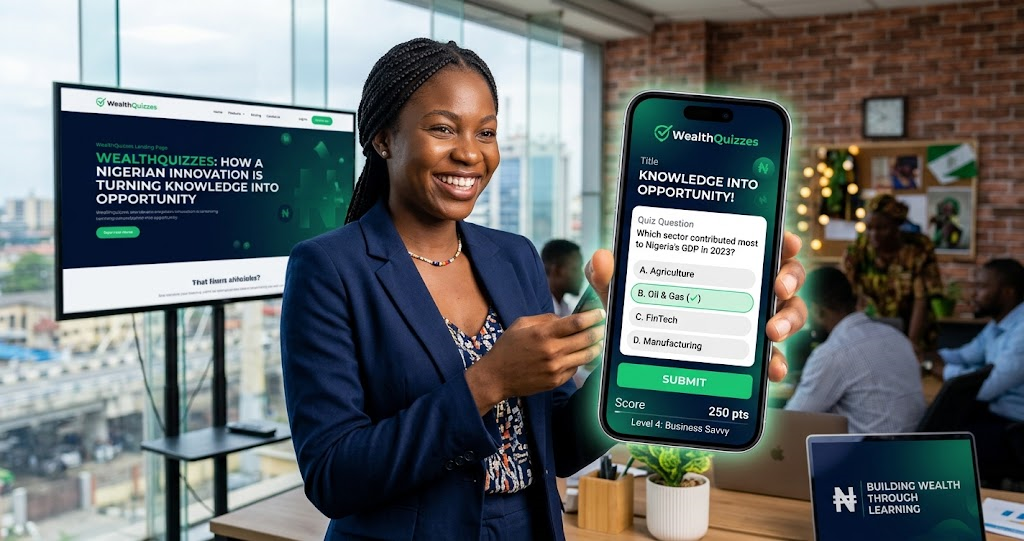
The platform provides timed quizzes across multiple subject categories, allowing eligible users to test their knowledge, progress through stages and unlock applicable rewards when they meet the relevant performance requirements.
Its official website describes the experience as a combination of knowledge testing, staged progression and rewards, supported by categories including general knowledge, business and finance, sports and football, music, entertainment, history and lifestyle. WealthQuizzes official website.
The importance of this approach lies in its accessibility as a concept. A person may begin with an interest in football, Nigerian history, business or entertainment and encounter questions that encourage further curiosity. A familiar subject can become an entry point into broader learning.
For the company, this creates an opportunity to develop a platform that is both entertaining and educational. For users, it offers a structured way to engage their knowledge, challenge themselves and discover subjects in which they may wish to improve.
The broader ambition is to build a recognisable Nigerian digital brand around the proposition that learning can be engaging, participation can be meaningful and performance can have tangible benefits.
2. Learn • Engage • Earn: More Than a Slogan
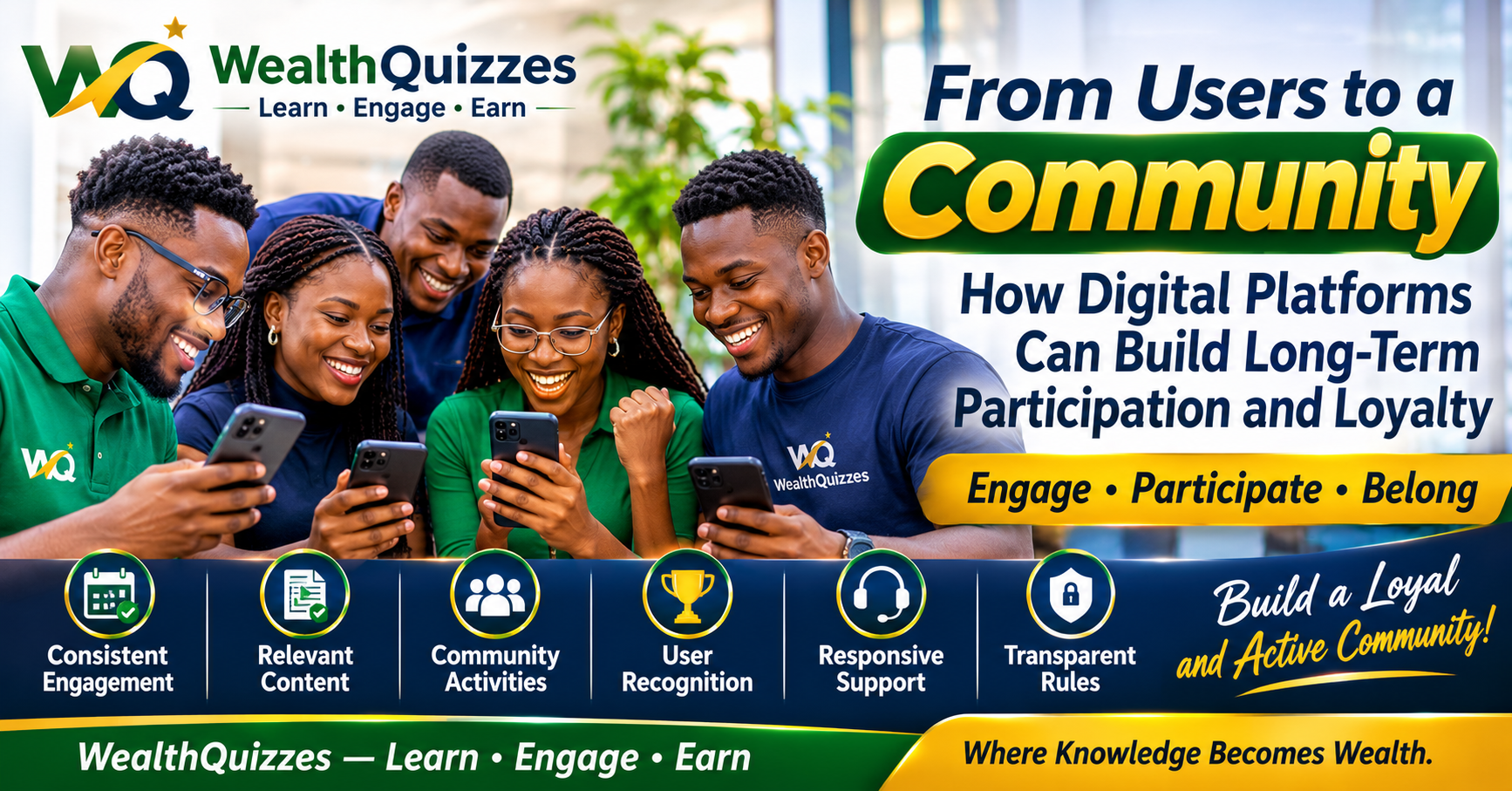
The three elements of the WealthQuizzes philosophy describe the intended relationship between knowledge, participation and rewards.
Learn: Making knowledge an active experience
Learning is often associated with classrooms, textbooks, lectures and formal assessments. These remain essential, but learning also takes place through discussion, reading, practice, observation and self-testing.
Quizzes can contribute to this wider process by requiring people to retrieve information, distinguish between possible answers and assess what they know. When questions are accurate and appropriately designed, they can help participants identify gaps in their knowledge and stimulate interest in unfamiliar subjects.
WealthQuizzes’ multi-category format provides a framework for this type of engagement. A participant interested in entertainment can explore other categories, while someone interested in finance can test their understanding of business concepts and related subjects.
The platform’s educational value can grow further when quiz participation is complemented by explanations, recommended reading and informative articles. In this way, a question need not be the end of a learning experience; it can be the beginning of a deeper investigation.
Engage: Turning participation into an experience
The second element recognises that access to information does not automatically produce sustained interest.
A digital experience must give users a reason to participate, return and improve. Timed questions, progressive stages, immediate results and structured challenges can provide clear goals and feedback.
Research offers qualified support for this approach. In their systematic review published in Educational Research Review, Zamzami Zainuddin and colleagues examined empirical studies on gamification in education. They identified positive themes involving learner engagement and motivation, academic achievement, and social connectivity, while also highlighting inconsistencies in the evidence. Zainuddin et al., “The Impact of Gamification on Learning and Instruction”.
Similarly, Shurui Bai, Khe Foon Hew and Biyun Huang examined the effects of gamification in educational settings in a 2020 meta-analysis. Their findings indicated an overall positive effect on learning performance, but also noted that learners may respond negatively when gamification adds little educational value or creates anxiety and jealousy. Bai, Hew and Huang, Educational Research Review.
These findings are relevant to WealthQuizzes because they suggest that engagement mechanisms can be useful when they support learning rather than merely capture attention. The design of questions, fairness of competition, quality of feedback and clarity of the rules therefore matter as much as the excitement of participation.
Earn: Recognising successful performance
The third element connects successful quiz progression with rewards under the platform’s applicable rules.
WealthQuizzes uses a staged participation model in which eligible users answer timed questions and must satisfy the relevant requirements to advance. Rewards are linked to successful stage completion, with the applicable amounts and conditions determined by the platform’s rules.
This feature differentiates the experience from quiz activities that offer entertainment alone. It gives participants a tangible incentive to demonstrate their knowledge and complete the challenges successfully.
However, responsible communication is essential. Rewards are conditional on performance and eligibility; they are not guaranteed simply because someone registers, subscribes or participates. Users should understand the applicable subscription costs, stage requirements, withdrawal conditions and verification procedures before committing funds.
The strongest interpretation of “Earn” is therefore not that every user will make money, but that the platform offers an opportunity to receive applicable rewards for successful performance while engaging with knowledge-based challenges.
3. How Progressive Stages Encourage Focus and Persistence
One of WealthQuizzes’ defining features is its progressive-stage structure.
Instead of treating participation as a single, disconnected question, the platform organises quizzes into stages through which eligible users may advance. Each stage requires participants to meet the stipulated performance conditions before proceeding.
This structure can encourage several useful behaviours.
Concentration: Timed questions encourage participants to focus on the task at hand.
Accuracy: Users must assess the available answers carefully rather than simply guess without consideration.
Recall: Repeated practice can help participants retrieve familiar information more efficiently.
Persistence: A progression system provides a clear objective and encourages users to improve their performance.
Self-assessment: Quiz results can help users identify strengths and subjects requiring further study.
These are potential benefits, not automatic outcomes. A timed quiz does not independently establish that a person has acquired lasting knowledge. Long-term learning depends on factors such as question quality, repeated practice, feedback, prior understanding and the opportunity to apply what has been learned.
For WealthQuizzes, this creates a continuing product-development opportunity: strengthening the educational value of the stages through carefully calibrated questions, reliable scoring, useful feedback and content that encourages learning beyond the immediate challenge.
4. Beyond the Quiz: Building a Knowledge Ecosystem
WealthQuizzes’ ambition extends beyond the quiz interface. Its website also features an educational blog that publishes material on Nigerian history, general knowledge, football and other subjects. WealthQuizzes Blog.
This creates the foundation for a wider knowledge ecosystem in which articles and quizzes can reinforce one another.
Consider a reader who discovers an article about Nigeria’s political history. The article introduces the country’s political parties, constitutional development and major historical events. A related quiz could then encourage the reader to test what they have learned.
A similar relationship could exist between financial-literacy articles and questions about budgeting, saving, inflation or responsible financial decisions. Football history, music, cultural heritage and general knowledge could also provide opportunities to connect reading with interactive participation.
The benefit is a more coherent experience: users can encounter information, explore it in greater depth and assess their understanding.
The blog also creates an opportunity for WealthQuizzes to contribute to public knowledge independently of its reward model. Readers who do not participate in paid quiz sessions can still benefit from accessible educational content.
Over time, a well-developed content strategy could help the platform build credibility, attract audiences with different interests and establish a stronger relationship between entertainment and learning.
5. Why WealthQuizzes Could Matter to Nigerian Youths
Young Nigerians are not a uniform group. They include students, graduates, artisans, entrepreneurs, job seekers, professionals and people in rural and urban communities. Their needs and circumstances differ, but many can benefit from opportunities to strengthen knowledge, develop digital familiarity and pursue continuous learning.
WealthQuizzes has the potential to complement these wider goals in several ways.
Encouraging continuous learning
An interactive platform can help make knowledge testing a regular activity rather than something reserved for examinations. Users may discover subjects they enjoy and become motivated to learn more.
Supporting financial awareness
Questions about finance and business can introduce or reinforce useful concepts. When supported by accurate explanations and further reading, such content may complement more comprehensive financial education.
Promoting knowledge of Nigeria
Questions about Nigerian history, institutions, culture and public affairs can encourage interest in the country’s past and present. This may contribute to informed citizenship and a stronger appreciation of the experiences that have shaped the nation.
Increasing familiarity with digital services
Using a mobile platform can help participants become more familiar with digital interfaces and online participation. This is a limited but potentially useful contribution to digital inclusion; it should not be confused with comprehensive training in professional digital skills.
Creating a structured recreational alternative
For people who enjoy trivia and competition, a knowledge-based quiz offers a form of entertainment centred on answering questions and meeting performance requirements. The platform can make this experience more engaging by combining progression with applicable rewards.
The potential social value will ultimately depend on whether WealthQuizzes can deliver a reliable, fair, accessible and educationally meaningful experience to a growing user base.
6. An Opportunity for Schools, Sponsors and Strategic Partners
The platform’s model may also be relevant to organisations seeking new ways to engage young people and communicate useful information.
Schools and educational organisations could explore knowledge challenges that complement existing learning activities. Financial institutions could consider educational campaigns on budgeting, savings and fraud awareness. Telecommunications companies and technology businesses could investigate partnerships that combine digital engagement with public education. Development organisations could assess whether a carefully designed pilot might support specific youth-learning or digital-inclusion objectives.
Such collaborations would require clear agreements, appropriate safeguards and measurable objectives. They should not be presented as existing partnerships unless formally confirmed.
For WealthQuizzes, the opportunity is to demonstrate how its technology and content can support objectives that matter to partners while retaining a clear benefit for users.
A practical pilot might measure participation, repeat engagement, quiz completion, user satisfaction and knowledge before and after a learning intervention. Where financial literacy or another specific subject is involved, appropriate assessments could help determine whether participants demonstrate improved understanding.
This evidence would help distinguish genuine impact from simple audience reach. It would also provide prospective partners with a more credible basis for deciding whether a programme should be expanded.
7. The Importance of Trust and Responsible Growth
Any platform that combines subscriptions, competition and rewards must earn the confidence of its users.
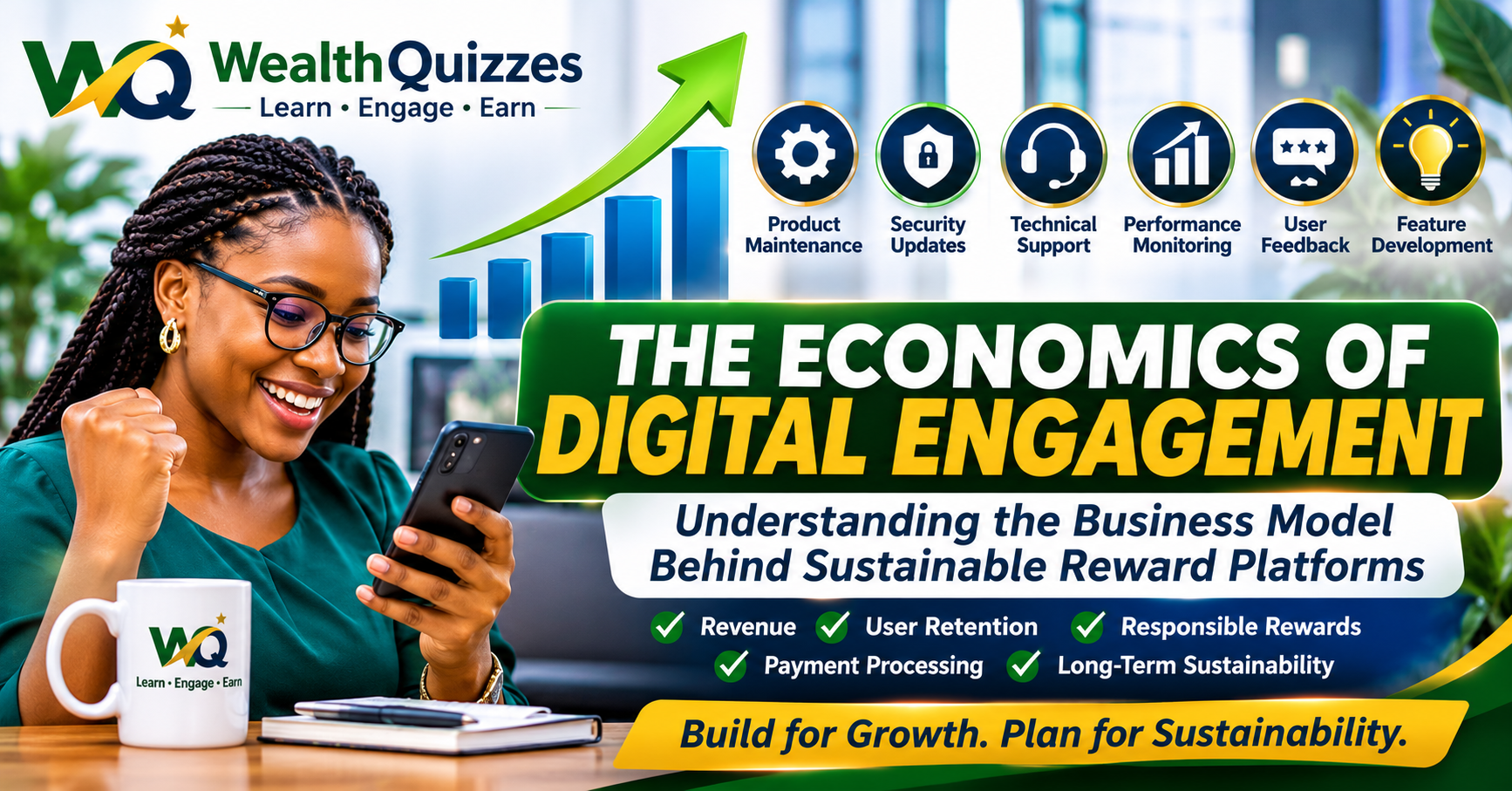
For WealthQuizzes, that means explaining its rules clearly, communicating subscription and withdrawal conditions accurately, maintaining appropriate payment and data-protection practices, and providing effective customer support.
Users should understand that rewards depend on successful performance and applicable eligibility requirements. They should participate responsibly, use only funds they can afford to spend and avoid treating potential rewards as guaranteed income.
The company also has a responsibility to ensure that questions are accurate, scoring is consistent and the platform’s design supports fair participation. The quality of the user experience will influence not only retention but also the credibility of the brand.
Responsible growth is especially important if WealthQuizzes intends to reach a large audience. Trust is not built through advertising alone; it must be supported by consistent performance, transparent communication and the fair treatment of participants.
8. From Nigerian Innovation to National Opportunity
WealthQuizzes is an emerging Nigerian digital platform with an ambition that extends beyond quiz participation. Its combination of knowledge-based challenges, progressive stages, performance-linked rewards and educational publishing offers a distinct approach to digital engagement.
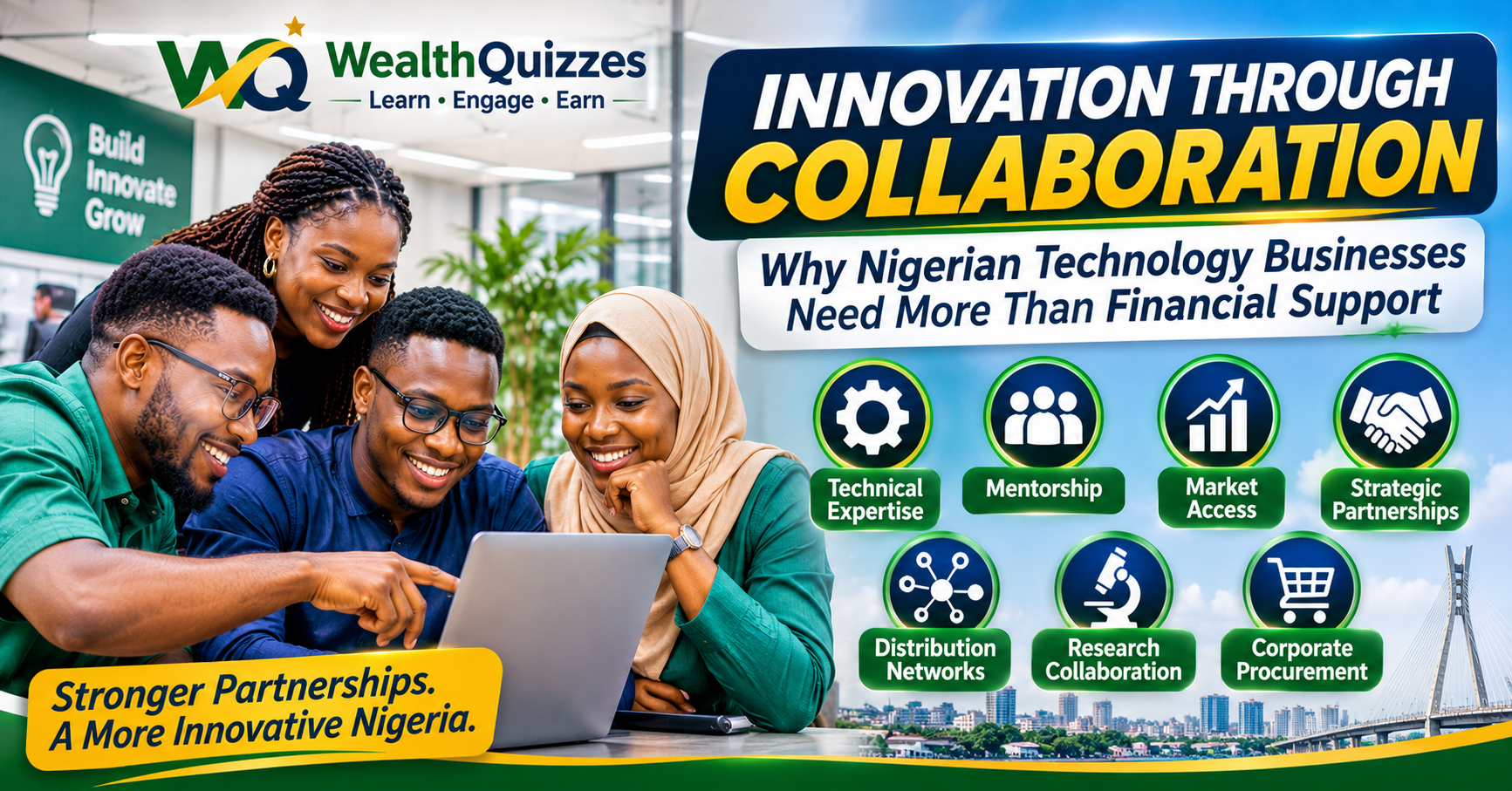
Its development reflects a wider possibility: Nigerian technology businesses can create products that respond to local interests and circumstances while contributing to education, digital participation and economic activity.
Realising that possibility will require sustained improvement, effective partnerships, responsible operations and evidence of user benefit. The ambition to reach millions should be treated as a long-term objective, not a claim that such impact has already been achieved.
The platform’s future significance will depend on whether it can consistently deliver value to users, build trust, strengthen its educational content and demonstrate that its model can operate sustainably at greater scale.
Conclusion: Making Knowledge Count
The WealthQuizzes proposition rests on an appealing idea: knowledge should be actively used, continuously developed and recognised as a valuable personal resource.
Through Learn • Engage • Earn, the platform seeks to make knowledge testing more interactive, progression more purposeful and successful performance more rewarding. Its educational blog offers another channel for discovery, while its wider partnership ambitions create opportunities to explore how digital engagement could support youth development and public education.
The platform is not a replacement for schools, vocational training, employment or broader economic reform. Its potential lies in complementing those efforts by making learning more engaging and creating an additional environment in which people can test and expand what they know.
If developed responsibly, WealthQuizzes could grow into a meaningful Nigerian knowledge platform—one that brings learning, digital participation and performance-based rewards together in a way that serves users and creates opportunities for collaboration.
WealthQuizzes: Learn • Engage • Earn. Where knowledge becomes wealth.
Selected Authorities and Further Reading
- WealthQuizzes. Official platform and description of its quiz experience, stages and rewards. https://wealthquizzes.com/
- WealthQuizzes Blog. Educational articles and informational content. https://wealthquizzes.com/blog/
- World Bank Group. State of the Nigerian Youth (2026). Read the report.
- Zainuddin, Z., Chu, S. K. W., Shujahat, M., & Perera, C. J. “The Impact of Gamification on Learning and Instruction: A Systematic Review of Empirical Evidence.” Educational Research Review, 30 (2020), 100326. https://doi.org/10.1016/j.edurev.2020.100326
- Bai, S., Hew, K. F., & Huang, B. “Does Gamification Improve Student Learning Outcome? Evidence from a Meta-Analysis and Synthesis of Qualitative Data in Educational Contexts.” Educational Research Review, 30 (2020), 100322. https://doi.org/10.1016/j.edurev.2020.100322
- UNESCO. Global Education Monitoring Report 2023: Technology in Education—A Tool on Whose Terms? Read the report.