
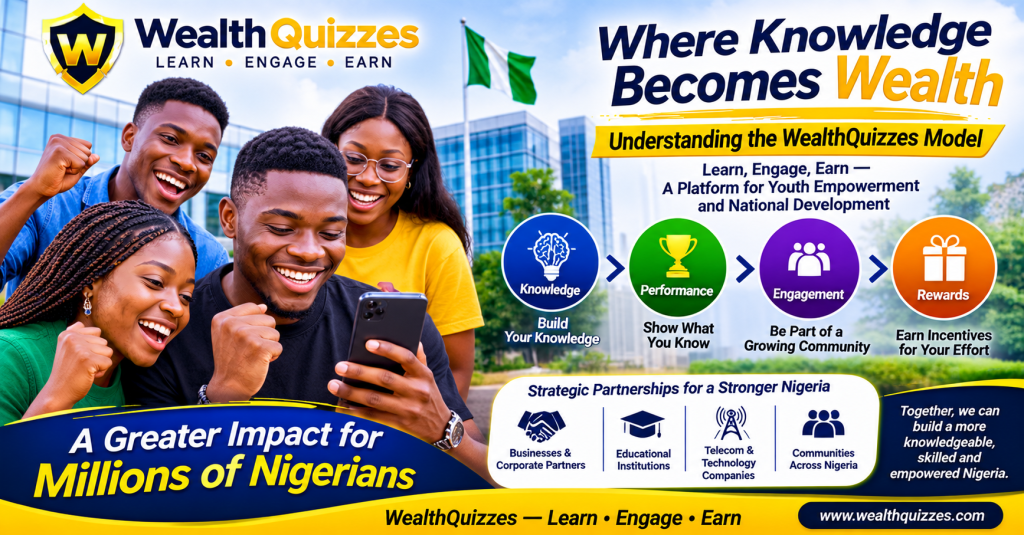
Where Knowledge Becomes Wealth: Understanding the WealthQuizzes Model
Youth Empowerment and National Development
Introduction: Giving Knowledge a Practical Purpose
Knowledge is one of the most valuable resources a person can possess. It helps people interpret information, evaluate choices, solve problems and recognise opportunities. Yet knowledge becomes more useful when it is actively applied, tested and developed through experience.
In a world where digital platforms increasingly shape how people learn, communicate and spend their time, there is growing scope for experiences that combine participation with purposeful learning. WealthQuizzes, a Nigerian knowledge-based quiz and digital engagement platform, seeks to explore this opportunity through interactive quizzes, progressive stages and rewards linked to successful performance under its applicable rules.
Its underlying proposition is captured in its brand philosophy: Learn • Engage • Earn.
The idea is straightforward: users engage with questions across different subject areas, demonstrate their knowledge through timed responses and have the opportunity to qualify for applicable rewards by successfully completing stages.
However, understanding this model requires an important distinction. Knowledge can create personal, educational and economic opportunities, but participation in a quiz platform does not guarantee income. WealthQuizzes offers a conditional, performance-based reward experience, not a promise of employment, investment returns or assured earnings.
Understanding this distinction is essential to appreciating both the potential of the model and the responsibilities that accompany it.
1. Knowledge: The Foundation of Opportunity
Knowledge has practical value because it can improve how people understand the world and respond to its challenges.
A young adult who understands personal finance may be better equipped to compare financial products, identify suspicious offers and make informed spending decisions. Someone who develops stronger general knowledge may become more confident in discussions, research and problem-solving. A person who understands technology can be better positioned to recognise useful digital tools and pursue further learning.
Knowledge alone does not guarantee success. Its value depends on factors such as judgement, access to opportunities, practical skills and the ability to apply what has been learned. Nevertheless, knowledge provides an important foundation on which these other capabilities can be developed.
Educational psychologists Henry L. Roediger III and Jeffrey D. Karpicke demonstrated the value of active retrieval in their 2006 study, Test-Enhanced Learning: Taking Memory Tests Improves Long-Term Retention. Their research found that attempting to recall information through testing can improve later retention compared with repeated studying alone in certain circumstances. This phenomenon is known as the testing effect. Read their research in Psychological Science.
This finding offers a useful perspective on knowledge-based quizzes. Answering questions is not merely a way to assess what someone remembers; when appropriately designed, it can also form part of an active learning process.
WealthQuizzes uses quiz participation to give knowledge a practical setting in which it can be tested. Its categories span areas such as general knowledge, finance and business, history, sports, music, entertainment and lifestyle. This breadth can expose users to different subjects and encourage curiosity beyond their immediate interests.
The platform should not be regarded as a substitute for formal education or specialised professional training. Rather, it can serve as an additional form of interactive engagement for adults who want to challenge themselves and explore what they know.
2. Performance: Turning Knowledge into Demonstrable Results
Knowing an answer and demonstrating that knowledge under specified conditions are not always the same thing.
A quiz participant must interpret the question, retrieve relevant information, select an answer and respond within the permitted time. Depending on the question, success may require factual recall, careful reading, reasoning or familiarity with the subject.
WealthQuizzes incorporates these elements into a staged quiz experience. According to the platform’s published description, users answer timed questions, progress through stages and qualify for rewards by successfully completing the applicable requirements. Explore the official WealthQuizzes website.
Performance is therefore central to understanding the model.
The relevant relationship is not simply between knowledge and money. It is between knowledge, demonstrated performance and the conditions governing reward eligibility.
A participant may possess considerable knowledge but still answer incorrectly, misunderstand a question or fail to complete a stage. Conversely, repeated participation may help a user recognise areas that require more study and develop greater familiarity with different topics.
This makes performance both an assessment mechanism and a potential learning opportunity.
It is important, however, not to overstate what a successful quiz result proves. Passing a stage demonstrates performance within that particular activity. It does not automatically establish professional competence, guarantee future success or prove mastery of an entire subject.
The responsible interpretation is narrower and more useful: a participant has met the platform’s stated performance requirements for the stage concerned.
3. Engagement: Making Participation Active and Purposeful
For knowledge to be tested, people must first be willing to participate.
Digital engagement can help create that opportunity by making activities accessible, interactive and sufficiently interesting to encourage continued use. Timed questions, different subject categories and progressive stages can give users a structured reason to return to an activity rather than merely consume information passively.
WealthQuizzes combines quiz participation with a progression-based experience. Users can engage with different categories, attempt questions and work towards completing the available stages.
This structure may appeal to people who enjoy intellectual challenges, friendly competition with themselves and opportunities to test their knowledge.
Engagement also has potential value beyond the individual participant. A knowledge-based platform can provide a channel through which educational messages, consumer awareness and other carefully designed learning activities may reach interested audiences. Any such initiative should be evaluated on its actual results rather than assuming that engagement automatically produces lasting learning.
For Nigeria, this possibility is relevant to broader discussions about digital inclusion and skills development. The World Bank’s 2025 report, Digital Skills in Nigeria, discusses the importance of digital skills and identifies continuing challenges in translating policy ambitions into implementation. Read the report.
WealthQuizzes is not, by itself, a comprehensive digital-skills programme. Its potential contribution is more focused: it offers a knowledge-based digital activity through which adults can participate, test themselves and engage with information in an interactive format.
The quality of that experience will depend on accurate questions, clear instructions, reliable technology, transparent rules and responsive user support.
4. Rewards: Understanding the Connection Between Performance and Value
The word wealth can suggest many things: financial security, assets, opportunity, useful skills and the ability to make informed decisions. In the context of WealthQuizzes, the brand’s promise of turning knowledge into wealth is best understood through the relationship between knowledge-based participation and the opportunity to qualify for applicable rewards.
The platform’s published model describes a process in which users subscribe, answer timed questions, progress through quiz stages and become eligible for rewards when they successfully complete the relevant requirements. The applicable subscription, stage rules, reward percentages and withdrawal conditions govern how that process operates. See WealthQuizzes’ published information.
The distinction between a reward opportunity and guaranteed income is fundamental.
A conditional reward is one that becomes available only when the relevant requirements have been satisfied. A guaranteed income, by contrast, would imply an assured payment regardless of whether the participant achieves a specified performance outcome. WealthQuizzes should not be understood as offering the latter.
A user who begins a quiz is not automatically entitled to the maximum reward. Eligibility depends on the applicable rules and the participant’s performance. A successful outcome in one stage does not necessarily guarantee completion of later stages or a particular overall return.
Users should therefore review the current terms before subscribing, understand the applicable fees and reward conditions, and participate only with money they can afford to spend. Rewards should not be treated as a dependable salary, a substitute for employment or a guaranteed way to meet essential expenses.
This clarity does not undermine the model. It helps people understand what the platform offers and make informed decisions about whether to participate.
5. A Simple Illustration of the Model
Consider an adult who enjoys general knowledge and decides to participate in a WealthQuizzes session.
The participant first reviews the applicable subscription and rules. They then answer the questions presented within the permitted time. If they satisfy the requirements for a stage, they may qualify for the reward specified under the current rules. They can then decide whether to continue, subject to the conditions governing subsequent stages.
If they fail to meet the requirements, they should not assume that the reward associated with an uncompleted stage will be paid.
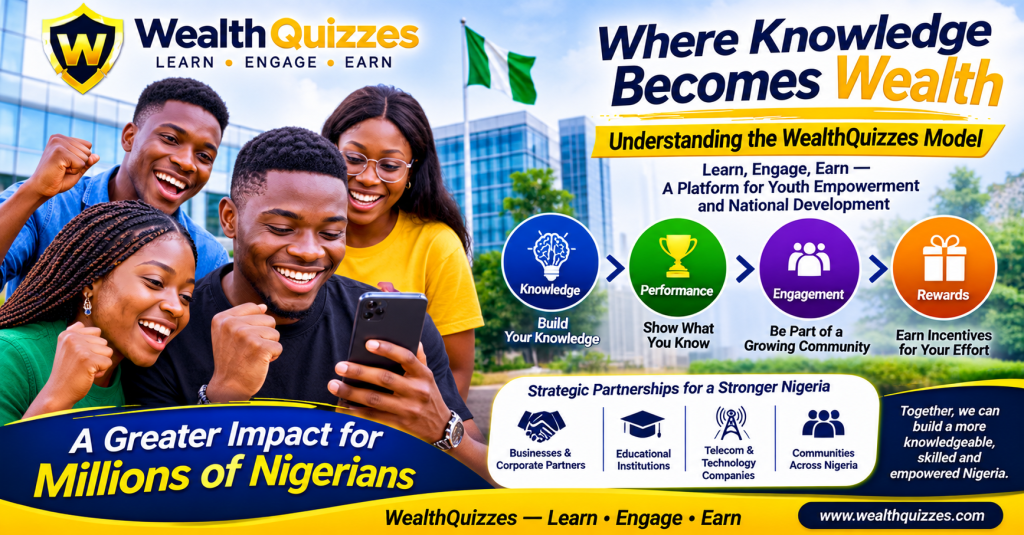
This illustration highlights four connected elements:
- Knowledge: the information and understanding the participant brings to the quiz.
- Performance: the participant’s ability to answer correctly and meet the stated requirements.
- Engagement: the decision to participate in the structured digital experience.
- Applicable rewards: the conditional benefits associated with qualifying performance under the platform’s rules.
These elements explain the logic of the model without implying that every participant will earn money or that every session will produce a positive financial outcome.
They also show why the model must be communicated carefully. Users should understand both the opportunity and the conditions before making a participation decision.
6. Youth Empowerment: More Than a Financial Incentive
Youth empowerment is often discussed in terms of jobs, entrepreneurship, education and access to technology. These are important areas, but empowerment also involves helping people develop confidence, curiosity and the capacity to make informed decisions.
A knowledge-based platform can contribute to this wider objective when it encourages active participation, provides an accessible user experience and treats participants fairly.
For young adults, quizzes may offer an engaging way to revisit familiar subjects, encounter unfamiliar information and recognise areas where further learning could be useful. A participant who discovers gaps in their knowledge can use that experience as a prompt to study more deeply.
Where appropriate, the platform could also explore collaborations with educational organisations, technology companies and other institutions interested in digital engagement or public education. Such programmes would need defined objectives, accurate content, responsible delivery and measurable outcomes.
The wider national-development opportunity lies in complementing other learning and empowerment initiatives—not replacing them. Nigeria’s digital future will depend on many factors, including infrastructure, relevant skills, affordability, quality education and access to meaningful opportunities.
WealthQuizzes can pursue a focused role within that wider environment by making knowledge-based participation engaging and by continuing to improve its product in response to user needs.
7. Trust, Transparency and Responsible Participation
Any platform that combines subscriptions with rewards has a responsibility to communicate its model clearly.
Users should be able to understand the applicable charges, participation requirements, stage-completion rules, reward eligibility and withdrawal conditions. They should also have access to appropriate support when they need clarification or encounter a problem.
Responsible communication means avoiding exaggerated claims about earning potential. It also means distinguishing cash rewards from promotional credits or other benefits that may have different conditions.
The platform’s long-term credibility will depend not only on attracting participants but also on providing a reliable experience, addressing complaints appropriately and ensuring that its public statements reflect its actual operations.
These principles matter particularly when promoting the platform to young adults. Empowerment should be associated with informed choice, realistic expectations and responsible use—not pressure to spend money or the suggestion that rewards are inevitable.
Conclusion: Where Knowledge Meets Opportunity
WealthQuizzes brings together knowledge, performance, engagement and conditional rewards in a structured digital quiz experience.
Its model invites users to test what they know, respond to timed questions, progress through stages and qualify for applicable rewards when they meet the stated requirements. The opportunity is real within the platform’s rules, but the outcome is not guaranteed income.
The broader significance lies in making knowledge an active part of digital participation. Quizzes can encourage curiosity and provide opportunities to practise retrieving information, while performance-based progression gives users a clear structure for engaging with the experience.
For Nigeria, knowledge-based digital platforms may contribute to the wider ecosystem of learning, participation and innovation when developed responsibly and evaluated honestly.
The enduring principle is simple: knowledge has value, performance demonstrates what a participant can do, engagement creates the opportunity to participate, and rewards remain subject to the conditions that govern them.
WealthQuizzes — Learn • Engage • Earn.
Explore the platform at www.wealthquizzes.com.
Participation and rewards are subject to the platform’s applicable terms and conditions. Rewards are conditional on qualifying performance and are not guaranteed income.
Selected Authorities and Further Reading
- Roediger, H. L. III, & Karpicke, J. D. (2006). “Test-Enhanced Learning: Taking Memory Tests Improves Long-Term Retention.” Psychological Science, 17(3), 249–255. https://doi.org/10.1111/j.1467-9280.2006.01693.x
- Roediger, H. L. III, & Karpicke, J. D. (2006). “The Power of Testing Memory: Basic Research and Implications for Educational Practice.” Perspectives on Psychological Science, 1(3), 181–210. https://doi.org/10.1111/j.1745-6916.2006.00012.x
- World Bank (2025). Digital Skills in Nigeria. Read the report.
- WealthQuizzes. Official platform information and published FAQs. https://wealthquizzes.com/.


