
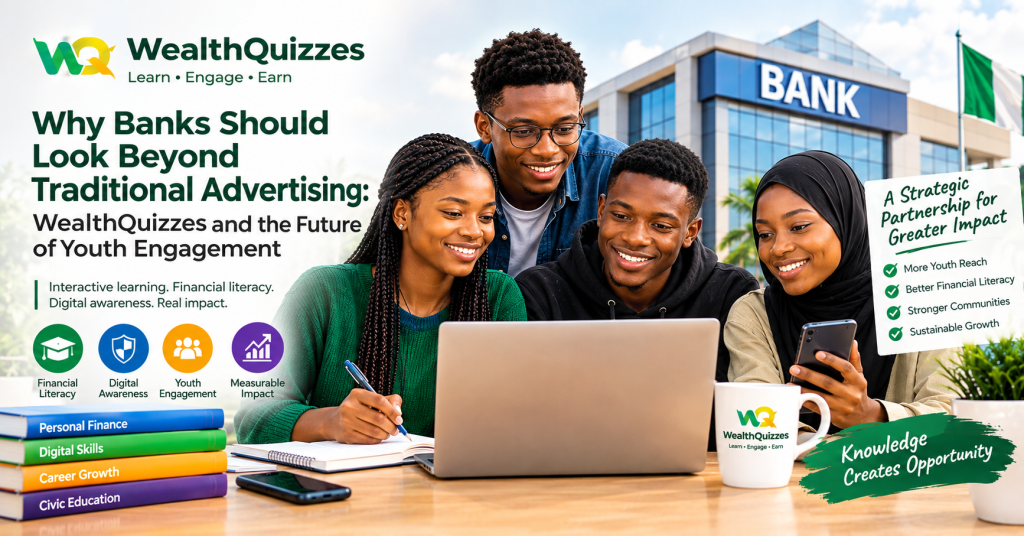
Why Banks Should Look Beyond Traditional Advertising: WealthQuizzes and the Future of Youth Engagement
The Value of WealthQuizzes’ Partnership Proposals
WealthQuizzes Blog | Learn • Engage • Earn
Introduction: Beyond Visibility to Meaningful Engagement
Banks have traditionally relied on television commercials, radio advertisements, billboards, social media campaigns, promotional offers and sponsorships to attract customers and strengthen brand recognition. These channels remain important. However, as financial services become increasingly digital and younger consumers interact with brands in different ways, banks have an opportunity to complement conventional advertising with approaches that provide practical value beyond brand exposure.
For today’s young Nigerians, financial institutions are not simply places to deposit money or obtain payment cards. They are part of a wider financial environment involving digital payments, savings, online shopping, financial planning, entrepreneurship and the growing need to recognise fraudulent schemes. Reaching young people effectively therefore requires more than promoting products. It also requires helping them understand financial services, make informed decisions and engage responsibly with the financial system.
This creates an opportunity for collaboration between banks and knowledge-based digital platforms such as WealthQuizzes, a Nigerian digital engagement platform built around interactive quizzes, participation and performance-based rewards.
Through an appropriately structured partnership, WealthQuizzes could complement a bank’s financial-literacy campaigns, youth outreach and customer education programmes. Interactive knowledge challenges could introduce relevant financial concepts, encourage participants to test their understanding and provide a measurable channel for educational engagement.
The proposition is not that traditional advertising has become obsolete or that quizzes can replace professional financial education. Rather, banks could explore an additional engagement channel that combines learning, digital participation and measurable outcomes.
The strategic question is whether financial institutions can create more meaningful relationships with younger audiences by giving them useful reasons to engage with their brands beyond viewing an advertisement.
1. Why Financial Institutions Need a Broader Youth Engagement Strategy
Young people are important to the long-term development of financial services. As they progress through education, employment, entrepreneurship and other life stages, they encounter decisions involving income, spending, saving, digital payments, borrowing and financial security.
Yet familiarity with technology does not automatically translate into financial capability. A young person may use a smartphone confidently but still struggle to distinguish a legitimate financial offer from a fraudulent one, understand borrowing costs, establish a realistic budget or identify the implications of sharing sensitive account information.
The Central Bank of Nigeria (CBN) recognises financial education as an important element of consumer protection and financial inclusion. Its Financial Literacy programme identifies the ability to manage financial resources effectively as central to financial well-being. It also explains that financially literate consumers can make better-informed choices about financial products, understand their rights and responsibilities, and contribute to a sounder financial system. <Cite refs={[“turn280581search1″,”turn280581search0”]}/>
For banks, this creates a dual opportunity.
First, financial education can help consumers understand the products and services available to them and use them more responsibly. Second, educational engagement can give banks opportunities to demonstrate that their relationship with customers extends beyond transactions and sales.
A bank that helps young people understand savings, budgeting, fraud prevention and responsible borrowing may be providing value that remains relevant long after a particular advertising campaign ends.
This does not mean every educational activity will produce customer acquisition or loyalty. Those outcomes must be assessed independently. It does mean that education can be considered a strategic complement to conventional marketing rather than merely an occasional corporate social responsibility activity.
2. The Limitations of Advertising Without Education
Traditional advertising is designed primarily to attract attention, communicate a message and influence awareness or purchasing decisions. It can be effective for launching products, communicating offers and maintaining brand visibility.
However, exposure to a message does not necessarily mean that an audience understands it, remembers it or can apply the information in a practical situation.
A young person may see an advertisement for a savings account without understanding how to establish a realistic savings goal. A campaign promoting digital banking may explain convenience without adequately addressing phishing, account security or the importance of protecting transaction credentials. An advertisement for credit may communicate availability without helping a potential borrower evaluate affordability and repayment obligations.
These are not arguments against advertising. They are reasons to complement it with educational experiences that allow people to engage with information more actively.
The OECD’s PISA 2022 Results, Volume IV: How Financially Smart Are Students? examines the financial literacy of 15-year-old students and the relationship between financial knowledge and behaviour. Its findings associate stronger financial literacy with more responsible financial behaviour, including saving and comparing prices before purchases. The report also highlights differences in financial literacy linked to socioeconomic background, reinforcing the importance of accessible learning opportunities. OECD — Student Financial Literacy. <Cite refs={[“turn280581search11”]}/>
For banks, the implication is practical: advertising can introduce a financial concept, while interactive education can help audiences explore what that concept means in everyday life.
A campaign about savings, for example, could be complemented by a short quiz on budgeting, emergency funds and the difference between needs and wants. A campaign about digital banking could direct participants towards an educational challenge on identifying suspicious messages and protecting their account information.
The advertisement attracts attention; the educational activity offers an opportunity to deepen understanding.
3. How WealthQuizzes Could Complement Bank Financial-Literacy Campaigns
WealthQuizzes offers a potential interactive channel through which financial institutions could explore educational engagement with relevant audiences. Its knowledge-based format can be adapted, subject to agreement, to support campaigns around practical financial concepts.
A bank could consider sponsoring or collaborating on a themed financial-literacy challenge addressing topics such as:
- Budgeting and responsible spending.
- Saving habits and financial planning.
- Understanding basic banking products and services.
- Recognising financial scams and suspicious offers.
- Digital payment safety and account security.
- Responsible borrowing and understanding repayment obligations.
- Consumer rights, complaint procedures and informed financial decisions.
Questions could be designed around everyday situations rather than definitions alone. For example, participants might be asked how to respond to a message requesting a one-time password, how to compare two savings options using disclosed terms, or what to consider before accepting a loan.
The educational value would depend on the accuracy and clarity of the content, the suitability of the questions and the explanations provided after each response. Subject-matter experts from the participating bank could review relevant material, while WealthQuizzes could provide the interactive engagement format.
The bank would retain control over its approved educational messages, brand usage and any product-specific information included in the programme. The platform would not need to replace the bank’s existing communication channels; it could provide another route through which audiences interact with educational content.
Such collaboration would be particularly relevant where a bank wants to move from simply distributing financial information to testing whether participants understand key concepts.
4. Youth Outreach: Meeting Young People Through Participation
Youth engagement programmes are more effective when they provide a reason for participation beyond the opportunity to receive promotional material.
An interactive knowledge challenge can give young people a defined activity: answer questions, test their understanding, learn from feedback and explore a subject in an engaging format. This can complement school outreach, university engagement, youth development initiatives and financial-literacy events.
For example, a bank could explore a proposed Young Nigerians and Smart Money Decisions Challenge with WealthQuizzes. The programme might invite eligible participants to engage with a series of questions on financial planning, digital safety and consumer awareness.
The bank could contribute subject-matter expertise, approved educational resources, programme sponsorship or access to appropriate outreach channels. WealthQuizzes could support the digital quiz experience and agreed participation reporting.
The initiative could be promoted through channels appropriate to the target audience, including the bank’s existing communication platforms, educational institutions or youth organisations where suitable permissions and agreements are in place.
This would allow the bank to test whether interactive activities attract participants who might not otherwise attend a conventional financial-literacy event.
It would also create an opportunity to evaluate which topics generate interest, where participants encounter difficulties and which forms of explanation improve understanding.
Such a programme should be designed to include, rather than exclude, young people who face barriers relating to device access, data costs, disability or digital literacy. Where appropriate, the digital activity could be complemented by in-person sessions or accessible educational materials.
The aim should be meaningful participation, not simply the collection of registrations.
5. Responsible Customer Education as a Long-Term Investment
Financial institutions have responsibilities that extend beyond selling products. Customers need sufficient information to understand the terms, risks, costs and obligations associated with financial services.
The CBN’s Consumer Education and Evaluation Division identifies collaboration, content development, consumer segmentation, monitoring and evaluation as elements of financial education. Its mandate includes evaluating financial-literacy and consumer-protection programmes and working with stakeholders on implementation and impact assessment. CBN — Consumer Education and Evaluation Division. <Cite refs={[“turn280581search0”]}/>
This institutional emphasis supports the case for educational partnerships that are planned and evaluated rather than treated as isolated promotional events.
WealthQuizzes could potentially complement responsible customer education by helping banks present general financial concepts through interactive questions and scenarios. A bank might develop an educational sequence explaining the importance of checking transaction details, understanding fees, protecting personal identification information and using official channels to resolve complaints.
Such activities must remain accurate and impartial. They should not obscure product risks, encourage unsuitable financial decisions or present a bank’s product as automatically superior to alternatives. Where a quiz refers to a specific product, its terms and disclosures should be reviewed by the bank and presented clearly.
A programme should also distinguish general education from personalised financial advice. A quiz can help someone understand a concept, but it cannot necessarily determine which financial product is appropriate for that individual’s circumstances.
When designed responsibly, customer education can support better-informed interactions between banks and the public. Whether it improves trust, retention or product usage should be tested through evidence rather than assumed.
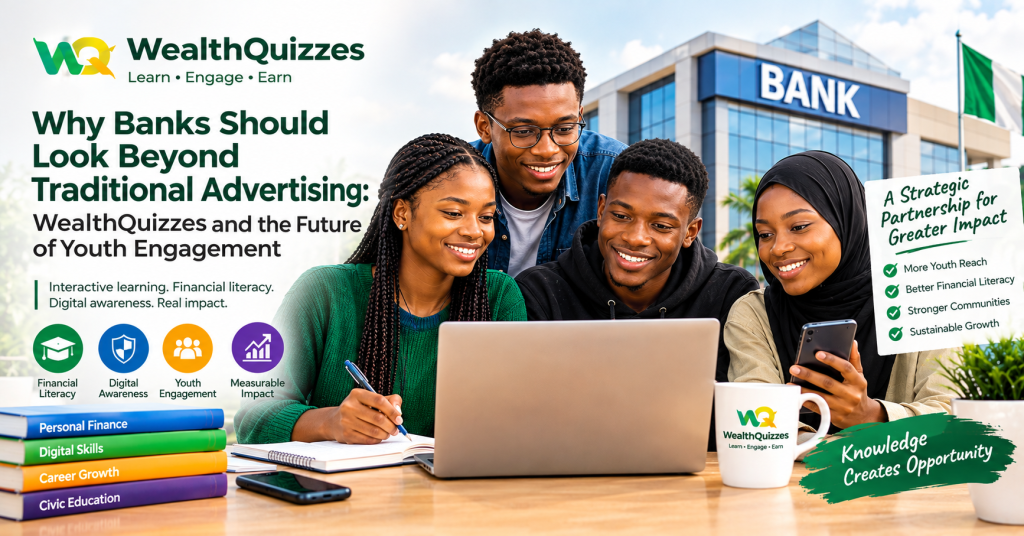
6. Measuring Engagement and Educational Outcomes
One potential advantage of a digital engagement programme is the opportunity to collect structured information about participation and performance. However, measurement must distinguish marketing activity from educational results.
A bank and WealthQuizzes could agree on a monitoring framework before launching a pilot. The framework might include four categories of indicators.
Reach and participation
- Number of eligible participants reached.
- Number of registrations and active participants.
- Quiz completion rates.
- Participation across relevant age groups or locations, where appropriate and lawful to measure.
Engagement
- Repeat participation during the programme.
- Completion of successive learning activities.
- Participant feedback and satisfaction.
- Drop-off points in the user journey.
Learning outcomes
- Baseline and follow-up assessment scores.
- Changes in participants’ ability to identify financial risks.
- Understanding of basic budgeting, savings and responsible borrowing concepts.
- Ability to select safer responses in digital banking scenarios.
Commercial and operational performance
- Cost per active participant.
- Cost per completed learning activity.
- Acquisition and retention indicators where relevant to the programme.
- Delivery costs compared with the approved budget.
The OECD’s Guidance on Digital Delivery of Financial Education examines how digital technologies can support financial education and why initiatives require appropriate design, implementation and evaluation. It provides a useful reference for banks considering digital delivery as part of their wider educational strategy. OECD — Guidance on Digital Delivery of Financial Education. <Cite refs={[“turn280581search2”]}/>
A pilot could, for instance, set a target for participant completion and a separate target for improvement in assessment scores. The bank should not treat the number of quiz attempts as proof that financial capability has improved. Likewise, an improvement in quiz scores does not by itself demonstrate that participants changed their real-world financial behaviour.
The strongest evaluation framework would combine activity data with suitable pre- and post-programme assessments, participant feedback and, where feasible, follow-up research.
Any numerical targets should be established jointly after considering the audience, budget, programme duration and baseline findings. They should not be presented as existing WealthQuizzes performance statistics or guaranteed results.
7. A Practical Partnership Model for Banks
Rather than committing immediately to a large campaign, a bank could explore a defined pilot with WealthQuizzes. A 60- or 90-day programme, for example, could test a specific educational theme and provide evidence to guide a future decision.
A potential structure could involve five steps.
Step 1: Agree on the objective. The bank identifies the priority issue—such as fraud awareness, savings education or responsible digital banking—and defines the intended audience.
Step 2: Develop and approve the content. Relevant experts review the questions, explanations and educational materials. The parties agree on branding, disclosures, data arrangements and reward conditions, if any.
Step 3: Recruit participants. The campaign is promoted through approved channels, with clear information about eligibility, participation and the purpose of the activity.
Step 4: Deliver and monitor the programme. Participants engage with the quiz activities while the parties monitor reach, completion, feedback and assessment performance.
Step 5: Evaluate and decide. The partners review results against agreed targets, identify lessons and decide whether to revise, repeat or expand the programme.
A written agreement should define responsibilities, costs, ownership and permitted use of content, data access, public communications and reporting obligations. Both parties should also establish how complaints will be handled and how the programme can be paused or terminated if necessary.
This structure allows a bank to test the approach within controlled limits before considering a larger commitment. It also gives WealthQuizzes an opportunity to demonstrate delivery capacity and refine the model in response to evidence.
8. Trust, Data Protection and Brand Integrity
Any partnership involving a bank and a digital platform must give serious attention to privacy, information security, customer protection and reputational risk.
The parties should agree on what information is necessary to operate and evaluate the programme, who can access it, how it will be protected and how long it will be retained. Data should not be shared between the bank and WealthQuizzes merely because a participant has taken part in a quiz; any sharing must have an appropriate lawful basis and transparent arrangements.
The Nigeria Data Protection Commission provides official information on the country’s data-protection framework. Banks should assess relevant legal and regulatory obligations with their compliance and data-protection teams before implementing a programme.
Brand association must also be handled carefully. A bank’s participation should not be portrayed as an endorsement of the entire WealthQuizzes platform unless the bank has expressly authorised that representation. Equally, WealthQuizzes should not imply that a bank guarantees the results of a quiz or any performance-based reward.
If rewards form part of a campaign, the terms should be clear, fair and accurately communicated. Educational participation must not be presented as a route to guaranteed income, nor should users be encouraged to spend money they cannot afford.
These safeguards are essential to ensuring that the partnership supports customer education without undermining the trust it seeks to build.
Conclusion: The Next Stage of Youth Engagement in Banking
Traditional advertising remains an important part of banking, but financial institutions have an opportunity to complement it with experiences that offer practical educational value.
Young Nigerians need more than promotional messages about accounts, cards and digital services. They also need opportunities to understand financial concepts, recognise risks, protect themselves online and make informed decisions. Banks have an established interest in financial literacy and consumer protection, while interactive digital platforms offer additional ways to engage audiences and assess their understanding.
WealthQuizzes could provide a supplementary channel through which banks explore these objectives using knowledge quizzes, educational challenges and structured youth engagement programmes. The potential value lies not in replacing existing campaigns, but in adding a measurable participation and learning component to them.
The case for collaboration should remain evidence-led. A well-designed pilot would define its audience, establish baseline measures, agree on realistic targets, protect participants and report outcomes honestly. If the results demonstrate value, the parties could consider expanding the programme. If they do not, the evidence should inform improvements or a different approach.
For banks, this offers a practical way to examine whether education-based engagement can complement customer acquisition, financial-literacy outreach and responsible use of digital services. For WealthQuizzes, it offers an opportunity to demonstrate how a Nigerian knowledge-based platform could contribute to broader financial education objectives.
The future of youth engagement in banking need not be advertising versus education. It can be advertising supported by education, customer relationships strengthened by useful knowledge, and partnerships evaluated by the value they create.
Selected Authorities and Further Reading
- Central Bank of Nigeria — Financial Literacy. Overview of financial literacy, consumer protection and the role of financial education in financial inclusion.
https://www.cbn.gov.ng/FinInc/FinLit/ - Central Bank of Nigeria — Consumer Education and Evaluation Division. Information on financial-literacy policy, stakeholder collaboration, programme implementation and evaluation.
https://www.cbn.gov.ng/supervision/cpdceed.html - OECD — PISA 2022 Results, Volume IV: How Financially Smart Are Students? Research on student financial literacy and its relationship with financial behaviours.
https://www.oecd.org/en/topics/student-financial-literacy.html - OECD/INFE — Guidance on Digital Delivery of Financial Education (2022). Guidance for designing and implementing digital financial education initiatives.
https://doi.org/10.1787/c980ce2b-en - World Bank — Financial Capability. Resources on financial knowledge, skills, attitudes and behaviours relevant to informed use of financial services.
https://responsiblefinance.worldbank.org/en/responsible-finance/financial-capability - Nigeria Data Protection Commission. Official information on Nigeria’s data protection framework.
https://ndpc.gov.ng/ - WealthQuizzes. Official platform website.
https://wealthquizzes.com/
WealthQuizzes Blog | Learn • Engage • Earn | Where knowledge becomes wealth.


