
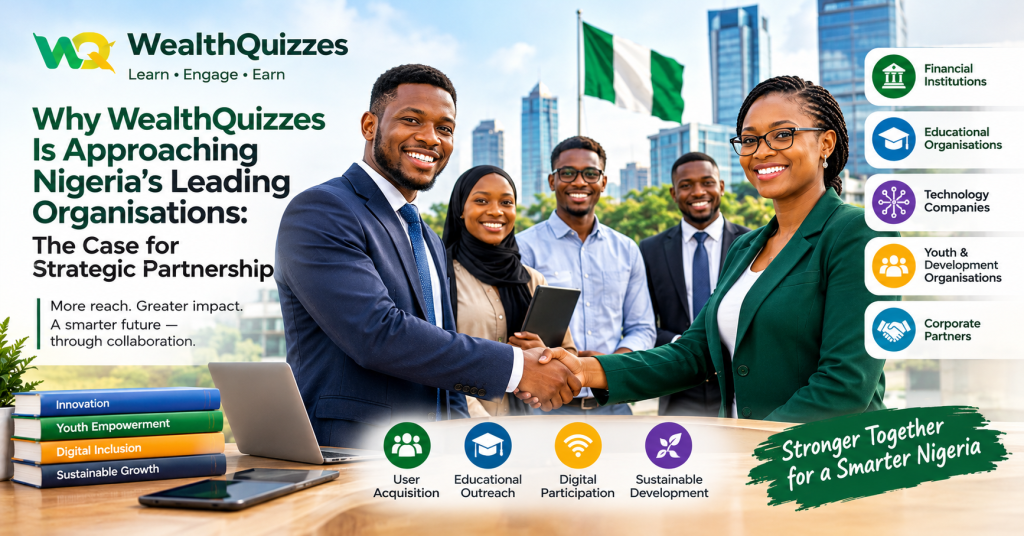
Why WealthQuizzes Is Approaching Nigeria’s Leading Organisations: The Case for Strategic Partnership
The Value of WealthQuizzes’ Partnership Proposals
WealthQuizzes Blog | Learn • Engage • Earn
Introduction: Building More Than a Digital Platform
The success of a digital platform is determined by more than the quality of its technology or the appeal of its concept. Sustainable growth also depends on public trust, effective distribution, user engagement, operational capacity and the ability to develop mutually beneficial relationships with organisations that share compatible objectives.
For WealthQuizzes, a Nigerian knowledge-based digital engagement platform built around the relationship between knowledge, participation and performance-based rewards, these considerations are central to its long-term development. The platform seeks to make knowledge more engaging while creating opportunities for users to participate in structured quiz activities across different subject areas.
However, reaching a wider audience, strengthening educational outreach and building a sustainable operating model are not objectives that a growing platform must pursue alone. Established organisations can contribute distribution networks, institutional credibility, communication channels, technical expertise, funding for agreed activities and access to communities that would otherwise take considerable time and resources to reach.
This is the strategic rationale behind WealthQuizzes’ approach to leading Nigerian organisations and potential development partners. The objective is not simply to request sponsorship or financial support. It is to explore collaborations through which both parties can pursue clearly defined outcomes, test practical ideas and determine whether a longer-term relationship would create measurable value.
In a digital economy where partnerships can connect technology with established institutions and existing audiences, the central question is not merely whether WealthQuizzes can grow independently. It is whether carefully structured collaboration could help it grow more effectively, responsibly and sustainably.
1. Why Strategic Partnerships Matter in the Digital Economy
Strategic partnerships allow organisations to combine complementary capabilities rather than attempt to develop every resource internally. One organisation may possess a digital product and the capacity to deliver it, while another has an established customer base, recognised brand, regional network or experience in reaching a particular audience.
When the parties share compatible objectives, their combined resources can create opportunities that would be difficult or expensive for either to achieve alone.
The World Bank’s World Development Report 2016: Digital Dividends examined how digital technologies can support development while emphasising that technology alone does not guarantee the expected economic and social benefits. Institutions, skills, competition and effective implementation remain important. This is a relevant lesson for digital platforms seeking to translate technical capability into broader public value. World Bank, World Development Report 2016: Digital Dividends.
For WealthQuizzes, strategic collaboration could help address several interconnected growth requirements:
- Audience development: Reaching suitable users through established communication and community networks.
- Educational outreach: Introducing interactive knowledge activities to schools, youth groups, professional communities and other appropriate audiences.
- Digital participation: Encouraging people to explore knowledge-based digital services and engage with structured learning activities.
- Brand confidence: Giving prospective users and partners clearer information about the platform, its operating model and its safeguards.
- Operational development: Obtaining specialist support, technical guidance and relevant institutional experience.
- Long-term sustainability: Testing acquisition channels, engagement models and partnership structures that may support continued operations.
These are potential benefits, not guaranteed outcomes. Their achievement would depend on the suitability of each partner, the quality of implementation, the resources committed and the evidence obtained during the collaboration.
2. User Acquisition: Reaching Beyond Conventional Marketing
For an emerging digital platform, attracting users is only the beginning. It must reach the right audience, communicate its value clearly and encourage people to try the service. Paid advertising, direct outreach and organic visibility can contribute to this process, but sustained acquisition may require access to trusted networks and communities.
Established organisations often maintain relationships with customers, employees, students, members, entrepreneurs or young people. Depending on their mandate and audience, they may be able to introduce a relevant digital initiative through newsletters, events, community programmes, digital channels or jointly organised activities.
A partnership with a bank, for example, might explore an educational campaign involving financial knowledge and responsible decision-making. A telecommunications company could potentially support digital participation initiatives. An education-focused organisation might help test knowledge activities with an appropriate learning community. These are illustrations of possible collaboration models, not claims that any such organisation has partnered with WealthQuizzes.
The strategic advantage is the possibility of connecting a digital service to an audience through a channel that already exists.
Nevertheless, access to an organisation’s audience does not automatically translate into active users. A successful arrangement would need clear audience selection, appropriate consent, transparent communication, an easy onboarding process and a relevant reason for people to participate.
The results should be measured through indicators such as registrations, activation rates, repeat participation, user retention and the cost of acquiring an active user. Where possible, the parties should compare these results with other acquisition channels to determine whether the partnership is genuinely effective.
For WealthQuizzes, this approach would turn user acquisition from a general marketing aspiration into a measurable programme of experimentation and improvement.
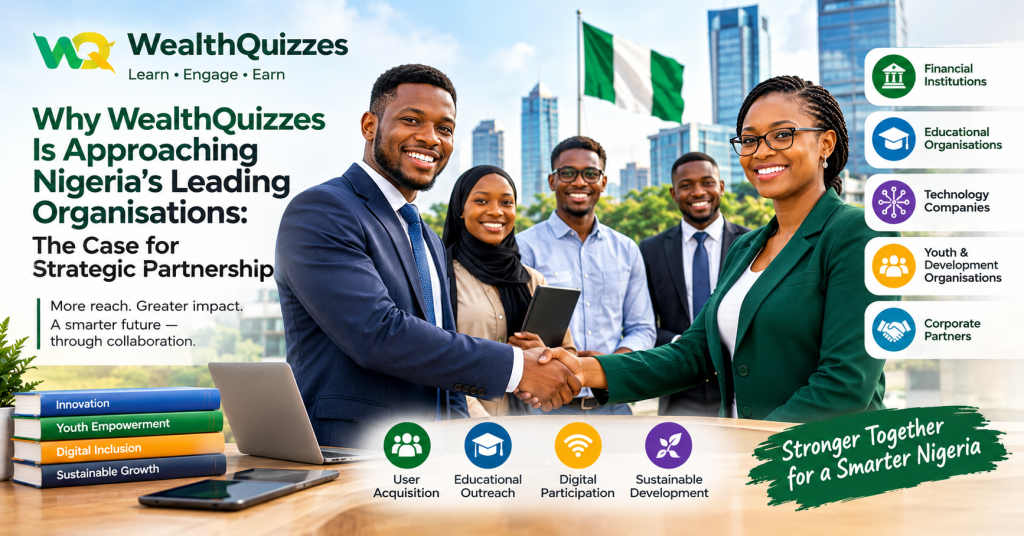
3. Educational Outreach: Making Knowledge More Engaging
Knowledge acquisition is a lifelong activity that extends beyond formal schooling. People need opportunities to explore subjects, test their understanding and apply what they learn in everyday situations.
The Organisation for Economic Co-operation and Development (OECD) has consistently examined the importance of skills, lifelong learning and the capacity to apply knowledge in changing economic and social environments. Its work on adult skills and education highlights the relevance of literacy, numeracy and problem-solving to participation in modern society. OECD, Survey of Adult Skills.
Interactive quizzes can provide one supplementary method of engaging learners with knowledge. Questions can encourage recall, reveal misunderstandings and motivate participants to revisit a subject. When properly designed, quizzes can also prompt curiosity about topics that users might not otherwise explore.
WealthQuizzes can potentially use this format to make general knowledge, Nigerian history, financial literacy, business concepts, sports, science and other subjects more accessible and engaging. Its role is not to replace formal education, professional instruction or authoritative learning resources. Rather, it can provide an additional avenue through which people interact with information and practise recalling what they know.
Partnerships could broaden this opportunity. An educational institution might help identify suitable learning topics; a youth development organisation could help reach its intended beneficiaries; a corporate partner might support a themed knowledge campaign; and a subject-matter expert could contribute to content review.
A credible educational partnership should also go beyond counting quiz attempts. It should consider whether questions are accurate, whether explanations support understanding and whether participants demonstrate improved knowledge over time. Baseline assessments, follow-up quizzes and participant feedback can help evaluate these outcomes.
This creates a potential point of alignment between WealthQuizzes and organisations interested in youth development, digital inclusion, lifelong learning and public education.
4. Digital Participation and Youth Engagement
Digital participation is increasingly relevant to education, commerce, professional development and access to information. However, meaningful participation involves more than owning a smartphone or having an internet connection. Users must also be able to navigate services, understand their terms, protect their information and make informed decisions about online activity.
The International Telecommunication Union (ITU), the United Nations specialised agency for digital technologies, publishes research and statistics on connectivity and digital development. Its work highlights the continuing importance of access, affordability and digital skills in ensuring that people can benefit from digital opportunities. ITU, Facts and Figures.
A knowledge-based platform can contribute to digital participation by giving users a structured reason to interact with digital content. If the service is accessible, reliable and clearly explained, users may gain experience navigating an online environment, following instructions and engaging with subject matter through a digital interface.
For WealthQuizzes, collaboration could help identify suitable audiences and design initiatives around their needs. A youth organisation might support an engagement programme for its members, while a corporate partner could explore a knowledge challenge linked to a defined public education objective.
Such initiatives should be designed around genuine user value rather than registrations alone. Clear terms, responsible handling of personal data, accessible interfaces, transparent reward conditions and effective customer support are essential to building a positive experience.
Digital inclusion also requires attention to people who face barriers related to data costs, device affordability, connectivity, disability or digital literacy. Partnerships that ignore these barriers risk reaching only those who are already well served.
The wider objective should be to expand meaningful participation while maintaining responsible standards for the people who use the platform.


