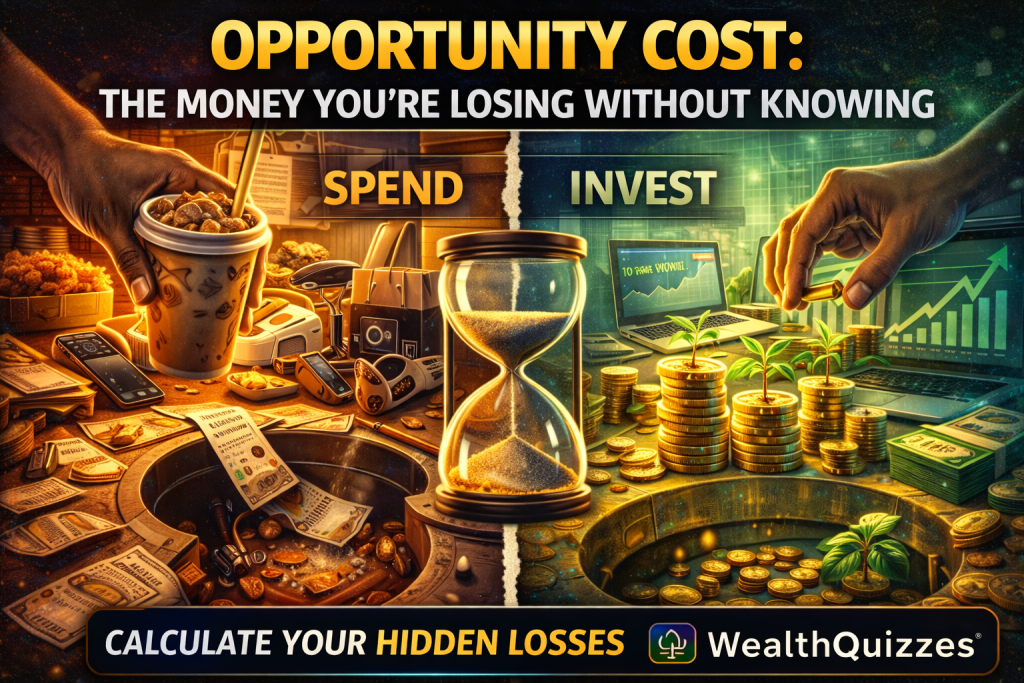
Opportunity Cost: The Money You’re Losing Without Knowing
The Hidden Price Behind Every Financial Decision
Introduction: The Cost You Never See
Every financial decision you make has a cost.
Not just:
- The money you spend
- The time you use
But something far more subtle:
The opportunity you give up.
This is what economists call opportunity cost—and it is one of the most powerful, yet most ignored, concepts in personal finance.
As the renowned economist Paul Samuelson explained, opportunity cost is the value of the next best alternative that you forgo when making a decision.
In simple terms:
Every “yes” to one thing is a “no” to something else.
The Core Truth
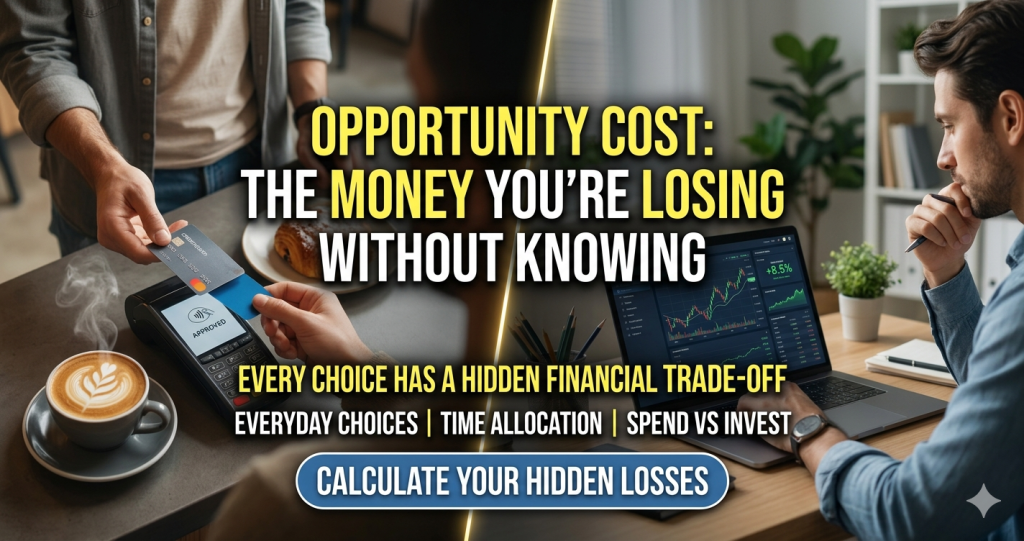
Core Idea: Every choice has a hidden financial trade-off
Mindset Shift: Spend vs invest decisions
Most people only see:
- What they are paying
But financially intelligent people see:
- What they are losing
Understanding Opportunity Cost
Opportunity cost is not always obvious.
It does not:
- Show up on receipts
- Appear in your bank statement
Yet, it affects:
- Your wealth
- Your future
- Your financial trajectory
As Greg Mankiw emphasizes, one of the fundamental principles of economics is:
“The cost of something is what you give up to get it.”
Why Opportunity Cost Is So Dangerous
1. It Is Invisible
Unlike expenses:
- You don’t feel it immediately
- You don’t track it
This makes it easy to ignore.
2. It Compounds Over Time
Small decisions:
- Repeated daily
- Accumulate silently
And over time:
They create massive financial differences.
3. It Feels Harmless
Spending ₦5,000 on something feels small.
But the real question is:
What could that ₦5,000 have become?
Everyday Opportunity Costs
1. Daily Spending Decisions
Let’s say you spend:
- ₦3,000 daily on non-essential items
That is:
- ₦90,000 monthly
- ₦1,080,000 yearly
But the real cost is not ₦1,080,000.
It is what that money could have:
- Earned
- Grown into
- Compounded over time
2. Lifestyle Choices
Buying:
- Expensive gadgets
- Designer items
- Frequent luxury experiences
Means giving up:
- Investment capital
- Business opportunities
- Future income streams
3. Subscription Culture
Recurring payments:
- Seem small
- Feel harmless
But over time:
- They accumulate
- They reduce investment capacity
The Power of Compounding (What You Lose)
Opportunity cost becomes more dangerous when combined with compound growth.
As famously noted by Albert Einstein:
“Compound interest is the eighth wonder of the world.”
When you spend instead of invest:
- You are not just losing money
- You are losing future growth
Example: The Real Cost of Delay
If you invest ₦100,000 today:
- It could grow significantly over time
If you spend it:
- Growth = zero
The difference:
That is opportunity cost.
Opportunity Cost: The Money You’re Losing Without Knowing
Time: The Most Overlooked Opportunity Cost
Money is not the only thing you lose.
You also lose:
Time
As Warren Buffett emphasizes:
“The most important investment you can make is in yourself.”
1. Time Spent vs Time Invested
Time used for:
- Entertainment
- Distraction
- Low-value activities
Could have been used for:
- Learning
- Building skills
- Creating income streams
2. The Cost of Wasted Time
One hour daily wasted equals:
- 365 hours yearly
That is:
- Over 15 full days
Lost.
The Spend vs Invest Decision
Every financial choice falls into one of two categories:
1. Spending
- Immediate satisfaction
- No long-term return
2. Investing
- Delayed gratification
- Future growth
The Key Question
Before any expense, ask:
“Am I consuming—or compounding?”
The Nigerian Context: Why This Matters More
In Nigeria:
- Inflation reduces money value
- Income growth is uncertain
- Economic pressure is high
This makes opportunity cost even more critical.
Because:
Money not invested is money losing value.
The Psychology Behind Ignoring Opportunity Cost
1. Present Bias
Humans prefer:
- Immediate rewards
Over:
- Future benefits
2. Emotional Spending
Decisions are often driven by:
- Feelings
- Social pressure
- Convenience
3. Lack of Awareness
Most people simply:
- Do not think in opportunity cost terms
Real-Life Illustration
Consider two individuals:
Person A
- Spends extra income
- Lives comfortably
Person B
- Invests extra income
- Delays gratification
After 10–20 years:
- Person A → Same lifestyle
- Person B → Financial independence
The difference?
Opportunity cost awareness.
How to Calculate Your Hidden Losses
Step 1: Track Your Spending
Identify:
- Daily expenses
- Monthly patterns
Step 2: Project Long-Term Value
Ask:
- What would this become if invested?
Step 3: Evaluate Trade-Offs
For every expense:
- What am I giving up?
Step 4: Prioritize High-Value Decisions
Focus on:
- Growth
- Assets
- Opportunities
The Opportunity Cost Framework
Before any decision, apply this:
- What am I choosing?
- What am I giving up?
- Which option creates more long-term value?
The Real Transformation
When you understand opportunity cost:
You move from:
- Impulsive → Intentional
- Spending → Strategic allocation
- Short-term → Long-term thinking
The Hard Truth
Most people are not poor because:
- They don’t earn enough
They are poor because:
They do not understand what they are losing.
Conclusion: The Invisible Wealth Killer
Opportunity cost is:
- Silent
- Invisible
- Powerful
It determines:
- Your financial direction
- Your wealth trajectory
- Your future outcomes
Because:
Wealth is not just about what you earn—
It is about what you choose.
Final Thought
Before your next financial decision, pause and ask:
“What is this costing me in the future?”
Because the most expensive choices are not the ones you see—
They are the ones you ignore.
👉 Calculate your hidden losses—take the quiz on WealthQuizzes