
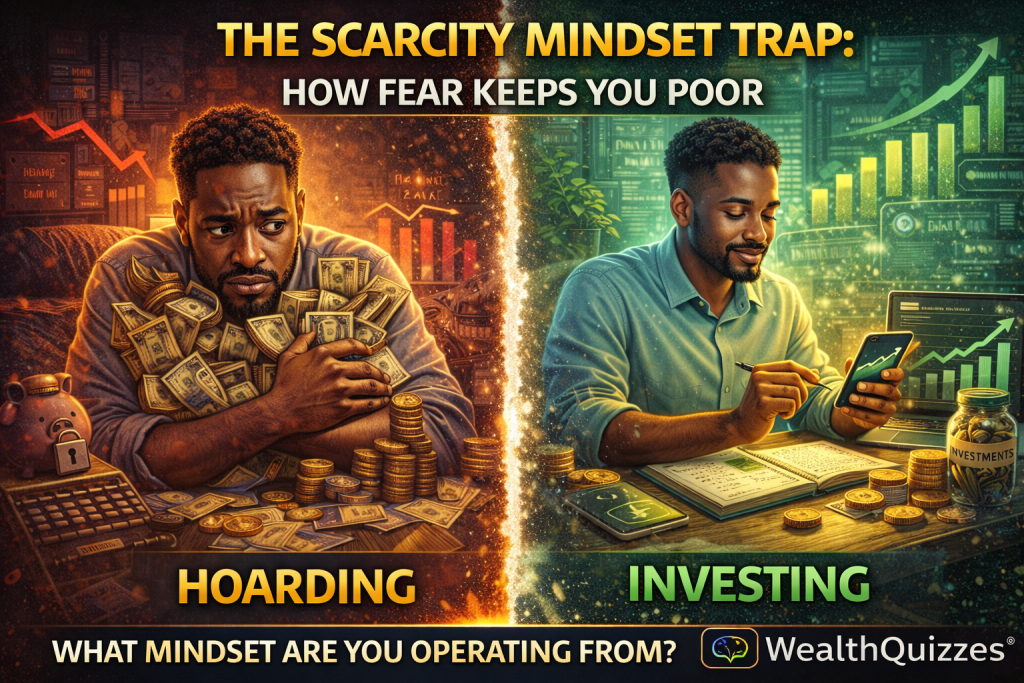
The Scarcity Mindset Trap: How Fear Keeps You Poor
Why Fear-Based Financial Decisions Quietly Block Wealth Creation
Introduction: The Invisible Limitation
Many people believe their financial struggles are caused by:
- Low income
- Economic conditions
- Limited opportunities
While these factors matter, there is a deeper and often overlooked constraint:
Mindset
More specifically:
A scarcity mindset
This mindset does not just affect how much you earn—it shapes how you:
- Think
- Decide
- Act financially
And over time, it can quietly keep you:
Stuck, cautious, and financially stagnant
The Core Truth
Core Idea: Fear-based decisions block growth
Mindset Shift: Scarcity → Strategic thinking
Your financial future is not determined only by:
- Opportunities
But by:
How you respond to them
What Is the Scarcity Mindset?
A scarcity mindset is the belief that:
- Resources are limited
- Opportunities are rare
- Loss is likely
- Risk must be avoided at all costs
This leads to decisions driven by:
Fear instead of strategy
The Psychology Behind Scarcity Thinking
As behavioral economist Sendhil Mullainathan explains, scarcity creates a tunneling effect, where people focus narrowly on immediate needs while ignoring long-term consequences.
This means:
- You prioritize short-term safety
- You ignore long-term growth
How Scarcity Manifests Financially
1. Hoarding Instead of Investing
People with a scarcity mindset tend to:
- Hold onto cash
- Avoid investments
- Delay financial decisions
They believe:
“It’s safer to keep what I have.”
The Problem
Cash alone:
- Does not grow significantly
- Loses value due to inflation
As Warren Buffett has consistently emphasized, capital must be deployed wisely to generate returns.
2. Fear of Loss
Fear of losing money leads to:
- Avoiding investments
- Missing opportunities
- Staying in comfort zones
As Daniel Kahneman explains through loss aversion, people feel the pain of loss more strongly than the pleasure of gain.
The Result
You:
- Protect small amounts
- Miss larger opportunities
3. Short-Term Decision Making
Scarcity thinking focuses on:
- Immediate needs
- Immediate safety
At the expense of:
- Long-term growth
4. Over-Cautious Behavior
You become:
- Risk-averse
- Hesitant
- Slow to act
This creates:
Missed opportunities
The Wealth Cost of Scarcity Thinking
1. No Capital Growth
Money is:
- Preserved
- Not multiplied
2. Opportunity Loss
You miss:
- Investments
- Business opportunities
- Skill development
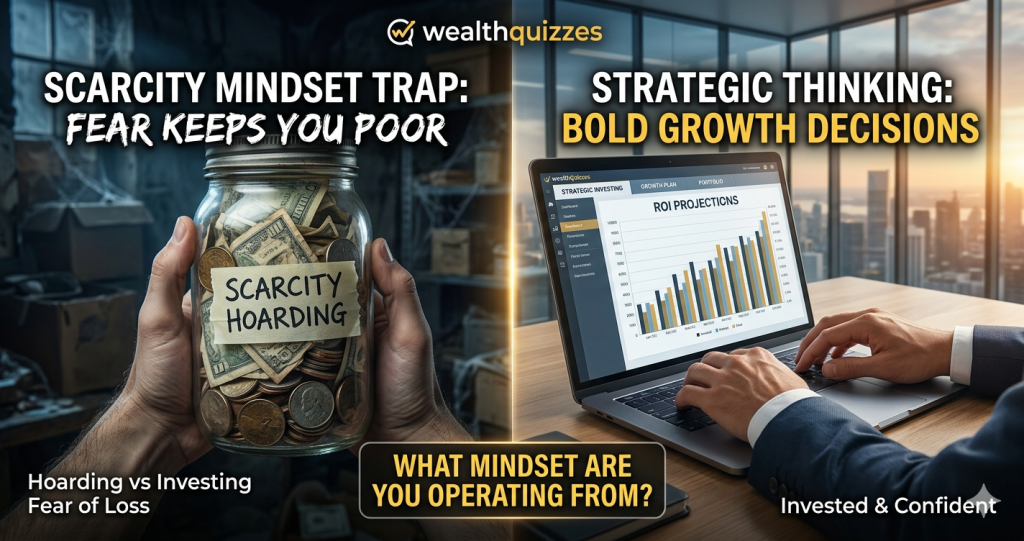
3. Delayed Wealth Creation
Growth is:
- Slowed
- Limited
4. Financial Stagnation
You remain:
- Safe—but stuck
The Paradox of Safety
Scarcity mindset seeks:
Safety
But often produces:
Long-term financial risk
Because:
- Not investing is risky
- Not growing is risky
- Not adapting is risky
The Nigerian Context: Why Scarcity Thinking Is Common
In Nigeria, scarcity mindset is reinforced by:
- Economic uncertainty
- Income instability
- Past financial hardships
These experiences shape beliefs like:
- “Money is hard to get”
- “Opportunities are limited”
- “Better to hold than risk”
But Here’s the Reality
While caution is necessary:
Excessive fear is costly
Scarcity vs Strategic Thinking
Scarcity Thinking:
- Protects
- Avoids risk
- Focuses on survival
Strategic Thinking:
- Evaluates risk
- Seeks growth
- Focuses on long-term outcomes
The Role of Risk in Wealth Creation
As Peter Lynch noted:
“Know what you own, and know why you own it.”
This reflects:
Informed risk—not blind avoidance
The Key Shift: From Fear to Strategy
The goal is not to:
- Eliminate risk
But to:
Understand and manage it
Practical Steps to Escape the Scarcity Trap
1. Reframe Risk
Instead of asking:
- “What if I lose?”
Ask:
- “What is the cost of not acting?”
2. Start Small
You don’t need:
- Large capital
Begin with:
- Small investments
- Gradual exposure
3. Build Financial Knowledge
Confidence reduces fear.
Learn:
- Investment basics
- Risk management
4. Diversify
Spread risk across:
- Multiple assets
- Different opportunities
5. Think Long-Term
Shift focus from:
- Immediate safety
To:
- Future growth
The Role of Confidence
Confidence is built through:
- Experience
- Knowledge
- Small wins
The Real Transformation
When you shift from scarcity to strategy:
You move from:
- Fear → Confidence
- Hoarding → Investing
- Stagnation → Growth
The Hard Truth
Most people are not poor because:
- They lack opportunities
They are poor because:
They are too afraid to act on them.
The Wealth Perspective
Wealth is built by:
- Taking calculated risks
- Deploying capital
- Thinking long-term
A Simple Mental Framework
Before making a financial decision, ask:
- Am I acting out of fear?
- Is this decision protecting or growing me?
- What is the long-term impact?
Conclusion: Fear Is Expensive
Fear feels safe.
But financially:
Fear is costly
Because:
- It delays action
- It blocks growth
- It limits potential
Final Thought
Before your next financial decision, pause and ask:
“Am I protecting myself—or holding myself back?”
Because the difference between staying stuck and building wealth is not opportunity—
It is mindset.
👉 What mindset are you operating from? Find out on WealthQuizzes