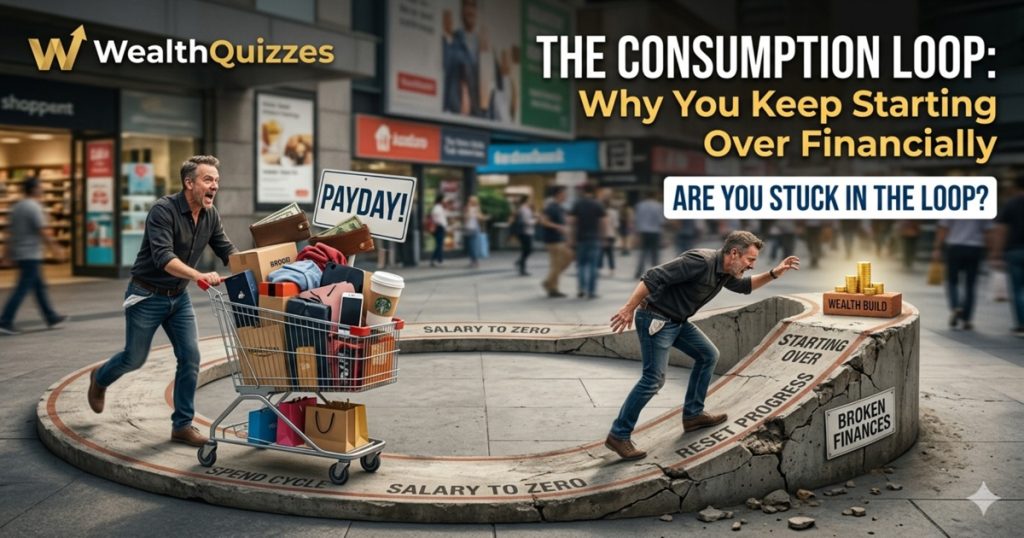
The Consumption Loop: Why You Keep Starting Over Financially
Breaking the Cycle That Quietly Resets Your Progress
Introduction: The Frustrating Financial Pattern
Have you ever experienced this cycle?
- You receive income
- You feel financially stable
- You spend gradually (or quickly)
- You reach the end of the month… with little or nothing left
Then it repeats.
Again.
And again.
This is not just poor money management.
It is something deeper:
A behavioral pattern known as the Consumption Loop
And until you break it, you will continue to:
Start over financially—no matter how much you earn
The Core Truth
Core Idea: Spending cycles reset progress
Mindset Shift: Break → Build → Sustain
The problem is not just how much you earn.
It is:
What happens to your money after you earn it
What Is the Consumption Loop?
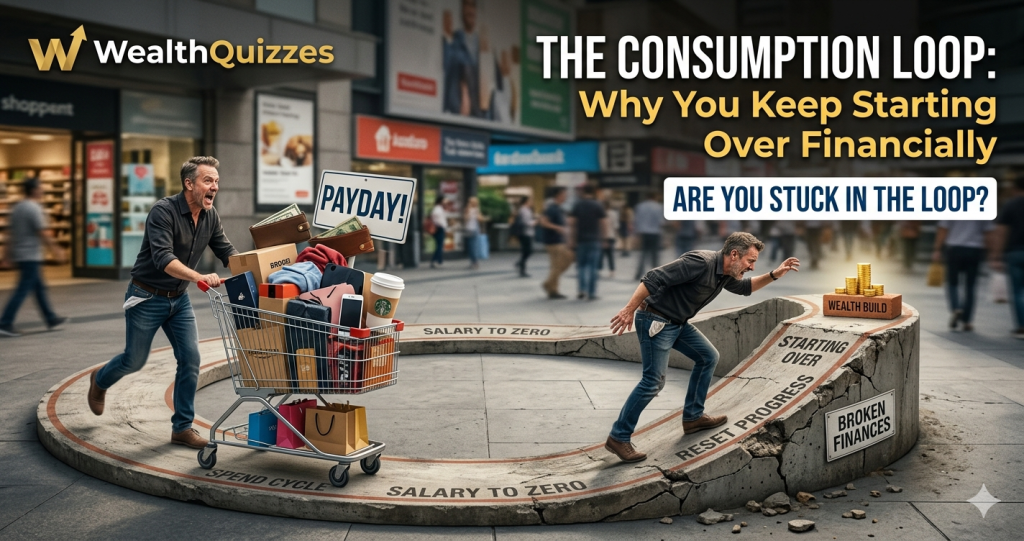
The Consumption Loop is a repeated financial cycle where:
- Income comes in
- Spending increases
- Savings disappear
- Financial position resets
This creates:
A continuous restart with no real progress
The Salary-to-Zero Cycle
One of the clearest expressions of this loop is the:
Salary-to-zero cycle
You:
- Earn
- Spend
- End at zero
As Morgan Housel explains, financial success is less about income and more about what you don’t spend.
Yet many people:
- Earn regularly
- Still remain financially stagnant
Why This Happens
Because income is treated as:
- Spendable money
Instead of:
- Strategic capital
The Illusion of Progress
Each new income cycle creates:
- Hope
- A sense of reset
- Temporary confidence
But in reality:
Nothing is being built
You are:
- Maintaining
- Not advancing
The Psychology Behind the Loop
1. Instant Gratification
Humans naturally prefer:
- Immediate rewards
Over:
- Delayed benefits
As Daniel Kahneman explains, people are wired to prioritize short-term satisfaction over long-term gain.
2. Consumption Triggers
Spending is not always logical.
It is triggered by:
- Emotions
- Environment
- Social influence
Common Triggers Include:
- Salary alerts (“I just got paid”)
- Social outings
- Online shopping exposure
- Peer pressure
- Stress and emotional relief
3. Reward Mentality
Many people believe:
“I worked hard, I deserve this.”
While true emotionally, financially it leads to:
- Continuous consumption
- Zero accumulation
The Real Cost of the Consumption Loop
1. No Wealth Accumulation
Money flows:
- In
- Then out
Nothing stays.
2. Delayed Financial Freedom
Because:
- Nothing is being built
- Everything is being consumed
3. Increased Financial Stress
Despite earning:
- You feel stuck
- You feel behind
4. Lost Opportunities
Money that could be:
- Invested
- Used to build assets
Is spent on:
- Temporary satisfaction
The Compounding Damage
The biggest danger of the consumption loop is:
Time loss
Every month spent in the loop:
- Delays progress
- Reduces compounding potential
As Albert Einstein is often credited with saying:
“Compound interest is the eighth wonder of the world.”
But here’s the reality:
You cannot benefit from compounding if you have nothing left to compound.
The Nigerian Context: Why the Loop Is Stronger
In Nigeria, the consumption loop is intensified by:
1. Social Expectations
- Weddings
- Celebrations
- Lifestyle visibility
2. Economic Pressure
- Rising costs
- Unstable income
3. Cultural Spending Norms
- Generosity expectations
- Family obligations
This creates a system where:
Spending is constant—and saving is optional
The Key Insight
The consumption loop is not:
- A money problem
It is:
A behavioral system problem
Breaking the Consumption Loop
To escape, you must move through three stages:
1. Break the Cycle
Identify Your Patterns
Ask:
- When do I spend the most?
- What triggers my spending?
Interrupt the Flow
Before spending:
- Pause
- Question
- Delay decisions
Create Friction
Make spending:
- Less convenient
- More intentional
2. Build Financial Structure
Pay Yourself First
Before spending:
- Save
- Invest
As George Clason advised:
“Pay yourself first.”
Create Allocation Systems
Divide income into:
- Needs
- Savings
- Investments
- Discretionary spending
Automate Discipline
Remove:
- Emotional decision-making
3. Sustain the Change
Build Habits
Consistency is more important than:
- Perfection
Track Progress
Measure:
- Savings growth
- Investment increases
Reinforce Identity
Shift from:
- Consumer
To:
- Builder
The Real Transformation
When you break the consumption loop:
You move from:
- Starting over → Building forward
- Spending → Structuring
- Surviving → Growing
The Hard Truth
Most people are not financially stuck because:
- They don’t earn enough
They are stuck because:
They keep resetting their progress.
The Wealth Perspective
Wealth is not built by:
- What you earn
It is built by:
- What you keep
- What you grow
A Simple Framework to Remember
Before you spend, ask:
- Is this necessary?
- Is this aligned with my goals?
- What am I giving up by spending this?
Conclusion: From Loop to Leverage
The consumption loop is:
- Subtle
- Repetitive
- Destructive
But it is also:
Breakable
Because once you:
- Control spending
- Structure money
- Build consistently
You stop restarting—and start progressing.
Final Thought
Before your next paycheck arrives, ask yourself:
“Will this be another cycle—or a turning point?”
Because the difference between being stuck and building wealth is not income—
It is what you do after you earn.
👉 Are you stuck in the loop? Find out on WealthQuizzes