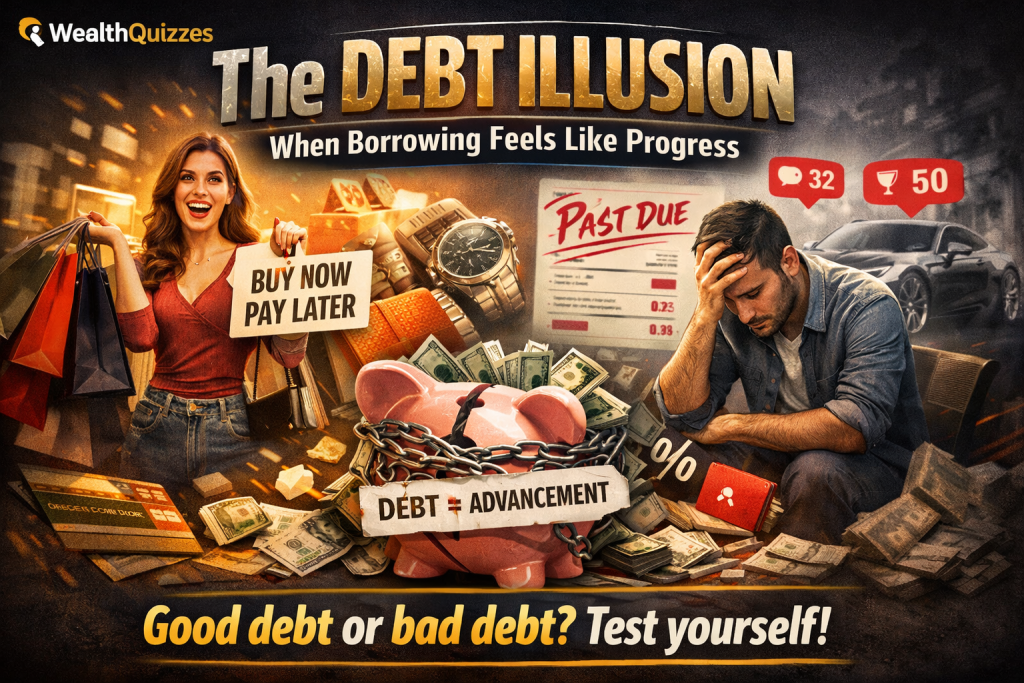
The Debt Illusion: When Borrowing Feels Like Progress
Why Taking on Debt Often Masquerades as Financial Growth
Introduction: The False Sense of Advancement
In today’s financial environment, borrowing has become easier, faster, and more socially acceptable than ever before.
You can:
- Buy a phone and pay later
- Upgrade your lifestyle instantly
- Spread payments across months
And it feels like progress.
But here is the uncomfortable truth:
Not all debt is growth—most is disguised consumption.
What feels like financial advancement is often just future income being spent in the present.
Understanding the Debt Illusion
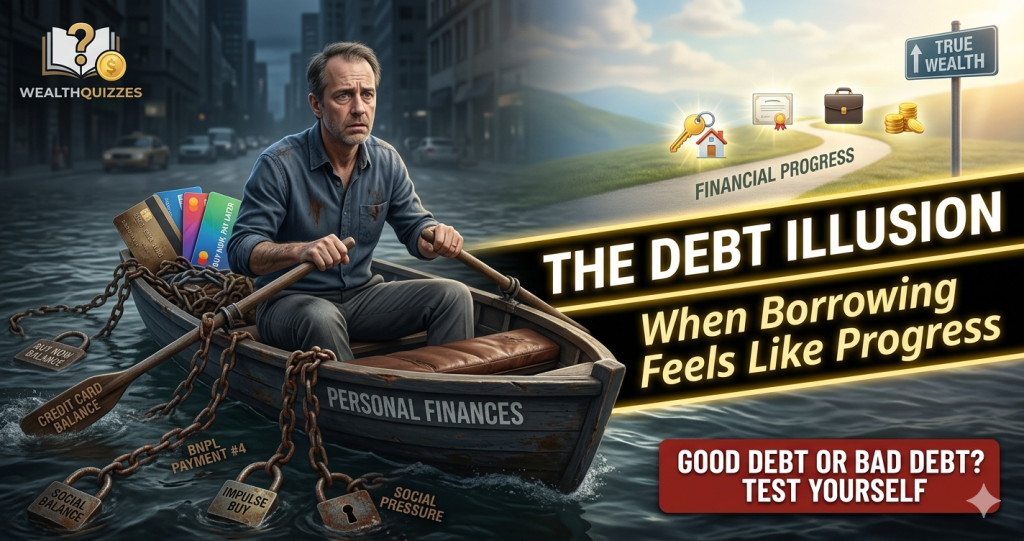
The Debt Illusion occurs when borrowing creates the appearance of financial progress without actual wealth creation.
You:
- Acquire assets (or what look like assets)
- Improve your lifestyle
- Feel financially elevated
But in reality:
- You owe money
- Your future cash flow is reduced
- Your financial flexibility is weakened
The Core Truth
Core Idea: Not all debt is growth—most is disguised consumption
Mindset Shift: Debt ≠ advancement
Debt only becomes beneficial when it:
- Generates income
- Increases productive capacity
- Builds long-term value
Everything else?
It is consumption—just delayed.
The Psychology of Borrowing: Why Debt Feels Good
Debt does not feel like a burden at the beginning.
It feels like:
- Opportunity
- Access
- Convenience
1. The “Own Now, Pay Later” Effect
Modern financial products—especially Buy Now, Pay Later (BNPL)—are designed to remove the psychological pain of spending.
Research shows that BNPL allows consumers to:
- Acquire goods immediately
- Delay the emotional impact of payment (Statista)
This creates a dangerous illusion:
If you don’t feel the cost now, it doesn’t feel expensive.
2. The Installment Illusion
Breaking a large payment into smaller chunks makes it feel more affordable.
Instead of:
- ₦200,000
You see:
- ₦25,000 × 8
Same cost.
Different perception.
3. Instant Gratification
Behavioral studies confirm that BNPL usage is strongly linked to impulse buying behavior, especially among young consumers (IJR Journal)
This means:
- You are not just borrowing
- You are borrowing emotionally
Buy-Now-Pay-Later: The Modern Debt Trap
1. The Disguised Loan
BNPL is often marketed as:
- Flexible
- Interest-free
- Convenient
But financially, it is still:
A loan
Experts warn that BNPL can lead to “debt spirals”, where multiple obligations accumulate and become difficult to manage (Statista)
2. The “Phantom Debt” Problem
One of the biggest risks is invisible accumulation.
Many BNPL obligations:
- Are not tracked like traditional loans
- Feel disconnected from your financial reality
This creates what economists call:
Phantom debt—obligations you underestimate or forget
3. Layered Debt Cycles
From real-world experiences:
“New debts + old installments… it never ends.” (Reddit)
This reflects a common pattern:
- Take one loan
- Add another
- Lose track
- Fall into a cycle
Social Debt Pressure: The Invisible Force
Debt is not just financial—it is social.
1. Borrowing to Belong
Research in behavioral finance shows that social norms significantly influence borrowing behavior, especially among young people (Taylor & Francis Online)
People borrow to:
- Match lifestyles
- Keep up appearances
- Avoid feeling left behind
2. The “Everyone Is Doing It” Effect
When borrowing becomes normalized:
- It feels safe
- It feels smart
- It feels necessary
But normalization does not equal wisdom.
3. Lifestyle Financing
In Nigeria and similar environments, this shows up as:
- Financing gadgets
- Borrowing for events
- Using credit for daily consumption
This is not investment.
It is:
Lifestyle financed by debt
Good Debt vs Bad Debt: The Critical Distinction
Not all debt is harmful.
Good Debt
- Generates income
- Builds assets
- Increases earning capacity
Examples:
- Education (when strategic)
- Business investment
- Income-generating assets
Bad Debt
- Funds consumption
- Depreciates in value
- Reduces future income
Examples:
- Fashion purchases on credit
- Gadgets financed without returns
- Lifestyle spending
The Key Question
Before taking any debt, ask:
“Will this debt pay me back—or will I pay for it?”
The Real Cost of Debt Illusion
1. Reduced Future Income
Debt is not free money.
It is:
- Future earnings already spent
Every repayment reduces your:
- Cash flow
- Investment capacity
2. Delayed Wealth Building
Money used to service debt cannot:
- Be invested
- Be saved
- Be compounded
This creates a hidden cost:
Lost financial growth
3. Financial Stress
As obligations increase:
- Pressure increases
- Flexibility decreases
- Risk exposure grows
4. Opportunity Cost
Every naira used to repay debt could have been:
- Invested
- Used to build assets
- Used to create income
The Illusion of Progress
Debt gives you:
- The appearance of success
- The feeling of advancement
But real progress is not:
- What you own
It is:
- What you control
Why Smart People Fall Into the Trap
This is not about ignorance.
Even financially aware individuals fall into the debt illusion because:
1. Convenience
Borrowing is easier than ever
2. Marketing
Debt is packaged as lifestyle
3. Emotion
Decisions are not purely rational
Breaking Free from the Debt Illusion
1. Redefine Progress
Progress is:
- Asset growth
- Cash flow improvement
- Financial stability
Not:
- Lifestyle upgrades
2. Delay Gratification
If you cannot afford it now:
- Question whether you need it
3. Track All Obligations
Make debt visible:
- List everything
- Know your total exposure
4. Prioritize Cash Flow Freedom
The goal is not:
- Owning more
The goal is:
- Owing less
5. Use Debt Strategically—Not Emotionally
Only take debt when:
- There is clear ROI
- There is a repayment plan
- There is long-term value
The Real Wealth Principle
Wealth is not built by:
- Accessing money
It is built by:
- Controlling money
Conclusion: The Truth About Borrowing
Debt is not inherently bad.
But it is often misunderstood.
Because:
- It feels like progress
- It looks like success
- It delivers immediate satisfaction
Yet:
Most debt does not move you forward—it only moves your payments forward.
Final Thought
Before your next purchase on credit, ask yourself:
“Am I building wealth—or borrowing an illusion?”
Because the difference between financial growth and financial struggle is not whether you borrow—
It is why you borrow.
👉 Good debt or bad debt? Test yourself on WealthQuizzes