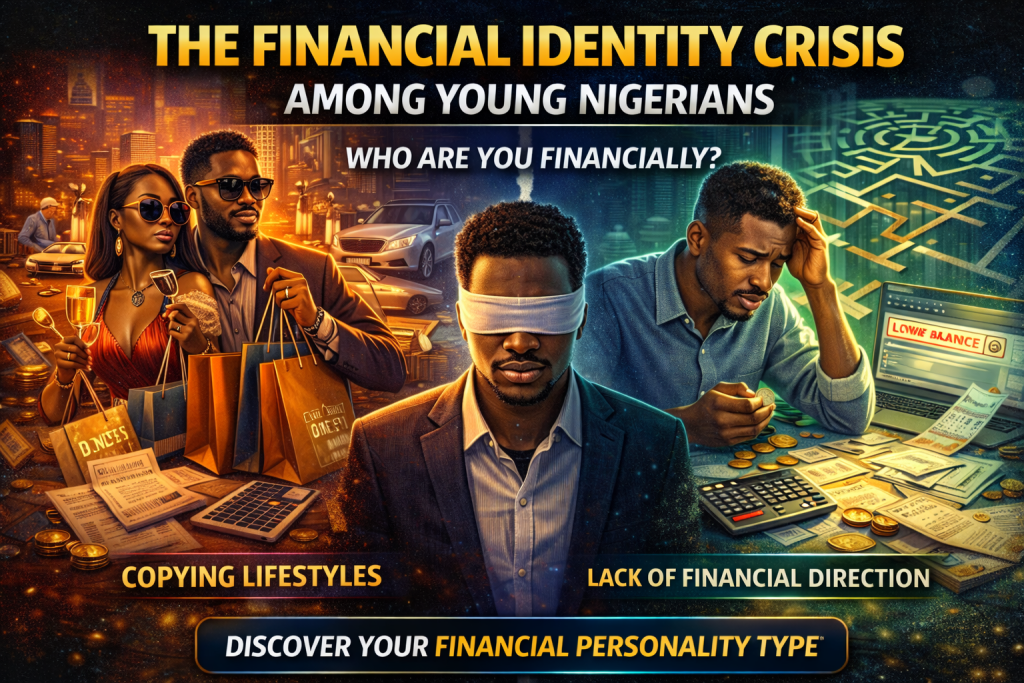
The Financial Identity Crisis Among Young Nigerians
The Financial Identity Crisis Among Young Nigerians
Why Not Knowing Who You Are Financially Is Costing You Everything
Introduction: The Invisible Crisis
Across Nigeria today, there is a silent but powerful crisis affecting millions of young people.
It is not just:
Unemployment
Inflation
Low income
It is deeper than that.
It is a financial identity crisis.
Many young Nigerians are:
Earning without direction
Spending without structure
Saving without clarity
And most importantly:
They do not know who they are financially.
What Is Financial Identity?
Your financial identity is:
How you see money
How you use money
What money means to you
It influences:
Your spending habits
Your saving behavior
Your risk tolerance
Your long-term decisions
Financial experts emphasize that behavior—not income—is the primary driver of financial outcomes. This aligns with the work of authorities like behavioral finance researchers who show that money decisions are shaped more by psychology than mathematics.
The Core Truth
Core Idea: Many people don’t know who they are financially Mindset Shift: Define your financial identity intentionally
Until you define your financial identity:
You will copy others
You will drift
You will remain inconsistent
The Nigerian Reality: A Gap Between Aspiration and Structure
Recent financial behavior studies in Nigeria reveal a striking contradiction:
79% of young Nigerians actively try to save
Yet nearly 1 in 5 cannot save at all due to unstable income and poor financial structure (Tech | Business | Economy)
This highlights something critical:
The problem is not just income—it is identity and structure.
Even more revealing:
Only 5.2% use proper budgeting systems
About 36.9% do not track spending at all (Businessday NG)
This is not just a financial gap.
It is an identity gap.
The Root of the Crisis
1. Copying Lifestyles Instead of Building Identity
One of the biggest drivers of financial confusion is imitation.
Young Nigerians are constantly exposed to:
Luxury lifestyles on social media
Influencer spending habits
“Soft life” narratives
Research shows that platforms like TikTok are now shaping how young Nigerians learn and apply financial behavior, blending entertainment with financial decisions (Pulse Nigeria)
This leads to:
Borrowed financial values
Imitated spending patterns
Unrealistic expectations
The Danger of Copying
When you copy:
You spend like someone else
You prioritize like someone else
You live financially like someone else
But:
Their income is not your income
Their reality is not your reality
2. Lack of Financial Direction
Another major issue is the absence of clear financial goals.
Many young people:
Want to “make money”
Want to “live better”
But cannot define:
What wealth means to them
What they are building toward
Reports show that most savings behavior in Nigeria is survival-driven, not strategy-driven (Businessday NG)
People save for:
Emergencies
Immediate needs
Not:
Wealth creation
Financial independence
The Result
Without direction:
Income gets consumed
Progress becomes random
Growth becomes inconsistent
3. Survival Mode vs Strategic Living
A major factor shaping financial identity in Nigeria is economic pressure.
Many young Nigerians are:
Managing unstable income
Facing rising living costs
Living month-to-month
Research confirms that a large portion of young Nigerians operate in survival mode, making long-term planning difficult (Nairametrics)
Why This Matters
Survival mode creates:
Short-term thinking
Emotional spending
Lack of planning
And over time:
Survival becomes a lifestyle—not a phase.
The Financial Identity Crisis Among Young Nigerians
4. The Influence of Social Validation
In Nigeria, money is not just functional—it is social.
It represents:
Status
Respect
Visibility
This creates pressure to:
Spend visibly
Appear successful
Maintain a certain image
Cultural practices and social trends increasingly reward visible wealth over actual financial stability, reinforcing identity confusion.
The Types of Financial Identity (Most People Fall Into One)
1. The Spender (Lifestyle-Driven)
Prioritizes enjoyment
Lives in the moment
Often lacks structure
2. The Survivor (Fear-Driven)
Focused on basic needs
Avoids risk
Struggles to grow
3. The Saver (Security-Driven)
Values stability
Avoids spending
May miss growth opportunities
4. The Builder (Growth-Driven)
Focuses on assets
Thinks long-term
Balances spending and investing
Most people are not consciously choosing these identities.
They are:
Drifting into them.
The Real Cost of Financial Identity Confusion
1. Inconsistent Financial Behavior
You:
Save today
Spend tomorrow
Restart next month
2. Poor Decision-Making
Without identity:
Every decision is reactive
There is no guiding framework
3. Delayed Wealth Creation
Lack of clarity leads to:
Missed opportunities
Poor investments
Wasted income
4. Emotional Financial Life
Money decisions become:
Stressful
Reactive
Impulsive
The Turning Point: Defining Your Financial Identity
The solution is not:
More income
More information
It is:
Clarity
Step 1: Ask the Right Questions
What does wealth mean to me?
Do I value freedom or comfort?
Am I building or consuming?
Step 2: Define Your Financial Values
Choose what matters:
Stability
Growth
Flexibility
Lifestyle
Step 3: Align Your Behavior
Your:
Spending
Saving
Investing
Must reflect your identity.
Step 4: Build Systems Around Your Identity
If you are:
A builder → Invest consistently
A saver → Automate savings
A spender → Create spending limits
Step 5: Stop Copying, Start Designing
Your financial life should be:
Intentional
Personal
Structured
The Nigerian Advantage (Hidden Opportunity)
Despite the challenges, Nigerian youth have:
High adaptability
Entrepreneurial mindset
Digital access
Reports show widespread use of financial apps and tools, even if underutilized (The Nation Newspaper)
This means:
The tools exist—what is missing is identity and direction.
The Real Transformation
When you define your financial identity:
You move from:
Confusion → Clarity
Reaction → Strategy
Consumption → Creation
Conclusion: Identity Before Income
You do not need:
More money
More hustle
More pressure
You need:
A clear financial identity
Because:
Identity drives behavior
Behavior drives results
Results create wealth
Final Thought
Before your next financial decision, ask yourself:
“Is this aligned with the kind of person I want to become financially?”
Because the biggest mistake is not earning too little—
It is living without direction.
👉 Discover your financial personality type on WealthQuizzes