
The Hidden Cost of Cheap Decisions
In everyday financial life, the instinct to save money is often treated as a universal virtue. Choosing the cheaper option, avoiding higher upfront costs, and minimizing spending are widely regarded as signs of prudence.
However, this approach contains a critical flaw.
Not all cheap decisions are economical. In fact, many are quietly expensive over time.
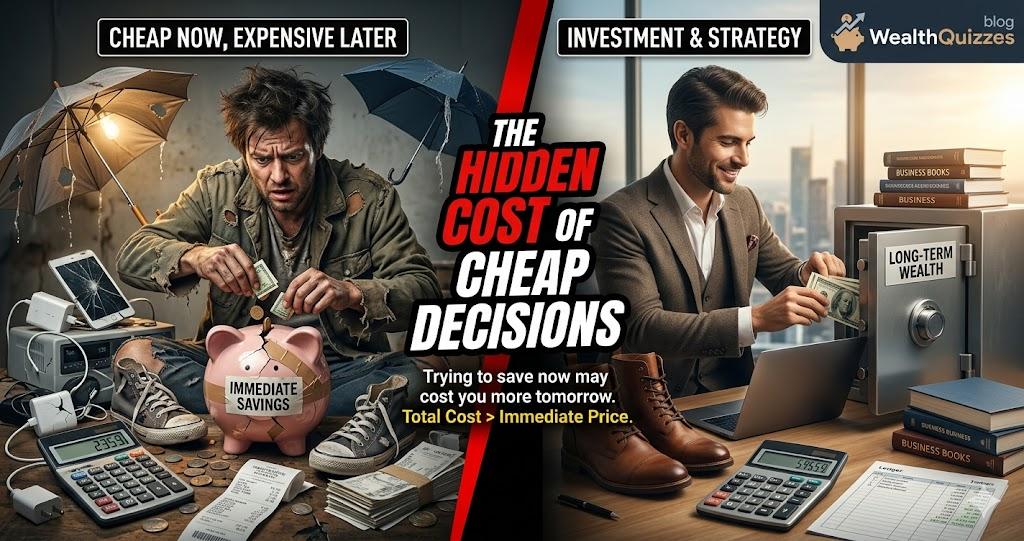
The difference lies in understanding the concept of total cost over time, rather than focusing solely on immediate price. When decisions are evaluated only by their upfront cost, individuals often incur hidden expenses that outweigh the initial savings.
This is what can be described as the hidden cost of cheap decisions—a pattern where attempts to save money lead to greater long-term financial loss.
Price vs Cost: A Critical Distinction
The first step in understanding this issue is distinguishing between price and cost.
- Price is what you pay upfront.
- Cost is what you pay over time.
Most people optimize for price. Economically rational individuals optimize for cost.
The investor Warren Buffett has consistently emphasized the importance of long-term thinking, noting that value is determined not by initial price but by what an asset delivers over time.
This principle applies not only to investments but to everyday financial decisions.
The Cycle of Low-Quality Purchases
One of the most common manifestations of cheap decisions is the repeated purchase of low-quality items.
Consider a simple example:
- A pair of shoes bought cheaply may wear out in a few months.
- A higher-quality pair may last several years.
At first glance, the cheaper option appears economical. However, repeated replacements lead to a higher cumulative cost.
This creates a cycle:
- Buy cheap
- Replace frequently
- Spend more over time
The economist Adam Smith highlighted efficiency as a core principle of economic productivity. Repeated inefficiencies—such as frequent replacements—reduce overall financial efficiency.
The key insight is clear:
Durability is a financial advantage.
The Cost of Avoiding Skill Investment
Another major hidden cost arises from the decision to avoid investing in skills.
Many individuals hesitate to spend money on:
- training programs
- certifications
- tools for professional development
- educational resources
These are often perceived as “expenses” rather than investments.
However, the long-term implications are significant.
Without skill development:
- income growth is limited
- job opportunities remain constrained
- earning capacity stagnates
The economist Gary Becker introduced the concept of human capital, emphasizing that investments in education and skills increase productivity and earning potential.
Failing to invest in skills is not a neutral decision—it is a costly one.
The hidden cost is lost future income.
Convenience vs Strategy
Cheap decisions are not always about price—they can also involve convenience.
Many individuals choose options that are:
- easier
- faster
- immediately accessible
Examples include:
- relying on inefficient processes instead of optimizing systems
- avoiding upfront investment in tools that improve productivity
- choosing short-term ease over long-term efficiency
While convenient choices may reduce immediate effort, they often increase:
- time spent on tasks
- operational inefficiencies
- long-term costs
The management expert Peter Drucker emphasized the importance of effectiveness—doing the right things, not just doing things easily.
Convenience without strategy can lead to repeated inefficiency, which accumulates over time.
The Psychology Behind Cheap Decisions
Understanding why people make cheap decisions requires examining behavioral factors.
Behavioral economics, as explored by Daniel Kahneman, shows that individuals are often biased toward short-term gains.
This includes:
- prioritizing immediate savings over future benefits
- avoiding upfront costs even when they lead to long-term gain
- underestimating future consequences
This tendency is known as present bias—the inclination to favor immediate rewards over long-term outcomes.
As a result, individuals may:
- choose cheaper options even when they are less efficient
- delay investments that would improve future financial position
- underestimate cumulative costs
The Compounding Effect of Poor Decisions
One of the most significant dangers of cheap decisions is their compounding effect.
A single inefficient decision may have a small impact.
However, when repeated over time, the effects accumulate.
Examples include:
- repeatedly buying low-quality goods
- consistently avoiding skill investment
- continuously choosing inefficient processes
Over years, these decisions can result in:
- higher total spending
- reduced income potential
- lost opportunities
This compounding effect mirrors the concept of compound interest—but in reverse.
Instead of wealth growing, inefficiency grows.
Opportunity Cost: The Invisible Loss
Another critical concept is opportunity cost—the value of what is given up when a decision is made.
When choosing a cheap option, individuals often ignore:
- the time spent replacing or repairing items
- the income lost due to lack of skills
- the productivity lost due to inefficiency
These are real costs, even though they are not immediately visible.
For example:
- saving ₦20,000 by avoiding a course may result in losing hundreds of thousands in future earnings
- buying cheaper tools may reduce productivity and limit output
Opportunity cost transforms seemingly small decisions into significant financial consequences.
Reframing Financial Decisions
To avoid the hidden cost of cheap decisions, individuals must change how they evaluate choices.
Instead of asking:
“How much does this cost?”
The more effective question is:
“What will this cost me over time?”
This shift introduces a broader perspective that includes:
- durability
- efficiency
- long-term value
- opportunity cost
A Strategic Approach to Spending
A more effective financial strategy involves:
1. Evaluating Total Cost
Consider the full lifecycle cost of a decision, not just the upfront price.
2. Investing in Quality
Prioritize durability and long-term performance over short-term savings.
3. Allocating for Skill Development
Treat education and skill acquisition as investments, not expenses.
4. Reducing Inefficiencies
Identify and eliminate processes that waste time or resources.
5. Thinking Long-Term
Align decisions with future goals rather than immediate comfort.
Behavioral Shift: From Cheap to Strategic
The most important change is psychological.
Instead of seeking the cheapest option, individuals should seek the most efficient option.
This means:
- prioritizing value over price
- focusing on outcomes rather than appearances
- making decisions based on long-term impact
This shift transforms spending from a reactive process into a strategic one.
Final Thought
The instinct to save money is valuable—but it must be applied intelligently.
As insights from Warren Buffett, Gary Becker, and Daniel Kahneman suggest, true financial success depends on long-term thinking, investment in capability, and awareness of behavioral biases.
Cheap decisions often feel smart in the moment.
But over time, they reveal their true cost.
Because in the end,
what you save today can cost you tomorrow—if you ignore the bigger picture.