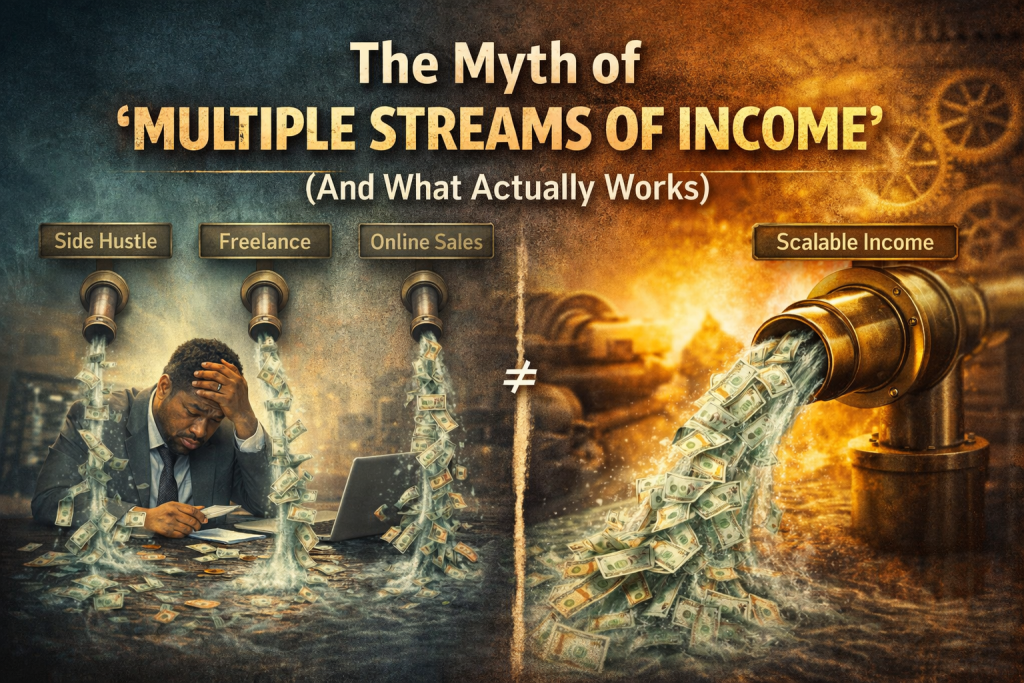
The Myth of “Multiple Streams of Income” (And What Actually Works)
In modern financial conversations, few ideas are as widely repeated—and as poorly understood—as the concept of multiple streams of income.
It is often presented as a universal solution to financial insecurity:
“Don’t rely on one source of income.”
“Build multiple streams.”
“Diversify your earnings.”
While this advice is directionally correct, its application is frequently flawed. Many individuals attempt to create several income streams simultaneously, only to end up overwhelmed, unproductive, and financially stagnant.
This raises an important question:
Is the problem the idea itself—or how it is being applied?
The answer lies in understanding the difference between activity and structure, and between income streams and income systems.
The Misinterpretation of Multiple Income Streams
The original intent behind the idea of multiple income streams is rooted in risk management.
Relying on a single source of income—especially employment—creates vulnerability. If that source is disrupted, financial stability is threatened.
However, what many people do is misinterpret this principle as:
“Start as many income activities as possible.”
This leads to a scattered approach:
- selling products online
- running a small side business
- freelancing occasionally
- experimenting with trading or investments
- engaging in multiple low-yield hustles
While this may appear productive, it often results in fragmentation of focus.
Instead of building strength in one area, energy is diluted across many.
The Problem of Divided Attention
Human attention is a limited resource.
The economist Herbert A. Simon famously observed that “a wealth of information creates a poverty of attention.” This insight applies directly to income generation.
Each additional income stream requires:
- time
- mental energy
- learning
- management
When these demands accumulate, performance in each area declines.
The result is:
- inconsistent execution
- low-quality output
- minimal financial returns
Rather than creating multiple strong streams, individuals end up with multiple weak streams.
Active Income vs Scalable Income
A critical distinction often overlooked is the difference between active income and scalable income.
1. Active Income Streams
These require continuous effort to generate income.
Examples include:
- freelancing
- trading time for money
- small-scale buying and selling
- part-time services
Active income is valuable, especially in the early stages, but it has a fundamental limitation:
it does not scale easily.
Income is directly tied to time and effort.
2. Scalable Income Streams
These allow income to grow without a proportional increase in effort.
Examples include:
- digital products
- content platforms
- systems-driven businesses
- investments that generate returns
Scalable income introduces leverage—the ability to produce more output with the same or less input.
This is where true financial growth begins.
Why Most People Fail at Multiple Streams
The failure of many “multiple income” strategies can be traced to three key issues:
1. Lack of Depth
People start new income streams before mastering any single one.
Without depth, there is no competitive advantage.
2. Premature Diversification
Diversification is applied too early.
In investing, diversification protects wealth. But in income generation, early diversification often prevents wealth from being created in the first place.
3. Absence of Systems
Many income streams are not structured as systems.
They rely on constant effort rather than processes that can run independently.

The Case for One Strong Stream
Contrary to popular belief, most financially successful individuals did not begin with multiple streams.
They started by building one strong, reliable, and scalable source of income.
This aligns with principles of focus and mastery.
The investor Warren Buffett has often emphasized the importance of concentration, noting that diversification is only necessary when individuals do not fully understand what they are doing.
In the context of income, this suggests:
Focus first. Diversify later.
Building a Strong Income System
A strong income system has several defining characteristics:
1. Consistency
It generates predictable and reliable income.
2. Scalability
It can grow without requiring equal increases in time.
3. Efficiency
It minimizes wasted effort and maximizes output.
4. Transferability
It can operate with reduced dependence on the individual’s constant involvement.
Building such a system requires:
- skill development
- market understanding
- repeated execution
- refinement over time
This process cannot be rushed or multiplied across several streams simultaneously.
When Diversification Makes Sense
Diversification becomes effective only after a strong foundation has been established.
At this stage:
- the primary income stream is stable
- systems are in place
- excess income is available
- time can be allocated strategically
Diversification then serves to:
- reduce risk
- increase income sources
- expand financial opportunities
Importantly, diversification should involve different types of income, not just more of the same.
For example:
- combining active income with scalable income
- adding investment-based income to business income
- creating complementary systems rather than unrelated hustles
The Power of Leverage
The ultimate goal is not to have many income streams, but to build leveraged income systems.
Leverage allows individuals to:
- earn more without working proportionally more
- create value at scale
- reduce dependency on time
Forms of leverage include:
- technology
- capital
- systems
- audience
The entrepreneur Naval Ravikant has emphasized that wealth is created through leverage, not just effort.
This reinforces the idea that structure matters more than quantity.
A Strategic Framework
A more effective approach to income generation can be summarized in three stages:
Stage 1: Focus
Build one primary income stream. Develop skills and achieve consistency.
Stage 2: Strengthen
Improve efficiency, introduce systems, and create scalability.
Stage 3: Expand
Add new income streams strategically, ensuring they complement the existing system.
This framework ensures that diversification enhances, rather than weakens, financial progress.
Behavioral Shift: From Many to Meaningful
The most important change is psychological.
Instead of asking:
“How many income streams do I have?”
The more useful question is:
“How strong and scalable is my primary income system?”
This shift moves individuals away from activity-based thinking toward strategy-based thinking.
Final Thought
The idea of multiple streams of income is not inherently flawed—but its widespread misapplication has led many people astray.
Attempting to build several income streams without structure, focus, or scalability often results in frustration and limited financial progress.
As insights from Herbert A. Simon and Warren Buffett suggest, attention and concentration are critical resources.
And as Naval Ravikant highlights, true wealth is built through leverage.
The real lesson is simple but powerful:
Multiple weak streams do not create wealth.
One strong, scalable system does.
Focus first. Build strength. Then expand.
That is what actually works.