
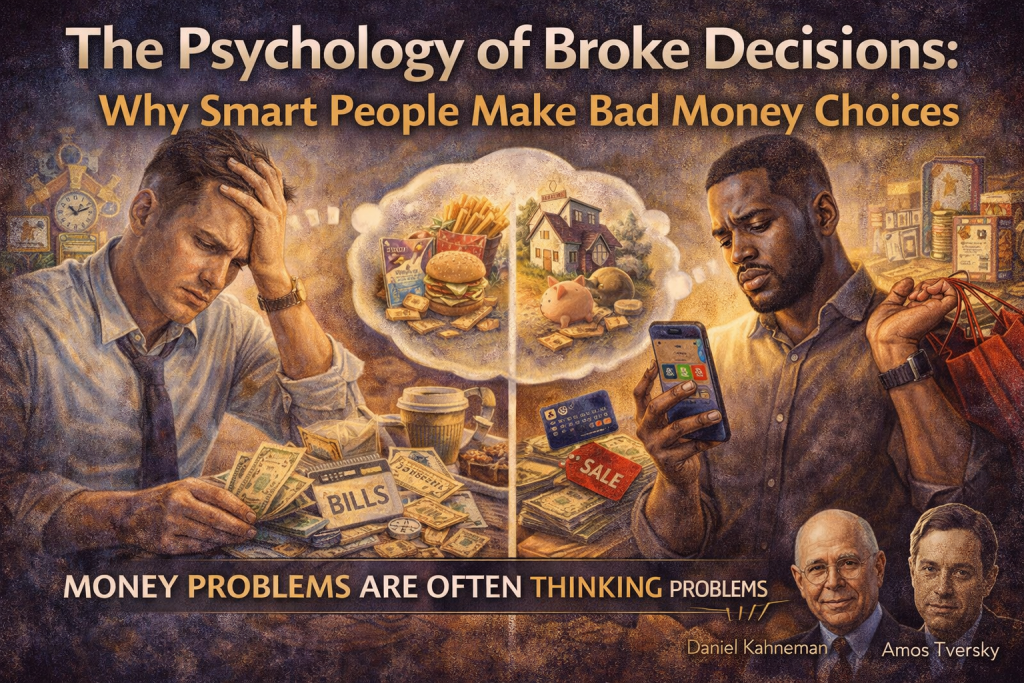
The Psychology of Broke Decisions: Why Smart People Make Bad Money Choices
It is a common assumption that financial success is primarily a function of intelligence. The logic seems straightforward: smart people should make smart financial decisions.
Yet, real-world evidence repeatedly contradicts this belief.
Highly educated professionals, successful executives, and intellectually capable individuals often struggle with money. They overspend, accumulate debt, fail to save, and fall into financial traps that seem avoidable.
This raises a critical question:
Why do intelligent people make poor financial decisions?
The answer lies not in a lack of knowledge, but in the domain of psychology. Financial behavior is not purely rational—it is deeply influenced by emotions, cognitive biases, and mental shortcuts.
In essence, money problems are often thinking problems.
The Behavioral Economics Perspective
Traditional economic theory assumes that individuals make rational decisions aimed at maximizing their financial well-being. However, behavioral economics has demonstrated that this assumption is often unrealistic.
Pioneers such as Daniel Kahneman and Amos Tversky showed that human decision-making is influenced by heuristics and biases—mental shortcuts that simplify complex choices but can lead to systematic errors.
Their research revealed that people:
- overvalue immediate rewards
- underestimate future consequences
- rely on emotions when making decisions
- are influenced by how choices are presented
These patterns apply directly to financial behavior.
Emotional Spending Triggers
One of the most powerful drivers of poor financial decisions is emotional spending.
Money is not just a tool for transactions—it is also a tool for emotional regulation.
People often spend money in response to:
1. Stress
After a difficult day, spending can feel like a reward or relief mechanism.
2. Boredom
Idle time often leads to browsing, and browsing frequently leads to buying.
3. Validation
Purchases can serve as a way to gain approval, status, or self-worth.
4. Celebration
Financial restraint is often abandoned during moments of excitement or achievement.
These behaviors are rarely conscious. The individual does not say, “I am spending because I am stressed.” Instead, the purchase feels justified in the moment.
However, repeated emotional spending creates long-term financial consequences.
Short-Term Gratification vs Long-Term Thinking
Another central issue is the conflict between immediate gratification and delayed rewards.
Humans are naturally inclined toward present bias—the tendency to prioritize immediate benefits over future gains.
For example:
- spending ₦50,000 today feels more rewarding than saving it for future use
- buying a desired item provides instant satisfaction
- saving or investing offers delayed and less tangible benefits
Behavioral research shows that the brain processes immediate rewards more intensely than future ones. This makes it difficult to prioritize long-term financial goals.
As a result, individuals may consistently choose short-term pleasure even when they understand the long-term cost.
This explains why knowledge alone is insufficient.
A person may fully understand the importance of saving, yet still choose to spend.
Decision Fatigue and Financial Behavior
Another important psychological factor is decision fatigue.
The concept, closely associated with the work of Roy Baumeister, suggests that the quality of decisions deteriorates after a long session of decision-making.
In modern life, individuals make hundreds of decisions daily—many of them trivial. By the time financial decisions arise, mental energy may already be depleted.
This leads to:
- impulsive purchases
- reduced self-control
- reliance on convenience over strategy
- increased susceptibility to marketing
For instance, after a long workday, the effort required to compare prices, evaluate needs, or resist temptation may feel overwhelming.
Spending becomes the easier option.
The Role of Cognitive Biases
Beyond emotions and fatigue, several cognitive biases directly affect financial decisions.
1. Anchoring Bias
People rely heavily on the first piece of information they encounter.
For example, seeing an item originally priced at ₦100,000 discounted to ₦70,000 creates a perception of value—even if the item is unnecessary.
2. Loss Aversion
As identified by Daniel Kahneman, individuals feel the pain of loss more strongly than the pleasure of gain.
This can lead to:
- holding onto bad investments
- refusing to cut losses
- making defensive financial decisions
3. Social Proof
People tend to follow the behavior of others.
If many people appear to be buying, investing, or spending in a certain way, individuals are more likely to do the same—even without independent analysis.
These biases operate automatically, often without conscious awareness.

Why Intelligence Is Not Enough
The presence of these psychological factors explains why intelligence alone does not guarantee sound financial decisions.
Academic intelligence focuses on:
- reasoning
- analysis
- knowledge acquisition
Financial behavior, however, is influenced by:
- emotion
- habit
- environment
- cognitive bias
This mismatch means that a person can understand what to do financially but still fail to act accordingly.
In other words:
Knowing is not the same as doing.
From Awareness to Control
The first step toward improving financial behavior is awareness.
Recognizing that financial decisions are influenced by psychological factors allows individuals to pause and reflect before acting.
Instead of reacting automatically, they can begin to question their impulses:
- “Am I buying this because I need it, or because I feel something?”
- “Is this decision aligned with my long-term goals?”
- “Would I make this choice if I were not influenced by my current mood?”
This simple pause introduces a critical gap between impulse and action.
Practical Strategies for Better Financial Decisions
To move from reactive behavior to intentional decision-making, individuals can adopt several practical strategies:
1. Delay Major Purchases
Introduce a waiting period before making non-essential purchases.
This reduces emotional influence and allows rational thinking to return.
2. Identify Personal Triggers
Understand what emotional states lead to spending.
Awareness of triggers makes it easier to manage them.
3. Simplify Financial Decisions
Reduce the number of decisions required through systems such as:
- automatic savings
- fixed spending categories
- predefined budgets
This minimizes decision fatigue.
4. Create Friction for Spending
Make impulsive purchases more difficult by:
- removing saved payment methods
- limiting access to discretionary funds
- avoiding browsing during idle time
5. Focus on Long-Term Identity
Shift from thinking about individual purchases to thinking about identity:
“Am I someone who spends impulsively, or someone who builds wealth intentionally?”
A Shift in Financial Thinking
The most important transformation is understanding that financial success is not purely a technical problem—it is a behavioral problem.
As research by Daniel Kahneman and Amos Tversky has shown, human decision-making is shaped by predictable psychological patterns.
Once these patterns are understood, they can be managed.
Final Thought
The reason many intelligent people struggle financially is not because they lack knowledge.
It is because their decisions are influenced by forces they do not fully recognize.
Emotions, biases, and mental fatigue quietly shape behavior, often leading to choices that contradict long-term goals.
The solution is not simply to become smarter, but to become more aware.
When individuals learn to pause, reflect, and understand their psychological triggers, they gain control over their financial decisions.
And in that moment, they move from being reactive spenders to intentional wealth builders.