

The Wealth Discipline Ladder: The Stages Nobody Talks About
Why Wealth Building Is Not Random—But Follows Predictable Levels of Progress
Introduction: The Myth of Sudden Wealth
Many people believe wealth happens in one of two ways:
- You get lucky
- You suddenly “blow” financially
This belief is reinforced by:
- Social media success stories
- Overnight business narratives
- Visible lifestyle upgrades
But beneath all these stories lies a quieter, more structured truth:
Wealth is not random—it is progressive.
It follows stages.
And each stage requires:
- A different mindset
- A different behavior
- A different level of discipline
This structured journey is what we call:
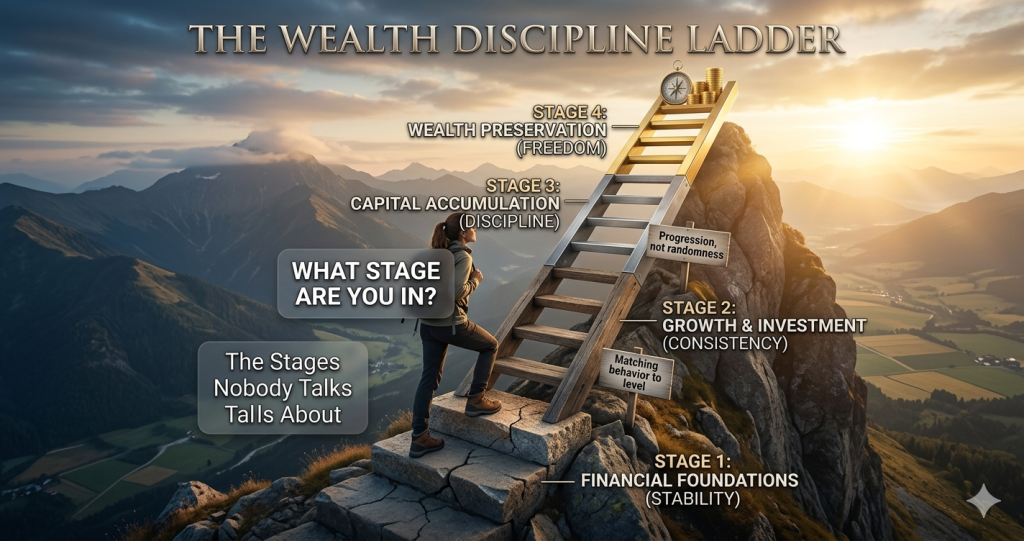
The Wealth Discipline Ladder
The Core Truth
Core Idea: Wealth building happens in predictable stages
Mindset Shift: Progression, not randomness
You don’t jump into wealth.
You:
Climb into it—step by step
Why Understanding Stages Matters
Most people struggle financially not because they are incapable—
But because they are:
- Applying the wrong strategy
- At the wrong stage
As Morgan Housel explains, financial success is less about intelligence and more about behavioral alignment.
The Wealth Discipline Ladder: The 5 Core Stages
Stage 1: Survival
Description:
This is the foundation level where:
- Income is unstable or just enough
- Expenses consume most earnings
- Financial stress is high
Key Focus:
- Meeting basic needs
- Stabilizing income
- Avoiding financial collapse
Common Behaviors:
- Living paycheck to paycheck
- Reactive spending
- No structured saving
The Danger:
You remain stuck here if:
- You ignore structure
- You normalize instability
Required Discipline:
Control before growth
Transition Trigger:
- Consistent income
- Basic expense awareness
Stage 2: Stability
Description:
At this level:
- Income becomes predictable
- Expenses are somewhat controlled
- You can breathe financially
Key Focus:
- Budgeting
- Building emergency funds
- Eliminating financial chaos
Common Behaviors:
- Basic savings
- Reduced impulsive spending
The Mistake People Make:
They become:
Too comfortable
As Dave Ramsey emphasizes, financial stability is important—but not the final goal.
Required Discipline:
Consistency
Transition Trigger:
- Emergency fund established
- Spending under control
Stage 3: Control
Description:
Now you are no longer reacting—you are managing.
- You track your finances
- You allocate intentionally
- You understand your cash flow
Key Focus:
- Financial systems
- Income allocation
- Eliminating inefficiencies
Common Behaviors:
- Structured budgeting
- Conscious spending
- Early investing attempts
The Risk:
Overconfidence without growth.
Required Discipline:
Intentional allocation
Transition Trigger:
- Surplus income
- Consistent savings
Stage 4: Growth
Description:
This is where wealth-building truly begins.
- You invest consistently
- You grow income streams
- Your money starts working for you
Key Focus:
- Investments
- Skill development
- Income expansion
Common Behaviors:
- Long-term thinking
- Asset acquisition
- Strategic risk-taking
Insight from Authority
As Warren Buffett highlights:
“Someone is sitting in the shade today because someone planted a tree a long time ago.”
Required Discipline:
Patience and strategy
Transition Trigger:
- Compounding effects begin
- Assets generate returns
Stage 5: Expansion
Description:
At this level:
- Wealth is no longer tied to effort alone
- Systems and assets generate income
- Financial independence becomes possible
Key Focus:
- Scaling
- Leveraging assets
- Wealth preservation
Common Behaviors:
- Diversification
- System building
- Delegation
Insight from Authority
As Naval Ravikant explains:
“Seek wealth, not money or status. Wealth is assets that earn while you sleep.”
Required Discipline:
Leverage and protection
The Biggest Mistake People Make
They try to:
- Invest like Stage 4
- While still in Stage 1 or 2
Or:
- Expand like Stage 5
- Without mastering Stage 3
The Result:
- Confusion
- Losses
- Frustration
The Principle of Alignment
Each stage requires:
| Stage | Focus | Discipline |
|---|---|---|
| Survival | Income | Control |
| Stability | Expenses | Consistency |
| Control | Systems | Allocation |
| Growth | Investment | Patience |
| Expansion | Scaling | Leverage |
The Nigerian Context: Why Many Get Stuck
In Nigeria:
- Economic pressure pushes people into survival mode
- Social expectations encourage premature spending
- Lack of financial education disrupts progression
This creates:
Stage confusion
Example of Misalignment
Someone in Stage 2:
- Starts investing aggressively
- Ignores emergency funds
Outcome:
- One shock → financial setback
Why Progression Matters More Than Speed
As Charlie Munger emphasizes:
“The big money is not in the buying and selling, but in the waiting.”
Wealth is Built Through:
- Time
- Discipline
- Progression
The Real Transformation
When you understand the Wealth Discipline Ladder:
You move from:
- Random decisions → Structured growth
- Frustration → Clarity
- Guesswork → Strategy
The Hard Truth
Most people are not failing financially because:
- They lack effort
They are failing because:
They are operating at the wrong stage.
How to Identify Your Stage
Ask yourself:
- Do I struggle to meet basic needs?
- Do I have consistent savings?
- Do I track and control my finances?
- Am I investing consistently?
- Do I have income-generating assets?
Your answers reveal:
Your current level on the ladder
Conclusion: Wealth Is a Climb, Not a Leap
Wealth is not built by:
- Luck
- Speed
- Random effort
It is built by:
Climbing the right stages with the right discipline
Because:
- You cannot skip levels
- You cannot rush maturity
- You cannot fake structure
Final Thought
Before chasing the next financial strategy, ask yourself:
“Am I operating at the right stage?”
Because the fastest way to build wealth is not doing more—
It is doing what your level requires.
👉 What stage are you in? Find out on WealthQuizzes