
Why Most People Never Build Anything That Pays Them Back
In modern economic life, most people are active participants—but not effective builders.
They work, earn, spend, and repeat. Over time, they may increase their income, upgrade their lifestyle, and improve their standard of living. Yet one critical element remains missing:
They never build anything that continues to pay them back.
This distinction—between earning income and creating value that compounds over time—is at the heart of long-term wealth creation.
The uncomfortable reality is this:
Most people consume more than they create. And consumption, by itself, does not produce financial independence.
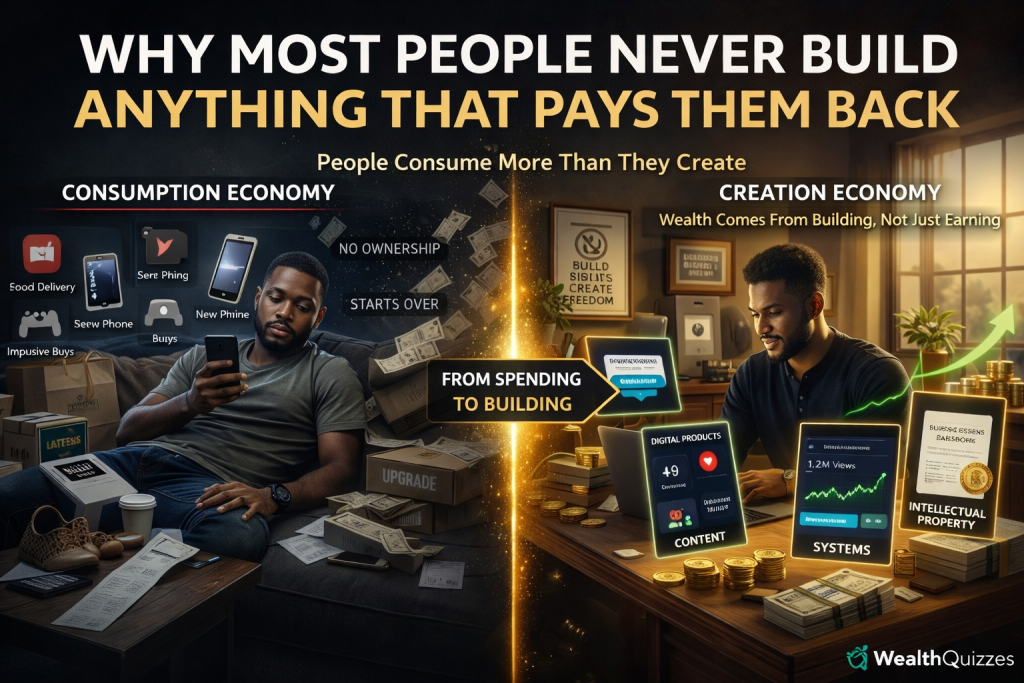
The Consumption Economy vs the Creation Economy
We live in what can be described as a consumption-driven economy.
Every day, individuals are encouraged—subtly and overtly—to:
- buy products
- upgrade devices
- subscribe to services
- spend on experiences
This cycle is not accidental. It is the foundation of modern economic systems.
However, within this system, there are two distinct roles:
1. Consumers
They exchange money for value.
2. Creators
They produce value and receive money in return.
Most people remain permanent consumers, even as their income grows.
The investor Naval Ravikant has emphasized that wealth is created by owning equity in things that generate value, not merely by selling time.
This highlights a crucial shift:
True financial progress comes from moving from consumption to creation.
Why Jobs Alone Do Not Create Ownership
Employment provides structure, stability, and income. It is a necessary and valuable stage in financial development.
However, jobs operate within a fundamental limitation:
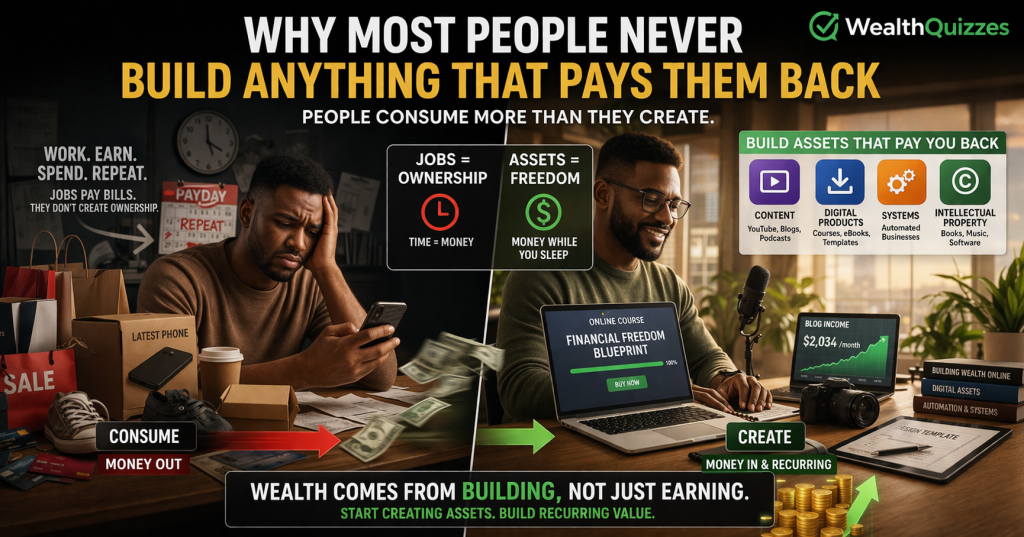
They exchange time for money.
This means:
- income is tied to hours worked
- earnings stop when work stops
- there is limited scalability
The economist Thomas Piketty distinguishes between labor income (earned through work) and capital income (earned through ownership).
Labor income sustains life.
Capital income builds wealth.
Without ownership, individuals remain dependent on continuous effort.
This is why many people, even after decades of work, have little to show beyond past consumption.
The Absence of “Payback Assets”
A key reason most people never build wealth is that they fail to create what can be called:
“Payback assets” — assets that continue to generate value after the initial effort is completed.
Instead, their financial activity is dominated by:
- consumption
- maintenance expenses
- non-productive purchases
These do not produce returns. They only absorb income.
In contrast, payback assets:
- generate recurring income
- appreciate in value
- reduce dependency on active work
What Does “Something That Pays You Back” Look Like?
To understand this concept, it is important to identify real-world examples of assets that generate ongoing returns.
1. Digital Products
These include:
- e-books
- online courses
- templates
- software tools
Once created, they can be sold repeatedly with minimal additional effort.
2. Content Platforms
Examples include:
- blogs
- YouTube channels
- educational platforms
Content, when built strategically, becomes a long-term asset that attracts attention and monetization opportunities.
3. Systems-Based Businesses
These are businesses that operate through processes rather than constant personal involvement.
They rely on:
- systems
- delegation
- automation
Such businesses can continue generating income even when the owner is not actively working.
4. Intellectual Property
This includes:
- written works
- creative content
- proprietary methods or frameworks
Intellectual property can be licensed, sold, or monetized repeatedly.
5. Financial Assets
These include:
- dividend-paying stocks
- investment funds
- income-generating partnerships
They represent ownership in value-producing systems.
The common feature across all these examples is simple:
They continue to produce value after the initial effort.
Why Most People Never Build These Assets
Despite their importance, most individuals never create such assets.
There are several underlying reasons.
1. Immediate Gratification Bias
Behavioral economics, as explored by Daniel Kahneman, shows that people tend to prioritize immediate rewards over long-term benefits.
Building assets often requires:
- delayed gratification
- upfront effort
- uncertain outcomes
Consumption, on the other hand, provides instant satisfaction.
This makes consumption psychologically easier.
2. Lack of Awareness
Many people simply do not understand the concept of building assets that generate recurring value.
Financial education often focuses on:
- saving
- budgeting
- spending control
While important, these do not address asset creation.
3. Fear of Uncertainty
Creating something new involves risk:
- uncertainty of success
- fear of failure
- lack of guaranteed income
As a result, individuals default to safer, familiar patterns—earning and spending.
4. Misallocation of Time
Time is often consumed by:
- work obligations
- entertainment
- low-value activities
Very little time is allocated to building long-term assets.
The Power of Creation
Building something that pays you back introduces leverage into your financial life.
Leverage allows:
- one unit of effort to produce multiple units of return
- income to grow without proportional increases in time
- financial independence to become achievable
This aligns with the broader principle that:
Wealth is built through systems, not just effort.
From Earning to Building
The transition from consumption to creation requires a fundamental shift in thinking.
Instead of focusing only on:
“How much did I earn this month?”
The more important question becomes:
“What did I build this month that can continue to pay me?”
This question redirects attention toward long-term value creation.
A Practical Framework
To begin building payback assets, individuals can follow a structured approach:
1. Identify a Valuable Skill
Skills form the foundation of asset creation.
2. Convert Skill into Output
Turn knowledge or ability into a product, service, or content.
3. Systemize the Output
Create processes that allow the output to be delivered repeatedly.
4. Introduce Leverage
Use technology, platforms, or systems to scale distribution.
5. Reinvest Returns
Use income generated to build additional assets.
This process transforms effort into compounding value.
Behavioral Shift: From Consumption to Creation
The most important change is behavioral.
Instead of asking:
“What can I buy next?”
Individuals begin asking:
“What can I build that will pay me repeatedly?”
This shift:
- reduces unnecessary consumption
- increases productive output
- accelerates wealth creation
Final Thought
The reality of modern financial life is clear:
Most people work hard.
Many people earn well.
But very few people build.
As insights from Thomas Piketty, Naval Ravikant, and Daniel Kahneman suggest, long-term wealth is not determined by effort alone, but by ownership, leverage, and behavioral choices.
Earning sustains you.
But building transforms your financial future.
Because in the end:
If you do not build anything that pays you back,
you will always have to keep working to get paid.