
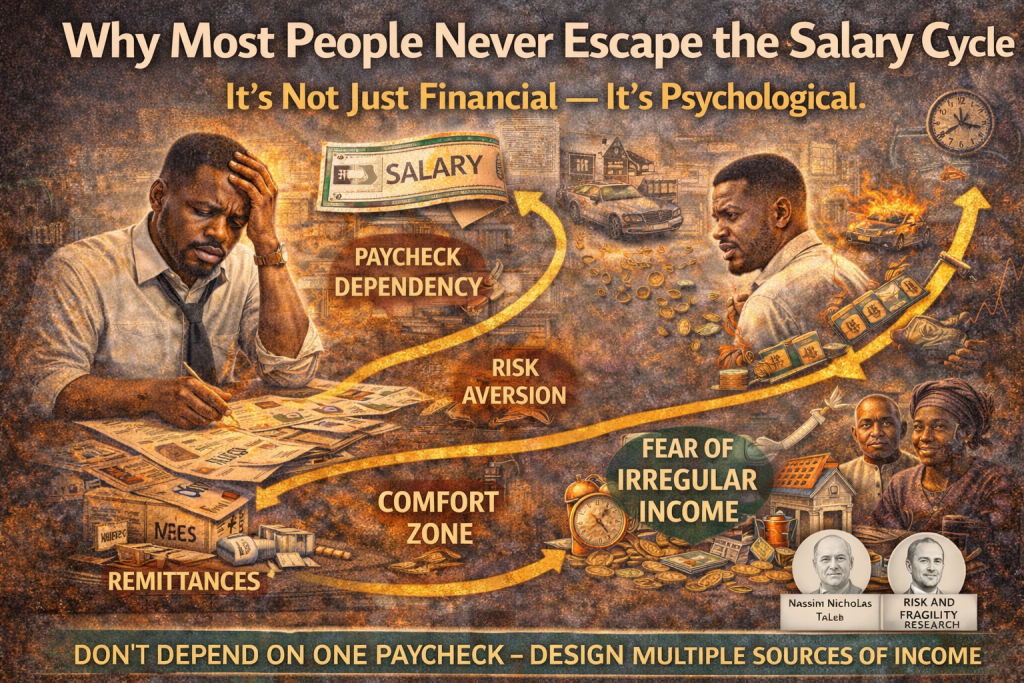
Why Most People Never Escape the Salary Cycle
For millions of professionals around the world, the monthly salary is the backbone of financial life. It pays the rent, buys food, funds transportation, and supports families. Yet despite years of hard work, promotions, and salary increases, many people find themselves trapped in a repeating financial loop: earn, spend, wait for the next paycheck.
This phenomenon is often called the salary cycle—a pattern where income arrives regularly but financial independence remains perpetually out of reach.
At first glance, the problem appears purely financial. But in reality, the salary cycle is not only about money. It is deeply psychological, shaped by human behavior, risk perception, and comfort with stability.
Understanding why so many people remain stuck in this cycle requires examining the forces that keep them there.
The Paycheck Dependency Problem
The most obvious feature of the salary cycle is paycheck dependency.
When a person relies on a single employer for their entire income, their financial stability becomes tightly linked to the continuation of that job. Every bill—rent, utilities, groceries, transportation—is structured around the assumption that the next salary payment will arrive on schedule.
This creates a fragile financial structure. If the paycheck stops due to job loss, illness, or economic downturn, the entire system can collapse quickly.
The scholar and risk analyst Nassim Nicholas Taleb has written extensively about systems that appear stable but are actually fragile. In his work on risk and uncertainty, particularly in The Black Swan and Antifragile, Taleb explains that systems dependent on a single source of stability are highly vulnerable to shocks.
Salary dependence is a classic example. It feels safe because the income is predictable. But the predictability hides the risk of single-point failure.
When financial life depends entirely on one source of income, that system becomes extremely fragile.
The Psychology of Risk Aversion
Another major factor keeping people trapped in the salary cycle is risk aversion.
Behavioral economics research has consistently shown that humans tend to prefer certainty over uncertainty—even when uncertainty might produce better outcomes.
One of the most influential scholars in this field, Daniel Kahneman, demonstrated that people are strongly biased toward avoiding potential losses rather than pursuing potential gains. This tendency is known as loss aversion.
In practical terms, this means many workers prefer:
- a predictable salary
- a fixed monthly income
- guaranteed employment stability
even if alternative income paths could eventually produce greater financial freedom.
Starting a side business, investing in a new venture, or developing independent income streams involves uncertainty. There is no guaranteed paycheck at the end of the month.
For individuals conditioned by years of salary stability, this uncertainty can feel psychologically threatening.
As a result, many people remain in the salary cycle not because they lack opportunities, but because their risk tolerance has been shaped by the security of predictable income.
Comfort Zone Economics
Closely related to risk aversion is the concept of comfort zone economics.
A salary provides more than money—it provides structure and predictability. Workers know when they will be paid, how much they will earn, and how their financial life should be organized.
This structure becomes deeply embedded in daily habits:
- monthly budgeting
- rent schedules
- loan repayments
- subscription services
Over time, the financial system becomes calibrated around a predictable salary rhythm.
Breaking away from that structure—even partially—requires stepping outside the comfort zone. Irregular income, fluctuating cash flow, and uncertain business outcomes can feel uncomfortable for individuals accustomed to financial stability.
Ironically, this comfort can become a trap.
The salary system provides short-term security but may limit long-term wealth creation because income growth remains tied to employment rather than ownership.
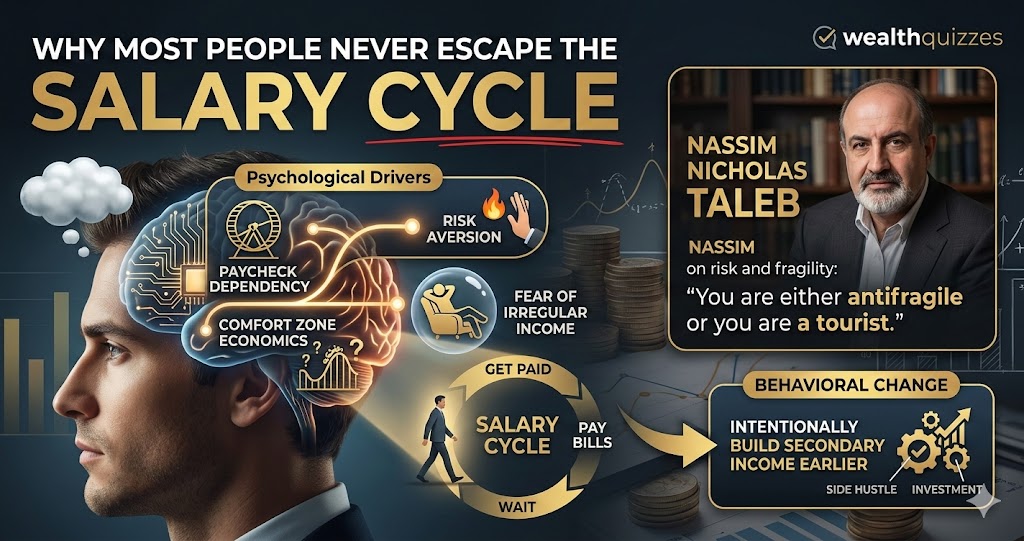
The Fear of Irregular Income
One of the most powerful psychological barriers preventing people from leaving the salary cycle is the fear of irregular income.
Entrepreneurs, freelancers, and investors rarely receive income on a fixed monthly schedule. Instead, their earnings fluctuate based on market conditions, client demand, or business performance.
For many salaried professionals, this unpredictability appears dangerous.
They imagine scenarios such as:
- months with little or no income
- unstable cash flow
- unpredictable financial planning
This fear is understandable. Human beings naturally prefer stability over uncertainty.
However, as Taleb has argued, systems that rely on multiple sources of income are often more resilient than systems dependent on a single stable source.
A person with three or four income streams—even if each one fluctuates—may ultimately face less financial risk than someone dependent entirely on one employer.
Yet psychologically, the stable paycheck feels safer.
The Institutional Design of the Salary System
It is also important to recognize that modern economic systems are structured around salary dependence.
Many financial institutions assume stable employment income when providing services such as:
- mortgage approvals
- personal loans
- credit cards
- rental agreements
These systems reinforce the idea that salary stability equals financial reliability.
While this structure makes economic coordination easier, it also reinforces a cultural belief: that the safest financial path is to remain employed indefinitely.
In reality, employment stability is increasingly uncertain in a world shaped by automation, technological change, and global economic shifts.
The traditional salary path may no longer guarantee long-term financial security.
The Hidden Cost of Waiting Too Long
Another reason many people remain trapped in the salary cycle is timing.
Secondary income streams—whether businesses, investments, or freelance work—take time to develop. Skills must be learned, networks must be built, and opportunities must be tested.
If individuals wait until financial pressure forces them to seek alternative income, they often face the challenge of starting from scratch.
Building additional income streams earlier in one’s career creates a powerful advantage: time for experimentation.
Small projects, side businesses, and investments can grow gradually while the primary salary still provides stability.
Over time, these additional streams may evolve into significant financial assets.
Building Income Resilience
Escaping the salary cycle does not necessarily require abandoning employment entirely. Instead, it involves building income resilience.
Income resilience means creating financial systems that do not depend on a single source.
This can include:
- side businesses
- freelance work
- investment income
- digital products
- rental assets
- professional consulting
Each additional income stream reduces dependence on a single employer.
The goal is not to eliminate salary income but to ensure that it is not the only pillar supporting financial life.
A Strategic Shift in Thinking
The most important shift required to escape the salary cycle is psychological.
Instead of viewing financial life as a single pipeline—salary flowing from employer to worker—individuals begin to think of income as a portfolio.
Just as investors diversify their assets, financially resilient individuals diversify their income sources.
This shift transforms financial strategy from dependence to design.
Rather than asking, “How can I earn a higher salary?” the more powerful question becomes:
“How many different ways can I generate income?”
Final Thought
The salary cycle persists not only because of economic systems but because of human psychology.
Predictability, comfort, and fear of uncertainty keep many people tied to a single income stream for decades.
Yet the modern economy increasingly rewards those who build flexible and diversified financial structures.
As Nassim Nicholas Taleb emphasizes in his work on risk, systems that rely on multiple sources of strength are far more resilient than those built on a single fragile pillar.
The lesson is simple but powerful:
A salary can support your life.
But multiple income streams can secure your future.