
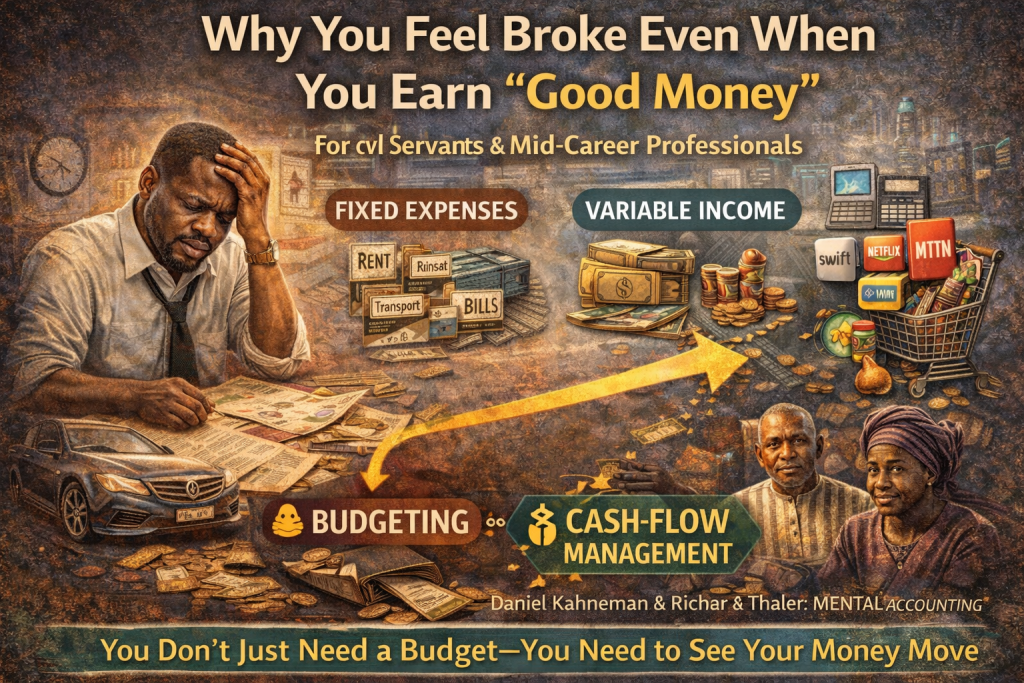
Why You Feel Broke Even When You Earn “Good Money”
There is a quiet frustration common among civil servants and mid-career professionals:
“I earn good money. So why do I still feel broke?”
The salary is respectable. The job is stable. The title is solid. Yet at the end of most months, liquidity is tight, savings are thin, and financial anxiety persists.
This experience is not necessarily a result of irresponsibility. In many cases, it is structural.
The problem is not simply how much you earn.
The problem is how cash flows through your life.
To understand this, we must move beyond basic budgeting and examine income stability, urban cost structures, financial leakage, and behavioral decision-making.
The Illusion of “Good Money”
“Good money” is relative.
In urban Nigeria — Lagos, Abuja, Port Harcourt — what appears like a strong salary on paper can dissolve quickly under structural expenses:
- Rent
- Transport or fuel
- Food
- School fees
- Utilities
- Communication costs
- Family support
Urban living carries a high baseline cost. Once fixed obligations are accounted for, discretionary income may be far smaller than assumed.
The issue is not gross income.
It is net liquidity after fixed commitments.
Fixed Expenses vs Variable Income
A central tension in personal finance is the imbalance between fixed expenses and variable income.
Fixed Expenses:
- Rent
- Loan repayments
- School fees
- Utility bills
- Insurance
- Car maintenance obligations
These costs are non-negotiable and recurring.
Variable Income:
Even salaried professionals experience variable effective income due to:
- Irregular allowances
- Delayed reimbursements
- Inflation eroding purchasing power
- Occasional side-income inconsistency
When fixed expenses consume 70–80% of monthly income, any fluctuation — even minor — creates stress.
High fixed-cost lifestyles produce fragility.
This is why someone earning ₦600,000 per month may feel financially strained if ₦500,000 is already committed before the month begins.
The Urban Cost Structure Problem
Urban environments amplify consumption opportunities and cost exposure.
Consider the structural differences:
- Transport costs are higher.
- Convenience services cost more.
- Social activity expectations increase.
- Work attire standards are stricter.
- Professional networking expenses rise.
Urban professionals are often surrounded by aspirational lifestyles. Constant exposure reshapes spending norms.
You may not consciously choose to spend more — but the environment nudges you toward higher consumption.
Financial Leakage: The Silent Drain
One of the least discussed contributors to feeling broke is financial leakage.
Leakage is small, repeated spending that escapes structured planning.
Examples include:
- Streaming subscriptions
- Multiple data plans
- Frequent ride-hailing trips
- Daily impulse purchases
- Untracked mobile app payments
- Small but regular food deliveries
Individually, these seem minor. Collectively, they are significant.
₦3,000 here. ₦5,000 there. ₦10,000 unplanned.
Over a month, leakage can exceed ₦80,000–₦150,000 without deliberate awareness.
Because each transaction feels small, it avoids emotional resistance.
This is where behavioral economics becomes crucial.
Mental Accounting and Financial Blind Spots
The work of Daniel Kahneman and Richard Thaler highlights how humans mentally categorize money into different “accounts.”
This phenomenon, called mental accounting, explains why:
- People treat bonuses differently from salary.
- Small expenses feel less significant than large ones.
- Subscription payments feel invisible after setup.
- Impulse purchases are justified as “minor.”
We do not evaluate money purely rationally. We label it psychologically.
A civil servant may carefully plan rent and school fees but underestimate cumulative discretionary spending because it is mentally categorized as “small” or “deserved.”
The result is cognitive distortion:
Income feels adequate. Liquidity feels insufficient.

Cash-Flow Management vs Budgeting
Most professionals attempt budgeting.
Few practice cash-flow management.
There is a difference.
Budgeting:
- Plans expenses in advance.
- Allocates categories.
- Focuses on limits.
Cash-Flow Management:
- Tracks the timing and movement of money.
- Monitors inflow and outflow patterns.
- Evaluates liquidity gaps.
- Anticipates stress points before they occur.
Budgeting answers: “What should I spend?”
Cash-flow management answers: “When will I run short?”
You can have a well-structured budget and still feel broke if cash timing is misaligned.
For example:
- Salary arrives on the 25th.
- Rent is due on the 1st.
- School fees are mid-month.
- Fuel prices spike unexpectedly.
Without flow forecasting, even disciplined earners feel constant pressure.
Lifestyle Anchoring and Income Absorption
Another overlooked factor is lifestyle anchoring.
Once income increases, spending recalibrates upward and rarely resets downward.
Mid-career professionals often upgrade:
- Housing location
- Children’s schools
- Vehicle category
- Social engagement frequency
Each upgrade becomes baseline.
When income grows, expenses absorb it almost automatically.
This absorption effect prevents margin expansion.
Without margin, there is no psychological security — regardless of income level.
The Emotional Component
Feeling broke is not solely numerical.
It is psychological.
When:
- Savings feel inadequate,
- Unexpected expenses cause anxiety,
- You cannot make major decisions without stress,
- You are dependent on the next salary alert,
You experience scarcity — even if your income is objectively strong.
Scarcity reduces cognitive bandwidth. It increases short-term thinking and reduces long-term planning capacity.
This dynamic reinforces financial stagnation.
Why Tracking Flows Changes Everything
The key behavioral shift is simple but powerful:
Stop tracking only expenses.
Start tracking flows.
This means:
- Recording all inflows — salary, side income, gifts, refunds.
- Tracking daily outflows — not just major expenses.
- Monitoring timing mismatches.
- Calculating monthly surplus or deficit precisely.
When professionals see actual flow data, surprises disappear.
Leakage becomes visible.
Patterns emerge.
Adjustments become strategic rather than emotional.
Tracking transforms vague anxiety into measurable structure.
Practical Structural Adjustments
Once flow awareness improves, several structural moves become possible:
1. Reduce Fixed Cost Ratio
Aim to keep fixed expenses below 60% of income where possible.
2. Consolidate Subscriptions
Audit recurring digital payments quarterly.
3. Create a Buffer Layer
Maintain at least one month of expenses in liquid reserves to reduce timing stress.
4. Separate Accounts by Function
- Income account
- Fixed-expense account
- Variable spending account
- Investment account
This reduces mental accounting errors by imposing physical structure.
5. Measure Surplus Rate
Track what percentage of income remains after all expenses. This is more informative than tracking salary alone.
The Core Realization
You do not feel broke because you earn too little.
You feel broke because:
- Fixed expenses are high.
- Leakage is invisible.
- Flows are misaligned.
- Margin is thin.
- Psychological accounting distorts perception.
Once these structural issues are corrected, the same income can feel dramatically different.
Final Reflection
“Good money” without structure creates stress.
Moderate money with strong cash-flow management creates stability.
The difference lies in awareness.
When you shift from asking:
“Where did my money go?”
To asking:
“How is my money moving?”
You regain control.
And control — not income level — is what ultimately determines whether you feel broke or financially grounded.