
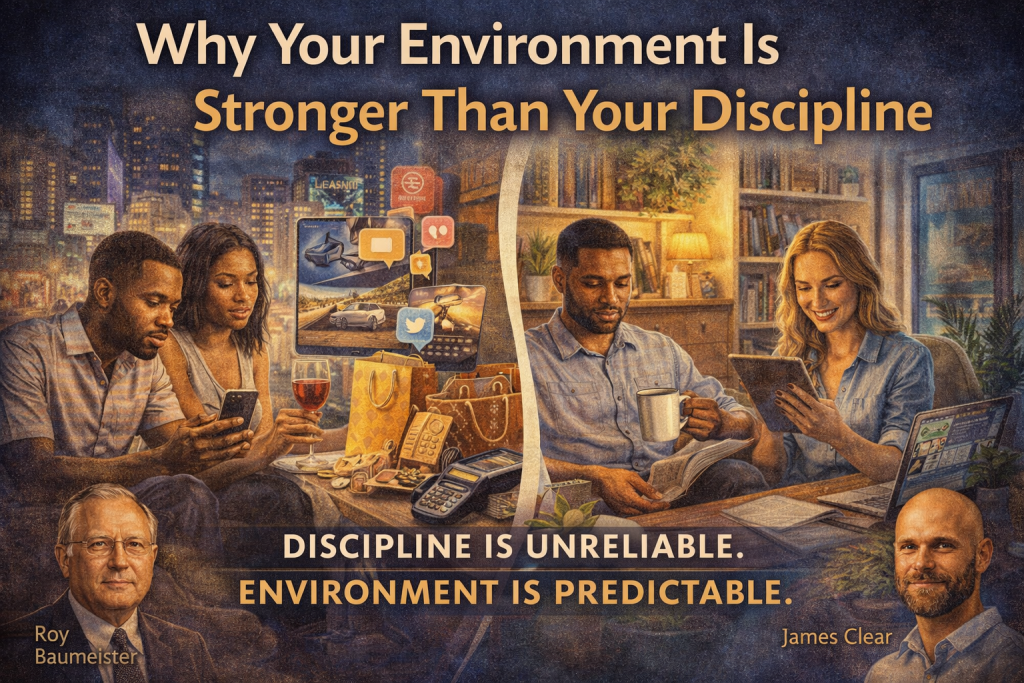
Why Your Environment Is Stronger Than Your Discipline
For many people trying to improve their financial lives, the default advice is simple: be more disciplined. Spend less. Save more. Avoid impulse purchases. Stick to a budget.
While this advice is not wrong, it is often incomplete—and sometimes misleading.
The uncomfortable truth is this: most people overestimate the power of willpower and underestimate the influence of their environment.
You may genuinely intend to make better financial decisions. Yet, despite your best efforts, you still overspend, save inconsistently, or struggle to build assets. This is not always a failure of discipline. In many cases, it is a failure to understand the systems shaping your behavior.
To build lasting financial change, one must first recognize a powerful principle:
Discipline is unreliable. Environment is predictable.
The Limits of Willpower
Willpower is often treated as the foundation of personal success. However, research in psychology suggests that willpower is a finite and inconsistent resource.
The renowned psychologist Roy Baumeister introduced the concept of ego depletion, which proposes that self-control diminishes as it is used throughout the day. The more decisions you make, the more your mental energy declines, making it harder to resist temptation.
In practical terms, this means:
- You are more likely to overspend when tired.
- You make poorer financial decisions under stress.
- You are less disciplined at the end of the day than at the beginning.
If financial success depends entirely on sustained willpower, then it is built on an unstable foundation.
This is why relying solely on discipline often leads to inconsistent results.
The Power of Environment
While willpower fluctuates, environmental influence remains constant.
Your environment includes:
- the people you interact with
- the places you spend time
- the content you consume
- the social norms around you
These factors continuously shape your behavior—often without your awareness.
The behavioral scientist James Clear emphasizes that environment is one of the most powerful drivers of habit formation. According to his work, behavior is largely a response to cues in the surrounding environment.
If your environment encourages spending, consumption, and status display, resisting those influences repeatedly becomes exhausting.
Over time, the environment wins.
Spending Is Socially Conditioned
One of the most overlooked drivers of financial behavior is social influence.
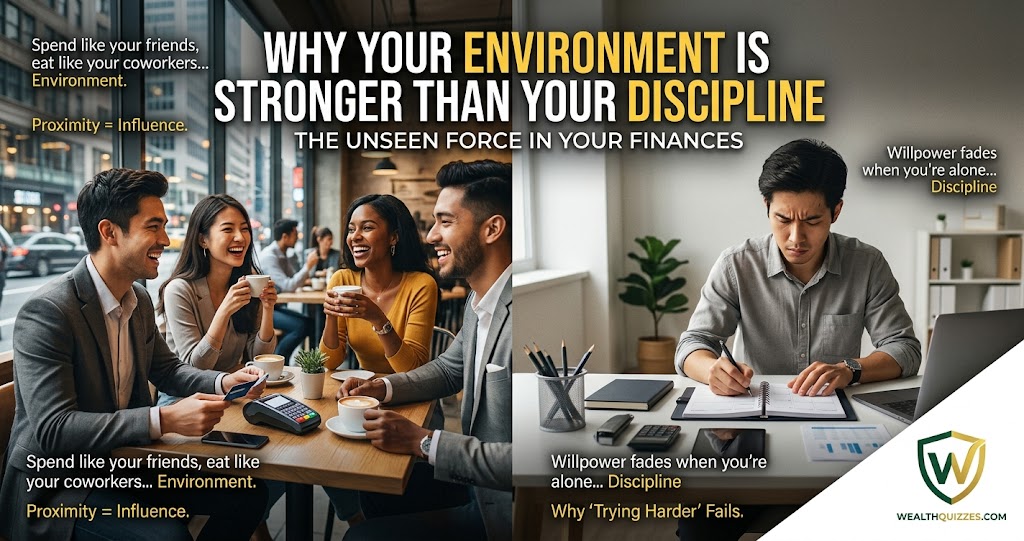
People do not make financial decisions in isolation. They observe, compare, and adapt to the behaviors of those around them.
Consider the following scenarios:
- If your friends frequently dine at expensive restaurants, your spending is likely to increase.
- If your workplace culture emphasizes luxury dressing and lifestyle, your expenses will rise accordingly.
- If your social circle values visible success, you may feel pressure to spend in order to belong.
This phenomenon reflects a broader sociological insight: human beings are deeply influenced by group norms.
We tend to align our behavior with what is considered normal within our immediate environment.
The Proximity Effect
A powerful concept that explains this dynamic is the proximity effect.
Simply put: you become like what you are around.
If you are consistently surrounded by:
- disciplined savers, you begin to adopt similar habits
- entrepreneurs, you begin to think in terms of opportunity
- consumers, you begin to spend more frequently
This effect operates subtly but consistently.
Over time, your financial identity begins to mirror your environment.
The challenge is that most people do not consciously choose their environment. It is often inherited—from family, workplace, or social networks.
As a result, their financial behavior is shaped passively rather than intentionally.
The Digital Environment: Your Invisible Influence
In the modern world, environment is no longer limited to physical surroundings.
Your digital environment—especially social media—plays an equally powerful role.
The content you consume daily influences:
- what you perceive as normal
- what you desire
- how you evaluate your own financial status
If your feeds are filled with:
- luxury lifestyles
- “soft life” content
- high-consumption habits
then your expectations—and spending patterns—will gradually adjust upward.
This happens even if your income has not changed.
The environment quietly redefines your financial baseline.
Why Changing Environment Works Faster Than Trying Harder
Many people attempt to improve their financial habits by exerting more effort:
- stricter budgets
- stronger self-control
- repeated resolutions
While these efforts may produce short-term improvements, they often fail to create lasting change.
Why?
Because they do not address the underlying system.
Changing your environment, however, alters the system itself.
For example:
- Moving closer to work reduces transport costs automatically.
- Surrounding yourself with financially disciplined peers reduces pressure to overspend.
- Curating your social media feed reduces exposure to consumption triggers.
In each case, the need for constant willpower decreases.
The environment begins to support, rather than resist, your financial goals.
Designing a Better Financial Environment
If environment is stronger than discipline, then the logical conclusion is clear:
You must design your environment intentionally.
This does not require extreme changes. Small, strategic adjustments can produce significant results over time.
1. Social Environment
Evaluate the financial behaviors of those closest to you.
- Do they encourage saving or spending?
- Do conversations revolve around growth or consumption?
You do not need to disconnect from people, but you can balance your circle by including individuals with stronger financial habits.
2. Physical Environment
Your daily surroundings influence your default actions.
- Living in high-cost areas increases spending pressure.
- Working in consumption-driven environments raises lifestyle expectations.
Where possible, adjust your physical environment to reduce unnecessary financial pressure.
3. Digital Environment
Your phone is one of the most powerful behavioral tools you carry.
- Unfollow accounts that trigger unnecessary spending.
- Follow content that promotes financial literacy and discipline.
This simple shift can significantly reduce comparison-driven consumption.
4. Structural Environment
Create systems that make good decisions easier:
- automate savings
- separate accounts for spending and investing
- limit access to funds meant for long-term goals
These structures reduce reliance on daily discipline.
From Effort to Design
The ultimate shift is moving from effort-based living to design-based living.
Instead of asking:
“How can I be more disciplined?”
The better question is:
“How can I make good decisions the default?”
When the environment is aligned with your goals, discipline becomes less necessary.
Good behavior becomes automatic.
Final Thought
Financial success is often portrayed as a test of character—a measure of discipline, restraint, and personal strength.
But this view overlooks a critical reality:
Behavior is shaped by context.
As Roy Baumeister demonstrated, willpower is limited. As James Clear explains, environment drives behavior.
The implication is clear:
If you want to change your financial life, do not rely solely on trying harder.
Change what surrounds you.
Because in the long run,
your environment will always outperform your discipline.