After the Final Whistle: The Legacy of FIFA World Cup 2026 – Champions, Records, Awards and the Stories That Will Be Remembered Forever
Spain’s Historic Triumph, Messi’s Emotional Farewell, Mbappé’s Goal-Scoring Record and the Tournament That Changed Football Forever
Every FIFA World Cup eventually reaches its inevitable conclusion. The confetti settles, the medals are awarded, champions celebrate, runners-up reflect, and millions of supporters begin counting the years until the next edition. Yet some World Cups leave a legacy that extends far beyond the trophy itself. The FIFA World Cup 2026, jointly hosted by the United States, Canada and Mexico, will be remembered not merely because Spain lifted the famous golden trophy, but because it fundamentally reshaped the future of international football.
From becoming the first-ever 48-team World Cup to producing 104 matches, record-breaking attendances, unprecedented digital engagement and unforgettable individual performances, FIFA World Cup 2026 has established new benchmarks that future tournaments will inevitably be measured against.
It was a World Cup of youthful brilliance and experienced leadership.
A World Cup of tactical innovation.
A World Cup where legends enhanced their reputations while future superstars announced themselves to the world.
Above all, it was a tournament that reminded football supporters why the FIFA World Cup remains the greatest sporting event on Earth.
Spain Are World Champions Again
The defining image of FIFA World Cup 2026 belongs to Spain, who defeated Argentina 1–0 after extra time in a tense and tactical final to claim their second FIFA World Cup title, sixteen years after their first triumph in South Africa in 2010. Ferran Torres scored the decisive extra-time goal, while Spain’s disciplined defence preserved another clean sheet to complete a remarkable tournament.
For manager Luis de la Fuente, the victory represented the culmination of years spent rebuilding Spanish football around technical excellence, positional intelligence and fearless young talent.
Spain were widely regarded as the tournament’s most consistent side.
Across eight matches they conceded just one goal, an extraordinary defensive achievement in modern international football. Their triumph confirmed the emergence of a new golden generation led by Rodri, Lamine Yamal, Pau Cubarsí, Pedri, Nico Williams and Unai Simón.
Argentina’s Painful but Proud Farewell
For Argentina, the final ended in heartbreak.
The defending champions came within one match of becoming the first nation since Brazil (1958 and 1962) to successfully retain the FIFA World Cup.
Although they fell just short, Argentina once again demonstrated why they have been one of the defining international teams of the modern era.
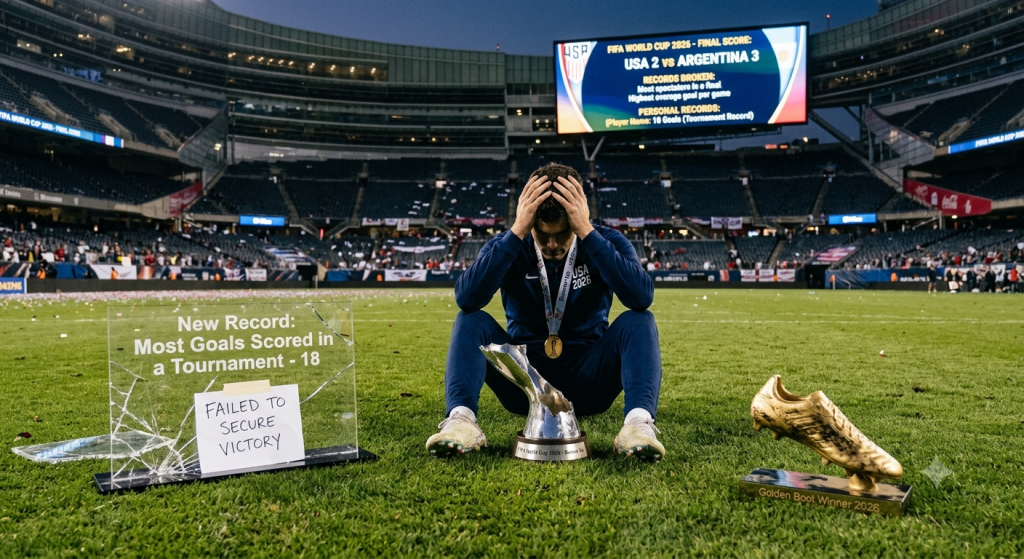
Perhaps the tournament’s most emotional storyline belonged to Lionel Messi.
His final World Cup appearance concluded with defeat, but not disappointment in terms of performance.
Messi finished the tournament with eight goals and four assists, earning the adidas Silver Ball and Silver Boot after another remarkable campaign. His creativity, leadership and influence remained central to Argentina’s run to a third consecutive World Cup final.
For millions of supporters, the sight of Messi acknowledging Argentina’s fans after the final whistle was one of the tournament’s most poignant moments.
Kylian Mbappé Rewrites the Record Books
If Spain lifted the trophy and Messi captured hearts, Kylian Mbappé dominated the scoring charts.
The French captain won the adidas Golden Boot after scoring 10 goals in eight matches, finishing ahead of Messi (Silver Boot) and England’s Jude Bellingham (Bronze Boot).
His outstanding tournament included a brilliant performance in the third-place play-off against England, even though France ultimately lost 6–4.
Mbappé also received the Bronze Ball, recognising his overall contribution as one of the tournament’s standout players.
His performances further strengthened his status among the greatest forwards of his generation.
Rodri: The Midfielder Who Defined the Tournament
Although attacking players often dominate headlines, FIFA’s Technical Study Group recognised the player whose influence extended beyond goals.
Spain’s Rodri received the adidas Golden Ball as the tournament’s best player.
His statistics illustrated complete midfield control.
In the final alone, Rodri completed 101 of 105 passes, won 80% of his duels, and helped Spain maintain defensive superiority. Throughout the tournament, Spain’s midfield balance and defensive organisation revolved around his intelligence and positioning.
His award reflected football’s growing appreciation for players whose influence lies in controlling games rather than merely finishing them.
The Tournament’s Major Individual Awards
Following the final, FIFA confirmed the official award winners:
- adidas Golden Ball: Rodri (Spain)
- adidas Silver Ball: Lionel Messi (Argentina)
- adidas Bronze Ball: Kylian Mbappé (France)
- adidas Golden Boot: Kylian Mbappé (France)
- adidas Silver Boot: Lionel Messi (Argentina)
- adidas Bronze Boot: Jude Bellingham (England)
- adidas Golden Glove: Unai Simón (Spain)
- FIFA Best Young Player: Pau Cubarsí (Spain)
- FIFA Fair Play Trophy: Netherlands
These honours reflected the balance between individual brilliance and collective success that characterised the tournament.
The Rise of Spain’s New Generation
Perhaps no nation leaves FIFA World Cup 2026 with greater optimism than Spain.
Young stars such as Lamine Yamal and Pau Cubarsí displayed maturity far beyond their years.
Cubarsí’s performances earned him FIFA’s Best Young Player Award, while Yamal consistently troubled elite defenders with his pace, creativity and confidence.
Combined with established leaders like Rodri, Pedri and Unai Simón, Spain appear well positioned to remain among football’s dominant nations for years to come.
England’s Encouraging Campaign
Although England narrowly missed the final after a dramatic semi-final defeat to Argentina, they concluded the tournament on a high by defeating France 6–4 in one of the highest-scoring third-place matches in World Cup history.
Jude Bellingham finished as the tournament’s Bronze Boot winner, while Bukayo Saka’s hat-trick in the bronze-medal match further underlined England’s exciting attacking future.
Under Thomas Tuchel, England demonstrated significant tactical growth and mental resilience.
Records That Defined World Cup 2026
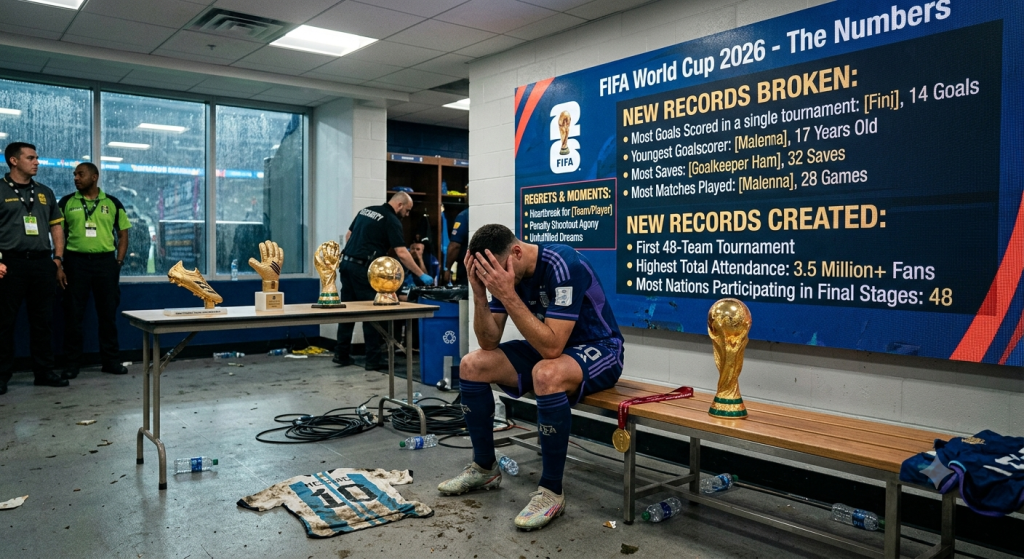
Several historic milestones ensured that FIFA World Cup 2026 will occupy a unique place in football history.
Among the most significant were:
- The first FIFA World Cup featuring 48 teams.
- A record 104 matches, the highest in tournament history.
- More than 6.25 million spectators attended matches.
- Stadium occupancy reached approximately 99.7%.
- FIFA reported around 20 billion video views across its digital platforms.
- The tournament was jointly hosted by three nations—the United States, Canada and Mexico—on an unprecedented scale.
These achievements demonstrate football’s continually expanding global reach.
Tactical Evolution Was Everywhere
Beyond statistics, FIFA World Cup 2026 showcased how modern football continues evolving.
Several trends became increasingly evident:
- Flexible tactical systems replacing rigid formations.
- Greater emphasis on coordinated pressing.
- Goalkeepers acting as additional playmakers.
- Increased reliance on sports science and performance analytics.
- Younger players assuming leadership responsibilities earlier in their careers.
Spain exemplified these developments better than any other nation.
The Regrets That Will Linger
Every World Cup creates unforgettable triumphs—but also lasting regrets.
For Argentina, the dream of defending their world title ended one match short.
For Lionel Messi, the final represented the closing chapter of an extraordinary World Cup career.
France will regret defensive lapses despite Mbappé’s brilliance.
England will forever wonder what might have been after surrendering a late lead against Argentina in the semi-final.
These disappointments are inseparable from the emotional power of the World Cup.
A Tournament Watched by Billions
The tournament’s commercial and broadcasting success matched its footballing quality.
The final became the most-watched English-language football broadcast in United States history, while Spanish-language coverage also set new audience records. Overall tournament viewership surpassed previous editions across several major markets, highlighting football’s continued global growth.
Looking Ahead to 2030
As celebrations conclude, attention inevitably turns toward the 2030 FIFA World Cup, a tournament that will carry enormous symbolic significance as football marks the centenary of the competition.
Spain’s victory establishes them as the team to beat.
Argentina will begin preparing for a future beyond Lionel Messi.
England’s youthful squad appears capable of challenging again.
France remain formidable despite falling short.
Several emerging football nations also demonstrated that the competitive gap between traditional powers and ambitious challengers continues to narrow.
Conclusion
The FIFA World Cup 2026 was far more than another edition of football’s greatest tournament.
It marked the beginning of a new era.
Spain reclaimed the world crown through tactical excellence, defensive discipline and fearless young talent.
Lionel Messi delivered one final masterpiece despite falling agonisingly short of another title.
Kylian Mbappé rewrote the tournament’s scoring history.
Rodri proved that midfield brilliance can define championships.
Pau Cubarsí emerged as the face of football’s future.
From record attendances and digital engagement to unforgettable goals, dramatic comebacks and emotional farewells, FIFA World Cup 2026 provided everything that makes the beautiful game unique.
Long after the medals have been stored, the stadium lights dimmed and the celebrations faded, the memories of this extraordinary tournament will continue to inspire football lovers around the world.
The final whistle may have ended the competition, but the legacy of FIFA World Cup 2026 has only just begun.