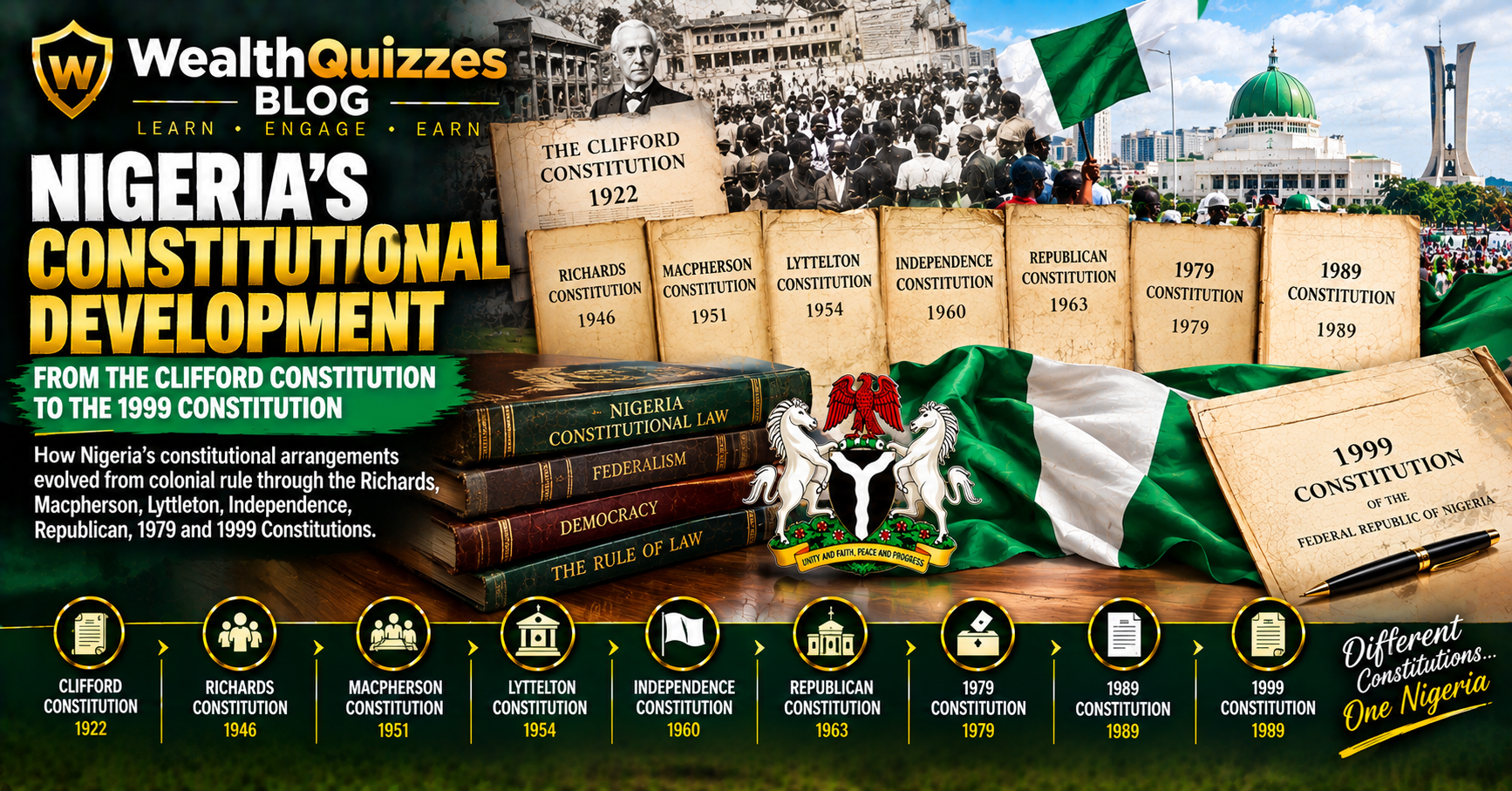
Nigeria’s Constitutional Development: From the Clifford Constitution to the 1999 Constitution
How Nigeria’s constitutional arrangements evolved from colonial rule through the Richards, Macpherson, Lyttleton, Independence, Republican, 1979 and 1999 Constitutions
Nigeria’s constitutional history is, in many respects, a history of the country itself.
The political system Nigerians operate today did not emerge fully formed at independence. It developed through successive constitutional experiments, political negotiations, colonial interventions, nationalist demands, military administrations and attempts to reconcile Nigeria’s extraordinary diversity with the need for an effective central government.
From the Clifford Constitution of 1922 to the 1999 Constitution, Nigeria moved from a colonial administrative system with extremely limited African participation to a federal presidential republic with elected institutions. Along the way, the country experimented with parliamentary government, regional federalism, presidentialism, military constitutional arrangements and repeated attempts at constitutional restructuring.
Political scientist Rotimi T. Suberu, one of the leading authorities on Nigerian federalism, describes this broader trajectory as a movement from a relatively decentralised parliamentary federation of regions to a much more centralised presidential federation consisting of 36 states and the Federal Capital Territory. (Oxford Academic)
The story of Nigeria’s constitutions is therefore not merely about legal documents. It is about the continuing search for a political structure capable of accommodating Nigeria’s geography, ethnic diversity, economic interests, regional aspirations and national ambitions.
Before the Clifford Constitution: The Colonial Foundations
The constitutional story needs to begin before 1922.
The amalgamation of the Northern and Southern territories in 1914 created the territorial framework of modern Nigeria, although the colonial administration continued to operate through distinct regional structures and administrative practices. The constitutional arrangements that followed were largely instruments of British colonial governance rather than products of popular Nigerian constitution-making. (SCCR)
This distinction is important.
Nigeria was not originally created through a constitutional convention in which its peoples freely agreed upon a common political settlement. Rather, the constitutional framework developed within British imperial administration and gradually became more participatory as nationalist politics intensified.
That tension between colonial authority and Nigerian participation would remain a recurring theme throughout the constitutional development of the country.
The Clifford Constitution of 1922: The Beginning of the Elective Principle
The Clifford Constitution of 1922, introduced under Governor Sir Hugh Clifford, represented a significant departure from the earlier colonial arrangements.
Its most important innovation was the introduction of an elective principle into Nigerian legislative politics. For the first time, limited numbers of Nigerians could directly participate in selecting representatives to the Legislative Council. The system initially provided four elected seats—three for Lagos and one for Calabar. (SCCR)
But this was a very restricted form of representation.
The franchise was based on a substantial income qualification, effectively excluding the overwhelming majority of Nigerians from participation. The Executive Council also remained largely outside Nigerian political control. (Cambridge University Press)
The Clifford Constitution therefore contained a fundamental contradiction: it introduced elections while maintaining colonial executive dominance.
Nevertheless, the elective principle had consequences far beyond the number of seats involved. Elections created new political opportunities for Nigerian elites and helped encourage the growth of organised nationalism.
The constitutional process had begun to create a political arena in which Nigerians could increasingly demand a greater voice in their own government.
The Richards Constitution of 1946: Regionalism Enters the Constitutional Structure
By the end of the Second World War, nationalist pressure had intensified considerably.
The Richards Constitution of 1946, named after Governor Sir Arthur Richards, attempted to address Nigeria’s size and diversity by giving greater constitutional recognition to regional interests. It established a central legislature while strengthening the importance of the Northern, Western and Eastern Regions. (Cambridge Assets)
The regional principle was significant because it anticipated the federal structure that would eventually become central to Nigerian government.
However, the Richards Constitution was criticised for the limited extent of Nigerian participation in its preparation. Its constitutional arrangements were regarded by many nationalists as insufficiently representative.
The constitutional history of Nigeria consequently began to establish a pattern that would recur repeatedly: constitutional reform was introduced in response to political pressure, but the process itself became a source of political controversy.
The Macpherson Constitution of 1951: Consultation and Wider Nigerian Participation
The Macpherson Constitution of 1951 represented a major attempt to correct some of the weaknesses associated with Richards.
Governor Sir John Macpherson adopted a much more consultative approach. Nigerians participated in discussions at local, divisional, provincial, regional and central levels before the constitutional proposals were finalised. The Cambridge literature specifically identifies this grassroots consultation as an important feature of the Macpherson process. (Cambridge University Press)
The Constitution created a central House of Representatives and strengthened regional legislatures. The Northern, Western and Eastern Regions increasingly acquired political institutions of their own.
This was an important step toward self-government.
But the Macpherson Constitution remained a transitional arrangement rather than a fully developed federation. Conflicts between regional and central authorities emerged, particularly over legislative powers and political representation. (Cambridge University Press)
Its most important historical contribution may therefore have been less the exact institutions it created than the political lesson it demonstrated: Nigerians themselves had to participate in determining the constitutional structure of the country.
The Lyttleton Constitution of 1954: The Federal Principle Takes Root
The political crises of 1953 demonstrated that Nigeria’s constitutional future could no longer be postponed.
The controversy surrounding Anthony Enahoro’s proposal for independence in 1956, opposition from northern representatives and the resulting political tensions exposed the inadequacy of the existing constitutional arrangement.
Constitutional conferences in London in 1953 and Lagos in 1954 eventually produced the Lyttleton Constitution, named after British Colonial Secretary Oliver Lyttleton. (SCCR)
This Constitution represented the decisive transition to federalism.
Nigeria was organised around a federal government and regional governments with constitutionally defined spheres of authority. The Northern, Western and Eastern Regions became the principal components of the federation, with Southern Cameroons also having a distinct constitutional position before its subsequent separation following a plebiscite. (SCCR)
The importance of the Lyttleton Constitution cannot be overstated.
It established the fundamental principle that Nigeria’s diversity could be accommodated through shared sovereignty between a federal centre and regional governments.
But it also created a problem that would haunt Nigerian politics: the regions were not equal in population or political weight. The Northern Region possessed a demographic advantage over the other regions, while minority communities complained that the tripartite structure empowered the major ethnic blocs. (Oxford Academic)
Thus, federalism solved one problem while creating others.
The 1960 Independence Constitution: Sovereignty Arrives
On 1 October 1960, Nigeria became independent under the Independence Constitution.
The Constitution largely retained the Westminster parliamentary model inherited from Britain. The British monarch remained the formal Head of State, represented in Nigeria by a Nigerian Governor-General, while the Prime Minister served as Head of Government. (SCCR)
The federal legislature was bicameral, and legislative authority was distributed between the federal government and regions.
The Constitution also established mechanisms for citizenship and constitutional amendment and provided a division of legislative responsibilities.
Yet independence was not complete in every constitutional sense. The continued position of the British monarch and the Judicial Committee of the Privy Council as the final appellate court were visible remnants of the colonial constitutional connection. (SCCR)
Nigeria had achieved political independence, but constitutional decolonisation was still incomplete.
The 1963 Republican Constitution: Constitutional Independence
Nigeria addressed those remaining links through the Republican Constitution of 1963.
The Constitution came into force on 1 October 1963. The Queen ceased to be Nigeria’s Head of State and the country became a republic. A Nigerian President became Head of State, elected by a joint session of the National Assembly. (SCCR)
The Supreme Court became the final judicial authority rather than the British Privy Council.
In other respects, however, the parliamentary system remained.
The Prime Minister continued to head the Federal Government, while the President largely performed the constitutional functions of Head of State.
The Republican Constitution therefore completed an important stage in Nigeria’s constitutional decolonisation without fundamentally altering the Westminster governmental model.
But the First Republic collapsed in January 1966 following a military coup, beginning a prolonged period in which constitutional government was repeatedly interrupted. (Oxford Academic)
Military Rule and the Transformation of Nigerian Federalism
Between 1966 and 1979, Nigeria was governed by military administrations.
Military governments suspended or modified constitutional arrangements and governed extensively through decrees. This period fundamentally altered the federal structure inherited from the First Republic.
One of the most important developments was the progressive replacement of the old regions with a growing number of states.
The transformation was politically significant. The military sought, among other things, to reduce the dominance of the three major regions and create smaller administrative units. But it also produced a stronger federal centre.
Rotimi Suberu argues that military constitutional restructuring transformed Nigeria from the relatively decentralised regional federation of the First Republic into a considerably more centralised presidential federation. (Oxford Academic)
This transformation would profoundly influence the constitutions that followed.
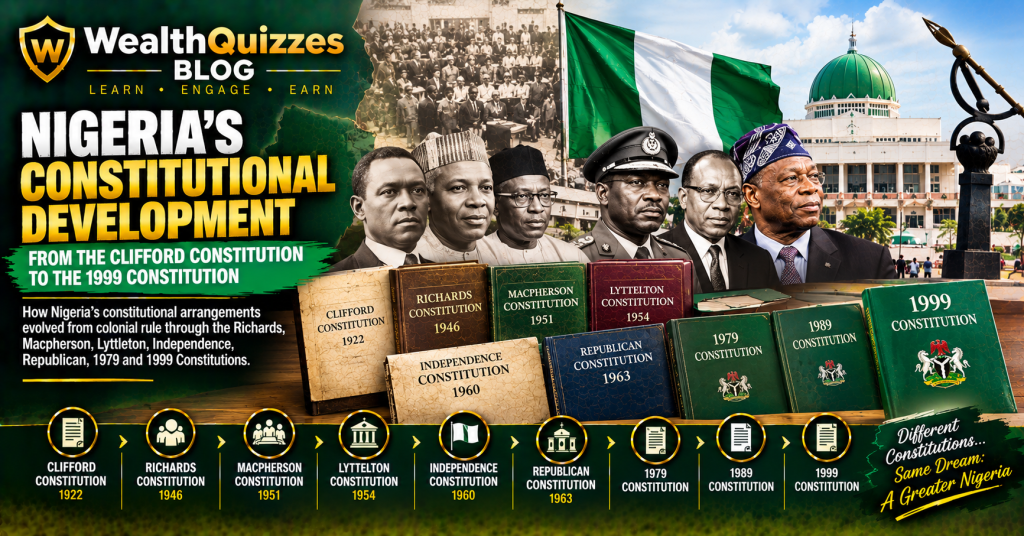
The 1979 Constitution: Nigeria Turns to Presidential Government
The next major constitutional watershed came in 1979.
As the military prepared to return Nigeria to civilian rule, the government established a Constitution Drafting Committee and subsequently a Constituent Assembly to consider the proposed constitutional framework. (Cambridge University Press)
The resulting 1979 Constitution abandoned the Westminster parliamentary model and introduced a presidential system.
This was one of the most consequential constitutional changes in Nigerian history.
Under the new system, the President was both Head of State and Head of Government. Executive and legislative powers were institutionally separated. The National Assembly became bicameral, consisting of a Senate and House of Representatives.
Cambridge constitutional scholar James S. Read described the 1979 Constitution as a Nigerian adaptation of the “Washington model”, marking a deliberate departure from Westminster. (Cambridge University Press)
The reasoning was partly institutional.
The parliamentary system had produced intense struggles between regional and federal political forces during the First Republic. Presidential government was seen as capable of creating a stronger national executive while separating executive authority from the legislature.
The Constitution also incorporated mechanisms intended to manage Nigeria’s ethnic diversity, including the federal character principle. Political scientist John A. A. Ayoade notes that the 1979 Constitution sought to promote ethnic equality and representation within government institutions. (Oxford Academic)
The Second Republic nevertheless lasted only from 1979 to 1983 before another military coup terminated civilian government.
The lesson was significant: changing the constitutional structure did not automatically solve Nigeria’s political problems.
The 1989 Constitution and the Aborted Third Republic
General Ibrahim Babangida’s transition programme generated another constitutional experiment.
The 1989 Constitution largely retained the presidential model established in 1979, while introducing other political and institutional changes. James Read notes that the 1989 framework closely reproduced much of the 1979 constitutional structure. (Cambridge University Press)
But the Third Republic was never fully established.
The annulment of the 12 June 1993 presidential election brought the transition to an end. Nigeria subsequently returned to military rule under General Sani Abacha.
The aborted Third Republic demonstrated another recurring feature of Nigerian constitutional history: the country repeatedly designed constitutional arrangements for civilian rule, only for political crises or military intervention to prevent their full consolidation.
The 1999 Constitution: The Beginning of the Fourth Republic
The death of General Sani Abacha in 1998 and the transition programme of General Abdulsalami Abubakar created the circumstances for Nigeria’s return to civilian government.
The 1999 Constitution came into force on 29 May 1999, the same day Olusegun Obasanjo was inaugurated as President. (PLACNG)
Its basic architecture was unmistakably presidential and federal.
Section 1 establishes the supremacy of the Constitution, providing that it has binding force on all authorities and persons throughout the Federal Republic. Section 2 describes Nigeria as a federation consisting of states and the Federal Capital Territory. (PLACNG)
The Constitution provides for:
- an elected President;
- elected state governors;
- a bicameral National Assembly;
- an independent judiciary;
- federal and state governments;
- constitutional fundamental rights;
- an electoral management framework;
- separation of powers;
- judicial review; and
- procedures for constitutional amendment.
The Fourth Republic therefore represented both continuity and change.
It was a return to civilian government, but its constitutional architecture drew heavily from the presidential system first established in 1979. Oxford scholarship confirms that Nigeria’s 1999 system maintained the presidential structure introduced in 1979. (Oxford Academic)
The 1999 Constitution and the Legacy of Military Rule
The most important debate surrounding the 1999 Constitution concerns its origins.
Unlike the 1979 Constitution, which followed a more elaborate drafting and constituent-assembly process, the 1999 Constitution emerged at the end of military rule and was heavily influenced by the existing military constitutional framework.
Scholars have therefore described the 1999 Constitution as carrying significant institutional legacies of military government.
Rotimi Suberu argues that military rule centralised constitutional functions and fiscal resources while restructuring Nigeria’s territory into a 36-state federation. (Oxford Academic)
Constitutional scholars have consequently continued to debate federalism, resource allocation, state autonomy, local government, policing and the distribution of legislative powers.
The Constitution itself has also continued to evolve through amendments. The Policy and Legal Advocacy Centre maintains a comprehensive record of the constitutional alterations, including the First through Fifth Alterations. (PLACNG)
Thus, the 1999 Constitution should not be understood as a document frozen in 1999. It is a constitutional framework that has continued to be amended, interpreted and contested.
From Colonial Constitution-Making to Constitutional Ownership
Perhaps the most important way to understand Nigeria’s constitutional evolution is to examine who participated in making the constitutions.
The Clifford and Richards Constitutions were primarily colonial projects. Nigerian participation was limited.
The Macpherson Constitution represented a major improvement because Nigerians were consulted extensively at different levels of society. (Cambridge University Press)
The Lyttleton and independence-era constitutions increasingly emerged from negotiations among Nigerian political elites and British authorities.
The 1979 Constitution involved a Constitution Drafting Committee and Constituent Assembly. (Cambridge University Press)
The 1999 Constitution, however, emerged from the transition away from military government and substantially preserved the presidential constitutional architecture associated with 1979.
This history demonstrates why constitution-making has remained a sensitive issue in Nigeria.
A constitution is not merely a legal document. The process through which it is made affects its legitimacy, its institutions and the willingness of citizens and political actors to regard it as their own.
The Larger Constitutional Journey
Nigeria’s constitutional development can therefore be viewed as a series of answers to recurring questions.
The Clifford Constitution asked how limited Nigerian participation could be introduced into colonial government.
The Richards Constitution attempted to accommodate regional diversity.
The Macpherson Constitution expanded consultation and representation.
The Lyttleton Constitution established federalism as the central organising principle.
The 1960 Independence Constitution established sovereign parliamentary government.
The 1963 Republican Constitution completed the formal transition from constitutional monarchy to republican statehood.
The 1979 Constitution replaced Westminster with presidential government.
The 1989 Constitution attempted to revive presidential constitutionalism but was overtaken by the collapse of the Third Republic.
The 1999 Constitution restored civilian government while retaining the presidential federal model.
Seen in this light, Nigeria’s constitutional history is not a straight line from colonialism to democracy. It is a process of experimentation, crisis, adaptation and institutional inheritance.
Conclusion
From the limited franchise of the Clifford Constitution to the constitutional supremacy of the 1999 Constitution, Nigeria’s constitutional development spans more than a century of political transformation.
The journey moved from colonial legislative councils to elected assemblies; from regional administration to federalism; from Westminster parliamentary government to presidentialism; and from military decrees to a constitutional order based on civilian government.
Yet the fundamental constitutional questions have remained remarkably persistent: How should power be divided between the centre and the constituent parts? How should Nigeria’s diversity be represented? How can minority interests be protected? How should resources be shared? How can executive authority be restrained? And how can constitutional government become genuinely owned by the people?
The evolution from Clifford to 1999 shows that Nigeria has never stopped searching for answers to these questions.
The constitutional history of Nigeria is therefore also the history of the country’s continuing effort to reconcile unity with diversity, authority with accountability, federalism with national integration, and constitutional design with political reality.
The 1999 Constitution did not end that search. It established the framework within which the search continues.