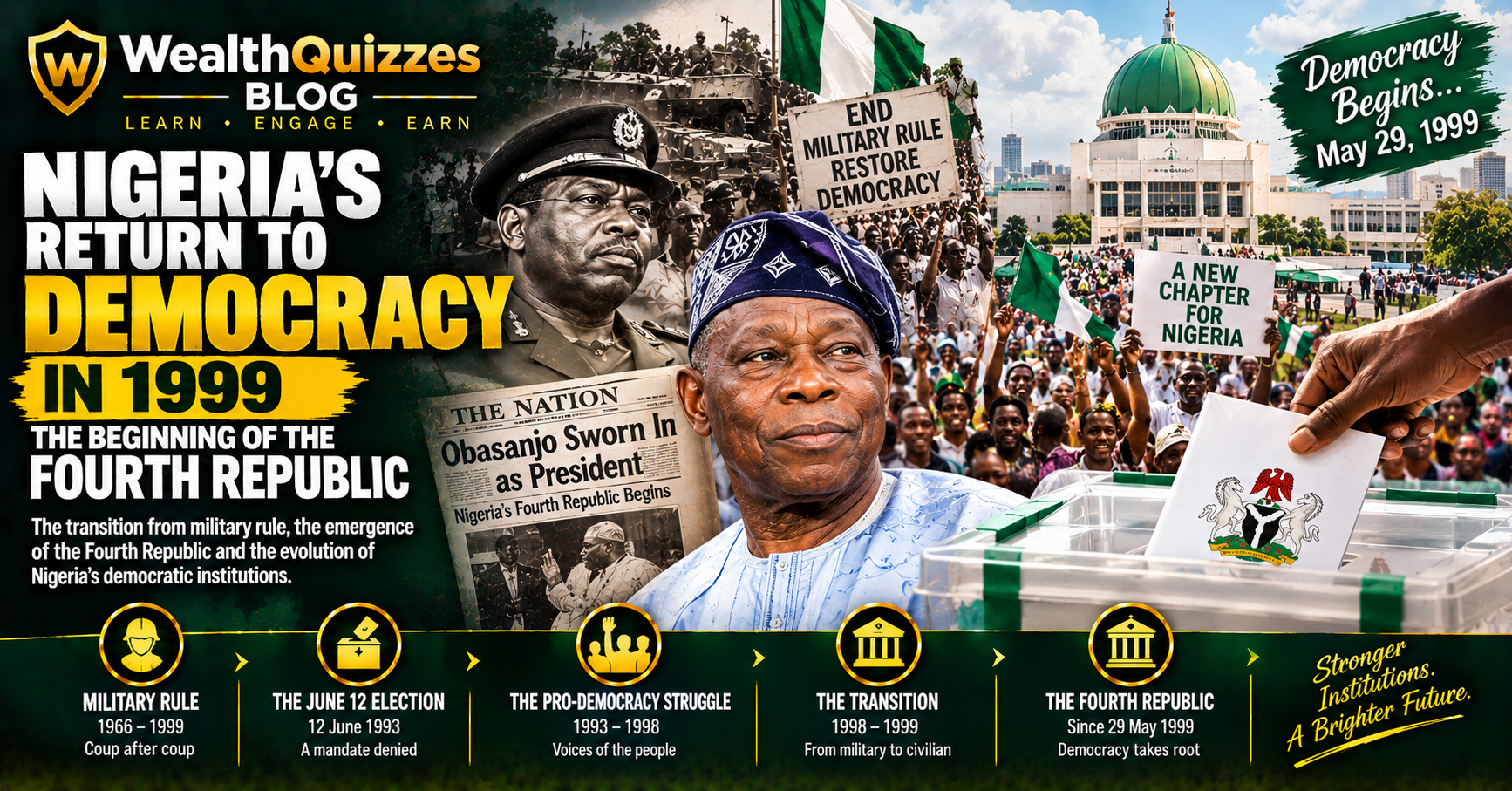
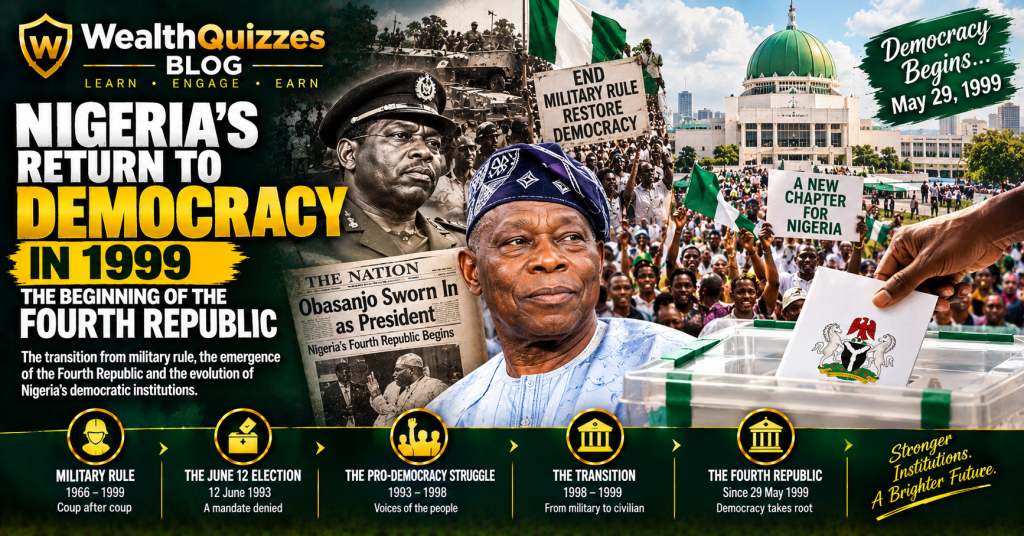
Nigeria’s Return to Democracy in 1999: The Beginning of the Fourth Republic
The transition from military rule, the emergence of the Fourth Republic and the evolution of Nigeria’s democratic institutions
Nigeria’s return to civilian rule on 29 May 1999 marked one of the most consequential political turning points in the country’s post-independence history. It ended almost 16 years of virtually uninterrupted military government that had followed the collapse of the Second Republic in 1983 and opened the way for a new constitutional order.
The transition was not simply another change of government. It represented an attempt to restore representative institutions, constitutional government, civil liberties and electoral politics after decades in which military authorities had repeatedly suspended or weakened democratic institutions. Scholars of Nigerian politics consequently regard 1999 as the beginning of the Fourth Republic, the longest uninterrupted period of civilian government in Nigeria since independence in 1960. (Council on Foreign Relations)
Yet the Fourth Republic was born with significant institutional inheritances from military rule. Its history has therefore been characterised by an important tension: Nigeria succeeded in sustaining civilian constitutional government, but many of the political, federal and institutional structures inherited from the military era continued to shape the character of the new republic. (Cambridge University Press)
The Road to 1999
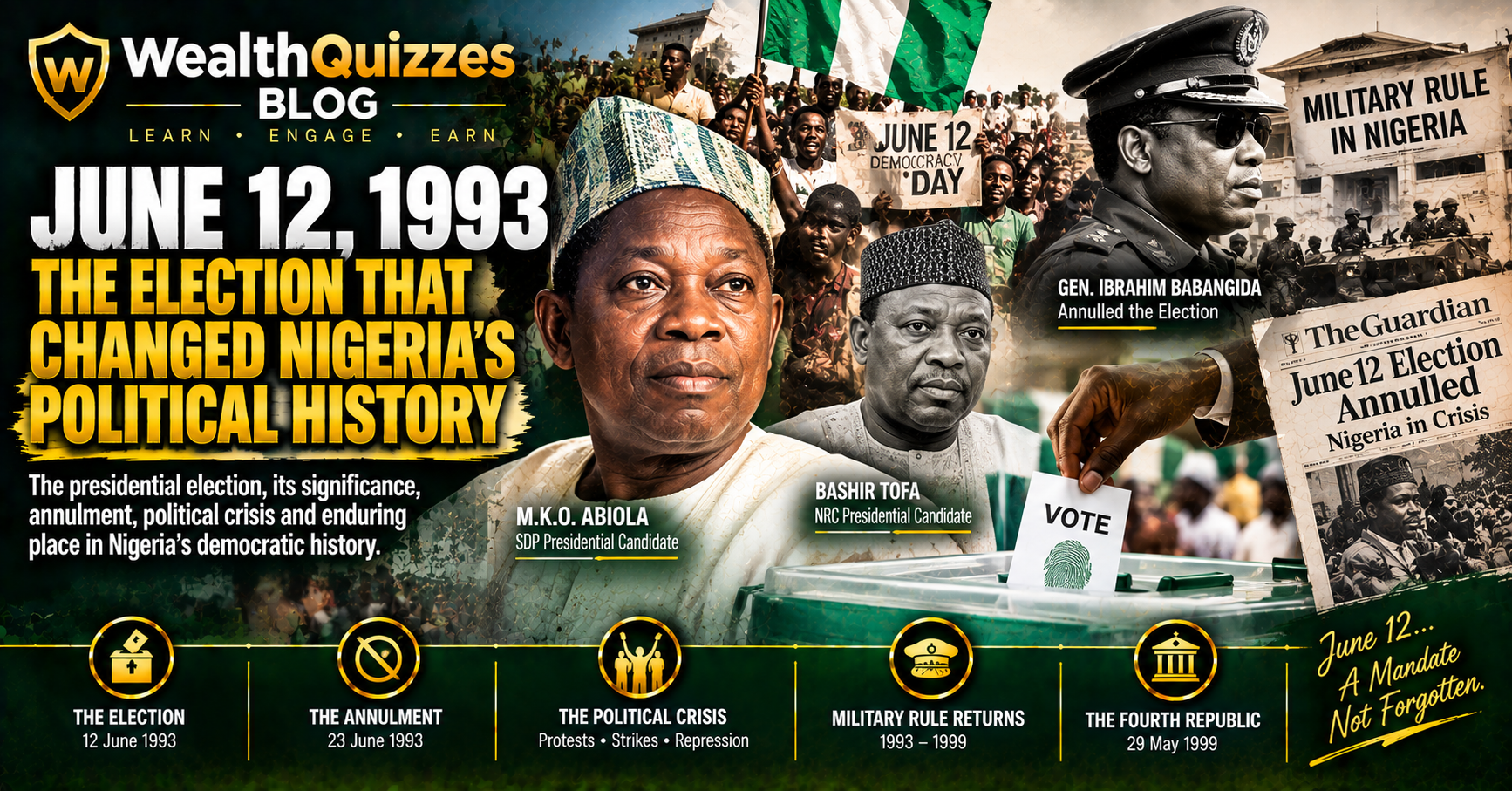
The immediate background to the Fourth Republic was the crisis surrounding the 12 June 1993 presidential election and the authoritarian governments that followed its annulment.
The election, conducted under the military government of General Ibrahim Babangida, was widely regarded by Nigeria’s electoral authorities and several observers as a significant democratic exercise. The eventual transition collapsed when the election was annulled. Nigeria subsequently passed through the short-lived Interim National Government under Ernest Shonekan before General Sani Abacha assumed power in November 1993. (INEC Nigeria)
Abacha’s government became increasingly repressive. Political opposition, civil society organisations, journalists and pro-democracy activists faced severe restrictions. The struggle for democratic government consequently moved beyond political parties and included labour unions, professional organisations, human-rights groups and pro-democracy coalitions. Scholars such as Idayat Hassan have emphasised the importance of organisations including the National Democratic Coalition (NADECO), the Civil Liberties Organisation, the Committee for the Defence of Human Rights and the Movement for the Survival of the Ogoni People in sustaining demands for constitutionalism and accountable government. (Cambridge University Press)
The death of General Abacha on 8 June 1998 unexpectedly changed the political landscape. His successor, General Abdulsalami Abubakar, moved rapidly toward a civilian transition. Unlike previous transition programmes, this one culminated in the actual transfer of federal power to an elected civilian administration in 1999. (OUP Academic)
Abdulsalami Abubakar and the Transition Programme
General Abdulsalami Abubakar inherited a country deeply distrustful of military rule and facing considerable international pressure. His administration therefore pursued an accelerated transition programme.
One of its most important institutional decisions was the establishment of the Independent National Electoral Commission (INEC) in 1998, replacing the National Electoral Commission of Nigeria (NECON). INEC subsequently organised the transitional elections that produced the institutions of the Fourth Republic. (INEC Nigeria)
Between December 1998 and February 1999, Nigerians voted in a series of elections covering local government, state assemblies and governorships, the National Assembly and finally the presidency. The presidential election was held on 27 February 1999. (OUP Academic)
Three registered political parties participated prominently in the transition elections: the People’s Democratic Party (PDP), the All People’s Party (APP) and the Alliance for Democracy (AD). Their geographical strengths reflected the continuing importance of Nigeria’s regional and political divisions. (OUP Academic)
The presidential contest was won by Olusegun Obasanjo of the PDP, who was declared elected over Olu Falae, the candidate associated with the APP and AD alliance. INEC records and academic accounts place Obasanjo’s share at approximately 62.78 percent. (OUP Academic)
The elections were sufficiently successful to permit the military to leave government, but they were not without controversy. Election observers identified irregularities and weaknesses in the registration and electoral processes. Thus, the 1999 transition represented both a democratic breakthrough and the beginning of a continuing debate about electoral credibility. (INEC Nigeria)
29 May 1999: The Fourth Republic Begins
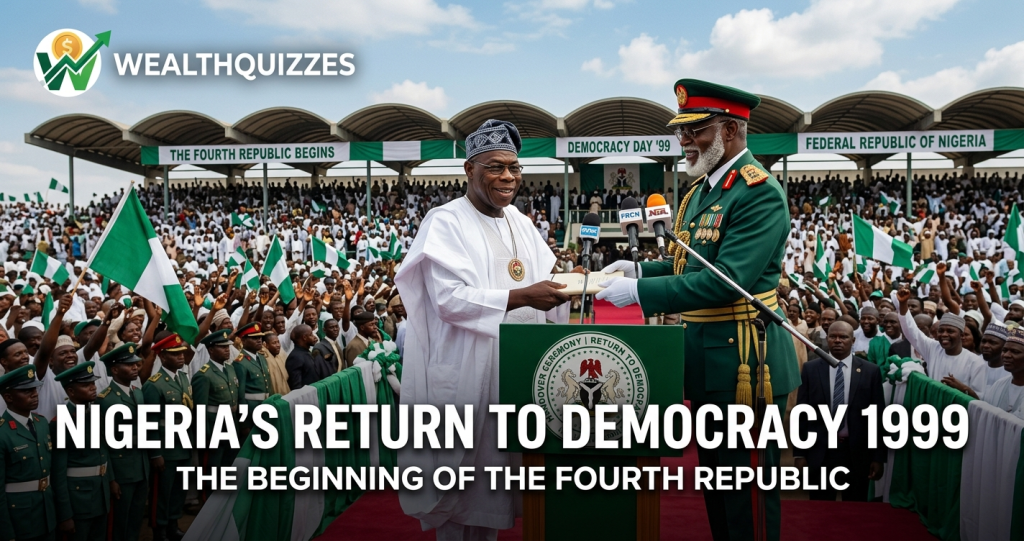
On 29 May 1999, Olusegun Obasanjo was sworn in as President of the Federal Republic of Nigeria.
The significance of that day extended beyond the inauguration of an individual president. For the first time since 1983, Nigeria once again had a civilian federal government operating under a constitutional framework rather than military decrees.
The new republic inherited the 1999 Constitution, which established a presidential system with an elected President, a bicameral National Assembly, an independent judiciary and elected state governments.
The constitutional arrangement differed substantially from the parliamentary system of the First Republic. Executive authority was concentrated in an elected presidency, while legislative authority belonged to the Senate and House of Representatives. The judiciary was constitutionally recognised as a separate branch of government.
However, the Constitution itself carried substantial institutional legacies of military rule. Political scientist Rotimi T. Suberu has argued that decades of military government transformed Nigeria from the earlier regional-federal arrangement into a highly centralised, multi-state federation. Scholars have consequently described the Fourth Republic’s federal system as containing tensions between constitutional federalism and strong central control. (Cambridge University Press)
Rebuilding Democratic Institutions
The Fourth Republic’s most important task was institutional reconstruction.
The Presidency
The presidency became the central institution of executive government. Unlike military heads of state, presidents were subject to constitutional terms, elections, legislative scrutiny and judicial review.
Obasanjo’s first administration therefore faced the difficult task of transforming executive authority from a military command structure into a civilian constitutional office.
The National Assembly
The National Assembly resumed its constitutional functions after years in which legislatures had been suspended.
The Senate and House of Representatives became arenas for legislation, representation, oversight and negotiation among Nigeria’s diverse political interests. Rotimi Suberu’s assessment of the Fourth Republic legislature describes its record as mixed: the National Assembly has contributed to constitutional amendments and electoral reforms and served as an arena for inter-ethnic negotiation, while also experiencing significant problems involving legislative effectiveness, oversight and political patronage. (OUP Academic)
The Judiciary
The judiciary also regained its position as a constitutional institution capable of reviewing governmental actions and resolving political disputes.
This was particularly important because military governments had frequently ruled through decrees that limited constitutional judicial authority. The restoration of constitutional government therefore meant restoring the courts as an institutional check within the political system. (OUP Academic)
INEC and Electoral Governance
Perhaps no institution has been more central to the evolution of the Fourth Republic than INEC.
Created in 1998 and constitutionally entrenched under the Fourth Republic, INEC has conducted Nigeria’s general elections since 1999. Over time, it has introduced or administered reforms including continuous voter registration, Smart Card Readers, the Bimodal Voter Accreditation System (BVAS) and the INEC Result Viewing Portal (IReV). (INEC Nigeria)
These developments demonstrate that democratic institutions are not static. Nigeria’s electoral system has undergone repeated attempts at technological, administrative and legal reform.
From 1999 to Electoral Reform
The shortcomings of the 1999 elections immediately created pressure for reform.
Nkwachukwu Orji’s study of electoral reform in the Fourth Republic notes that demands for electoral reform have been a persistent feature of Nigerian democracy. The transition elections themselves generated calls for improvements, while controversies surrounding the 2003 elections produced further pressure for legislative and administrative change. (Cambridge University Press)
The Electoral Acts of 2001, 2002 and subsequent amendments reflected this continuing process. Later reforms culminated in significant changes under the 2010 Electoral Act and subsequent legislation.
Carl LeVan and Abiodun Ajijola argue that important reforms were facilitated not merely by changes within INEC but also by reform-oriented coalitions within the National Assembly and changes within civil society that gave electoral administrators greater room to operate. (OUP Academic)
Thus, the evolution of Nigerian democracy cannot be understood solely through presidential elections. It also involves the gradual development of electoral administration, legislative institutions, civil society and judicial processes.
The Growth of Political Parties
The Fourth Republic also witnessed the development of a competitive, although often highly fluid, party system.
The PDP dominated national politics for much of the period from 1999 to 2015, while opposition parties developed through successive realignments. The eventual emergence of the All Progressives Congress (APC) and its victory in the 2015 presidential election demonstrated that an incumbent national party could be defeated through the electoral process.
Political scientist Jake D. Dan-Azumi notes that Nigeria’s party system developed considerably between 1999 and 2019 and that political parties played an important role in the endurance of the Fourth Republic. (OUP Academic)
At the same time, scholars have identified persistent weaknesses in internal party democracy, candidate selection and the influence of political elites. Jibrin Ibrahim, for example, argues that the party system has often been constrained by the influence of political godfathers and party barons. (Cambridge University Press)
Civil Society and the Media
Democracy also created greater institutional space for civil society and the media.
Organisations that had previously operated under severe military restrictions became able to campaign more openly for electoral reform, human rights, transparency and accountability.
The media similarly assumed a more prominent role in scrutinising government. Research by Ayo Olukoyun on the early Fourth Republic found that Nigerian media organisations played an important role in demanding accountability and public standards during the 1999–2003 period. (Cambridge University Press)
This represented an important reversal of the military period, when censorship and repression severely constrained public political discourse.
The Unfinished Constitutional Question
One of the most persistent issues of the Fourth Republic has been the structure of the Nigerian federation.
The 1999 Constitution created a federation of 36 states and the Federal Capital Territory, but substantial powers and resources remain concentrated at the federal level.
Rotimi Suberu’s scholarship identifies constitutional restructuring as one of the central unresolved questions of the Fourth Republic. Repeated constitutional amendments have altered electoral and political rules, but have not fundamentally transformed the architecture of Nigeria’s federal system. (OUP Academic)
The debate has therefore continued over fiscal federalism, state autonomy, local government, policing, resource control and the appropriate distribution of political power.
These debates demonstrate that returning to democracy did not automatically settle the constitutional questions inherited from military rule.
The Significance of the Fourth Republic
The most historically significant feature of the Fourth Republic is its longevity.
The First Republic lasted from 1960 to 1966. The Second Republic lasted from 1979 to 1983, while the Third Republic was aborted before it could fully consolidate following the annulment of the June 12, 1993 presidential election.
By contrast, the Fourth Republic survived successive presidential administrations, changes of governing parties, political crises, constitutional amendments, electoral disputes and major social pressures.
Oxford scholar Eghosa E. Osaghae and other contributors to Democracy and Nigeria’s Fourth Republic emphasise that this longevity provides a much larger historical field for evaluating Nigerian democratic development than was possible with the earlier republics. (Cambridge University Press)
The endurance of civilian government, however, should not be confused with the complete consolidation of democracy. The Fourth Republic has simultaneously demonstrated institutional resilience and persistent weaknesses in electoral administration, party politics, federalism, executive-legislative relations and constitutional design.
The Fourth Republic as an Ongoing Democratic Project
Nigeria’s return to democracy in 1999 was therefore both an ending and a beginning.
It ended the long cycle of military intervention that had repeatedly interrupted civilian government. But it also began the much harder task of constructing democratic institutions capable of surviving political competition, institutional conflict and changing public expectations.
INEC evolved from a newly established electoral body into a permanent national institution. The National Assembly developed into a continuing legislative arena. The judiciary resumed its constitutional role. Political parties became vehicles for electoral competition. Civil society and the media acquired greater operating space. Electoral technology and legislation evolved substantially.
Yet the persistence of electoral controversies, party patronage, constitutional centralisation and demands for political restructuring demonstrates that democratic development remains an institutional process rather than a single historical event. (OUP Academic)
The Fourth Republic’s historical importance ultimately lies in the fact that Nigeria has remained under civilian constitutional government since 29 May 1999. That continuity created the institutional space within which Nigerians could contest governments through elections, litigate political disputes in courts, organise through civil society, demand constitutional reform and gradually reshape the rules of political competition.
The return to democracy did not resolve Nigeria’s political contradictions. It transferred the responsibility for resolving them from military governments to constitutional institutions and, ultimately, to the Nigerian people.
Conclusion
Nigeria’s return to democracy in 1999 was the product of a long and difficult journey through military intervention, constitutional crises, the annulment of the June 12 election, pro-democracy resistance and the accelerated transition programme of General Abdulsalami Abubakar.
The inauguration of Olusegun Obasanjo on 29 May 1999 established the Fourth Republic, restoring presidential government, legislative institutions, constitutional adjudication and regular elections. INEC became the permanent electoral management body, while political parties, civil society, the media and the courts assumed renewed importance in public life. (INEC Nigeria)
But the Fourth Republic also inherited a political architecture profoundly shaped by nearly three decades of military rule. Its centralised federal structure, presidential dominance, party system and electoral institutions have consequently remained subjects of continuous debate and reform. (Cambridge University Press)
The story of the Fourth Republic is therefore not simply the story of Nigeria’s return to civilian rule. It is the story of an ongoing attempt to transform civilian government into durable democratic governance—a process that began on 29 May 1999 and continues to shape Nigeria’s political history.