June 12, 1993: The Election That Changed Nigeria’s Political History
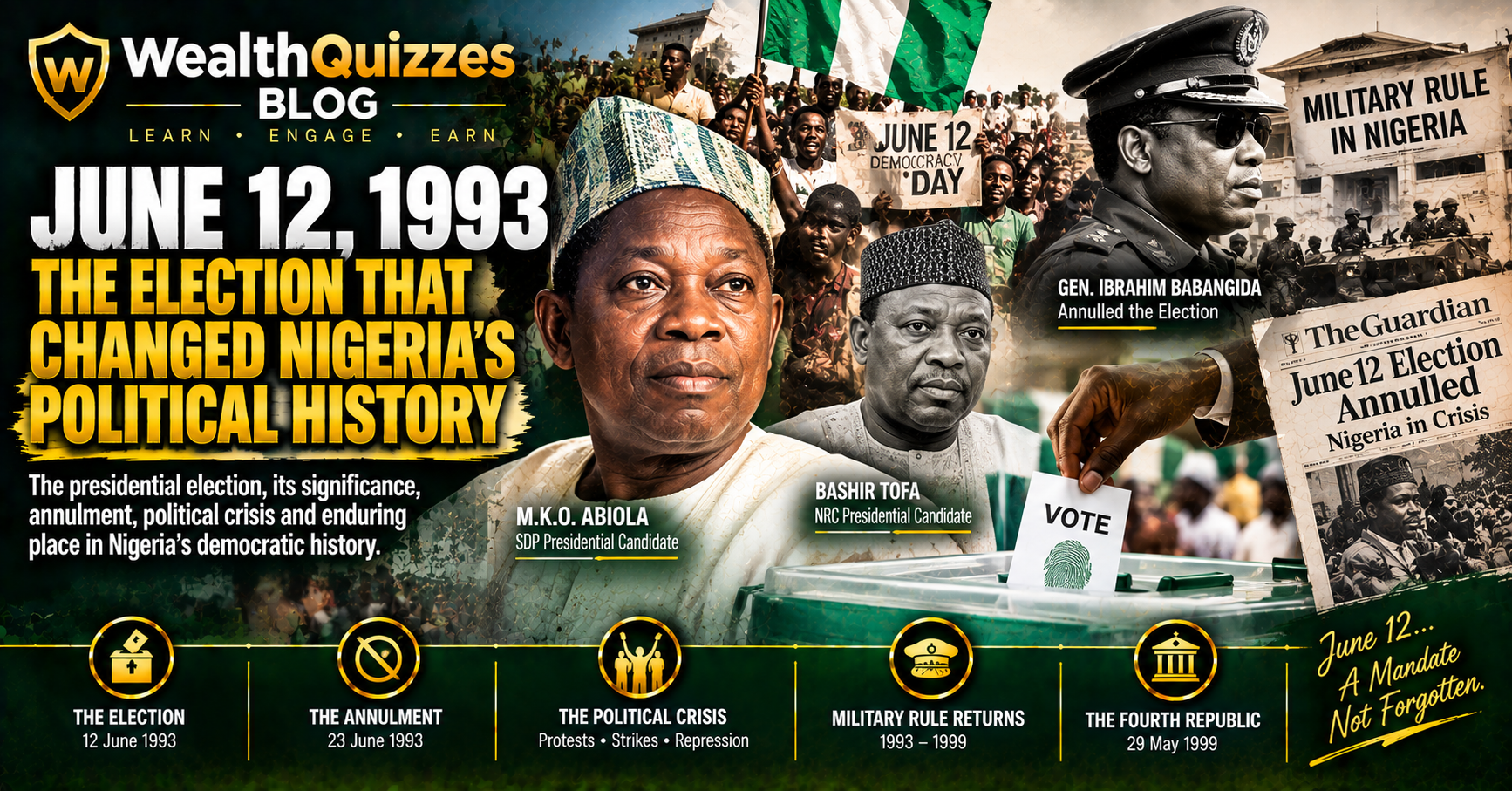
The Presidential Election, Its Significance, Annulment, Political Crisis and Enduring Place in Nigeria’s Democratic History
Few dates occupy as consequential a place in Nigeria’s democratic history as 12 June 1993.
On that day, millions of Nigerians went to the polls to elect a civilian president after almost a decade of military rule. The election was the culmination of General Ibrahim Babangida’s elaborate transition programme and was intended to usher Nigeria into the long-awaited Third Republic.
Instead, the election became one of the defining political crises of modern Nigeria.
The presidential contest between Chief Moshood Kashimawo Olawale Abiola of the Social Democratic Party (SDP) and Alhaji Bashir Othman Tofa of the National Republican Convention (NRC) was conducted under an electoral system designed by the military government. Although the National Electoral Commission (NEC) did not complete the formal declaration of the result before the process was halted, the available results showed Abiola with a substantial lead. Nigeria’s present electoral commission, INEC, describes the June 12 election as “widely acclaimed as free and fair.” (INEC Nigeria)
The annulment of the election by the Babangida administration transformed an electoral contest into a national political crisis. It contributed directly to Babangida’s eventual departure, the collapse of the Interim National Government, the rise of General Sani Abacha, a prolonged pro-democracy struggle, and ultimately the transition that produced the Fourth Republic in 1999. Cambridge’s Contemporary Nigerian Politics describes the three months following the annulment as a period of turmoil that culminated in Abacha’s seizure of power. (Cambridge University Press)
June 12 therefore occupies a peculiar position in Nigerian history: an election that did not produce the government it was intended to create nevertheless profoundly influenced the democratic order that eventually emerged.
The Road to June 12
To understand June 12, it is necessary to understand the political environment in which it occurred.
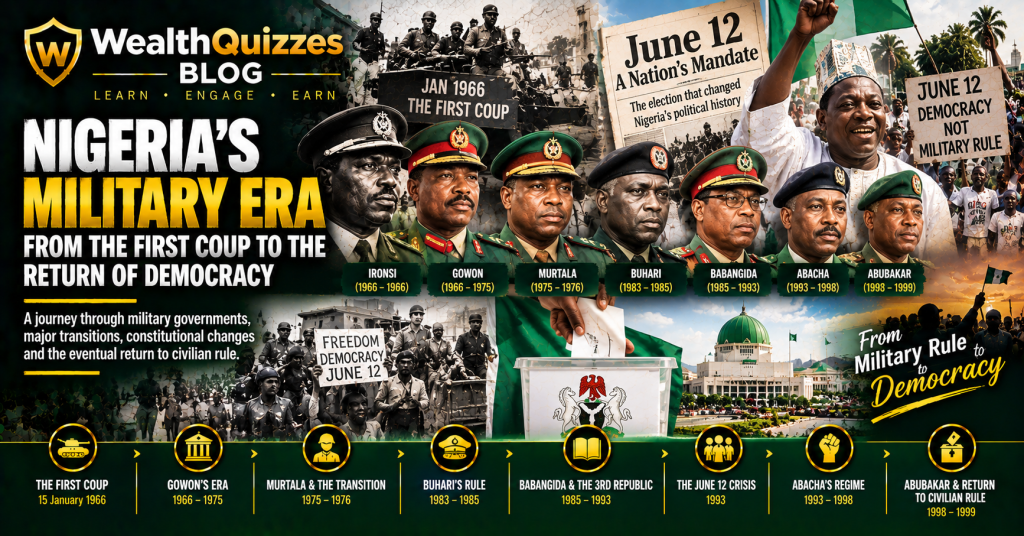
Nigeria had returned to military rule following the coup of 31 December 1983, which overthrew the Second Republic government of President Shehu Shagari. Major-General Muhammadu Buhari subsequently ruled until he was overthrown by General Ibrahim Babangida in August 1985.
Babangida presented himself as a reformer who would eventually return Nigeria to democratic government. In 1986, his administration announced a structured political transition programme.
The process involved extensive political and constitutional experimentation. A new electoral commission, the National Electoral Commission (NEC), was established, and political institutions were gradually reintroduced. According to electoral scholar Emmanuel Remi Aiyede, the transition involved attempts to reorient Nigerians towards democratic practices and introduced innovations in electoral administration and political organisation. (INEC Nigeria)
The process was nevertheless tightly controlled by the military.
The government restricted the number of political parties, regulated their formation and eventually authorised only two parties to contest the presidential election: the SDP and the NRC.
The arrangement was deliberately designed to prevent the proliferation of parties that had characterised the First Republic and, in the government’s view, contributed to political instability.
It was within this controlled transition that the June 12 election emerged.
The Two Presidential Candidates
The contest brought together two very different political figures.
Moshood Kashimawo Olawale Abiola, a wealthy businessman, publisher and philanthropist from Ogun State, contested on the platform of the Social Democratic Party.
His running mate was Baba Gana Kingibe, a prominent northern Muslim politician.
Their Muslim-Muslim ticket was controversial in some quarters, but it also demonstrated an important characteristic of the June 12 election: the presidential contest did not fit neatly into Nigeria’s traditional regional and religious political divisions.
The NRC candidate, Bashir Tofa, was a prominent businessman and politician from Kano. His running mate was Sylvester Ugoh, an Igbo Christian from the Southeast.
The electoral arrangement therefore produced an unusual political configuration. Abiola, a Yoruba Muslim from the Southwest, was running with a northern Muslim, while Tofa, a northern Muslim, had an Igbo Christian running mate.
More importantly, the campaign developed into a national contest.
June 12: Nigerians Go to the Polls
On Saturday, 12 June 1993, Nigerians voted.
The election was conducted using the electoral procedures established by NEC under Professor Humphrey Nwosu, including the controversial but innovative Option A4 open-ballot system.
The election was observed by Nigerian and international observers, journalists and civil society actors. INEC’s institutional history records that the NEC conducted the election and that it was widely acclaimed as free and fair. (INEC Nigeria)
Professor Humphrey Nwosu later published his own detailed account, Laying the Foundation for Nigeria’s Democracy, arguing that the election represented an important experiment in democratic legitimacy and that its annulment prevented the completion of the democratic process. (Google Books)
The emerging results indicated a decisive Abiola victory.
The figures subsequently circulated showed:
- M.K.O. Abiola (SDP): 8,341,309 votes — 58.36%
- Bashir Tofa (NRC): 5,952,087 votes — 41.64%
- Total votes: 14,293,396
The available results credited Abiola with victories in 19 of the 30 states, as well as the Federal Capital Territory. Tofa won 11 states. (Vanguard News)
Perhaps the most politically significant aspect of the result was its geographical spread.
Abiola was not simply winning his southwestern base. His support extended into other regions, including areas where ethnic and religious calculations had historically shaped presidential politics.
This is one reason June 12 became historically important: it offered evidence that a presidential candidate could potentially construct a cross-regional electoral coalition.
Falola and Heaton, in A History of Nigeria, describe Abiola as having won what has been widely regarded as one of the freest and fairest elections in Nigerian history. (Cambridge Assets)
The Results and the Legal Battle
The election’s aftermath became increasingly complicated.
Before NEC could complete the formal announcement of all results, litigation emerged over the election.
The Association for a Better Nigeria (ABN), led by Arthur Nzeribe, pursued legal action seeking to halt the process. Contemporary accounts and later scholarship describe the resulting litigation as one of the mechanisms through which the announcement of the results was interrupted. (The Guardian Nigeria)
NEC nevertheless continued processing the results until it was ordered to stop.
The legal controversy subsequently became intertwined with the military government’s own position.
Instead of allowing the electoral and judicial processes to run their course, the Federal Military Government intervened.
The Annulment
On 23 June 1993, the Federal Military Government announced that it had annulled the presidential election.
The government’s stated justification centred on concerns about litigation, the judiciary and the political consequences of allowing the process to continue. A contemporary account of the government’s statement records that the administration argued that it was taking steps to prevent the judiciary and legal system from being undermined by the disputes surrounding the election. (Vanguard News)
The government’s action effectively cancelled the electoral process.
The result was extraordinary.
Millions of Nigerians had voted, an electoral commission had conducted the election, results had been compiled and a clear leading candidate had emerged—yet the political authorities prevented the election from producing a president.
The annulment therefore transformed the central political question from “Who won the election?” to “Can the Nigerian people choose their government?”
That distinction became fundamental to the June 12 struggle.
The Crisis That Followed
The annulment produced widespread political resistance.
Political organisations, labour unions, professional associations, journalists, human-rights groups and civil society organisations mobilised against the military government.
The National Democratic Coalition (NADECO) subsequently became one of the most prominent platforms for opposition to military rule.
Journalists and activists faced arrest, harassment, censorship and intimidation.
Some activists went into exile.
Others remained in Nigeria and organised resistance despite the risks.
The crisis also generated strikes and economic disruption, particularly in Lagos and the Southwest.
The annulment therefore became much larger than Abiola’s personal political struggle.
It became a struggle over electoral legitimacy, civilian rule and constitutional government.
Pita Agbese of Cambridge’s African Issues argues that Babangida’s annulment brought Nigeria closer to the brink of a major political breakdown than any comparable crisis since the Civil War, while also demonstrating the military’s inability to engineer a durable transition to democracy. (Cambridge University Press)
Babangida “Steps Aside”
The crisis eventually became unsustainable for Babangida.
On 27 August 1993, he stepped aside and transferred authority to an Interim National Government headed by Chief Ernest Shonekan. (Cambridge Assets)
The arrangement did not resolve the crisis.
Instead, it created another constitutional and political uncertainty because the Interim National Government itself lacked the democratic legitimacy that June 12 had come to represent.
On 17 November 1993, General Sani Abacha overthrew the Interim National Government.
Nigeria consequently entered another phase of military dictatorship.
Abacha and the June 12 Struggle
Abacha’s government refused to recognise the June 12 mandate.
Abiola declared himself the rightful president in 1994 after demanding that the military government recognise the election result.
He was subsequently arrested and imprisoned.
His struggle continued from detention.
Meanwhile, the pro-democracy movement intensified.
The death of Kudirat Abiola, who had become an important public voice in support of her husband’s mandate, shocked the country. Several other activists and journalists were killed, detained or forced into exile during the struggle against military rule.
The June 12 crisis consequently became intertwined with a broader Nigerian struggle for civil liberties.
The Death of Abiola
One of the most dramatic developments occurred in July 1998.
General Abacha had died suddenly on 8 June 1998, and General Abdulsalami Abubakar succeeded him.
Abubakar initiated a rapid transition to civilian government and released many political detainees.
M.K.O. Abiola remained central to the unresolved June 12 question.
However, on 7 July 1998, Abiola died while still in government custody, shortly after meeting a delegation of American and United Nations officials.
His death removed the individual around whom the political dispute had been concentrated, but it did not erase the historical significance of the election.
Cambridge’s account of Nigeria’s transition to the Fourth Republic notes that Abiola’s death considerably changed the political calculations surrounding the June 12 mandate and the transition programme. (Cambridge University Press)
June 12 and the Birth of the Fourth Republic
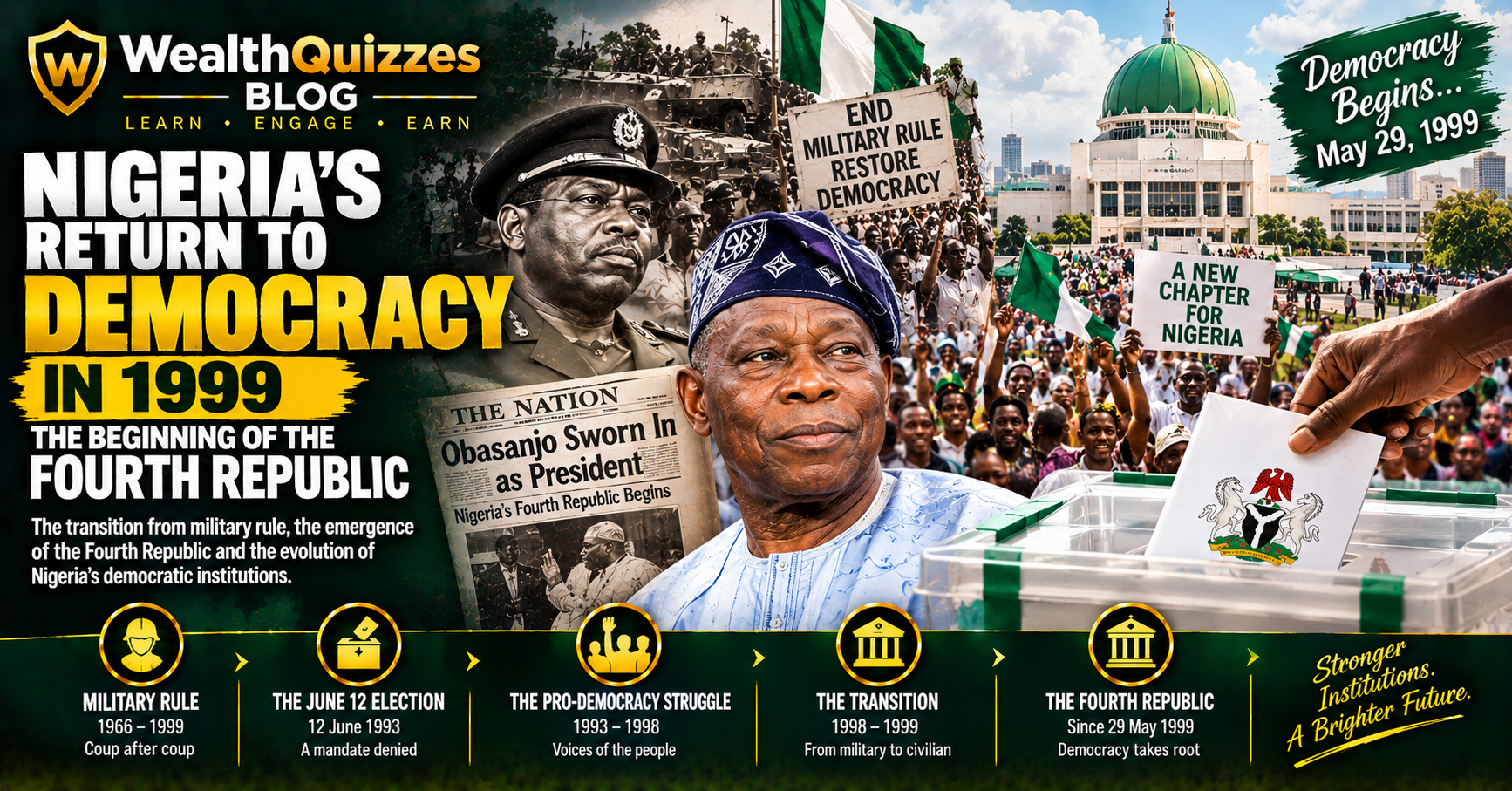
The military subsequently organised elections that culminated in the inauguration of Olusegun Obasanjo as president on 29 May 1999.
Nigeria entered the Fourth Republic.
Yet June 12 remained unresolved in an important symbolic sense.
For years, successive governments avoided formally recognising Abiola as the winner of the 1993 election.
That changed in 2018.
President Muhammadu Buhari’s administration formally recognised June 12 as Nigeria’s Democracy Day and posthumously recognised M.K.O. Abiola as the winner of the election, with Baba Gana Kingibe recognised as his running mate. Buhari described the decision as an attempt to “put right a national wrong” and formally apologised to Abiola’s family and those who lost their lives during the June 12 struggle. (State House Abuja)
The national holiday was subsequently moved from 29 May to 12 June.
The change was more than a change of date.
It represented an official reinterpretation of Nigerian democratic history.
Why June 12 Matters
June 12 occupies a special place in Nigeria’s political history for several reasons.
It demonstrated the possibility of cross-regional politics
The election showed that electoral support could cross traditional ethnic, regional and religious boundaries.
Abiola’s ticket was particularly significant because his running mate, Kingibe, was a northern Muslim. His reported victories across multiple regions reinforced the possibility of a national electoral coalition.
It exposed the vulnerability of electoral legitimacy
The election demonstrated that even a broadly accepted electoral process could be overturned when political authority was not subordinate to constitutional rules.
It transformed civil society
The annulment produced one of Nigeria’s strongest pro-democracy movements.
Lawyers, journalists, labour activists, students, academics, religious leaders and human-rights organisations participated in the struggle.
It contributed to the eventual end of military rule
Aiyede’s study of Nigeria’s transition notes that the annulment reversed significant democratic gains achieved during the Babangida transition and triggered the political crisis that ultimately contributed to the collapse of the transition process. (INEC Nigeria)
It became a symbol of democratic sacrifice
The June 12 struggle produced imprisonment, exile, economic hardship and deaths.
For that reason, later governments have increasingly presented June 12 not simply as an aborted election but as part of the struggle through which Nigerians demanded civilian government.
The Enduring Historical Debate
June 12 is nevertheless not without historical complexity.
The election occurred within a military-controlled transition programme. Political parties were created and regulated by decree, and the electoral process operated within a constitutional framework designed by the military.
The claim that it was the “freest and fairest election” in Nigerian history is widely repeated and is reflected in the accounts of Falola and Heaton and the official historical account maintained by INEC. (Cambridge Assets)
Nevertheless, the formal result was never constitutionally completed through an official presidential declaration before the annulment.
That distinction matters historically.
It is therefore more precise to say that the available NEC results and subsequent historical scholarship establish Abiola as the clear electoral leader, while the Federal Government prevented the election from reaching its constitutional conclusion.
That formulation recognises both the historical evidence and the unusual procedural circumstances surrounding the election.
Conclusion
June 12, 1993 was much more than an election date.
It was the point at which Nigeria’s long struggle between military authority and democratic legitimacy became impossible to ignore.
Millions of Nigerians voted.
A clear result emerged.
The military government annulled the election.
The annulment triggered protests, strikes, repression and political crisis. It contributed to the collapse of Babangida’s transition programme, the rise of Abacha, the imprisonment and eventual death of M.K.O. Abiola, and a prolonged pro-democracy struggle.
Yet the story did not end there.
The sacrifices of the June 12 movement became part of the political foundation upon which the Fourth Republic was eventually built in 1999.
The decision in 2018 to recognise June 12 as Democracy Day and formally acknowledge Abiola and Kingibe as the elected president and vice president of 1993 gave the episode an official place in Nigeria’s democratic narrative. (State House Abuja)
Perhaps the deepest lesson of June 12 is therefore straightforward:
An election is not meaningful merely because citizens are allowed to vote. Its true value lies in whether the votes are respected, the rules are obeyed and political power is transferred according to the will of the electorate.
June 12 remains Nigeria’s enduring reminder that democracy is not simply the act of voting; it is the protection of the people’s mandate after they have voted.