Nigeria’s National Symbols Through History: The Flag, Coat of Arms, Anthem and National Identity
How Nigeria’s symbols evolved and what they represent about the country’s history and identity
Every country has symbols through which it presents itself to its citizens and to the wider world. A flag can represent sovereignty; a coat of arms can compress history, geography and political ideals into a single image; and a national anthem can turn ideas about citizenship, unity and collective destiny into words and music.
For Nigeria, these symbols carry an especially complex significance. Nigeria is a country of hundreds of ethnic communities, numerous languages, different religious traditions and political histories that predate the modern state by centuries. The national symbols were therefore created, adopted and repeatedly reinterpreted against the difficult background of colonialism, independence, military rule, civil war, regional competition and democratic reconstruction.
Political theorist Benedict Anderson, in his influential work Imagined Communities, argued that nations are sustained partly through shared cultural representations that enable people who will never meet most of their fellow citizens to imagine themselves as members of the same political community. (Google Books)
Historian Eric Hobsbawm similarly examined how national rituals and symbols help construct and reinforce collective identity. His work on nationalism specifically considered the political importance of flags, anthems and national emblems. (Cambridge University Press)
Nigeria provides a particularly interesting example of this process. Its national symbols are not merely decorative objects. They represent an ongoing attempt to transform an extraordinarily diverse population into a recognisable national community.
The Nigerian Flag: A Symbol Born on the Road to Independence
The Nigerian flag is arguably the country’s most immediately recognisable national symbol.
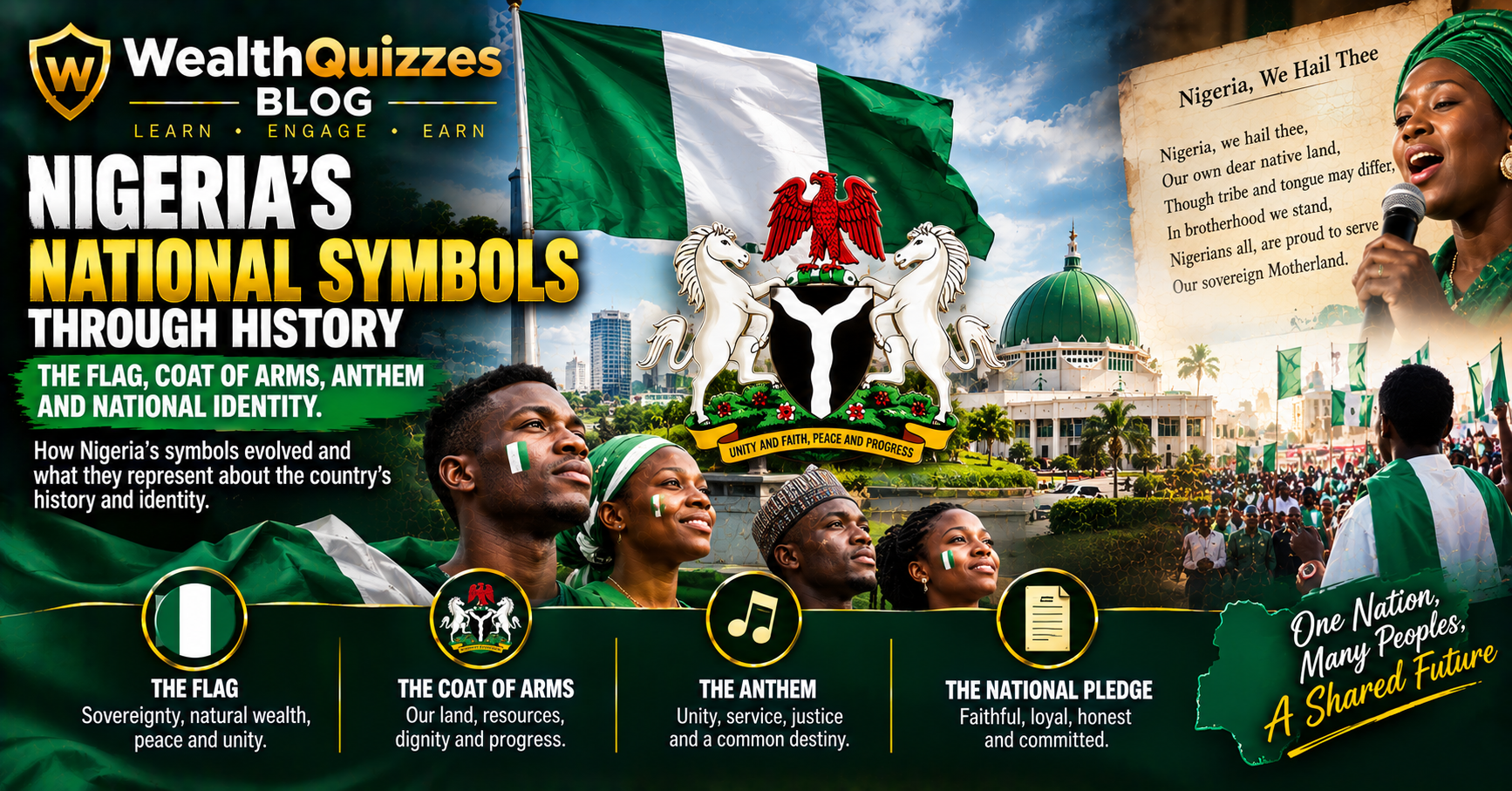
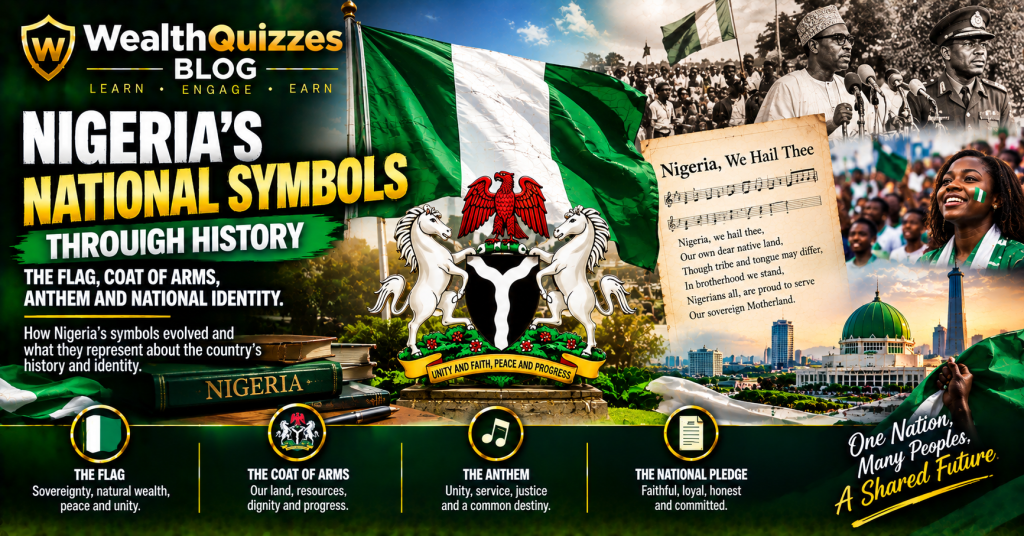
Its familiar design consists of three equal vertical bands: green, white and green. The design was created in 1959 by Michael Taiwo Akinkunmi, then a young Nigerian student in London, who entered a national competition for a proposed Nigerian flag. His design was selected, although elements of the original proposal were subsequently modified. The flag was first officially hoisted on 1 October 1960, when Nigeria became independent. (Nigeria Embassy USA)
The symbolism commonly attached to the colours is straightforward but significant. The green represents Nigeria’s natural wealth and agricultural resources, while white represents peace and unity. Nigeria’s Ministry of Foreign Affairs presents the flag as one of the country’s principal national symbols. (Ministry of Foreign Affairs)
The historical timing of the flag is important.
It was not created centuries ago and inherited unchanged from a precolonial Nigerian civilisation. Rather, it emerged during the final phase of the nationalist struggle for independence. It therefore belongs to the political birth of modern Nigeria.
The green-and-white flag had to perform a difficult symbolic task: to represent a country whose constituent communities had never previously existed as one sovereign nation-state.
In that sense, the flag represents both difference and unity.
Its two green panels can be read as a visual expression of Nigeria’s physical and economic resources, while the central white field offers an image of peace and coexistence. The design is remarkably simple, allowing it to function equally well at government buildings, schools, sporting events, diplomatic missions and international ceremonies.
As scholars of national identity have observed, symbols become powerful partly because their meanings can be shared across otherwise very different communities. (University of Jos Journals)
That explains why the Nigerian flag can appear simultaneously in contexts of government authority, national celebration, sporting competition, protest and public mourning.
The Coat of Arms: Nigeria’s Geography and Ideals in One Image
If the flag is Nigeria’s most accessible symbol, the Coat of Arms is arguably its most concentrated historical statement.
Nigeria’s Coat of Arms was created and adopted in 1960, shortly before independence. It contains a number of elements intended to represent different aspects of the country. (Nigeria Embassy USA)
At its centre is a black shield crossed by a white Y-shaped feature, or pall.
The white Y represents the confluence of the River Niger and River Benue at Lokoja. This is symbolically important because the two great river systems are among the most significant geographical features connecting different parts of Nigeria.
The black shield is officially associated with Nigeria’s fertile soil. Two white horses support the shield, representing dignity, while an eagle above the shield represents strength. At the base is the yellow flower Costus spectabilis, Nigeria’s national flower. Beneath the emblem appears the national motto:
“Unity and Faith, Peace and Progress.” (Nigeria Embassy USA)
The Coat of Arms consequently operates on several levels.
It is geographical because the Niger and Benue are represented. It is economic because fertile soil and natural resources are invoked. It is aspirational because dignity, strength, unity, peace and progress are incorporated into the design.
Most importantly, it presents Nigeria not merely as territory but as a political community with a stated set of ideals.
The Nigerian Constitution itself reinforces this connection. Section 15 identifies the national motto as “Unity and Faith, Peace and Progress” and provides that national integration should be actively encouraged while discrimination based on ethnic, linguistic, religious and other affiliations is prohibited. (SCCR)
Thus, the Coat of Arms and the Constitution speak to each other: the emblem expresses the aspiration symbolically, while the Constitution articulates it institutionally.
The National Anthem: From Independence to the Fourth Republic
Perhaps no Nigerian national symbol has undergone a more revealing transformation than the national anthem.
At independence in 1960, Nigeria adopted “Nigeria, We Hail Thee.” The lyrics were written by Lillian Jean Williams, a British expatriate living in Nigeria, while the music was composed by Frances Berda. The anthem was used from independence until 1978. (Radio Nigeria Kaduna)
Its language reflected the aspirations of a newly independent state.
The opening stanza explicitly acknowledges Nigeria’s diversity while calling Nigerians to stand together:
“Though tribe and tongue may differ”
That formulation is historically significant. It recognised a basic reality of the Nigerian state: its citizens belonged to numerous ethnic and linguistic communities.
The anthem’s second stanza elevated the national flag as a symbol of truth and justice, while the third called upon God to help build a nation “where no man is oppressed.” The official Ministry of Foreign Affairs continues to reproduce these themes in its presentation of the national anthem. (Ministry of Foreign Affairs)
But in 1978, during the military era, “Nigeria, We Hail Thee” was replaced by “Arise, O Compatriots.”
The replacement represented a different historical moment.
“Arise, O Compatriots” placed greater emphasis on service, sacrifice, freedom, peace, unity and the labour of previous generations. Its lyrics were assembled from entries submitted during a national competition, with contributions from five Nigerians, and the music was arranged by the Nigerian Police Band under the direction of Benedict E. Odiase. (Wikipedia)
The change was therefore not merely musical. It reflected the changing political context of Nigeria after the civil war and during military government.
The 2024 Return of “Nigeria, We Hail Thee”
On 29 May 2024, Nigeria formally reinstated its first national anthem, “Nigeria, We Hail Thee,” replacing “Arise, O Compatriots.”
The National Assembly passed the legislation and President Bola Ahmed Tinubu assented to it. (Radio Nigeria Kaduna)
The decision generated considerable public discussion because it transformed an old anthem into a contemporary national symbol.
Supporters of the change pointed to the historical significance of restoring the anthem associated with independence. Critics and commentators, meanwhile, debated whether the change was sufficient to address the country’s deeper challenges of national cohesion and governance.
Academic studies published since the reinstatement have treated the anthem as more than a patriotic song. Emmanuel Jolaolu Adegbenro and Abosede Grace Mayadenu, for example, analyse it as a socio-pragmatic text whose language communicates ideas of national identity, unity and civic duty. (jcolang.uobaghdad.edu.iq)
Similarly, a 2026 comparative study by Samuel Oyeyemi Agbeleoba, Rotimi Adewusi and Olufemi Adeosun argues that Nigeria’s two anthems reflect different historical moments and different rhetorical visions of the nation. Their analysis identifies “Nigeria, We Hail Thee” with themes of hopeful idealism and unity in diversity, while “Arise, O Compatriots” places greater emphasis on urgency, sacrifice and collective action. (AB Journals)
The return of the old anthem therefore demonstrates something important about national symbols: their meanings can change without the symbols themselves changing.
The words written in the late colonial period can acquire new significance when sung by citizens living in a very different Nigeria.
National Identity: Beyond Ethnicity and Region
The central challenge facing Nigerian national symbols is the same challenge that has confronted the Nigerian state since independence: how to create a sense of common belonging without erasing the country’s extraordinary diversity.
The Nigerian national identity has never completely replaced ethnic, regional, religious or local identities. Rather, Nigerian identity exists alongside them.
This is why the wording of “Nigeria, We Hail Thee” is particularly revealing. Its reference to differences of “tribe and tongue” acknowledges diversity while proposing brotherhood as the political relationship capable of connecting those differences. (Ministry of Foreign Affairs)
The flag makes a similar proposition visually: two green fields separated by a common white centre.
The Coat of Arms does it geographically: the Niger and Benue, flowing through different parts of the country, meet at Lokoja.
The motto does it politically: Unity and Faith, Peace and Progress.
Taken together, the symbols tell a consistent story.
Nigeria is diverse, but diversity is not supposed to prevent common citizenship.
Symbols as Living History
National symbols are sometimes treated as fixed objects whose meanings were permanently determined at independence. History suggests something more complicated.
A 2026 study by Oluwatobiloba Oye-Oluwafemi, Mobolanle Ebunoluwa Sotunsa and Paula Ibukun Idowu argues that national symbols in postcolonial Africa function as dynamic sites where power, identity, memory and popular imagination intersect. Citizens can reinterpret symbols through public ceremonies, protest, art and contemporary culture. (University of Jos Journals)
Nigeria’s history demonstrates this particularly well.
The flag designed in 1959 has been carried through independence, civil war, military coups, democratic transitions, international sporting competitions and national celebrations.
The Coat of Arms created at independence continues to appear on official documents, currency-related institutions, government buildings and state communications.
The anthem has changed and then returned.
These developments show that national identity is not a finished product.
It is continually negotiated.
The National Pledge and the Everyday Performance of Citizenship
Although the flag, Coat of Arms and anthem receive the greatest attention, the National Pledge is another important part of Nigeria’s symbolic framework.
Its language is deliberately civic. It asks citizens to be faithful, loyal and honest; to serve Nigeria; to defend its unity; and to uphold its honour and glory. The official Ministry of Foreign Affairs reproduces the pledge alongside the anthem and Coat of Arms. (Ministry of Foreign Affairs)
The pledge illustrates a crucial distinction between national symbolism and mere decoration.
A flag tells citizens who they are supposed to belong to.
A Coat of Arms communicates what the state says it represents.
An anthem expresses what citizens are invited to believe and aspire toward.
A pledge goes further by asking what citizens themselves should do.
Together, they create a symbolic language of citizenship.
What Nigeria’s Symbols Ultimately Represent
Viewed historically, Nigeria’s national symbols tell a story much larger than their individual designs.
The flag represents sovereignty, natural wealth, peace and the creation of a common national identity at independence.
The Coat of Arms brings together geography, natural resources, dignity, strength and the political ideals of unity, faith, peace and progress.
The anthem reveals how Nigeria’s conception of nationhood has evolved—from the optimism of independence, through the more urgent language of the military era, to the 2024 restoration of the original anthem and its renewed emphasis on brotherhood, service, justice and freedom from oppression.
The pledge translates national ideals into expectations of citizenship.
But perhaps the deepest lesson is that symbols do not automatically create national unity.
They provide a language through which unity can be imagined and pursued.
Benedict Anderson’s conception of the nation as an imagined community helps explain why millions of Nigerians can feel connected to strangers through a flag, anthem or shared national ceremony. Hobsbawm’s work similarly reminds us that national rituals acquire their power through repetition, public performance and the emotional meanings attached to them. (Google Books)
Nigeria’s symbols consequently represent both an achievement and an unfinished project.
They embody the country’s aspiration to become one political community without denying the many communities from which Nigeria was formed.
Conclusion
Nigeria’s national symbols are visual, verbal and ceremonial records of the country’s journey.
The green-white-green flag emerged on the eve of independence. The Coat of Arms was created as the new sovereign state sought an official visual language. “Nigeria, We Hail Thee” gave musical expression to the aspirations of 1960. “Arise, O Compatriots” reflected another historical period and remained in use for 46 years. Its replacement in 2024 with the original anthem demonstrated that even national symbols can return to the centre of public debate when a country reassesses its history and identity. (Radio Nigeria Kaduna)
Ultimately, these symbols represent an idea that remains central to Nigeria’s history: many peoples attempting to build one nation.
Their deepest meaning is therefore not found merely in the colours of a flag, the figures on a shield or the words of an anthem. It lies in the national ideals those symbols repeatedly ask Nigerians to pursue—unity, dignity, peace, justice, service, brotherhood and progress.
Whether those ideals are fully realised is a matter of history still being written.
But every time the Nigerian flag is raised, the Coat of Arms is displayed, the national anthem is sung or the pledge is recited, the country is symbolically reminded of the same unfinished task: transforming the idea of Nigeria into a shared and enduring national identity.