
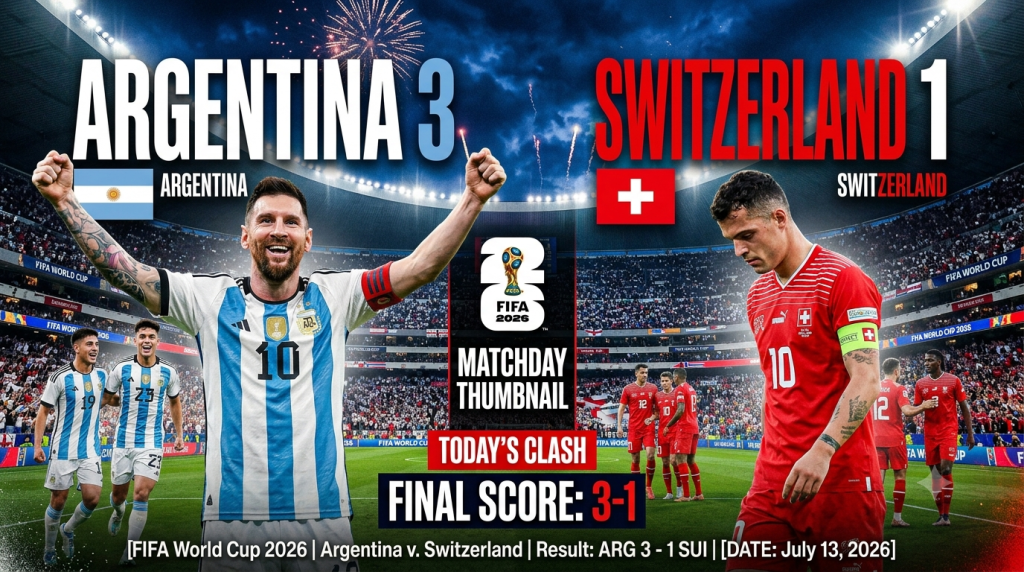
Argentina 3–1 Switzerland (AET): Messi the Creator, Álvarez the Hero as Defending Champions Reach the FIFA World Cup 2026 Semi-Finals
Mac Allister, Julián Álvarez and Lautaro Martínez seal a hard-fought victory after extra time as Argentina overcome resilient Switzerland to keep their title defence alive
The FIFA World Cup has a unique way of reminding the footballing world that championships are not won solely by brilliance, but by resilience. Every champion eventually reaches a point where individual genius alone is insufficient and collective determination becomes the defining characteristic. Argentina’s dramatic 3–1 extra-time victory over Switzerland in the quarter-finals of the FIFA World Cup 2026 was precisely that kind of match. It was not a display of effortless dominance from the defending champions. Instead, it was a stern examination of their mentality, patience and tactical discipline against a Swiss side that refused to surrender until circumstances eventually turned against them.
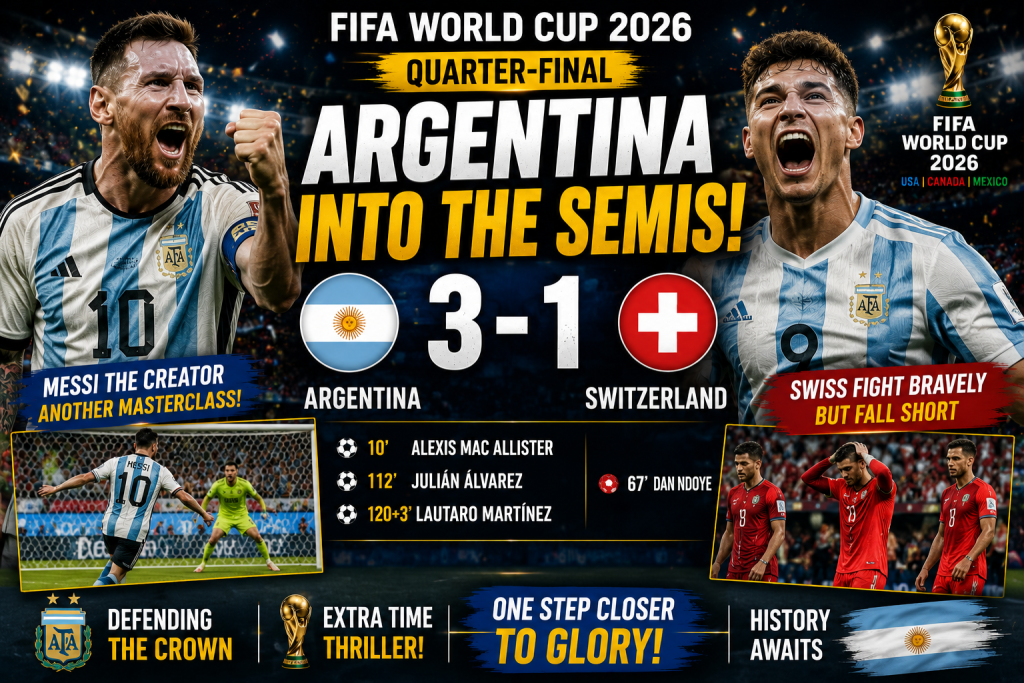
For the first time in this tournament, Lionel Messi did not score. Yet, paradoxically, this may have been one of his most influential performances of the competition. Rather than deciding the match through goals, the Argentine captain orchestrated attacks, dictated tempo and produced the decisive assist that set Argentina on their way. Goals from Alexis Mac Allister, Julián Álvarez and Lautaro Martínez ultimately secured a 3–1 victory after extra time, while Dan Ndoye’s second-half equaliser briefly threatened to derail Argentina’s dream of retaining the World Cup. Reuters reported that Switzerland’s challenge became significantly harder after Breel Embolo’s controversial red card following a VAR review, allowing Argentina to capitalise during extra time and book a blockbuster semi-final against England.
The victory keeps alive Argentina’s quest to become the first nation since Brazil in 1962 to successfully defend the FIFA World Cup, an achievement that would further cement this generation among football’s greatest international teams.
Switzerland Arrived With a Clear Tactical Plan
Long before kickoff in Kansas City, Switzerland understood the size of their challenge.
Argentina entered the quarter-final as defending world champions, unbeaten throughout the tournament and led by arguably the greatest footballer in history. Switzerland, however, have built an international reputation as one of Europe’s most tactically disciplined teams. Their approach was predictable in the best possible sense: remain compact, frustrate Argentina’s creative players, deny Lionel Messi space between the lines and attack selectively through quick transitions.
Before the match, Reuters observed that Switzerland intended to rely on their disciplined defensive structure in an effort to neutralise Messi and force Argentina into uncomfortable territory.
For much of normal time, that strategy worked remarkably well.
Rather than allowing Argentina to dominate freely, Switzerland compressed central areas and forced the South Americans into wider positions. Gregor Kobel organised his defence impressively, while Granit Xhaka controlled the midfield with his usual intelligence and composure.
It became increasingly clear that this would not be another comfortable Argentine victory.
Alexis Mac Allister Opened the Door
Argentina nevertheless found the breakthrough early in the contest.
In the 10th minute, Alexis Mac Allister rose superbly to head home from a Lionel Messi corner, rewarding Argentina’s early territorial dominance and giving the defending champions the ideal start. Reuters confirmed that Mac Allister’s opener came directly from Messi’s delivery, illustrating once again the captain’s extraordinary creative influence even without finding the scoresheet himself.
Mac Allister’s importance throughout the tournament continues to grow.
The Liverpool midfielder has become one of Lionel Scaloni’s most reliable performers, combining intelligent positioning, accurate distribution and a remarkable ability to arrive in dangerous attacking positions. His goal against Switzerland perfectly reflected those qualities.
Rather than relying exclusively on Argentina’s forwards, Scaloni has consistently encouraged midfield runners to support attacks, making his team significantly less predictable than many opponents anticipate.
Switzerland Refused to Collapse
If Argentina expected the early goal to simplify the contest, Switzerland quickly demonstrated otherwise.
Instead of abandoning their structure, Murat Yakin’s side remained calm.
They continued circulating possession intelligently whenever opportunities emerged while maintaining excellent defensive organisation.
Their patience was rewarded midway through the second half.
Dan Ndoye equalised in the 67th minute following one of Switzerland’s most effective attacking sequences, silencing the Argentine supporters and suddenly transforming the emotional landscape of the match. Reuters described the equaliser as a deserved reward for Switzerland’s persistence after they had frustrated Argentina for much of the contest.
At 1–1, the defending champions looked vulnerable.
The possibility of another major World Cup upset suddenly became very real.
The Turning Point: Embolo’s Red Card
Every major tournament contains moments that redefine entire matches.
For Argentina versus Switzerland, that moment arrived just five minutes after the equaliser.
Swiss striker Breel Embolo received a red card following a VAR review after an incident that generated immediate controversy across the football world. Reuters reported that the dismissal followed a review for simulation, leaving Switzerland to complete the remainder of the match with ten players.
Swiss coach Murat Yakin later expressed frustration with the decision, believing the dismissal fundamentally altered the balance of the contest.
Playing against Argentina with ten men for the remainder of normal time and the entirety of extra time represented an enormous challenge.
Yet Switzerland continued defending courageously.
Their resilience deserves enormous respect.
Messi Proved Greatness Is About More Than Goals
One of the biggest talking points before the match centred on Lionel Messi’s extraordinary scoring streak.
The Argentine captain had scored in nine consecutive World Cup matches and entered the quarter-final among the tournament’s leading scorers.
Against Switzerland, however, that remarkable run came to an end.
Yet reducing Messi’s performance to the absence of a goal would completely misunderstand his influence.
Former Barcelona manager Pep Guardiola once observed that the greatest footballers are those who control matches even when they do not score.
Messi embodied that principle perfectly.
He consistently dropped deeper to dictate Argentina’s rhythm, drew multiple Swiss defenders toward him, and repeatedly created opportunities for teammates.
His assist from the corner for Mac Allister’s opener demonstrated his enduring creative brilliance.
Later, during extra time, his powerful effort forced goalkeeper Gregor Kobel into an outstanding save before the rebound eventually led to Julián Álvarez’s decisive goal. Reuters noted that although Messi’s scoring streak ended, his influence remained central to Argentina’s victory.
Statistics often celebrate goals.
Football history, however, remembers influence.
Messi provided exactly that.
Julián Álvarez Delivered the Defining Moment
World Cup quarter-finals frequently require unexpected heroes.
For Argentina, that hero was Julián Álvarez.
After over one hundred minutes of relentless football, the Manchester City striker produced the moment that finally broke Swiss resistance.
Receiving possession outside the penalty area after Messi’s initial effort had been parried away, Álvarez unleashed a magnificent long-range strike into the corner of the net in the 112th minute.
Reuters described the goal as a stunning finish that ultimately separated the two teams after a fiercely contested encounter.
Sky Sports similarly characterised Álvarez’s strike as the decisive turning point that booked Argentina’s place in the semi-finals.
Championship teams consistently require players capable of producing extraordinary moments under immense pressure.
Álvarez once again proved he belongs among football’s elite finishers.
Lautaro Martínez Applied the Final Touch
With Switzerland forced to chase the match despite their numerical disadvantage, spaces inevitably began appearing across the pitch.
Argentina exploited them ruthlessly.
Deep into stoppage time of extra time, Lautaro Martínez scored Argentina’s third goal, finally ending any lingering Swiss hopes.
The Inter Milan striker has repeatedly demonstrated his value throughout Lionel Scaloni’s tenure, not only as a prolific goalscorer but also as a relentless worker capable of pressing defenders and stretching defensive lines.
His late goal reflected Argentina’s superior depth and physical endurance.
Championship-winning squads rarely depend on a single attacking threat.
Argentina possess several.
Emiliano Martínez Quietly Did His Job Again
Although much attention inevitably focused on Messi, Mac Allister and Álvarez, goalkeeper Emiliano Martínez once again demonstrated why he remains one of the world’s finest tournament goalkeepers.
His positioning throughout the evening was exceptional.
Whenever Switzerland managed to bypass Argentina’s defence, Martínez remained calm and decisive.
Football analysts have repeatedly observed that elite goalkeepers often influence matches through decisions supporters barely notice.
Choosing the correct angle.
Remaining patient during one-on-one situations.
Organising defenders.
Martínez continues performing these responsibilities with remarkable consistency.
According to post-match assessments, his key interventions preserved Argentina’s belief during Switzerland’s strongest spell before extra time ultimately shifted the contest in Argentina’s favour.
Lionel Scaloni’s Team Continues to Show Championship Character
One recurring theme throughout Argentina’s World Cup campaign has been their ability to survive difficult moments.
The defending champions have not enjoyed an easy knockout journey.
They required a dramatic comeback against Egypt in the Round of 16 before enduring another gruelling examination against Switzerland.
Yet each challenge has strengthened rather than weakened them.
After the match, Lionel Scaloni acknowledged that Argentina had struggled but praised his players for finding solutions under pressure and continuing their pursuit of another World Cup title.
Former Manchester United manager Sir Alex Ferguson often remarked that champions are defined not by perfection but by their response to adversity.
Argentina continue validating that philosophy.
Switzerland Leave With Pride
Although Switzerland depart the tournament disappointed, their performance deserves widespread admiration.
They matched the defending champions for long periods.
They frustrated one of football’s greatest attacks.
They refused to surrender despite playing with ten men.
This was Switzerland’s first World Cup quarter-final appearance since 1954, making their achievement significant regardless of the result.
Their disciplined approach once again demonstrated why they remain one of Europe’s most respected international teams.
For Murat Yakin and his players, there is disappointment today.
There should also be pride.
England Awaits
Argentina’s reward is a mouth-watering semi-final against England.
The fixture revives one of international football’s most historic rivalries, recalling unforgettable World Cup meetings in 1966, 1986, 1998 and beyond.
Reuters confirmed that the defending champions will now face England in Atlanta for a place in the FIFA World Cup 2026 Final.
With France and Spain contesting the other semi-final, the tournament has now reached a stage where every remaining nation possesses genuine championship credentials.
Conclusion
Argentina’s 3–1 extra-time victory over Switzerland was not simply another knockout success.
It was a demonstration of resilience, tactical intelligence and collective strength.
Lionel Messi may not have scored, but he orchestrated the match with the authority that only football’s greatest players possess.
Alexis Mac Allister delivered the early breakthrough.
Julián Álvarez produced the defining moment.
Lautaro Martínez sealed the victory.
Switzerland departed with honour after pushing the defending champions to their limits despite eventually being reduced to ten men.
For Argentina, however, the dream continues.
The reigning world champions remain only two victories away from defending their crown.
If this dramatic quarter-final proved anything, it is that champions are not always those who dominate every match.
More often, they are those who find a way to win when the path to victory is at its most difficult.