
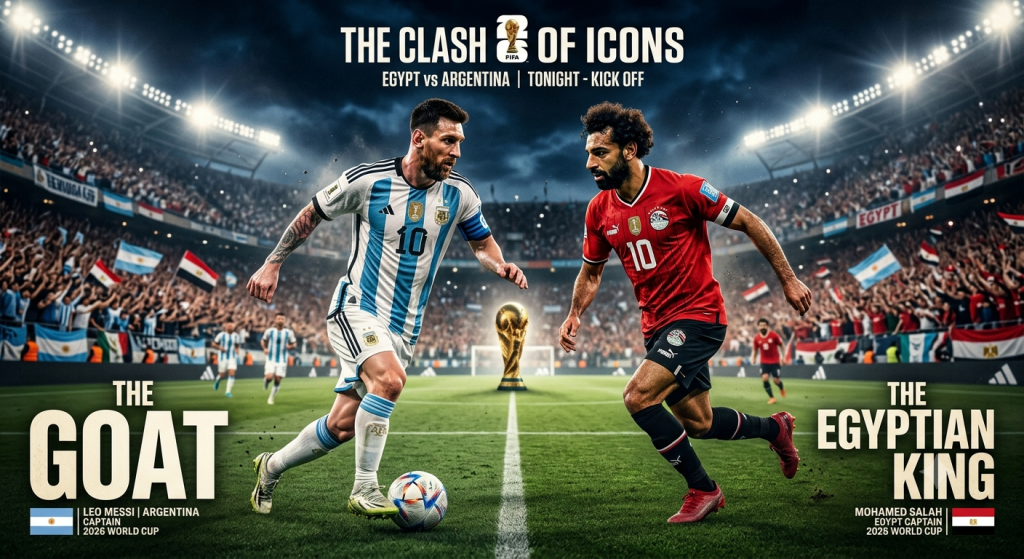
Argentina 3–2 Egypt: Why Lionel Messi Is Still Football’s GOAT
How Messi Turned a World Cup Crisis Into Another Masterclass of Greatness
For seventy-eight minutes in Atlanta, Argentina looked like a team on the brink of one of the most damaging exits of the FIFA World Cup 2026. Egypt were organised, brave and dangerous. Mohamed Salah’s side had already shown throughout the tournament that they were not in the United States merely to participate, and on Tuesday they pushed the reigning world champions to the edge. At one point Argentina trailed 2–0. Their defending looked uncertain, their buildup lacked rhythm, and the weight of expectation that comes with being world champions seemed to be turning into panic. Then Lionel Messi happened again.
By full time, Argentina had completed a staggering 3–2 comeback to eliminate Egypt and reach the quarter-finals. The late surge was dramatic in itself, but the match became something bigger than a simple knockout win because it once again placed Messi at the centre of football’s most persistent argument: what truly makes a player the greatest of all time? This was not a match in which Messi dazzled from the opening whistle. It was more revealing than that. It was a match in which Argentina were wobbling, the tournament was slipping away, and the 39-year-old captain still found the authority, composure and decisive quality to drag his team back from the brink. Reports from live match coverage and post-match summaries confirm the key sequence: Egypt led through Yasser Ibrahim and Mostafa Zico, before Argentina stormed back late with goals from Cristian Romero, Messi and Enzo Fernández to win 3–2 in one of the wildest matches of the knockout phase so far.
That comeback matters because it was not merely about qualification. It was about legacy under pressure. If the GOAT debate is really a debate about who best combines talent, longevity, influence, consistency and the ability to define football’s biggest moments, then Argentina’s escape against Egypt offered another piece of evidence in Messi’s favour. The match did not make him the greatest player of all time; for many, that case was already made years ago. What it did was reinforce why the argument refuses to die even in the late stages of his career. Messi still has the ability to bend a match, a tournament and even a national emotional state around himself.
A Match That Looked Like It Was Slipping Away
Before the heroic comeback, there was a very real possibility of Argentine collapse. Egypt began with the courage of a side that had already broken one barrier by reaching the knockout rounds and now believed a second barrier was possible. They were not intimidated by the shirt, the occasion or the opponent. Hossam Hassan’s team pressed with discipline, attacked with conviction, and understood that Argentina had not looked invulnerable in the previous round against Cape Verde. Reuters had already noted before kick-off that Lionel Scaloni’s side were approaching Egypt with caution after that scare, and with good reason. Argentina had begun to show signs of vulnerability at exactly the stage where champions are usually expected to tighten up.
Egypt exploited that uncertainty brilliantly. Their opening goal, credited to Yasser Ibrahim, gave them belief and forced Argentina into a more nervous rhythm. When Mostafa Zico doubled the lead in the 67th minute, the game had turned into one of the stories of the tournament. Suddenly the defending champions were staring at elimination. Egypt, led by the intelligence and composure of Mohamed Salah, were not just surviving; they were threatening to produce one of the World Cup’s most memorable shocks.
This is the context in which Messi’s performance must be judged. Greatness is not only about dominating matches that unfold comfortably. It is about what happens when the script breaks, when the team loses control, when the opponent believes, and when the margin for error disappears. That was the environment in which Messi operated on Tuesday.
Messi’s GOAT Case Has Never Been Only About Numbers
Football’s greatest-player debates often become simplistic because they are reduced to goals, trophies and highlight reels. Those things matter, of course. Messi’s statistical record is already overwhelming: world titles, continental titles, domestic league titles, Champions League triumphs, Ballon d’Or awards, goals, assists, records for Argentina, and a catalogue of moments that have defined the modern game. But the reason many analysts, former players and coaches place him at the summit is not merely because of quantity. It is because of the nature of his influence.
Former Arsenal manager Arsène Wenger has described Messi as a player with “genius” in both creation and finishing, someone whose understanding of space and timing elevates not just his own game but the collective structure of his team. Pep Guardiola, who coached Messi at FC Barcelona, has repeatedly argued that Messi sees the game differently from other players, understanding where the next action will happen before everyone else does. Jorge Valdano, one of Argentina’s great football thinkers, has often framed Messi’s greatness not just in terms of technical brilliance but in terms of his capacity to carry the emotional burden of a nation without losing his footballing intelligence. Those observations matter because they point to something the Egypt match illustrated vividly: Messi’s greatness is not just what he does with the ball. It is what his presence does to the entire game.
Against Egypt, Argentina looked emotionally frayed until the comeback began. Then Messi took over the temperature of the contest. That is not a mystical claim. It is a footballing one. He began to demand the ball in more dangerous zones. He accelerated the rhythm of Argentina’s attacks. He made Egypt’s defenders retreat a few yards deeper because they knew one mistimed step could end them. And when the opportunity came, he scored.
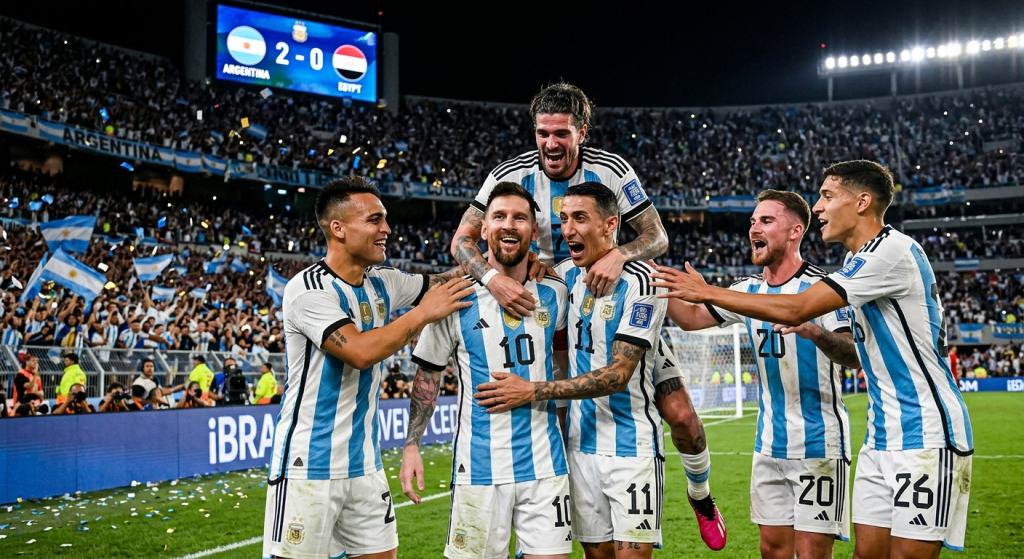
The Goal Was Important. The Authority Was Even More Important
Messi’s equaliser in the 83rd minute will naturally dominate the headlines, and it should. It was the goal that changed panic into possibility and reset the emotional balance of the match. But focusing only on the finish would miss the deeper significance of his contribution. What made Messi’s intervention so powerful was not merely that he scored. It was that he imposed belief on a team that had begun to look beaten.
This is one of the clearest ways to understand why Messi remains at the centre of GOAT discussions. Football is a collective game, but the greatest individuals alter the emotional state of the collective. They make team-mates play with more certainty, opponents defend with more fear, and coaches believe there is always one route back into a match. Reuters wrote after Argentina’s previous escape against Cape Verde that Messi had once again “stolen the World Cup spotlight” and reaffirmed the sense that Argentina still turn to him whenever the pressure peaks. The Egypt game only strengthened that perception.
The late comeback followed a pattern that has become central to Messi’s legacy with Argentina. At club level, his genius was often displayed inside dominant teams that monopolised the ball and overwhelmed opponents. With Argentina, especially in the latter stages of tournaments, his greatness has often taken a different form: rescue work. It is the genius of intervention rather than orchestration from comfort. It is one thing to be brilliant in a superior side; it is another to become decisive when your national team is one mistake from elimination.
Why the GOAT Debate Is Really About More Than Talent
There have been many gifted footballers. There have been explosive dribblers, prolific scorers, transcendent playmakers and devastating athletes. The GOAT debate exists because some players combine several of those traits while also leaving a mark on the sport’s most difficult stages. When football historians, coaches and elite former players weigh greatness, they tend to return to a cluster of questions:
Who changed the sport?
Who sustained excellence longest?
Who delivered in the biggest matches?
Who could dominate in multiple ways?
Who carried the heaviest burden and still performed?
Messi’s argument is so strong because he scores on every one of those measures.
He changed the sport by redefining what a forward could be. He was not just a winger, not just a number 10, not just a false nine, not just a playmaker, not just a goalscorer. He was all of those things at once. He sustained excellence for nearly two decades at the highest level of club and international football. He has delivered in Champions League finals, Copa América campaigns, World Cup finals and now, even at 39, in the knockout rounds of another World Cup. He dominates matches through passing, tempo control, gravity, finishing, dribbling and set-piece threat. And perhaps most importantly, he has carried the emotional and symbolic weight of Argentina in a way few players in history have had to carry a footballing nation.
That last point is especially important. Before Argentina won the 2022 World Cup, one of the main criticisms levelled at Messi was that he had not conquered the ultimate international summit the way Diego Maradona had in 1986. That criticism has long since lost its force. Messi has already won the Copa América, the Finalissima and the World Cup. What he is doing now in 2026 is not trying to complete his legacy. He is adding layers to it.
Egypt Deserve Credit for Forcing Argentina Into the Deep End
Any article that focuses on Messi must still be fair to Egypt, because this was not a match Argentina won against passive opposition. Egypt were excellent for long stretches and did a huge amount to expose Argentina’s current weaknesses. Salah’s leadership was evident again, and Reuters had already documented how this World Cup has transformed his international legacy by helping Egypt reach the knockout stage for the first time and turning him into the emotional face of the country’s greatest tournament run.
Egypt’s structure, discipline and attacking conviction made them one of the most compelling African stories of the tournament. They defended with bravery, countered with intelligence and, for over an hour, looked capable of one of the greatest results in their football history. Even in defeat, they leave with enormous credit. In truth, their performance actually strengthens the case for Messi’s greatness, because it underlines how serious the threat was. Argentina did not come back against a broken side. They came back against a team playing some of the best football in its World Cup history.
The Other Part of the GOAT Argument: Longevity at the Highest Level
One of the most astonishing aspects of Messi’s current World Cup is that it is happening at 39. Football is full of players who peak brightly and fade. It is far rarer to find a player who remains decisive at the sharp end of the World Cup almost twenty years after first announcing himself on the global stage. Reuters had already highlighted before the knockout rounds that Messi was scoring in a seventh straight World Cup finals match and continuing to function as Argentina’s answer whenever a game tilted toward danger.
Longevity matters in GOAT debates because it tests a different kind of greatness. Raw talent can carry a player to a spectacular peak. Staying decisive across generations requires reinvention, discipline, football intelligence and a capacity to adapt as the body changes. Messi at 22 was a dribbler who could destroy defensive lines through acceleration and close control. Messi at 39 is still technically exquisite, but he is also something else: a strategist within the game, a player who knows when to slow it, when to lure defenders, when to release a runner, when to conserve energy and when to strike.
That version of Messi was visible against Egypt. He did not need to sprint endlessly to dominate the match. He needed to read the match better than anyone else when it reached its most fragile point.
Argentina’s Dependence on Messi Is Both a Compliment and a Warning
There is, however, a harder truth buried inside this victory. Argentina’s dependence on Messi is still profound. Reuters was right to note after the Cape Verde match that the defending champions can look overly reliant on one man. The Egypt comeback did not erase that concern; if anything, it intensified it. Argentina conceded twice, lost control of long stretches of the game and required a late rescue from their captain to survive. That is not the profile of a flawless title defence.
Yet even that dependence contributes to the GOAT discussion. If a team still leans on a player this heavily in the knockout rounds of a World Cup at the age of 39, what does that say about the player? It says that his relevance has outlasted multiple football eras. It says that while younger stars have emerged across Europe and South America, Argentina still trust Messi to solve the hardest problems. That is not nostalgia. It is football reality.
Why Messi Is the GOAT
So why is Messi the GOAT? The Egypt match offers a clean answer.
He is the GOAT because he combines genius with productivity, beauty with efficiency, longevity with reinvention, and individual brilliance with collective influence. He is the GOAT because football’s biggest stages have repeatedly bent toward him, not only when his team is dominant, but when it is vulnerable. He is the GOAT because he has won everything that matters and still behaves in decisive moments as if there is one more responsibility to fulfil. He is the GOAT because he can spend much of a difficult match looking contained and then, in ten minutes, completely alter the emotional and tactical shape of a World Cup knockout tie.
And perhaps above all, he is the GOAT because his greatness has survived every challenge football can throw at a player: stylistic change, tactical evolution, age, criticism, national pressure, historical comparison and the sheer difficulty of staying essential for nearly two decades.
Conclusion: Egypt Nearly Wrote History, but Messi Wrote Another Chapter of His Own
Argentina’s 3–2 win over Egypt will be remembered as one of the most dramatic matches of the World Cup 2026 knockout rounds so far. Egypt led 2–0, Salah’s team looked ready to produce a monumental upset, and the world champions seemed close to collapse. Then Argentina found three late goals through Cristian Romero, Lionel Messi and Enzo Fernández, turning disaster into survival and survival into another chapter of World Cup theatre.
But beyond the scoreline, the match also sharpened a bigger truth about football history. Lionel Messi’s case as the greatest player of all time is not built on one goal, one tournament or one trophy. It is built on the repeated experience of watching the sport’s biggest moments arrive, and watching Messi somehow still own them. Against Egypt, he did not simply score. He reminded everyone what separates great players from the very greatest: when the team shakes, when the game turns hostile, and when the World Cup starts to slip away, the very greatest still find a way to pull it back.
That is what Messi did in Atlanta.
That is why Argentina are still alive.
And that is why, even in 2026, Lionel Messi remains football’s GOAT.