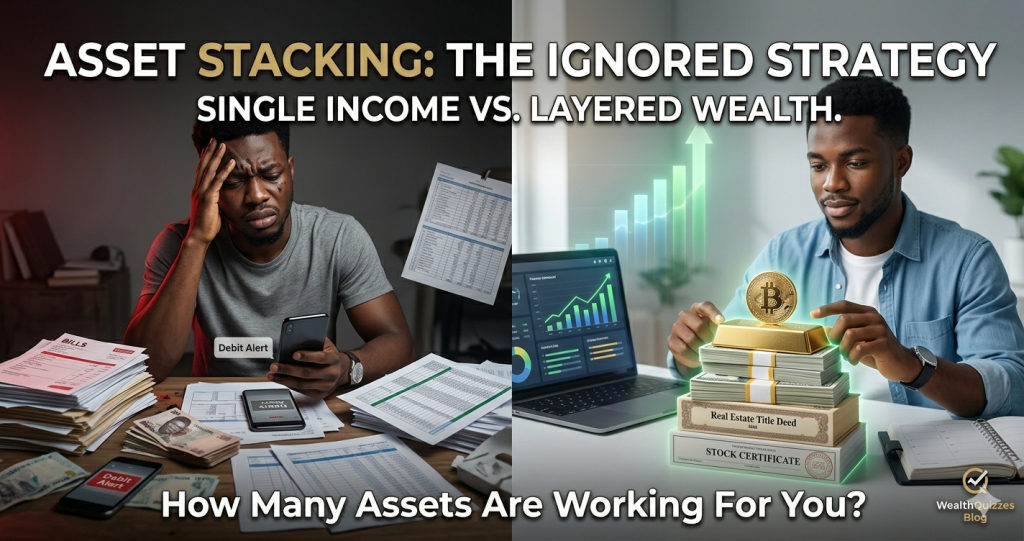
Asset Stacking: The Strategy the Middle Class Ignores
Why Wealth Is Not Built on One Income Stream—but on Multiple Layers of Productive Assets
Introduction: The Illusion of Financial Sufficiency
For many individuals, financial progress is measured by a single metric:
- “My salary is good.”
- “My business is doing okay.”
- “At least I have a steady income.”
While stability is important, it often creates a dangerous illusion:
That one reliable income source is enough to build wealth.
History, data, and real-world outcomes consistently prove otherwise.
True wealth is rarely the result of a single income stream. Instead, it emerges from a deliberate strategy known as:
Asset Stacking
The Core Truth
Core Idea: Wealth grows through layered assets
Mindset Shift: Single income → Layered assets
Income sustains life.
But:
Assets build wealth.
And multiple assets?
They accelerate it.
What Is Asset Stacking?
Asset Stacking refers to:
The strategic accumulation and layering of multiple income-generating and value-appreciating assets over time.
These assets work together to:
- Generate cash flow
- Appreciate in value
- Reinforce each other
The Difference Between Income and Assets
Income:
- Requires effort
- Is often linear
- Stops when work stops
Assets:
- Generate returns
- Can grow exponentially
- Continue producing value over time
Insight from Authority
As Robert Kiyosaki explains:
“Assets put money in your pocket, whether you work or not.”
Why the Middle Class Often Misses This Strategy
1. Income Comfort
Many individuals focus on:
- Salary increases
- Job security
Instead of:
- Asset creation
2. Consumption Pressure
Income is often directed toward:
- Lifestyle upgrades
- Status spending
Rather than:
- Asset acquisition
3. Lack of Financial Structure
Without a system:
- Money is not retained
- Capital is not accumulated
4. Misunderstanding of Wealth
Wealth is often mistaken for:
- Visible lifestyle
- Material possessions
Instead of:
Productive ownership
Insight from Authority
As Thomas J. Stanley found:
Many wealthy individuals live below their means and invest in income-producing assets.
The Layers of Asset Stacking
Asset stacking is not about doing everything at once.
It is about:
Building in layers over time
Layer 1: Cash Flow Assets
These generate regular income:
- Side businesses
- Freelance income streams
- Dividend-paying investments
Layer 2: Growth Assets
These increase in value over time:
- Stocks
- Equity investments
- Intellectual property
Layer 3: Stability Assets
These protect wealth:
- Emergency funds
- Low-risk investments
Layer 4: Leverage Assets
These amplify income:
- Scalable businesses
- Digital products
- Systems that generate income without constant effort
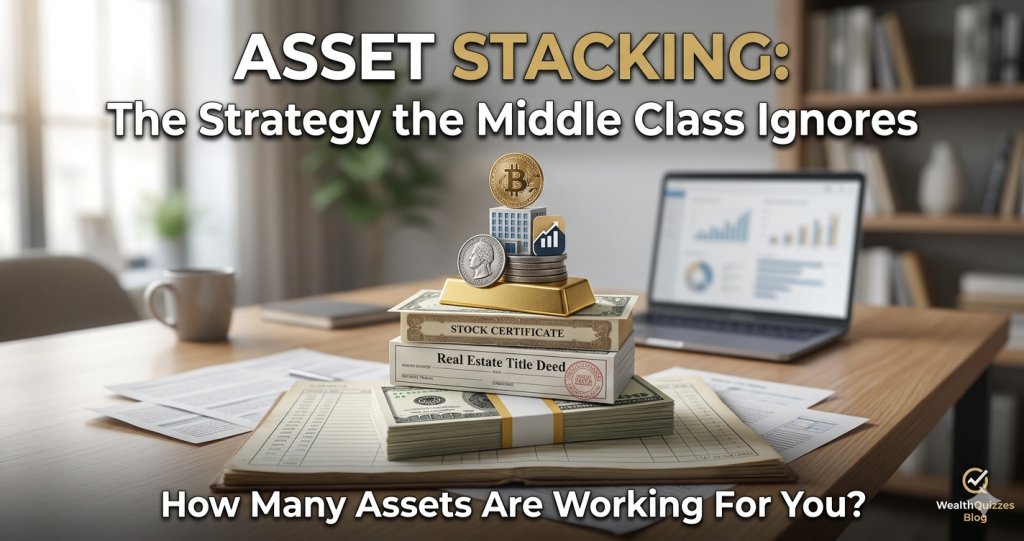
Why Layering Matters
Each asset type serves a different function:
- Cash flow → provides income
- Growth → builds wealth
- Stability → reduces risk
- Leverage → accelerates expansion
The Power of Combined Assets
When layered correctly:
- One asset supports another
- Risk is distributed
- Income becomes diversified
Insight from Authority
As Warren Buffett demonstrates through his investment philosophy:
Diversification and disciplined allocation create long-term financial strength.
The Risk of a Single Income Stream
Relying on one income source creates:
- Financial vulnerability
- Limited growth
- High stress
If That Income Stops:
- Financial stability collapses
Asset Stacking Solves This
It creates:
- Multiple income channels
- Greater resilience
- Financial independence potential
The Nigerian Context: Why Asset Stacking Is Critical
In Nigeria:
- Economic conditions can change rapidly
- Job security is uncertain
- Inflation erodes income
Without Asset Stacking:
- Income struggles to keep up with costs
- Financial progress slows
With Asset Stacking:
- Multiple income sources provide stability
- Capital grows over time
- Wealth becomes achievable
The Psychology of Asset Building
Many people delay asset creation due to:
- Fear of risk
- Lack of knowledge
- Desire for immediate comfort
Insight from Authority
As Morgan Housel explains:
Long-term financial success depends more on behavior than intelligence.
The Identity Shift
To adopt asset stacking, you must move from:
- “I earn and spend”
To:
“I earn, retain, and build assets consistently.”
Practical Implementation Guide
Step 1: Control Your Cash Flow
- Track income and expenses
- Identify surplus
Step 2: Build Initial Capital
- Save consistently
- Reduce unnecessary spending
Step 3: Acquire Your First Asset
- Start small
- Focus on income-generating opportunities
Step 4: Reinvest Returns
- Avoid early consumption
- Grow your capital base
Step 5: Add New Asset Layers
- Diversify gradually
- Maintain structure
The Compounding Effect of Asset Stacking
Over time:
- Assets generate income
- Income is reinvested
- More assets are acquired
Result:
Exponential financial growth
The Long-Term Outcome
With consistent asset stacking:
- Financial stress reduces
- Income becomes diversified
- Wealth accumulates
The Real Transformation
You move from:
- Dependence on income
To:
- Ownership of income-producing systems
The Hard Truth
Most people remain financially stuck not because:
- They don’t earn enough
But because:
They never move beyond a single income stream.
Conclusion: Build Layers, Not Limits
Wealth is not built by:
- Working harder alone
It is built by:
Owning and stacking productive assets
Money earned is temporary.
Assets built are:
- Durable
- Scalable
- Transformational
Final Thought
Right now, ask yourself:
“How many assets are actually working for me?”
Because the difference between financial survival and financial independence is not income—
It is how many layers of assets you have built.
👉 How many assets are working for you? Find out on WealthQuizzes