The Evolution of Football Tactics: From Total Football to Modern Pressing: Tactical Innovation
How Has Football Strategy Changed Over the Last 50 Years?
Football has always been more than a contest of speed, strength and skill. Beneath every spectacular goal, decisive tackle and dramatic comeback lies a carefully crafted tactical plan. While supporters often remember individual brilliance, coaches understand that victories are usually built upon intelligent organisation, disciplined movement and strategic innovation.
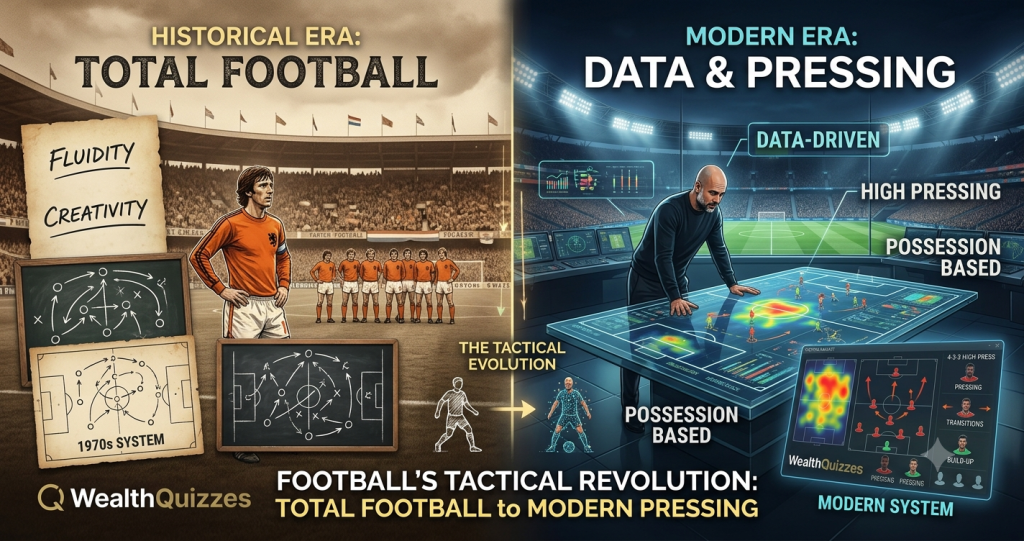
Over the past fifty years, football has undergone one of the most remarkable tactical transformations in sporting history. The rigid formations of the twentieth century have gradually evolved into fluid systems where every player attacks, defends and adapts according to the demands of the game. Positions have become more flexible, pressing has become more aggressive, data analytics have refined decision-making, and modern football now resembles a sophisticated game of chess played at extraordinary speed.
The recently concluded FIFA World Cup 2026, jointly hosted by the United States, Canada and Mexico, once again demonstrated how tactical innovation continues to shape international football. Teams that advanced furthest were not necessarily those with the most famous players, but those capable of executing disciplined tactical systems, adapting during matches and responding intelligently to different opponents. Spain’s championship campaign provided another compelling example of how technical excellence combined with tactical flexibility can produce sustained success.
This raises an important question:
How has football strategy changed over the last fifty years?
The answer is found in one continuous process of innovation, where visionary coaches have repeatedly challenged conventional thinking and redefined how football should be played.
As legendary Dutch coach Rinus Michels, widely regarded as the father of modern tactical football, famously observed:
“Football is war.”
Although modern football rightly rejects the militaristic tone of that statement, Michels’ underlying message remains relevant: success in football requires organisation, discipline, planning and intelligent execution.
Football Was Once Defined by Fixed Positions
Half a century ago, football tactics were considerably more rigid than they are today.
Players were expected to remain within clearly defined positional responsibilities.
Defenders defended.
Midfielders created.
Forwards attacked.
Movement between positions was relatively limited.
Traditional formations such as the 4-4-2, 4-3-3 and 3-5-2 emphasised structure rather than fluidity.
Managers generally valued defensive solidity and positional discipline above tactical flexibility.
According to football historian Jonathan Wilson, author of the acclaimed Inverting the Pyramid: The History of Football Tactics, tactical evolution has largely been a continuous search for creating numerical superiority in different areas of the pitch.
Every innovation has sought to solve that fundamental challenge.
The Birth of Total Football
No tactical philosophy has influenced modern football more profoundly than Total Football.
Developed during the late 1960s and early 1970s by Rinus Michels and perfected by Ajax Amsterdam and the Netherlands national team, Total Football revolutionised the sport.
Its central principle was remarkably simple.
Every outfield player should be capable of performing multiple roles.
When one player vacated a position, another immediately occupied the space.
Rather than relying upon fixed positions, teams functioned as interconnected units.
Movement became continuous.
Possession became purposeful.
Pressing began immediately after losing the ball.
The philosophy reached global prominence during the 1974 FIFA World Cup, where the Netherlands captivated audiences despite finishing as runners-up.
The tournament permanently changed football’s tactical landscape.
Johan Cruyff Became Football’s Greatest Tactical Ambassador
No player embodied Total Football more completely than Johan Cruyff.
Cruyff combined extraordinary technical ability with exceptional tactical intelligence.
Later, as coach of Barcelona, he introduced principles that transformed both the club and modern football itself.
His philosophy emphasised:
- Positional play.
- Ball retention.
- Technical superiority.
- Intelligent movement.
- Spatial awareness.
Cruyff famously declared:
“Playing football is very simple, but playing simple football is the hardest thing there is.”
His ideas continue influencing coaches throughout world football.
Arrigo Sacchi Changed Defensive Organisation
During the late 1980s, Italian coach Arrigo Sacchi introduced another tactical revolution at AC Milan.
Unlike traditional Italian systems built around deep defending, Sacchi demanded:
- Collective pressing.
- Compact defensive lines.
- Coordinated movement.
- High defensive positioning.
- Zonal marking.
Sacchi believed defending should involve the entire team rather than only defenders.
His AC Milan side became one of football’s greatest teams while fundamentally altering defensive strategy.
Former FIFA Technical Director Howard Wilkinson described Sacchi’s Milan as one of the most tactically influential teams in football history.
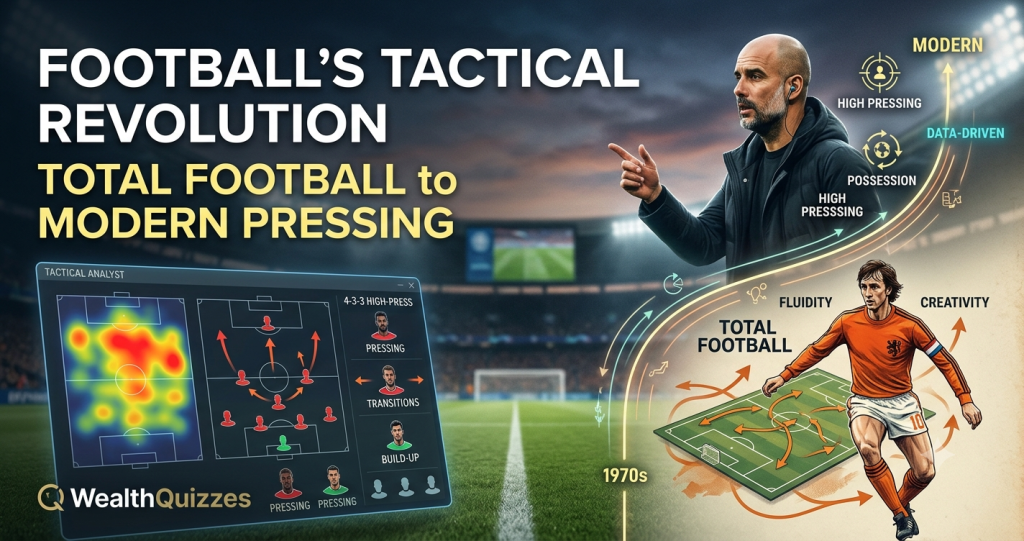
Pep Guardiola Perfected Positional Play
Few modern coaches have shaped football as profoundly as Pep Guardiola.
Having absorbed Johan Cruyff’s philosophy at Barcelona, Guardiola refined positional football into an extraordinarily sophisticated tactical model.
His teams prioritise:
- Controlled possession.
- Short passing.
- Numerical superiority.
- Structured positioning.
- Patient build-up.
- Immediate counter-pressing.
Under Guardiola, football became increasingly focused on controlling space rather than simply controlling the ball.
Former Bayern Munich and Germany captain Philipp Lahm has repeatedly praised Guardiola’s ability to redefine players’ understanding of positional intelligence.
Modern football owes much to Guardiola’s innovations.
Jürgen Klopp Popularised Gegenpressing
If Guardiola refined possession football, Jürgen Klopp transformed defensive aggression.
His tactical philosophy, known as Gegenpressing (counter-pressing), requires teams to regain possession immediately after losing it.
Rather than retreating into defensive positions, players aggressively pressure opponents high up the pitch.
Klopp famously described counter-pressing as:
“The best playmaker in the world.”
His Borussia Dortmund and Liverpool teams demonstrated how coordinated pressing could overwhelm technically gifted opponents.
Today, pressing has become an essential component of elite football.
Tactical Flexibility Defines Modern Football
Unlike previous generations, today’s teams rarely rely upon one fixed formation.
Managers frequently alter tactical structures during matches.
A team may begin in a 4-3-3 before transforming into:
- 3-2-5 during possession.
- 4-4-2 while defending.
- 2-3-5 during sustained attacks.
Players increasingly perform multiple functions.
Full-backs become midfielders.
Midfielders become defenders.
Centre-backs initiate attacks.
Goalkeepers participate in build-up play.
According to FIFA’s Technical Study Group (TSG), tactical flexibility represented one of the defining characteristics of the FIFA World Cup 2026.
Adaptability consistently distinguished elite teams.
The Goalkeeper Has Become the First Playmaker
Perhaps no position has evolved more dramatically than goalkeeping.
Modern goalkeepers no longer function solely as shot-stoppers.
They initiate attacks.
Distribute possession.
Support defensive build-up.
Sweep behind defensive lines.
Legends such as Manuel Neuer, Ederson, Alisson Becker and Marc-André ter Stegen have transformed expectations surrounding the position.
Former Germany goalkeeper Manuel Neuer’s role as the “sweeper-keeper” influenced an entire generation of coaches.
The goalkeeper has become football’s first attacker.
Data Analytics Has Accelerated Tactical Evolution
Modern tactical planning increasingly relies upon data.
Elite clubs analyse:
- Passing networks.
- Pressing intensity.
- Expected Goals (xG).
- Defensive compactness.
- Transition speed.
- Player positioning.
- Running distances.
Companies including Opta, Stats Perform and StatsBomb provide sophisticated analytical insights that support coaching decisions.
Sports economist Professor Stefan Szymanski, co-author of Soccernomics, argues that statistical analysis increasingly enables clubs to identify competitive advantages previously invisible through observation alone.
Technology now complements tactical intelligence.
FIFA World Cup 2026 Demonstrated Tactical Excellence
The FIFA World Cup 2026 showcased football’s tactical evolution brilliantly.
Spain combined technical precision with intelligent pressing.
Argentina demonstrated structured defensive organisation and efficient transitions.
Several emerging nations displayed remarkable tactical discipline despite possessing fewer globally recognised players.
According to FIFA’s Technical Study Group, modern international football increasingly rewards teams capable of adapting strategically between opponents rather than relying solely upon individual brilliance.
Preparation matters more than ever.
Tactics Must Still Serve Creativity
Despite football’s increasing tactical sophistication, the sport remains fundamentally creative.
No tactical system succeeds without intelligent players capable of making sound decisions.
Former Arsenal manager and FIFA Chief of Global Football Development Arsène Wenger has consistently argued that tactics should enhance creativity rather than restrict it.
Great coaches establish frameworks.
Great players provide imagination.
The two remain inseparable.
Lessons Beyond Football
Football’s tactical evolution offers valuable lessons for business, government and leadership.
Successful organisations continually adapt.
They embrace innovation.
They learn from competitors.
They analyse evidence.
They remain flexible.
Management scholar Peter Drucker famously observed:
“The greatest danger in times of turbulence is not the turbulence—it is to act with yesterday’s logic.”
Football illustrates this truth perfectly.
Teams refusing to evolve rarely remain successful.
The Future of Football Tactics
Football’s tactical evolution continues.
Artificial intelligence.
Machine learning.
Real-time performance analysis.
Virtual reality coaching.
Enhanced player tracking.
Advanced biomechanical analysis.
These innovations will undoubtedly influence future tactical thinking.
Nevertheless, one reality remains constant.
No tactical system can replace intelligence, teamwork and technical excellence.
The greatest coaches will always be those capable of balancing innovation with simplicity.
Conclusion
The history of football tactics is a story of continuous evolution. From Rinus Michels’ revolutionary Total Football and Johan Cruyff’s positional philosophy to Arrigo Sacchi’s organised pressing, Pep Guardiola’s positional play and Jürgen Klopp’s relentless Gegenpressing, each generation has reshaped the way football is understood and played.
The FIFA World Cup 2026 reaffirmed that tactical intelligence remains one of the defining characteristics of championship teams. Success increasingly depends upon flexibility, preparation, collective discipline and the ability to adapt to rapidly changing situations.
Yet despite advances in analytics, technology and sports science, football’s essence has not changed. Tactical systems remain tools rather than guarantees. They provide structure, but players provide inspiration.
As Jonathan Wilson demonstrates in Inverting the Pyramid, football’s history is ultimately the history of ideas—ideas that challenge convention, inspire innovation and continually redefine what is possible on the pitch.
Ultimately, the evolution of football tactics reminds us that greatness is never static.
The teams that shape football history are not those that simply master today’s strategies.
They are the ones bold enough to invent tomorrow’s.