
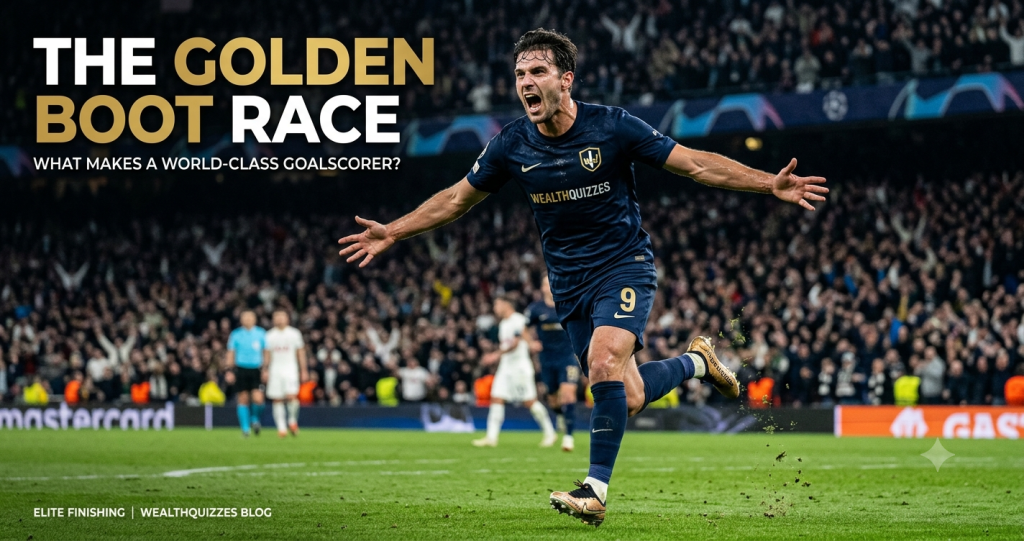
The Golden Boot Race: What Makes a World-Class Goalscorer? Elite Finishing
Why Do Some Strikers Score Consistently While Others Fade Away?
Football ultimately revolves around one decisive action: putting the ball into the net. Teams may dominate possession, complete hundreds of passes and execute sophisticated tactical systems, but goals remain the currency by which matches are won and championships are decided. This is why the world’s greatest goalscorers occupy a special place in football history. They possess an ability that appears simple to spectators but is extraordinarily difficult to reproduce consistently: the capacity to turn opportunities into goals.
The Golden Boot is therefore more than an individual award. It represents the culmination of positioning, technique, anticipation, decision-making, athleticism, tactical intelligence and psychological strength. Whether it is the FIFA World Cup Golden Boot, the European Golden Shoe or a domestic league scoring title, the race for the top scorer provides a fascinating window into what separates prolific strikers from ordinary finishers.
The recently concluded FIFA World Cup 2026 once again demonstrated that goalscoring is not simply about shooting harder or possessing extraordinary natural talent. The most dangerous forwards understand space, anticipate defensive movements, make intelligent runs and remain composed when opportunities appear.
So, why do some strikers score consistently while others fade away?
The answer lies in the combination of technical excellence, tactical intelligence, physical preparation and mentality.
Goalscoring Is a Skill, Not an Accident
A common misconception is that elite goalscorers simply possess an instinct that cannot be taught. While natural ability undoubtedly matters, modern football research demonstrates that finishing can be developed through deliberate practice, tactical education and repetition.
Former Arsenal manager Arsène Wenger has repeatedly emphasised the importance of technical education in player development. The finest strikers do not merely learn how to strike the ball; they learn how to recognise the right opportunity to strike it.
A world-class goalscorer understands:
- Where to position himself.
- When to make a run.
- When to shoot.
- When to pass.
- Which foot to use.
- How much power is required.
- How the goalkeeper is positioned.
The shot is often the final step in a much longer sequence of decisions.
The First Secret: Positioning
Elite goalscorers are frequently described as having an extraordinary “nose for goal.”
In analytical terms, this often means exceptional positioning.
A striker who consistently finds himself in dangerous areas will naturally receive more scoring opportunities.
Players such as Gerd Müller, Ruud van Nistelrooy, Robert Lewandowski and Erling Haaland became renowned for their ability to occupy precisely the spaces defenders struggle to protect.
The legendary Gerd Müller demonstrated this brilliantly. He was not necessarily the tallest, fastest or most spectacular player on the pitch, yet his positioning enabled him to score at an extraordinary rate.
Football historian David Goldblatt, author of The Ball Is Round, has noted that the greatest goalscorers often possess an extraordinary understanding of where the decisive moment is likely to occur.
The best striker is frequently where the ball will arrive—not where it is currently located.
Anticipation Separates Great Strikers
Positioning and anticipation are closely connected.
Elite forwards read the game several seconds ahead.
They watch:
- The defender’s body position.
- The midfielder preparing to pass.
- The goalkeeper’s movement.
- The space behind the defensive line.
- The direction of teammates’ runs.
This enables them to arrive first.
Former Manchester United striker Ruud van Nistelrooy was famous for this characteristic. His movement inside the penalty area often appeared effortless because he had already anticipated where the opportunity would develop.
This is why some strikers seem to “appear from nowhere.”
They are not appearing randomly.
They are reading the game earlier than everyone else.
Finishing Technique Matters
A world-class goalscorer must possess a comprehensive finishing repertoire.
That includes:
- First-time finishes.
- Headers.
- One-on-one finishing.
- Volleys.
- Low finishes.
- Curled shots.
- Near-post strikes.
- Long-range efforts.
- Penalties.
Different situations require different techniques.
A striker who always attempts maximum power becomes predictable.
Elite finishers understand variation.
Sometimes precision is better than power.
Sometimes a goalkeeper must be beaten rather than overwhelmed.
Sometimes the simplest finish is the best finish.
The Science of Expected Goals
Modern football has transformed the analysis of goalscoring through Expected Goals (xG).
Expected Goals measures the probability that a particular scoring opportunity will result in a goal based on historical data.
For example, a close-range opportunity directly in front of the goal generally carries a higher probability than a long-range attempt.
This allows analysts to distinguish between:
- Creating many good chances.
- Finishing chances efficiently.
- Taking low-probability shots.
- Consistently outperforming expected scoring levels.
Companies such as Opta, StatsBomb and Stats Perform have helped make advanced football analytics increasingly accessible to clubs and supporters.
However, xG should not be mistaken for a prediction of what must happen.
It is a probability model.
Elite strikers can consistently outperform expectations because their technical ability and decision-making influence the quality and outcome of chances.
The Modern Striker Must Do More
The traditional centre-forward was primarily expected to score goals.
Modern football demands considerably more.
Today’s elite striker may be required to:
- Press defenders.
- Initiate defensive pressure.
- Link midfield and attack.
- Create space for teammates.
- Participate in build-up play.
- Defend set pieces.
- Attack transitions.
- Make runs that create opportunities for others.
This tactical evolution has expanded the definition of a world-class forward.
Robert Lewandowski, for example, combines exceptional finishing with intelligent movement and link-up play.
Erling Haaland combines physical power, extraordinary movement and remarkable efficiency inside the penalty area.
Kylian Mbappé adds explosive acceleration and transitional threat.
Different players reach elite goalscoring levels through different combinations of qualities.

Physical Attributes Matter—But Differently Than People Think
Elite goalscorers do not necessarily need to be the fastest players on the pitch.
What matters is the ability to create separation.
Acceleration over the first few metres can be more valuable than maximum sprint speed.
Strength can help a striker hold off defenders.
Balance allows players to finish while under pressure.
Coordination enables precise strikes.
Timing can make physical limitations almost irrelevant.
Sports scientists increasingly use GPS tracking and biomechanical analysis to understand these characteristics.
According to FIFA’s medical and performance research, modern elite football requires players to repeatedly perform high-intensity actions while maintaining technical precision.
Goalscoring therefore depends upon both physical preparation and technical execution.
Mental Strength Is Perhaps the Greatest Difference
The physical and technical qualities of a striker can be measured.
Mentality is more difficult to quantify.
Yet it may be the most important factor.
A striker may miss three chances and receive another in the final minute.
What happens next?
Does he hesitate?
Does he become frustrated?
Or does he remain confident enough to take the next opportunity?
Sports psychologist Richard H. Cox, in Sport Psychology: Concepts and Applications, identifies confidence, concentration and emotional control as crucial components of elite athletic performance.
World-class goalscorers possess remarkable psychological resilience.
They accept failure quickly.
They reset.
They continue searching for opportunities.
Pressure Defines the Greatest Goalscorers
Scoring in an ordinary league match is one thing.
Scoring when millions of people are watching is another.
World Cup knockout matches, Champions League finals and decisive title matches create extraordinary psychological pressure.
The greatest goalscorers often become more influential when the stakes rise.
This is one reason players such as Cristiano Ronaldo, Lionel Messi, Miroslav Klose, Ronaldo Nazário and Pelé occupy such prominent positions in football history.
Their scoring records were not built solely against ordinary opposition.
They repeatedly performed on the biggest stages.
Consistency Is the Ultimate Test
Many footballers enjoy one extraordinary season.
Far fewer remain elite for a decade.
Consistency requires:
- Adaptation.
- Injury management.
- Continuous training.
- Tactical intelligence.
- Professional discipline.
- Psychological resilience.
Defenders eventually study every striker.
Opponents adapt.
Tactical systems change.
Physical abilities decline.
The greatest goalscorers evolve with the game.
Cristiano Ronaldo’s transformation from explosive winger to elite penalty-box goalscorer provides a striking example.
His game changed as his physical profile changed.
The goals continued.
That is adaptation.
Why Some Strikers Fade Away
The difference between temporary success and sustained excellence can be explained by several factors.
Some strikers depend heavily on pace.
Others struggle with injuries.
Some lose confidence after periods without scoring.
Others fail to adapt tactically.
Some become predictable.
Others struggle when transferred to different leagues or systems.
A striker’s performance is also heavily influenced by teammates.
A forward playing for a team that creates numerous high-quality chances will naturally have more scoring opportunities than one operating in a defensive system.
Therefore, individual goalscoring statistics must always be interpreted within tactical context.
The Role of Teammates
Even the greatest striker cannot score without service.
Elite forwards depend upon:
- Creative midfielders.
- Intelligent wingers.
- Overlapping full-backs.
- Set-piece specialists.
- Tactical systems that generate opportunities.
The relationship between striker and creator has shaped football history.
Messi and Luis Suárez.
Cristiano Ronaldo and Karim Benzema.
Thierry Henry and Robert Pirès.
Xavi and David Villa.
Football is ultimately a collective sport.
The Golden Boot may belong to one player, but the goals are often the product of an entire team’s work.
What Makes a Golden Boot Winner?
A Golden Boot winner typically combines several characteristics:
Elite positioning — consistently arriving in dangerous areas.
Exceptional finishing — converting opportunities efficiently.
Tactical intelligence — understanding how opponents defend.
Movement — creating separation from defenders.
Physical preparation — maintaining performance across an entire season or tournament.
Mental resilience — recovering quickly from missed chances.
Consistency — scoring repeatedly rather than occasionally.
Adaptability — adjusting to different opponents and tactical systems.
These characteristics explain why genuine world-class goalscorers are so rare.
The Future of Goalscoring
Technology will increasingly influence how strikers develop.
Artificial intelligence can analyse shooting patterns.
Wearable technology can monitor physical workload.
Video analysis can identify defensive weaknesses.
Advanced data can reveal where a striker is most effective.
Virtual reality may eventually allow players to rehearse realistic finishing scenarios without physical opponents.
Yet technology will never completely replace instinct.
Football remains unpredictable.
The extraordinary striker will continue to be the player capable of seeing an opportunity before everyone else.
Conclusion
The Golden Boot race represents far more than a competition between players with the highest number of goals. It is a demonstration of the extraordinary combination of skills required to become an elite goalscorer.
The world’s greatest strikers possess technical precision, intelligent movement, anticipation, tactical awareness, physical preparation and exceptional psychological resilience.
Most importantly, they understand that goalscoring begins long before the ball reaches their feet.
It begins with reading the game.
A world-class striker sees the space before it opens, anticipates the pass before it is played and makes the decision before defenders recognise the danger.
That is why some strikers score consistently while others disappear.
Talent may create the opportunity.
Training develops the technique.
Tactics create the chances.
But mentality, intelligence and consistency transform a talented forward into a goalscoring legend.
Ultimately, the Golden Boot does not simply belong to the player who scores the most goals.
It belongs to the player who repeatedly finds a way to make the decisive moment count.