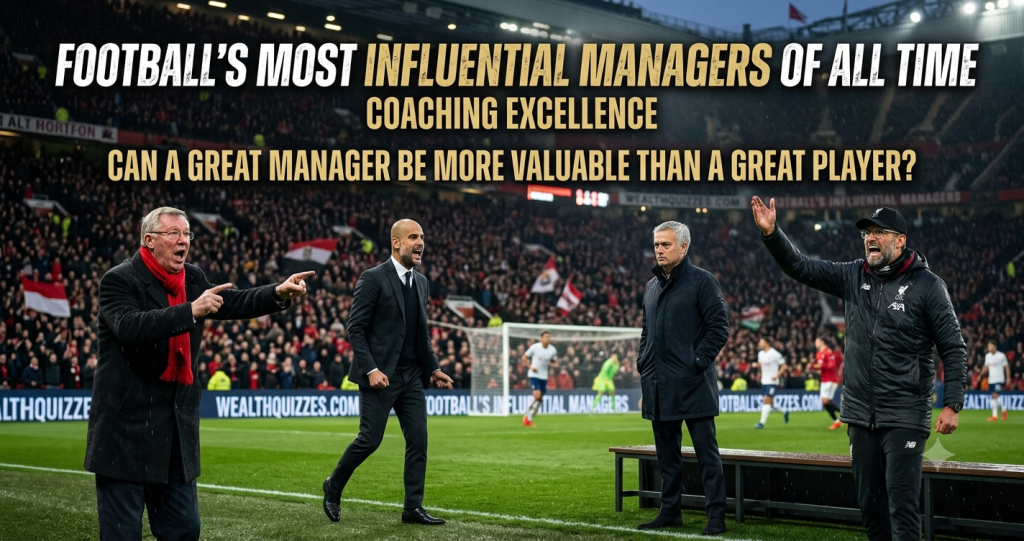
Football’s Most Influential Managers of All Time: Coaching Excellence
Can a Great Manager Be More Valuable Than a Great Player?
Football is usually celebrated through its stars. Supporters remember the goals of Pelé, the dribbles of Diego Maradona, the finishing of Cristiano Ronaldo, the vision of Lionel Messi and the brilliance of countless other players who have transformed the sport. Yet behind many of football’s greatest teams stood another kind of genius—the manager who created the system, established the culture, developed the players and turned individual talent into collective excellence.
A great player can decide a match. A great manager can influence an entire generation.
That distinction explains why some managers have left an imprint on football far greater than the trophies displayed in their cabinets. They did not merely win matches. They changed how the game was understood.
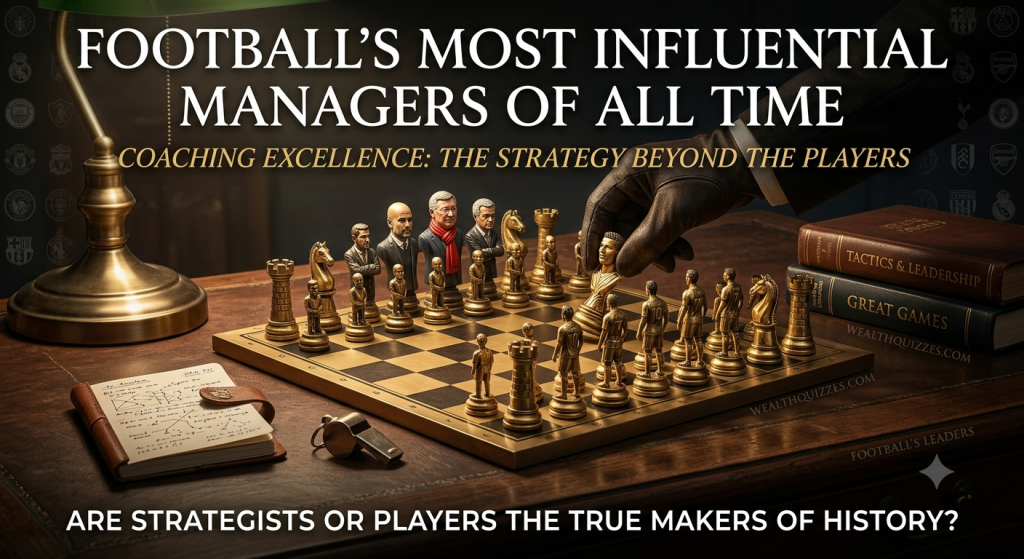
From Rinus Michels and Johan Cruyff to Sir Alex Ferguson, Arrigo Sacchi, Arsène Wenger, José Mourinho, Pep Guardiola and others, football’s most influential managers have repeatedly challenged conventional wisdom and demonstrated that coaching excellence can transform both players and institutions.
The question, therefore, is compelling:
Can a great manager be more valuable than a great player?
The answer is not straightforward. Football remains a players’ game, and no tactical system can succeed without exceptional footballers. But the history of the sport demonstrates that a visionary manager can multiply the value of the talent available to him.
As legendary Dutch coach Rinus Michels, widely regarded as the father of Total Football, demonstrated, football is not merely about individual ability. It is about organising individual abilities into a coherent collective.
What Makes a Manager Influential?
Winning trophies is important, but influence is measured by something larger.
An influential manager changes:
- Tactical thinking.
- Training methodology.
- Player development.
- Team culture.
- Recruitment philosophy.
- Club structures.
- The expectations of supporters.
- The wider direction of football.
Some managers leave behind trophy cabinets.
The greatest leave behind ideas.
Their methods are copied by competitors, taught in coaching schools and incorporated into future generations of football.
Rinus Michels: The Architect of Total Football
Any discussion of influential managers must begin with Rinus Michels.
Michels transformed football during his time with Ajax and the Netherlands national team, developing the philosophy that became known as Total Football.
The concept challenged traditional positional rigidity.
Players were expected to understand multiple positions, interchange intelligently and maintain collective structure despite constant movement.
The Netherlands reached the 1974 FIFA World Cup final under Michels, producing football that influenced coaches around the world despite ultimately losing to West Germany.
Michels was named FIFA’s Coach of the Century in 1999, an extraordinary recognition of his influence.
His greatest achievement was arguably not a trophy.
It was changing the football vocabulary.
Johan Cruyff: From Revolutionary Player to Revolutionary Manager
If Michels created the blueprint, Johan Cruyff became one of its greatest architects.
Cruyff’s managerial career at Barcelona transformed the club’s footballing identity.
His philosophy emphasised possession, positional intelligence, technical quality and attacking initiative.
Cruyff’s Barcelona won the club’s first European Cup in 1992 and established the foundations upon which later generations of Barcelona teams were built.
His influence extended beyond trophies.
Pep Guardiola, one of the most successful modern managers, openly acknowledges Cruyff as a foundational influence on his football philosophy.
Cruyff understood that coaching was not simply about telling players what to do.
It was about teaching them how to understand the game.
Sir Alex Ferguson: The Master of Sustained Success
Few managers demonstrated leadership over a longer period than Sir Alex Ferguson.
During more than two decades at Manchester United, Ferguson transformed the club into one of the most successful sporting institutions in the world.
His achievements included:
- 13 Premier League titles.
- 5 FA Cups.
- 2 UEFA Champions League titles.
- Numerous other domestic and international honours.
Yet Ferguson’s greatest achievement may have been his ability to rebuild successful teams repeatedly.
The Manchester United sides of the early 1990s differed considerably from those of the late 1990s and the 2000s.
He developed young players.
He adapted tactics.
He managed egos.
He refreshed ageing squads.
He created an enduring winning culture.
Former Manchester United players have frequently described Ferguson’s ability to create belief as one of his greatest strengths.
Arrigo Sacchi: Football Without the Ball
Italian football had traditionally been associated internationally with defensive organisation, particularly through the famous catenaccio tradition.
Arrigo Sacchi challenged that perception.
At AC Milan, Sacchi introduced a highly coordinated system built around pressing, defensive compactness and collective movement.
His Milan team of the late 1980s became one of the greatest sides in European football.
Sacchi insisted that defending was a collective responsibility.
The distance between players mattered.
The team’s movement mattered.
Individual talent could not compensate for organisational weakness.
His ideas influenced generations of coaches and helped establish modern pressing as a central tactical principle.
Arsène Wenger: The Modernisation of English Football
When Arsène Wenger arrived at Arsenal in 1996, English football was about to experience a profound transformation.
Wenger introduced approaches to:
- Nutrition.
- Fitness.
- Training.
- Player preparation.
- Tactical organisation.
- International recruitment.
His Arsenal teams became famous for technically sophisticated attacking football.
The 2003–04 Arsenal “Invincibles” went an entire Premier League season unbeaten, an extraordinary achievement.
Wenger also demonstrated that managers could fundamentally alter the professional culture of a club.
His influence extended beyond the pitch.
José Mourinho: The Tactical Pragmatist
José Mourinho represents a different managerial philosophy.
Where some coaches prioritised possession and attacking aesthetics, Mourinho demonstrated the power of tactical pragmatism.
His 2004 Porto team won the UEFA Champions League against expectations, following their UEFA Cup triumph the previous season.
He subsequently won major trophies with Chelsea, Inter Milan, Real Madrid and Manchester United.
Mourinho’s teams became renowned for:
- Defensive organisation.
- Tactical preparation.
- Transition football.
- Opponent analysis.
- Psychological management.
His Inter Milan side famously defeated Barcelona in the 2010 Champions League semi-final before winning the competition.
Mourinho demonstrated that there is no single formula for winning.
Pep Guardiola: The Age of Positional Football
Modern football has perhaps no more influential manager than Pep Guardiola.
Influenced heavily by Cruyff, Guardiola has developed an exceptionally sophisticated interpretation of positional play.
His teams seek to create numerical and positional advantages across the pitch.
His achievements with Barcelona, Bayern Munich and Manchester City have established him among the most successful managers in modern football.
At Manchester City, he transformed the club into a dominant force in English and European football, culminating in the club’s first UEFA Champions League title in 2023 and a historic treble.
Guardiola’s influence extends beyond Manchester City.
Coaches around the world increasingly study:
- Inverted full-backs.
- Positional rotations.
- Build-up structures.
- High pressing.
- Numerical superiority.
- Controlled possession.
His greatest contribution may be the continued evolution of positional football.
Jürgen Klopp: The Power of Collective Intensity
Jürgen Klopp demonstrated another pathway to elite success.
His football is closely associated with gegenpressing, the aggressive attempt to regain possession immediately after losing the ball.
At Borussia Dortmund and Liverpool, Klopp developed teams that combined intensity, athleticism, collective pressing and rapid transitions.
His Liverpool side won the UEFA Champions League in 2019 and the Premier League in 2020, ending the club’s 30-year wait for an English league title.
Klopp also demonstrated the importance of emotional leadership.
He created teams in which players and supporters appeared psychologically connected.
Vicente del Bosque: Managing Talent Without Ego
Influential management is not always about tactical revolution.
Sometimes it is about managing extraordinary personalities effectively.
Vicente del Bosque guided Spain to victory at the 2010 FIFA World Cup and UEFA Euro 2012.
Spain possessed exceptional players from Barcelona, Real Madrid and other elite clubs.
Del Bosque’s achievement was maintaining harmony while allowing a generation of exceptional footballers to operate within a coherent system.
His calm personality demonstrated that leadership does not necessarily require confrontation.
Managers and the Development of Players
One of the greatest measures of coaching excellence is the ability to improve players.
Sir Alex Ferguson developed generations of Manchester United players.
Wenger helped transform young talents into elite professionals.
Guardiola has repeatedly developed players by giving them new tactical responsibilities.
Cruyff influenced an entire generation of Barcelona academy graduates.
This demonstrates a crucial principle:
Great managers do not merely use talent. They develop it.
Can a Manager Be More Valuable Than a Great Player?
The comparison is difficult because the roles are fundamentally different.
A player directly executes actions on the pitch.
A manager influences the entire team.
A world-class striker may score 30 goals.
A world-class manager can potentially improve the performance of 20 or more players.
This is why the greatest managers can create extraordinary value.
Consider a talented squad lacking structure.
A manager introduces tactical clarity.
The same players suddenly perform at a higher level.
The manager has effectively multiplied the team’s collective ability.
Yet there is an important limitation.
Managers cannot score goals themselves.
Football remains dependent upon player quality.
The relationship is therefore complementary rather than hierarchical.
The greatest teams require both extraordinary players and extraordinary coaching.
The Manager as Culture Builder
Modern managers are increasingly responsible for creating institutional culture.
They determine:
- Standards.
- Discipline.
- Training intensity.
- Professional expectations.
- Dressing-room relationships.
- Tactical identity.
Leadership expert John C. Maxwell argues that leadership is fundamentally about influence.
Football provides perhaps one of the clearest demonstrations of that principle.
A manager’s influence can extend beyond match day and shape the identity of an entire club.
The Future of Football Management
The modern manager is increasingly supported by technology.
Data analysts.
Performance scientists.
Video analysts.
Sports psychologists.
Recruitment specialists.
Medical professionals.
Artificial intelligence.
The manager therefore functions increasingly as the leader of a multidisciplinary performance organisation.
The future’s greatest coaches will need not only tactical knowledge but also:
- Data literacy.
- Communication skills.
- Emotional intelligence.
- Talent development expertise.
- Strategic thinking.
Football management is becoming more complex.
Conclusion
Football’s greatest managers have demonstrated that coaching excellence is about far more than selecting a starting XI.
Rinus Michels changed the tactical philosophy of the sport.
Johan Cruyff transformed Barcelona’s footballing identity.
Sir Alex Ferguson demonstrated the art of sustained leadership.
Arrigo Sacchi revolutionised defensive organisation.
Arsène Wenger modernised English football.
José Mourinho demonstrated the power of tactical pragmatism.
Vicente del Bosque proved the value of calm leadership.
Jürgen Klopp showed how collective intensity can become a competitive weapon.
Pep Guardiola continues to redefine positional football.
Their legacies remind us that football evolves whenever someone dares to challenge conventional thinking.
So, can a great manager be more valuable than a great player?
Perhaps the better answer is that football needs both.
The player provides execution.
The manager provides direction.
The player creates moments.
The manager creates the environment in which those moments become possible.
And when exceptional talent is placed under exceptional leadership, football can produce something greater than either individual could achieve alone.
That is the true measure of coaching excellence—and the reason the greatest managers are remembered not merely as trophy winners, but as architects of football history.