
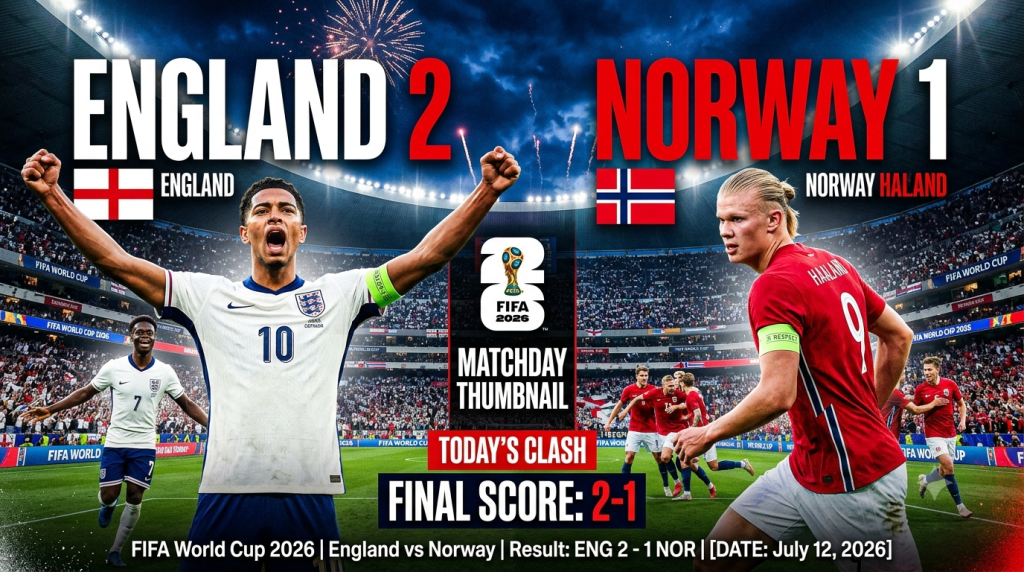
England 2–1 Norway: Three Lions End Haaland’s Dream and Roar Into the FIFA World Cup 2026 Final
Kane’s Leadership, England’s Resilience and Tuchel’s Tactical Masterclass Bring Football Home One Step Closer
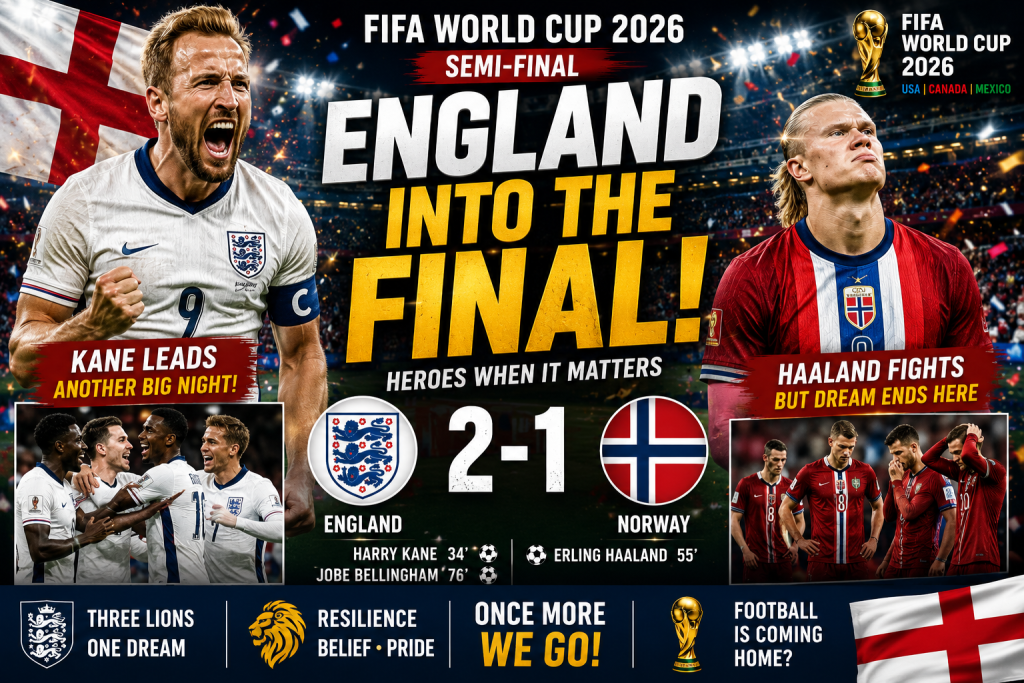
The FIFA World Cup has always been defined by moments that transcend the ninety minutes played on the pitch. Some matches become historical milestones because of the quality of football displayed, while others are remembered for ending remarkable dreams or launching new ones. England’s dramatic 2–1 victory over Norway in the semi-final of the FIFA World Cup 2026 belongs firmly in the latter category. It was a contest between two nations pursuing history for entirely different reasons. England sought to return to the World Cup final for the first time since 1966, while Norway hoped to complete one of the greatest underdog stories the tournament has ever witnessed. By the final whistle, England had prevailed, booking their place in the World Cup Final and ending Norway’s remarkable campaign. The victory also reaffirmed an enduring truth about tournament football: talent may inspire belief, but discipline, experience and composure often determine who survives.
The match carried enormous significance long before kickoff. England entered the semi-final having overcome stubborn opposition throughout the tournament, displaying tactical flexibility under manager Thomas Tuchel and relying on the leadership of captain Harry Kane alongside the brilliance of Jude Bellingham, Bukayo Saka and a balanced squad filled with Premier League and European elite talent. Norway, meanwhile, had captured the imagination of football supporters worldwide. Having stunned Brazil earlier in the knockout stages and continued their fearless run behind the sensational form of Erling Haaland, they arrived believing that nothing was impossible.
Football, however, has an unforgiving way of rewarding the smallest margins.
England proved clinical when it mattered most.
A Semi-Final Worthy of the Occasion
Semi-finals are rarely open, carefree spectacles.
The closer teams move toward lifting football’s greatest prize, the greater the tactical caution becomes.
That reality was evident from the opening whistle.
England established early control through intelligent possession while Norway remained compact, waiting patiently for opportunities to release Haaland into space behind England’s defensive line.
The tactical battle quickly became fascinating.
England preferred patient construction from midfield, with Declan Rice providing defensive stability while Jude Bellingham constantly drifted between the lines looking to overload Norway’s midfield.
Norway, under pressure for large periods, remained disciplined and dangerous on the counterattack.
Every time Haaland touched the ball, the atmosphere inside the stadium changed.
England understood that containing one of the world’s deadliest strikers required collective organisation rather than individual defending.
That discipline ultimately became one of the decisive factors of the evening.
Thomas Tuchel’s Tactical Blueprint Delivered Again
When England appointed Thomas Tuchel, expectations immediately rose.
The German coach had already established a reputation as one of football’s finest tacticians through his successes with Borussia Dortmund, Paris Saint-Germain, Chelsea and Bayern Munich.
Throughout FIFA World Cup 2026, Tuchel has repeatedly demonstrated his ability to prepare his team specifically for each opponent.
Against Norway, England never allowed themselves to become emotionally distracted by Haaland’s reputation.
Instead, they concentrated on limiting the quality of service reaching him.
Former Arsenal manager Arsène Wenger has frequently argued that elite coaches do not merely stop great players; they prevent great players from receiving the ball in dangerous positions.
England executed that philosophy superbly.
Rice screened the defence brilliantly, while England’s centre-backs maintained excellent positional discipline throughout the match.
Rather than chasing Haaland into uncomfortable areas, they protected central spaces and forced Norway into wider attacking channels where England held numerical superiority.
It was a tactical performance built upon patience, preparation and trust.
Harry Kane Once Again Delivered on the Biggest Stage
Great captains understand that World Cup semi-finals are not won through speeches.
They are won through actions.
Harry Kane once again demonstrated why he remains one of international football’s greatest leaders.
Whether linking midfield with attack, pressing Norway’s defenders or finishing calmly inside the penalty area, Kane’s influence extended far beyond goals.
His movement consistently created space for England’s attacking midfielders.
His hold-up play relieved defensive pressure whenever Norway threatened sustained attacks.
His experience ensured England remained calm during the most difficult phases of the contest.
Former England manager Sir Gareth Southgate often described Kane as “the complete modern striker.”
This semi-final provided another compelling demonstration of that assessment.
Even when not directly involved in decisive moments, Kane constantly elevated those around him.
Championship-winning teams require precisely that type of leadership.
Jude Bellingham Continues to Mature Into a Global Superstar
Every major tournament eventually identifies football’s next generation of leaders.
For England, Jude Bellingham has become exactly that figure.
His performance against Norway once again illustrated why many observers consider him among the finest midfielders in world football.
Bellingham combined physical power with technical elegance.
He recovered possession, carried the ball forward under pressure, broke defensive lines with intelligent passing and repeatedly arrived inside dangerous attacking areas.
Former Real Madrid coach Carlo Ancelotti has praised Bellingham’s ability to influence every phase of the game.
Against Norway, those qualities were visible throughout.
Rather than attempting spectacular moments every time he received possession, Bellingham consistently chose intelligent solutions.
His maturity continues to distinguish him from many players of similar age.
The World Cup has become another stage upon which his extraordinary talent continues to flourish.
Norway’s Extraordinary Journey Deserves Celebration
Although Norway leave the tournament disappointed, their campaign should be remembered as one of the defining stories of FIFA World Cup 2026.
Entering the competition, few neutral observers genuinely expected Norway to challenge football’s traditional superpowers.
By reaching the semi-finals, eliminating Brazil and competing courageously against England, they transformed perceptions of Norwegian football.
Central to that transformation has been Erling Haaland.
Already regarded as one of the world’s most prolific goalscorers, Haaland finally experienced his first FIFA World Cup and immediately justified the enormous expectations surrounding him.
His goals carried Norway beyond the Round of 16 and into football history.
Yet Norway’s success cannot be explained by Haaland alone.
Their defensive organisation, midfield discipline and collective spirit consistently allowed them to compete with nations possessing far greater footballing pedigrees.
Their campaign illustrates the growing competitiveness of international football.
The gap between traditional powers and emerging nations continues to narrow.
Haaland Was Dangerous Until the Very End
Despite England’s tactical discipline, Erling Haaland still reminded everyone why defenders fear him.
His equalising goal demonstrated the instinctive finishing that has made him one of football’s most feared strikers.
Given the smallest opportunity inside the penalty area, Haaland reacted faster than anyone else.
England suddenly found themselves facing renewed pressure.
The stadium atmosphere shifted dramatically.
Norway believed another upset was possible.
This psychological resilience has become one of the defining characteristics of Haaland’s career.
Former Manchester City manager Pep Guardiola has frequently praised Haaland’s mentality, noting that elite strikers possess an extraordinary ability to forget previous missed opportunities and remain fully prepared for the next chance.
Against England, Haaland again embodied that quality.
Even when closely marked, he required only a single opening to change the complexion of the match.
England Found the Winning Moment
Championship-winning teams rarely dominate every minute.
Instead, they recognise decisive opportunities when they appear.
England’s winning goal perfectly reflected this characteristic.
After patiently recycling possession across midfield, England suddenly accelerated the tempo through quick passing combinations that disrupted Norway’s defensive structure.
Within moments, what appeared to be harmless possession became a devastating attacking move.
The finish itself demonstrated remarkable composure under enormous pressure.
Rather than forcing the opportunity, England calmly exploited the available space before clinically finding the back of the net.
It was precisely the type of goal expected from teams capable of winning World Cups.
Defensive Excellence Often Wins Championships
Football supporters naturally celebrate goals.
Yet history repeatedly shows that tournaments are frequently decided by defensive organisation.
England’s back line deserves enormous credit for reaching the World Cup Final.
Even after Haaland’s equaliser, they never lost emotional control.
Communication remained constant.
Positional discipline remained intact.
Every defender understood his role.
Legendary Italian coach Arrigo Sacchi famously argued that defending begins with the forwards and attacking begins with the defenders.
England’s performance against Norway perfectly illustrated that philosophy.
Their pressing began high up the pitch.
Their midfield recovered possession quickly.
Their defenders rarely became isolated.
This collective organisation transformed individual quality into championship-level performance.
Thomas Tuchel Has Changed England’s Mentality
Perhaps the greatest achievement of England’s World Cup campaign extends beyond tactics.
It concerns mentality.
For decades, England possessed talented squads but frequently struggled to manage the psychological pressures associated with major tournaments.
World Cup exits often arrived not because England lacked footballing ability but because moments of anxiety undermined otherwise excellent performances.
Under Thomas Tuchel, that mentality appears transformed.
England now approach knockout football with visible calm.
When they concede, they respond intelligently rather than emotionally.
When leading, they continue playing rather than retreating excessively.
When pressured, they trust their structure.
Such maturity has become one of England’s greatest competitive advantages.
The Final Awaits
England now stand just one victory away from football immortality.
Having overcome Norway in a tense semi-final, the Three Lions advance to the FIFA World Cup 2026 Final carrying enormous confidence.
Their journey has been built not upon spectacular attacking football alone but upon tactical intelligence, collective discipline and unwavering belief.
Whether facing France, Spain or another finalist, England will enter the championship match believing they possess every quality required to become world champions.
Norway, meanwhile, return home with heads held high.
Their remarkable campaign has inspired supporters across the globe and demonstrated that football’s emerging nations are increasingly capable of challenging the traditional elite.
This tournament should mark not the end of Norway’s progress but the beginning of an exciting new era.
Conclusion
England’s 2–1 victory over Norway will be remembered as one of the defining matches of FIFA World Cup 2026.
It was a contest rich in tactical intrigue, emotional intensity and individual brilliance.
Harry Kane once again led by example.
Jude Bellingham confirmed his place among football’s global elite.
Thomas Tuchel produced another tactical masterclass.
Norway fought courageously, while Erling Haaland once again demonstrated why he remains one of the world’s most feared forwards.
Ultimately, however, England possessed the qualities that separate outstanding teams from champions.
They remained organised under pressure.
They recognised decisive moments.
They executed their game plan with remarkable discipline.
The dream of bringing football home now stands just one match away.
For England, history beckons.
For the rest of the footballing world, the FIFA World Cup 2026 Final promises to be an unforgettable spectacle.