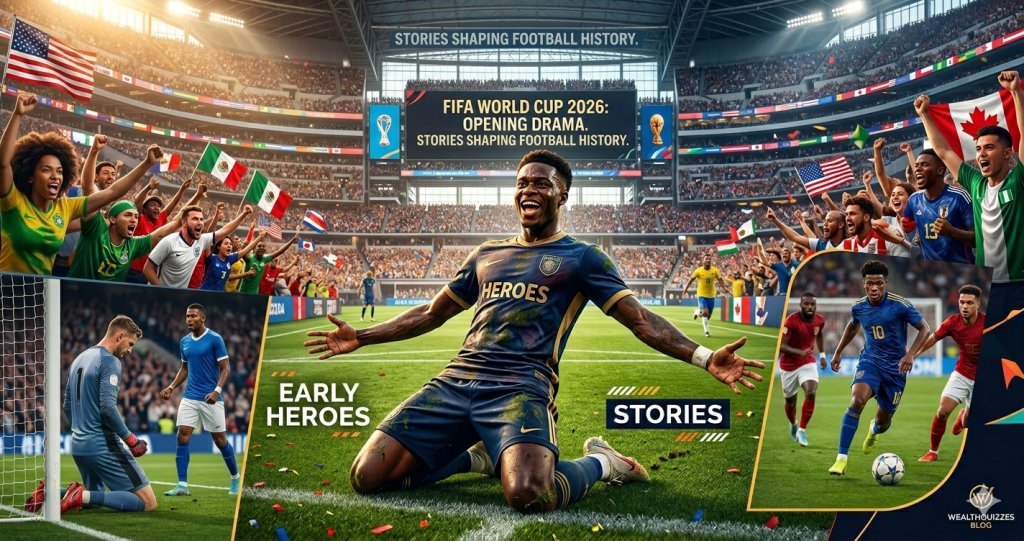
FIFA World Cup 2026: Opening Drama, Early Heroes and the Stories Already Shaping Football History
Just Days Into the Tournament, Which Teams, Players, and Moments Are Already Defining the Biggest World Cup Ever?
The FIFA World Cup has always been football’s grandest stage, but the 2026 edition has already proven that it is unlike anything the sport has ever witnessed. Hosted jointly by the United States, Canada, and Mexico, this tournament is the largest in FIFA history, featuring 48 nations, 104 matches, and an unprecedented continental celebration of football. Before a ball was even kicked, the tournament had already broken new ground through its scale, global reach, and innovative format. (Al Jazeera)
Now, only days after kickoff on June 11, the World Cup has already delivered drama, memorable performances, emotional moments, cultural celebrations, and compelling storylines that are beginning to shape the narrative of football’s greatest competition.
The journey to the final in New Jersey is still long, but the opening days have provided a fascinating glimpse into what may become one of the most memorable World Cups ever staged.
A Historic Opening Like No Other
For the first time in World Cup history, the opening celebrations were spread across three host nations over two days. Mexico City hosted the primary opening ceremony on June 11, while Canada and the United States staged their own celebrations on June 12, symbolizing the tournament’s unique tri-national identity. (People.com)
The iconic stadium formerly known as Estadio Azteca once again became the center of the football world. Having hosted World Cup milestones in 1970 and 1986, it welcomed more than 80,000 spectators for the opening festivities of another historic tournament. (New York Post)
FIFA President Gianni Infantino has repeatedly described the 2026 World Cup as the most inclusive and expansive tournament in football history. The opening ceremonies reflected that ambition, combining music, culture, technology, and football into a global spectacle. (Inside FIFA)
The Musical Stars Who Lit Up the Opening Ceremony
One of the biggest talking points before the opening match was the star-studded entertainment lineup.
Global music icon Shakira headlined the Mexico City ceremony, performing the official FIFA World Cup anthem “Dai Dai.” She was joined by Nigerian Afrobeats superstar Burna Boy, making the opening performance a celebration of football’s worldwide appeal. Shakira’s appearance was particularly significant because it marked her fourth World Cup performance, a remarkable achievement unmatched by any other artist. (Page Six)
The entertainment lineup also featured J Balvin, Belinda, Alejandro Fernández, and South African Grammy-winning star Tyla, who performed as part of the pre-match festivities and celebrations surrounding South Africa’s return to the World Cup stage. (People.com)
Meanwhile, ceremonies scheduled in Toronto and Los Angeles feature additional global stars including Michael Bublé, Alanis Morissette, Alessia Cara, Katy Perry, Future, Rema, Anitta, and Lisa, further emphasizing football’s growing cultural influence. (People.com)
Mexico Delivers the First Statement
Opening matches often carry enormous pressure, especially for host nations.
Mexico entered the tournament carrying the expectations of an entire nation and responded impressively with a 2-0 victory over South Africa. The result immediately positioned El Tri as the early leader of Group A and provided the perfect start to their World Cup campaign. (The Guardian)
The victory was built on discipline, energy, and clinical finishing. Mexico controlled key periods of the match and capitalized on South African mistakes. South Africa’s challenge became even more difficult after two red cards reduced them to nine men before the final whistle. (The Guardian)
For Mexico, the opening win was about more than three points. It signaled that the co-hosts intend to be serious contenders capable of advancing deep into the competition.

Early Heroes Emerge
Every World Cup creates new heroes, and the process has already begun.
Among the most celebrated names from the opening match was Raúl Jiménez, who scored his first-ever World Cup goal during his fourth appearance at the tournament. His emotional strike became one of the defining images of the opening day and represented a moment of personal redemption after years of perseverance and setbacks. (The Guardian)
Mexico also benefited from strong performances by emerging talents and experienced leaders alike, suggesting a balanced squad capable of handling the pressures that come with hosting football’s biggest event. (The Guardian)
Elsewhere, South Korea produced one of the tournament’s earliest comebacks, recovering from a deficit to defeat Czechia 2-1 in Guadalajara. The victory immediately strengthened South Korea’s position in Group A and demonstrated the resilience that has often characterized their World Cup performances. (ABC News)
The Rise of New Storylines
Every World Cup develops narratives that extend beyond the results.
One of the most compelling stories so far is the expanded 48-team format itself. Critics questioned whether a larger tournament would dilute quality, but the opening matches have instead highlighted football’s growing global competitiveness. Nations previously considered outsiders are arriving better prepared, tactically organized, and increasingly capable of challenging established powers. (Al Jazeera)
Another developing storyline involves the co-host nations. Mexico has already made a strong statement, while attention now shifts toward Canada and the United States as they begin their campaigns. Their performances could significantly influence the atmosphere and momentum of the tournament. (People.com)
Football Meets Culture
One of the defining characteristics of the 2026 World Cup has been its effort to merge football with culture.
FIFA introduced enhanced pre-match ceremonies designed to strengthen connections between fans and players while showcasing the identity of each host nation. Traditional performances, local artistic expressions, and global music collaborations have all contributed to an atmosphere that feels distinctively North American while remaining unmistakably global. (Inside FIFA)
This fusion of sport and culture reflects what renowned football historian David Goldblatt has often argued: that football’s greatest tournaments become cultural events as much as sporting competitions.
The opening days of the 2026 World Cup appear to support that view.
Challenges Beyond the Pitch
No major sporting event unfolds without complications.
The opening day was also marked by protests outside the stadium in Mexico City, drawing attention to broader social issues within the host nation. While the tournament itself remained the focus inside the venue, the demonstrations served as a reminder that global sporting events often intersect with larger societal conversations. (The Sun)
Historically, World Cups have reflected not only football but also the political, social, and cultural realities of their time. The 2026 tournament is unlikely to be different.
What We Have Learned So Far
Several conclusions can already be drawn from the tournament’s opening days.
First, the expanded World Cup format appears capable of producing compelling football and fresh narratives.
Second, host nations continue to benefit enormously from home support, as demonstrated by Mexico’s opening victory.
Third, football’s relationship with entertainment and global culture is stronger than ever, with artists from Africa, North America, Latin America, Europe, and Asia contributing to the spectacle.
Finally, the tournament’s earliest matches have reminded fans why the World Cup remains unique: it consistently produces moments that transcend sport.
Conclusion: A Historic Tournament Is Only Beginning
The FIFA World Cup 2026 is still in its infancy, yet it has already delivered many of the elements that make football’s greatest tournament special.
Historic opening ceremonies.
Global music superstars.
Emotional goals.
Emerging heroes.
Unexpected drama.
Passionate supporters.
Compelling narratives.
As legendary football coach Sir Alex Ferguson once observed, football is a game that constantly creates new stories.
The opening days of the 2026 FIFA World Cup have already proven that point.
With weeks of competition still ahead, countless matches yet to be played, and football’s ultimate prize still awaiting its next champion, one thing is certain: the biggest World Cup ever has begun in unforgettable fashion, and football history is already being written.