FIFA World Cup 2026 So Far: The Biggest Highlights, Turning Points and Stories Defining the Tournament
From Messi’s brilliance and Haaland’s explosion to Brazil’s fall and the rise of new contenders, here are the moments shaping the biggest World Cup ever
Just a few weeks into FIFA World Cup 2026, the tournament has already delivered what every great World Cup promises: drama, shocks, tactical intrigue, iconic individual performances, emotional farewells, emerging stars, and a growing sense that football’s global balance of power is shifting again. Hosted across the United States, Mexico and Canada, and expanded for the first time to 48 teams, this edition of the World Cup was always going to be historic before a ball was kicked. What no format change, marketing campaign or opening ceremony could guarantee, however, was the quality of the football story itself. That part has to be written on the pitch. So far, World Cup 2026 has done exactly that.
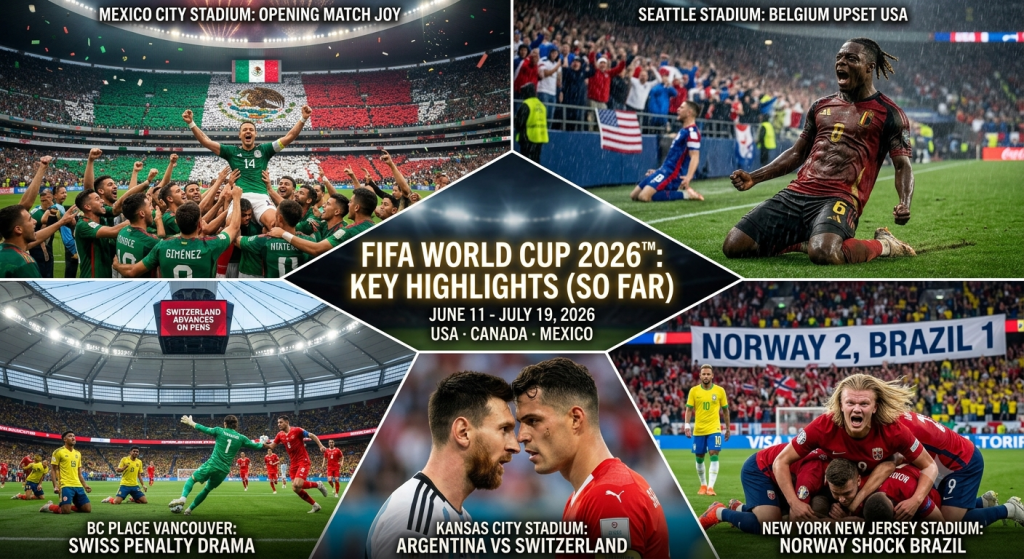
From Mexico’s winning start in the tournament opener to Lionel Messi’s latest acts of international genius, from Erling Haaland’s arrival as a World Cup force to Brazil’s painful exit against Norway, from Spain’s knockout maturity to Portugal’s heartbreak, the tournament has already built a narrative strong enough to stand alongside the early chapters of some of the most memorable World Cups in modern history. FIFA’s official tournament coverage, match reports and round-ups show a competition that has combined heavyweight storylines with the unpredictability that makes the World Cup football’s most compelling event.
What follows is not just a list of results, but a deeper look at the biggest highlights of the World Cup so far—the moments, performances and trends that are shaping the tournament’s identity.
1. Lionel Messi Has Once Again Taken Hold of the World Cup Narrative
Every World Cup seems to produce a moment when the conversation bends back toward Lionel Messi. In 2026, that moment has not been a single flash of magic but a sustained reminder that even at 39, he remains one of the defining forces in international football. Messi has already been central to Argentina’s tournament story, scoring, creating, and above all rescuing his team when matches have started to slip into danger.
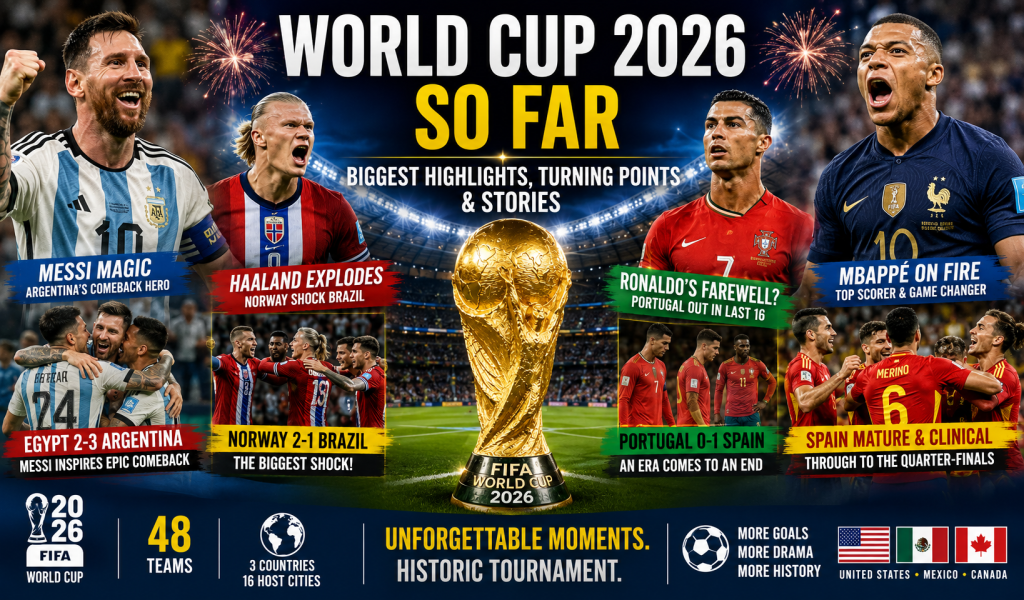
Argentina’s knockout comeback against Egypt may become the clearest example. Trailing 2–0 and facing the prospect of a stunning elimination, the reigning world champions turned to Messi once more. He scored, took control of the emotional rhythm of the game, and helped inspire a late turnaround that ended 3–2 in Argentina’s favour. That performance did not merely keep Argentina alive; it reinforced the larger truth that Messi remains football’s great tournament problem-solver. Reuters and FIFA coverage throughout the tournament have repeatedly underlined his continued influence, while broader World Cup reporting has placed him among the clear contenders for the Golden Ball and Golden Boot conversations.
The significance of Messi’s World Cup so far lies in more than numbers. It lies in timing. He is not just scoring in comfortable matches; he is shaping games that carry existential weight for Argentina. In a tournament full of stars, he still feels like one of the few players capable of altering the emotional climate of an entire match by himself.
2. Erling Haaland Has Turned Norway Into One of the Stories of the Tournament
If Messi represents enduring greatness, Erling Haaland represents the tournament’s most explosive force of arrival. This is Haaland’s first World Cup, and he has treated it as a stage to be conquered rather than merely explored. Norway came into the tournament as a dangerous but not universally trusted side. They now look like one of the most compelling teams left in the competition, and Haaland is the main reason why.
His most dramatic statement came in Norway’s 2–1 Round of 16 victory over Brazil, where he scored twice to knock one of football’s superpowers out of the World Cup. That result instantly became one of the defining shocks of the tournament and transformed Norway from interesting outsiders into genuine contenders. The wider reporting around the tournament now consistently places Haaland among the leading scorers and most decisive performers of World Cup 2026.
But the bigger highlight is not just the goals. It is what Haaland’s presence says about the changing structure of international football. Norway are no longer a side that depends on respectability. They are a side capable of eliminating Brazil on merit, and Haaland’s ruthless finishing has given them the elite edge every underdog dreams of carrying into a World Cup knockout bracket.
3. Brazil’s Elimination Is the Tournament’s Biggest Shock So Far
Every World Cup produces at least one result that instantly alters the mood of the tournament. So far in 2026, that result is Norway 2–1 Brazil. Brazil did not arrive as a flawless team, but they arrived as Brazil always do: as a country with enough talent, prestige and expectation to make a deep run seem almost compulsory. Their elimination in the Round of 16 therefore matters far beyond one result.
It matters because Brazil remain one of football’s defining nations. It matters because they were coached by Carlo Ancelotti and still carried major attacking talent. It matters because World Cups are shaped by the survival or disappearance of their biggest footballing brands. Norway’s win did not just send Brazil home; it reshaped the bracket, shifted the power balance of the knockout phase, and reinforced one of the key themes of this tournament: the giants are vulnerable. Coverage around the match made clear how significant the upset was, with Haaland’s brace becoming one of the images of the tournament so far.
Brazil’s exit is therefore one of the biggest highlights not because it was beautiful, but because it was consequential. It changed the tournament’s landscape.
4. Cristiano Ronaldo’s World Cup Story Appears to Have Reached Its Final Chapter
One of the most emotionally charged storylines of the tournament has been Cristiano Ronaldo’s final World Cup campaign. Portugal’s Round of 16 defeat to Spain, settled by a stoppage-time goal from Mikel Merino, did more than eliminate a talented team. It likely closed Ronaldo’s World Cup story for good.
That ending has been one of the defining emotional moments of the tournament so far. Ronaldo remains one of the greatest players in football history, but World Cups are unforgiving. Portugal’s loss to Spain turned a knockout match into a symbolic handover scene: the old era fighting to stay alive, the new era pressing forward without sentiment. Reports and commentary after the match focused heavily on Ronaldo’s likely farewell and on the contrast between Portugal’s individual quality and Spain’s greater collective control.
Even for neutral observers, that matters. World Cups are not just about who wins. They are also about the closing of eras. Ronaldo’s exit is one of those moments.
5. Spain Have Quietly Become One of the Most Complete Teams in the Tournament
Not every highlight needs to be explosive. Some are about the slow accumulation of credibility. Spain’s progress so far belongs in that category. They have not necessarily produced the single loudest moment of the tournament, but they have built the profile of a team that understands knockout football.
Their 1–0 win over Portugal was a perfect example. It was not spectacular, but it was mature. Spain controlled the emotional temperature of the game, stayed tactically disciplined, and found the decisive moment through Merino when extra time seemed inevitable. That kind of win matters in World Cups. It suggests a team that can survive awkward, low-scoring, high-pressure contests rather than needing ideal conditions to flourish.
Spain also carry one of the tournament’s most fascinating squad balances: established control players in midfield, wide threats, technical depth, and the youthful electricity of Lamine Yamal. As a result, one of the biggest highlights of the tournament so far is not a single Spanish goal or result, but the growing sense that Spain may be one of the hardest teams to eliminate.
6. The 48-Team Format Has Already Changed the Feel of the Tournament
This World Cup is historic for structural reasons as much as footballing ones. It is the first men’s World Cup with 48 teams, and the expansion has changed both the scale and texture of the tournament. FIFA’s tournament overview makes clear that this is the biggest World Cup ever, featuring more teams, more matches, more host cities and an added Round of 32.
So far, the new format has produced two important effects. First, it has created more room for nations outside the traditional elite to reach the knockout stage and believe they can stay there. That matters for teams such as Norway, Egypt, Ghana, Congo DR and others whose tournament journeys have carried genuine narrative weight. Second, it has made the early rounds feel more expansive and less compressed, allowing stories to emerge from a wider range of football cultures.
There are debates about whether the format dilutes the sharpness of some group-stage drama, and some observers have raised concerns that the final group matchdays were not always as tense as they might have been under the older structure. But even with that criticism, the broader picture is clear: the expanded format has widened the World Cup’s cast of meaningful participants and made the tournament feel more global than ever.
7. The Golden Boot Race Has Become One of the Tournament’s Best Side-Plots
Every World Cup needs a scoring race that fans can follow alongside the main trophy chase, and 2026 has produced a strong one. Messi, Haaland, Kylian Mbappé and Harry Kane have all been central names in the Golden Boot discussion, while other attackers have also inserted themselves into the conversation as the knockout rounds progress. The Guardian’s running coverage of the Golden Boot race, along with broader tournament reporting, shows just how competitive the battle has become.
This matters because the Golden Boot race often acts as a second tournament inside the tournament. It sharpens the focus on individual brilliance, creates direct comparisons between the world’s best forwards, and helps frame each knockout match around more than just progression. Haaland’s emergence has added freshness to the race. Messi’s continued scoring has added legacy weight. Mbappé’s threat keeps France in the centre of the conversation. Kane’s output keeps England relevant not just as a team, but as a source of elite finishing.
The result is a scoring race that has become one of the World Cup’s most watchable subplots.
8. Underdogs Are Not Just Participating — They Are Changing Matches
One of the most enjoyable features of this World Cup so far has been the refusal of so-called smaller nations to behave like background characters. Some have taken points off stronger teams, some have reached the knockout stage, and some have pushed elite sides to the edge of elimination.
England had to come from behind to beat Congo DR 2–1 in the Round of 32. Ghana frustrated England earlier in the group stage. Egypt nearly knocked Argentina out. Cape Verde pushed Argentina and became one of the tournament’s most charming stories. South Africa earned significant moments of resistance. Congo DR’s progress to the knockouts was itself historic. FIFA’s match reports and round-ups show a tournament full of smaller teams refusing to disappear politely.
This is one of the most important highlights of the tournament because it speaks to a bigger truth: the competitive gap in international football is narrowing. Better coaching, more players at top European clubs, improved sports science and wider tactical literacy have made it harder for the traditional powers to simply turn up and dominate.
9. Host-Nation Energy Has Helped Give the Tournament Scale and Emotion
Mexico’s victory over South Africa in the opening match gave the tournament an immediate emotional pulse. The hosts, and indeed the three-host structure involving Mexico, the United States and Canada, have given the competition a unique continental scale. FIFA’s tournament coverage has emphasised the vast geography of the event—sixteen host cities across three countries—and that scale has already shaped the feel of the competition.
Mexico’s opening win was a significant early highlight not just because of the result, but because it gave the tournament the kind of host-nation energy that World Cups need. Canada’s emphatic win over Qatar was another important host-related moment, signalling that the co-hosts are not just organisers but contributors to the football narrative.
10. The World Cup Is Giving Us an Intergenerational Football Moment
Perhaps the most beautiful highlight of World Cup 2026 so far is the sense that we are watching football generations overlap in real time. Messi and Ronaldo are still here, still shaping matches and headlines. Mbappé is now fully established as one of the tournament’s dominant forces. Haaland has arrived as a World Cup star. Jude Bellingham continues to grow in stature. Lamine Yamal represents the next wave entirely.
This overlap matters because it gives the tournament an unusual richness. It is not just a World Cup of the future or of the past. It is both at once. It contains farewell arcs, prime years and first arrivals. Few tournaments manage to feel like a bridge between eras in such a vivid way. That may be one of the reasons this World Cup already feels so narratively full.
Conclusion: A World Cup Already Rich in Drama, and Still Far From Finished
So what are the biggest highlights of FIFA World Cup 2026 so far? Messi’s continued brilliance. Haaland’s breakout as a World Cup destroyer. Brazil’s stunning elimination. Ronaldo’s likely farewell. Spain’s rise as a serious knockout machine. The expanded format’s impact. A fierce Golden Boot race. The stubborn courage of underdogs. Host-nation emotion. And the extraordinary collision of football generations on one stage.
That is already a lot for one tournament. And the remarkable thing is that the competition is not over. The quarter-finals and beyond will add new heroes, new failures, new tactical lessons and perhaps a defining final narrative none of us can yet fully see. But even at this stage, one conclusion is already safe: World Cup 2026 has not felt like an over-expanded tournament struggling under its own size. It has felt like a competition overflowing with stories.
That, ultimately, is the greatest highlight of all. The World Cup is supposed to make football feel bigger than itself. It is supposed to take familiar names and unfamiliar nations, throw them into the same bracket, and create matches that feel like theatre, history and chaos all at once. So far, FIFA World Cup 2026 has done exactly that—and if the opening weeks are any guide, the best may still be ahead.