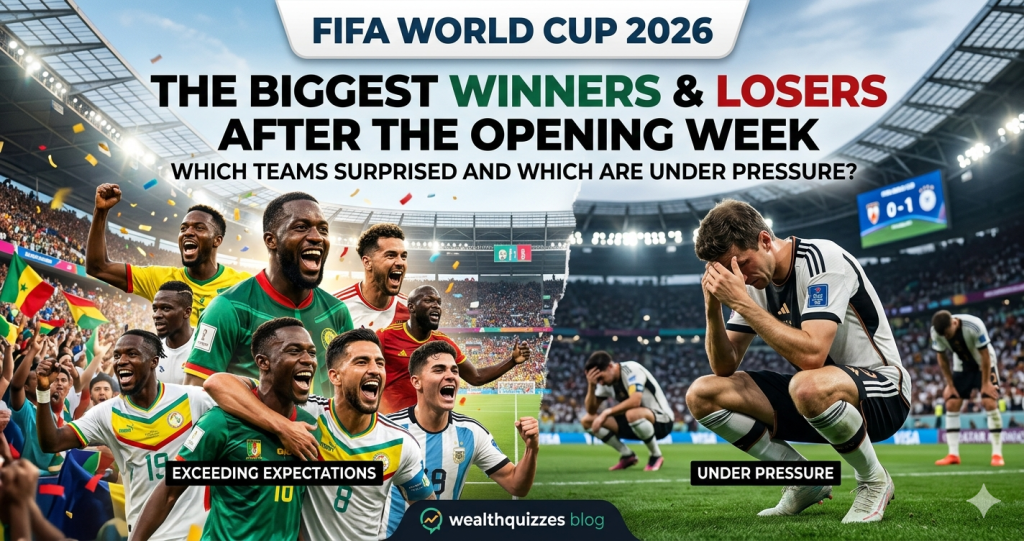
FIFA World Cup 2026: The Biggest Winners and Losers After the Opening Week
Which Teams Have Exceeded Expectations, and Which Nations Are Already Under Pressure?
The opening week of a FIFA World Cup is often filled with anticipation, emotion, and uncertainty. Coaches spend years preparing, players dream of representing their nations on football’s biggest stage, and supporters arrive carrying hopes that may have been decades in the making. Yet once the tournament begins, expectations quickly collide with reality.
The opening week of the FIFA World Cup 2026 has already delivered drama, surprises, breakout performances, emotional moments, and intense scrutiny. As the first matches conclude and teams begin preparing for their next fixtures, clear winners and losers are already emerging.
While no nation has yet been eliminated, some teams have strengthened their credentials as genuine contenders, while others now face mounting pressure to rescue their campaigns before it is too late.
The largest World Cup in history is only beginning, but the opening week has already revealed important clues about which nations may thrive and which could struggle in the weeks ahead.
Mexico: The Opening Week’s Biggest Winner
Few teams enjoyed a better start than Mexico national football team.
As one of the tournament’s co-hosts, Mexico entered the competition carrying enormous expectations. Opening a World Cup at home brings unique pressure, and history shows that host nations often face intense scrutiny from fans and media alike.
Mexico responded impressively.
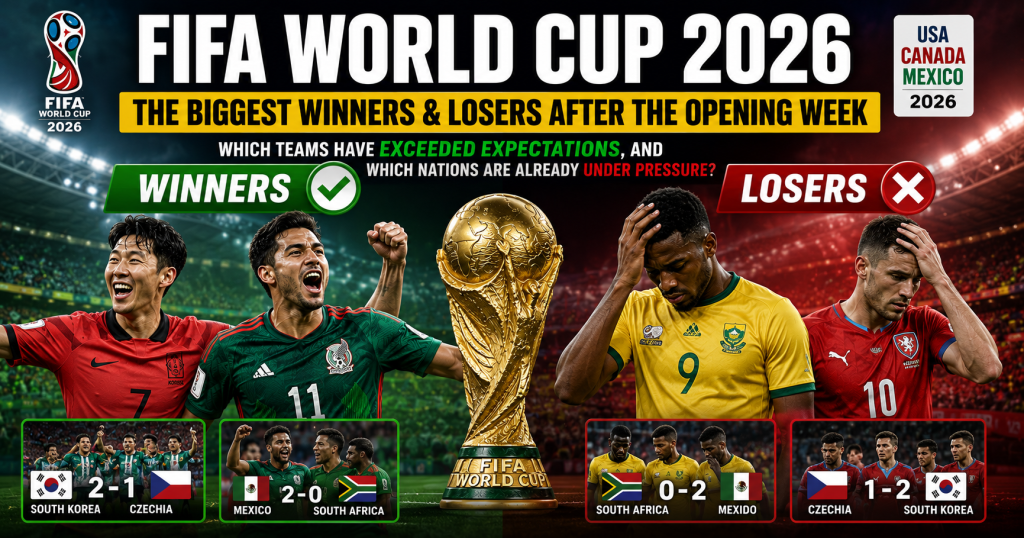
El Tri defeated South Africa 2-0 in the opening match of the tournament, with Julián Quiñones scoring the first goal of the World Cup and Raúl Jiménez adding a second-half header to secure victory. The result placed Mexico atop Group A and gave the hosts a perfect start to their campaign. (Reuters)
Beyond the result, Mexico displayed organization, confidence, and attacking intent. The performance energized supporters and immediately established momentum.
Football historian David Goldblatt has often emphasized the importance of early tournament momentum. Successful World Cup campaigns frequently begin with strong opening performances that build belief within squads and fan bases alike.
Mexico has achieved precisely that.
South Korea: Quietly Making a Statement
Another major winner of the opening week is South Korea national football team.
Unlike Mexico, South Korea entered the tournament with relatively little global attention. However, their opening performance demonstrated resilience and tactical maturity.
After falling behind against Czechia, South Korea produced a second-half comeback to secure a 2-1 victory. Hwang In-beom emerged as one of the early heroes of the tournament, leading his team’s recovery and helping secure three valuable points. (FIFA)
Tournament football rewards adaptability and mental toughness.
Former World Cup-winning coach Vicente del Bosque has repeatedly argued that teams capable of responding effectively to adversity often perform well in major competitions.
South Korea’s opening comeback suggests they possess exactly that quality.
The Co-Hosts: A Strong Start for North America
The broader group of host nations also deserves recognition.
Mexico’s victory generated excitement throughout the tournament, while the World Cup’s atmosphere has benefited enormously from enthusiastic crowds across the three host countries. Attendance figures during the opening matches have been remarkably strong, reflecting widespread public engagement with the competition. (Reddit)
The success of host nations is important because their performances often influence the tournament’s overall energy and narrative.
According to sports economist Stefan Szymanski, host nations frequently enjoy advantages stemming from familiar conditions, crowd support, and reduced travel burdens.
The opening week suggests that the co-hosts are benefiting from those advantages.
Raúl Jiménez and the Early Heroes
World Cups create heroes.
Few stories have captured attention more than the performance of Raúl Jiménez.
His goal against South Africa was not merely important for Mexico’s campaign; it represented a remarkable personal achievement following the serious head injury that threatened his career several years ago. His celebration became one of the defining images of the opening week. (Reuters)
Similarly, Hwang In-beom’s influence in South Korea’s comeback victory elevated his profile significantly. Early tournament performances often transform respected players into global stars.
History repeatedly demonstrates that World Cups provide a unique platform for footballers to redefine their careers.
South Africa: Early Pressure Mounts
If Mexico represents one of the opening week’s biggest winners, then South Africa national football team finds itself among the biggest losers.
The 2-0 defeat to Mexico was disappointing enough. However, the manner of the loss has intensified concerns.
South Africa struggled defensively, committed costly errors, and finished the match with nine players after two red cards. The disciplinary problems compounded an already difficult evening and significantly damaged their position within Group A. (Reuters)
Former FIFA Technical Director Arsène Wenger has frequently stressed that discipline and concentration are essential in tournament football because small mistakes can have enormous consequences.
South Africa learned that lesson the hard way.
Their next match now carries immense importance.
Czechia: Opportunity Lost
Another nation facing pressure is Czech Republic national football team.
After taking the lead against South Korea, Czechia appeared poised to begin its campaign positively. Instead, the team surrendered its advantage and ultimately suffered defeat. (ABC News)
Losing after leading can be psychologically damaging.
Sports psychologist Bob Rotella has often observed that teams must manage momentum swings effectively during high-pressure competitions.
Czechia now faces the difficult challenge of recovering quickly while knowing that another poor result could seriously jeopardize qualification hopes.
The Winners Beyond the Pitch
Not all winners are teams.
The tournament itself has enjoyed an encouraging opening week.
Television audiences have been substantial, with broadcasters reporting significant global viewership. The expanded 48-team format has attracted widespread attention and generated curiosity among supporters eager to see how the new structure unfolds. (The Economic Times)
Meanwhile, the opening ceremonies showcased football’s growing cultural influence.
Performances by global artists including Shakira and Burna Boy highlighted the tournament’s global appeal and reinforced the World Cup’s status as one of the world’s largest cultural events. (Oceania Football Confederation)
Has the 48-Team Format Passed Its First Test?
One of the most significant questions entering the tournament concerned the expanded format.
Critics worried that increasing participation from 32 to 48 teams might dilute quality and produce excessive mismatches.
The opening week suggests a more nuanced reality.
While disparities remain between some nations, several matches have been competitive and entertaining. South Korea’s comeback victory and the intensity of Mexico’s opener demonstrate that emerging football nations are increasingly capable of competing at a high level. (ABC News)
Football analyst Jonathan Wilson has long argued that tactical and technical standards have improved globally.
The opening week appears to support that assessment.
Nations Already Feeling the Heat
Pressure arrives quickly at a World Cup.
Several teams now find themselves in situations where their next match could determine their tournament fate.
South Africa and Czechia both need positive results to avoid falling further behind in Group A. Their margin for error has already narrowed considerably.
History shows that teams beginning a World Cup with defeat often struggle to recover. While qualification remains possible, urgency has already become a factor.
The psychological challenge is significant.
Players must balance confidence with realism while avoiding panic.
Conclusion: Momentum Is Everything
The opening week of FIFA World Cup 2026 has reinforced a timeless truth about tournament football: momentum matters.
Mexico has energized a nation and strengthened belief in its campaign.
South Korea has demonstrated resilience and tactical discipline.
Raúl Jiménez and Hwang In-beom have emerged as early heroes.
Meanwhile, South Africa and Czechia face difficult questions after disappointing starts.
Yet World Cups are rarely decided in the opening week.
Many teams that begin strongly fade later, while others recover from early setbacks to produce memorable runs.
As legendary coach Sir Alex Ferguson once observed, football is a game of momentum, resilience, and belief.
The first chapter of FIFA World Cup 2026 has already produced clear winners and losers.
The challenge now is determining which of those early impressions will endure and which will ultimately become footnotes in a much larger story.
With weeks of football still ahead, the biggest World Cup in history is only beginning to reveal its true contenders.